


26,99 €
Mehr erfahren.
- Herausgeber: ibidem
- Kategorie: Geisteswissenschaft
- Sprache: Englisch
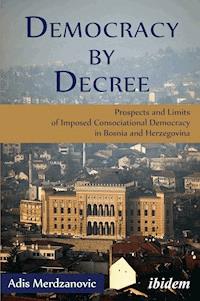
The introduction of consociational power sharing as a post-war political system has become one of the international community´s preferred post-conflict devices. In situations where warring polities are internally divided by ethnic, religious, linguistic, or national identity, consociationalism guarantees the inclusion of all groups in the political process and prevents a ‘tyranny´ of the majority over one or more minorities. However, if international actors keep intervening in the political process, the advantages of consociationalism are turned upside down. In this exceptional book, Adis Merdzanovic develops a theoretical and empirical approach to understanding consociational democracies that include external intervention. Using the case of Bosnia and Herzegovina, where the consociational Dayton Peace Agreement ended the three-year war between Serbs, Croats, and Bosniaks twenty years ago, it elaborates on the different approaches used in the past and gives practical recommendations for future state-building exercises by the international community.
Das E-Book können Sie in Legimi-Apps oder einer beliebigen App lesen, die das folgende Format unterstützen:
Seitenzahl: 986
Veröffentlichungsjahr: 2015
Ähnliche




















ibidemPress, Stuttgart
Table of Contents
Acknowledgements
Thisbook,which isbased on my PhD thesis at theDepartments of Political Science and Philosophy of theUniversity of Zurich,would never have been possible without the support of manypeople and institutions.My deepest gratitudebelongstomyprimary doctoral supervisor Josette BaerHilland my secondary supervisor Francis Cheneval for their support and encouragement.Thestudyfurthermorereceivedsubstantialfundingfromthe University of Zurich. Mythanks goto the commissions of theForschungskreditthat not only approved my initial grant proposal, but, when the project ran longer than expected, also extended the funding (Grant-Nr.FK-13-072).TheForschungskreditallowed me to finish mystudywithout financial worries, while being part of a stimulating academic communityand enjoying the benefits of institutional support.
As far as thecontentof thestudyis concerned, I would like to express my gratitude to the interview partnerswhoreadily accepted to meet me and patiently answered my questions. These include former High Representatives in BosniaandHerzegovina—Carlos Westendorp, Wolfgang Petritsch, Paddy Ashdown, Christian Schwarz-Schilling, and Miroslav Lajčák—who have given part of their time to me, and a much bigger part of it to Bosnia and Herzegovina. I cannot be anything but impressed by their commitment to help a countryto which, perhaps a decade before the war, many of them hadpresumablyno connection. Whatever one may think of their performances during their mandates, it is beyond doubt that coming to Bosniaand Herzegovinaand dealing with Bosnian politics isnoeasy job; it is not somethingjustanyone would happily agree to do. Rather, it takes a special kind of commitment and a particular kind of person to accept the task of rebuilding a state and unifying a society that has just comefroma bloody war. Having met and talked to them, I honestly believe that all former High Representatives included in this study implemented policies that they thought best for the country at the time. All of them had the best intentions and acted accordingly. Naturally, not all of theirpolicies fulfilled the expectations and some had rather serious unintended consequences. Even though it is the aim of this study to scientifically examine such consequences by putting them into a larger theoretical context, my intent is by no means to discredit the records of those fine individuals for whom I have the utmost respect.Furthermore,I am greatlythankfulto my Bosnian interview partners, to whom I will refer as Bosnia’s‘political elite’throughout thebook.I wish to thankHaris Silajdžić, Mladen Bosić, Mladen Ivanić, Dragan Čović, Božo Ljubić, Nebojša Radmanović, and Željko Komšić for their time and readiness to participatein the interviews. Their contribution helped me understand the problems of the contemporary Bosnianpolitical system, whereas theirpolitical stancesmade me realise how difficult it would be to achieve a real,post-conflict ‘solution’.
To be clear: In this study, my loyalties are not with a particular case and not with Bosnia and Herzegovina as such; rather, my goal is to present an academic contribution to existing literature on consociationalism and post-conflict state building. I am thus sincerely confined by respective standards when reviewing the collected material and, especially, when analysing the interviews with international and local decision makers. Almost by definition, my analysis will disagree with some of the views presented during these interviews and point to inconsistencies and false assumptions contained in some statements. I hope such critique is perceived as substantiated, i.e. founded on facts and trustworthy sources and presented in a comprehensible manner. I would like to thank my interview partners for their understanding in this regard.
On a more personal level, Iwishto thankcolleagues, with whom I had numerous occasions to discuss my theoreticalideasand empiricalthoughts.This list includes Anja Heidelberger, Sylvie Ramel, Sevan Pearson, Julianne Funk, as well as Nenad Stojanović and Daniel Bochsler. Special thanks are also in order for Donald L. Horowitz, who was kind enough to comment on my theoretical model during a seminar in Zurich, and Stefan Troebst, who did the same during a conference in New Orleans.Needless to say, all errors in the manuscript are my own.Finally, I owe the greatest amount of gratitude to my parents, Ibrahim and Senada,to whom this book is dedicatedfor their unbelievableand unconditionalsupport.
A.M.
Oxford/Zurich,April2015
List of Acronyms
ABiH
BiH / BH
Army of Bosnia and Herzegovina
Bosnia and Herzegovina
BOSS
Bosanska Stranka, Bosnian Party
BPS
Bosanska Patriotska Stranka, Bosnian Patriotic Party
CD BiH
Koalicija za cjelovitu i demokratsku BiH, Coalition for aUnited andDemocratic BiH
DF
Demokratski Front, Democratic Front
DPA
Dayton Peace Agreement, General Framework Agreement for Peace in Bosnia and Herzegovina
EU
European Union
EUFOR
European Union Force
EUSR
European Union Special Representative to Bosnia and Herzegovina
FBiH
Federation of Bosnia and Herzegovina
GDS
Gradjanska demokratska stranka, Citizen's Democratic Party
HDZ
Hrvatska Demokratska Zajednica Bosne i Hercegovine, Croat Democratic Union of Bosnia and Herzegovina
HDZ1990
Hrvatska Demokratska Zajednica 1990, Croat Democratic Union 1990
HSS
Hrvatska SeljačkaStranka, Croat Peasants’Party
HVO
Hrvatskovijeće obrane,Croat Defence Council(Croatian military forcesin Bosnia)
HZ HB
Hrvatska Zajednica Herceg Bosna,Croatian Community of Herceg Bosna(aCroat parastate during the Bosnian war)
IFOR
NATOImplementation Force
LDS
Liberalno Demokratska Stranka, Liberal Democratic Party
NARS
Narodna skupština Republike Srpske,National Assemblyof theRepublic of Srpska
NHI
Nova Hrvatska Inicijativa, New Croat Initiative
OHR
Office of the High Representative of the International Community in Bosnia and Herzegovina
PDP
Partija Demokratskog Progresa, Party of Democratic Progress
PIC
Peace Implementation Council
RBiH
Republic of Bosnia and Herzegovina (1992-1995)
RS
SAA
Republika Srpska, Republic of Srpska
Stabilisation and Association Agreement
SB
Steering Board
SBB
Stranka za Bolju Budućnost, Party for a Better Future
SBiH
Stranka za Bosnu i Hercegovinu, Party for Bosnia and Herzegovina
SDA
Stranka Demokratske Akcije, Party for Democratic Action
SDP
Socijaldemokratska StrankaBosne i Hercegovine, Social Democratic Party of Bosnia and Herzegovina
SDS
Srpska Demokratska Stranka, Serb Democratic Party
SFOR
NATOStabilisation Force
SNS
Srpski Narodni Savez, Serb NationalAlliance
SNSD
Savez Nezavisnih Socijaldemokrata, Alliance of Independent Social Democrats
SPRS
Socijalistička Partija Republike Srpske,Socialist Party of the Republic of Srpska
SR BiH
Socijalistička Republika Bosna i Hercegovina,Socialist Republic of Bosniaand Herzegovina(usedin thisbookfor the entireYugoslavperioduntil1992)
SRS
Srpska Radikalna Stranka, SerbianRadical Party
UDSB
Unija Bosanskih Socijaldemokrata, Union of Bosnian Social Democrats
UN SC
United NationsSecurity Council
1Introduction
As we approach the twentieth anniversary of the Dayton Peace Accords—this fundamental set of treatiesthat ended the 1992–1995 war in Bosnia-Herzegovina[1]as well as the battles between Croatia and thesignificantly shrunk Yugoslavia(i.e. Serbia)—we find ourselveswishingforalargerconclusion, some sort of athoroughassessment of theirmeritstwo decades after the fact.Whilethe Accordsare generally credited for the conclusion of military hostilities and thusforputting an end to the human suffering in the narrower region, especially the General Framework Agreement for Peace in Bosnia and Herzegovina (usually referred to as the Dayton Peace Agreement, DPA) is often criticised for establishing asuboptimalpost-war state structure; the latter, it is said,institutionalises the ethno-national segregation of the society, discriminates against national minorities, makes the political system inefficient as well as prone to patronage politics, and isgenerallynot apt for the challenges of the centuryin which we live.Since the Bosnian political system reflects the philosophy of the so-called consociational power-sharing model that tries to integrate different groups into a common state through a particular set of political institutions, the failure to establish a self-sustaining democracy in this particularcountryhas become one of the major arguments fordiscrediting the model itself. Critics of consociationalism tend to point to Bosnia in order to emphasise the general inadequateness of this institutional solution for establishing stable democratic rule in dividedpost-warsocieties.
Whatsuch criticsoften fail to see, however, is that the Bosnian consociation did not develop autonomously or in a power vacuum, but as part of a larger international context. International actors heavily affected not only the negotiations of the peace treaty but also the post-war development of the political system.WhileI have no intentionto present a final judgement on the Bosnian case—that would be presumptuous–, Inevertheless wanttoemphasisethat any serious attempt to reflect on the benefits and failures of theDPAhas to account for external influence.In this respect, I wish to shine a light on a particular aspect of Bosnia’s post-war development that necessarily needs to form an integral part of any larger narrative.The internationals had a significant effect on how the consociational system worked in practice and theythereforealsoshare part of the responsibility for thecontemporary situation.
In a nutshell, this bookexplores the relationship between international actors and consociational democracy in post-war Bosnia and Herzegovina.But like Arend Lijphart’s first treatise on consociational politics in the Netherlands, itis not conceptualised ‘as a country study in the conventional sense’ but as ‘an extended theoretical argument based on a single case of particular interest’[2]for consociational theory. So even though the major part of the text deals with the case study, the research aim goes well beyond the understanding of this particular country. It is directed at what we may call a fundamental misconception of consociational theory. Especially in its contemporary form, consociationalism tends to argue that stable democratic rule is the necessary result of a post-war political system that includes the four consociationalinstitutions ofagrand coalition, proportional representation, veto powers, and group autonomy.
Against this background, I shall argue that power sharing worksin a different mannerin post-warsocieties than in other kinds of divided societies,sincethe formercannot be regarded and analysed independentlyofthe international contextsin which they are situated.Unfortunately, this hasindeedbeen done with some regularityin the past. In such studies,the performance of institutions as well as prevailing group dynamics and incentive structures are examined from an intra-state perspective while little attention is
Lesen Sie weiter in der vollständigen Ausgabe!
Lesen Sie weiter in der vollständigen Ausgabe!
Lesen Sie weiter in der vollständigen Ausgabe!
Lesen Sie weiter in der vollständigen Ausgabe!
Lesen Sie weiter in der vollständigen Ausgabe!
Lesen Sie weiter in der vollständigen Ausgabe!
Lesen Sie weiter in der vollständigen Ausgabe!
Lesen Sie weiter in der vollständigen Ausgabe!
Lesen Sie weiter in der vollständigen Ausgabe!
Lesen Sie weiter in der vollständigen Ausgabe!
Lesen Sie weiter in der vollständigen Ausgabe!
Lesen Sie weiter in der vollständigen Ausgabe!
Lesen Sie weiter in der vollständigen Ausgabe!
Lesen Sie weiter in der vollständigen Ausgabe!
Lesen Sie weiter in der vollständigen Ausgabe!
Lesen Sie weiter in der vollständigen Ausgabe!
Lesen Sie weiter in der vollständigen Ausgabe!
Lesen Sie weiter in der vollständigen Ausgabe!
Lesen Sie weiter in der vollständigen Ausgabe!
Lesen Sie weiter in der vollständigen Ausgabe!
Lesen Sie weiter in der vollständigen Ausgabe!
Lesen Sie weiter in der vollständigen Ausgabe!
Lesen Sie weiter in der vollständigen Ausgabe!
Lesen Sie weiter in der vollständigen Ausgabe!
Lesen Sie weiter in der vollständigen Ausgabe!
Lesen Sie weiter in der vollständigen Ausgabe!
Lesen Sie weiter in der vollständigen Ausgabe!




