


27,59 €
Mehr erfahren.
- Herausgeber: Packt Publishing
- Kategorie: Fachliteratur
- Sprache: Englisch
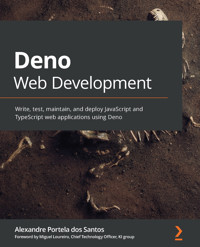
Deno is a JavaScript and TypeScript runtime with secure defaults and a great developer experience. With Deno Web Development, you'll learn all about Deno's primitives, its principles, and how you can use them to build real-world applications. The book is divided into three main sections: an introduction to Deno, building an API from scratch, and testing and deploying a Deno application.
The book starts by getting you up to speed with Deno's runtime and the reason why it was developed. You'll explore some of the concepts introduced by Node, why many of them transitioned into Deno, and why new features were introduced. After understanding Deno and why it was created, you will start to experiment with Deno, exploring the toolchain and writing simple scripts and CLI applications. As you progress to the second section, you will create a simple web application and then add more features to it. This application will evolve from a simple 'hello world' API to a web application connected to the database, with users, authentication, and a JavaScript client. In the third section, the book will take you through topics such as dependency management, configuration and testing, finishing with an application deployed in a cloud environment.
By the end of this web development book, you will become comfortable with using Deno to create, maintain, and deploy secure and reliable web applications.
Das E-Book können Sie in Legimi-Apps oder einer beliebigen App lesen, die das folgende Format unterstützen:
Seitenzahl: 350
Veröffentlichungsjahr: 2021
Ähnliche



















Deno Web Development
Write, test, maintain, and deploy JavaScript and TypeScript web applications using Deno
Alexandre Portela dos Santos
BIRMINGHAM—MUMBAI
Deno Web Development
Copyright © 2021 Packt Publishing
All rights reserved. No part of this book may be reproduced, stored in a retrieval system, or transmitted in any form or by any means, without the prior written permission of the publisher, except in the case of brief quotations embedded in critical articles or reviews.
Every effort has been made in the preparation of this book to ensure the accuracy of the information presented. However, the information contained in this book is sold without warranty, either express or implied. Neither the author, nor Packt Publishing or its dealers and distributors, will be held liable for any damages caused or alleged to have been caused directly or indirectly by this book.
Packt Publishing has endeavored to provide trademark information about all of the companies and products mentioned in this book by the appropriate use of capitals. However, Packt Publishing cannot guarantee the accuracy of this information.
Associate Group Product Manager: Pavan Ramchandani
Publishing Product Manager: Aaron Tanna
Commissioning Editor: Pavan Ramchandani
Senior Editor: Sofi Rogers
Content Development Editor: Rakhi Patel
Technical Editor: Saurabh Kadave
Copy Editor: Safis Editing
Project Coordinator: Manthan Patel
Proofreader: Safis Editing
Indexer: Rekha Nair
Production Designer: Prashant Ghare
First published: March 2021
Production reference: 1240321
Published by Packt Publishing Ltd.
Livery Place
35 Livery Street
Birmingham
B3 2PB, UK.
ISBN 978-1-80020-566-6
www.packt.com
To my parents, Fátima and António, and to my brother Pedro. Thanks for your unconditional support – you are the best. Wouldn't have made it without you.
To my friends, who helped me make this book a reality. Thank you, Felipe, Gonçalo, Bruno, Nuno, János, João, and Miguel for all the conversations, reviews, and suggestions.
– Alexandre
Foreword
Many of us witnessed a time where JavaScript was not considered a real language but rather a scripting tool for those who wanted to improve the user experience when interacting with the browser.
Its increasing popularity drove the JavaScript community to broaden its purpose. Suddenly, someone who was mainly skilled in client-side web development now had the chance to dive into the world of server-side with no language barrier. On top of that, they had something quite natural that was becoming trendy – concurrency and event-driven design.
At the same time, looking around the programming language landscape over the last 10-15 years, other languages were being released as well, positioned to be more advanced alternatives leveraging the learnings of the traditional ones; simpler to package; removing legacy; providing more advanced standard libraries and features so that we developers could focus on delivering value to the end users of the software. There are, however, two trends worth highlighting. Concurrency and interoperability were topics we could see being addressed in all of them. Golang, Kotlin, Elixir, and Rust offered easier ways to handle concurrency, but they also provided an easy way to interop with other languages. You could use Erlang code in Elixir, Java code in Kotlin, C in Golang and Rust, and so on... Interop was critical for language adoption in existing legacy systems.
On one hand, most of these languages did well in solving a problem that Node.js was also solving while being quite mature because they leveraged existing ecosystems with interop capabilities. On the other hand, Node.js suffers from some design decisions that drag improvement in different areas such as security, packaging, and interoperability to name a few. One might say there's some catching up to be done...
Being a software engineer means being in an infinite loop of learning. This book is a remarkable achievement and a must-read in one iteration of that learning loop. It is an introduction to a new language that promises to fill some gaps, building a strong foundation to consolidate the reason why the most popular language in the world is even more everywhere – Deno Web Development: Write, test, maintain, and deploy JavaScript and TypeScript web applications using Deno.
Miguel Loureiro
Chief Technology Officer, KI group
Contributors
About the author
Alexandre Portela dos Santos is a software engineer passionate about products and start-ups. For the last 8+ years, he's been working together with multiple companies, using technology as an enabler for ideas and businesses. With a big interest in education and getting people excited about technology, he makes sure he's always involved with people that are learning about it, be it via blog posts, books, open source contributions, or meetups. This is, by itself, a learning adventure that Alexandre loves to be a part of. Being a true believer that great software only happens through collaboration, ownership, and teams of great people, he strives to nurture those values in every project he works on.
About the reviewers
Maxim Mazurok is a software engineer with a focus on web development. He has 6+ years of enterprise experience in software product and e-commerce companies located in Silicon Valley, Ukraine, and Sydney.
He has applied this experience to teach teens the basics of web development and taught adults more advanced web technologies.
He is passionate about open source and sharing knowledge, an active GitHub contributor, and a Stack Overflow member, always happy to connect.
When not at the computer, he rides a bicycle, takes pictures of nature, and attends meetups and conferences.
Yusuke Tanaka is a software engineer living in Tokyo, Japan. After getting a BS degree in engineering at the University of Tokyo in 2019, he now works at STADIUM Co., Ltd. engaging in the development of a web application that provides an online job interview system. Although he uses TypeScript and Go at work, he has been enthusiastic about the Rust programming language for about 2 years and makes contributions to open source software related to Rust in his spare time. In particular, he is so interested in Deno and the core of Rust that he devotes a lot of time to them. To get in touch with him or for more details, feel free to visit his GitHub (@magurotuna) or Twitter (@yusuktan).
Acknowledgement
Firstly, I am grateful to the editors and publishers who gave me a chance to participate in such a wonderful project. And most of all, I would like to thank Alexandre Santos for making this book happen. I am delighted to get involved in this book, hoping it will help more people recognize the fantastic development experience with Deno.
Table of Contents
Preface
Section 1: Getting Familiar with Deno
Chapter 1: What is Deno?
A little history
Handling I/O
Node.js enters the scene
Why Deno?
Presenting Deno
A web browser for command-line scripts
Architecture and technologies that support Deno
Inspiration from POSIX systems
Architecture
Grasping Deno's limitations
Not as stable as Node.js
Better HTTP latency but worse throughput
Compatibility with Node.js
TypeScript compiler speed
Lack of plugins/extensions
Exploring use cases
A flexible scripting language
Safer desktop applications
A quick and complete environment to write tools
Running on embedded devices
Generating browser-compatible code
Full-fledged APIs
Summary
Chapter 2: The Toolchain
Technical requirements
Setting up the environment
Installing Deno
Installing VS Code
Shell completions
Hello World
Debugging code in Deno
Modules and third-party dependencies
Locally cached dependencies
Managing dependencies
Import maps
Inspecting modules
Exploring the documentation
Running and installing scripts
Installing utility scripts
Permissions
Using the test command
Filtering tests
Fail fast
Formatting and linting
Formatting
Lint
Bundling code
Compiling to a binary
Using the upgrade command
Summary
Chapter 3: The Runtime and Standard Library
Technical requirements
The Deno runtime
Stability
Program lifecycle
Web APIs
Exploring the Deno namespace
Building a simple ls command
Using dynamic permissions
Using the filesystem APIs
Using buffers
Reading and writing from Deno.Buffer
Using the standard library
Adding colors to our simple ls
Building a web server using the HTTP module
Summary
Section 2: Building an Application
Chapter 4: Building a Web Application
Technical requirements
Structuring a web application
Deno as an unopinionated tool
The most important part of an application
What is our application about?
Understanding folder structure and application architecture
Developing the business logic
Developing the data accessing logic
Creating the web server
Wiring the web server to the business logic
Exploring Deno HTTP frameworks
What alternatives exist?
The verdict
Summary
Chapter 5: Adding Users and Migrating to Oak
Technical requirements
Managing dependencies and lock files
Using a centralized dependency file
Creating a lock file
Writing a web server with Oak
Adding event listeners to an Oak application
Handling routes in an Oak application
Connecting the router to the application
Adding users to the application
Creating the user module
Storing a user in the database
Creating the user repository
Creating the register endpoint
Wiring the user controller with the web layer
Summary
Chapter 6: Adding Authentication and Connecting to the Database
Technical requirements
Using middleware functions
How does middleware work?
Adding request timing via middleware
Adding request logging via middleware
Adding authentication
Creating the login business logic
Creating the login endpoint
Adding authorization with JWT
Returning a token from login
Making an authenticated route
Connecting to MongoDB
Creating a User MongoDB repository
Installing the MongoDB client library
Developing the MongoDB repository
Connecting the application to MongoDB
Connecting to a MongoDB cluster
Summary
Chapter 7: HTTPS, Extracting Configuration, and Deno in the Browser
Technical requirements
Enabling CORS and HTTPS
Enabling CORS
Enabling HTTPS
Extracting configuration and secrets
Creating a configuration file
Accessing secret values
Running Deno code in the browser
Summary
Section 3: Testing and Deploying
Chapter 8: Testing – Unit and Integration
Technical requirements
Writing your first test in Deno
Defining a test
A unit test for MuseumController
Writing an integration test
Testing the web server
Creating integration tests for the application
Testing the application together with the API client
Benchmarking parts of the application
Summary
Chapter 9: Deploying a Deno Application
Technical requirements
Preparing the environment for the application
Creating a Dockerfile for the Deno application
Running a Terminal inside a container
Building and running the application in Heroku
Creating the application in Heroku
Building and running the Docker image
Configuring the application for deployment
Getting the application port from the environment
Summary
Chapter 10: What's Next?
Looking back at our journey
Deno's roadmap
Deno's future and community
Interesting things happening in the community
Publishing a package to Deno's official registry
Summary
Why subscribe?
Other Books You May Enjoy
Section 1: Getting Familiar with Deno
In this section, you will get to know what Deno is, why it was created, and how it was created. This section will help you set up the environment and get familiar with the ecosystem and available tooling.
This section contains the following chapters:
Chapter 1, What Is Deno?Chapter 2, The ToolchainChapter 3, The Runtime and Standard Library




