


56,99 €
Mehr erfahren.
- Herausgeber: John Wiley & Sons
- Kategorie: Fachliteratur
- Sprache: Englisch
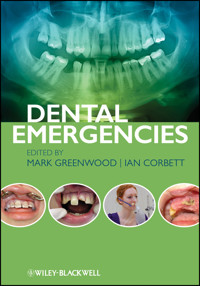
Dental emergencies are common and require rapid response. Order today and keep readily accessible in your dental practice!
Filled with clinical examples and step-by-step procedures, Dental Emergencies covers the full range of both common and complex traumatic injuries, pain, and oral lesions.
From clinical examination and assessment of potential complications to key considerations in pain management, acute oral medical and surgical conditions, restorative emergencies, treating special needs patients, and beyond, you get a comprehensive reference that:
- distills essential information on dental emergencies
- offers succinct, practical instruction for immediate treatment
- highlights conditions for referral
- and much more!
Sie lesen das E-Book in den Legimi-Apps auf:
Seitenzahl: 336
Veröffentlichungsjahr: 2012
Ähnliche
















Contents
Cover
Title Page
Copyright
List of Contributors
Preface
Acknowledgements
Chapter 1: Introduction, Infection Control and Prescribing
Introduction to the dental emergency clinic
Infection and infection control
Prescribing
Conclusions
Chapter 2: History Taking and Clinical Examination of Patients on a Dental Emergency Clinic
Introduction
History taking
Patient examination
Special tests
Record keeping
Consent
Conclusions
Chapter 3: Radiology and the Dental Emergency Clinic
Introduction
Patients in pain
Trauma radiology
Looking at radiographs
Conclusions
Chapter 4: Acute Oral Medical and Surgical Conditions
Introduction
Oro-facial swelling
Blistering disorders of the oral mucosa
Oral ulceration
Disturbed oro-facial sensory or motor function
Haemorrhage
Other acute conditions
Bony pathology
Summary
Chapter 5: Restorative Dental Emergencies
Introduction
General principles
Pain management
Infections and soft tissue problems
Crack, fracture and mobility of teeth and dental restorations
Fractured and loose implants
Fractures and swallowing of removable prostheses
Conclusions
Chapter 6: Acute Presentations of Chronic Oro-Facial Pain Conditions
Introduction
Oro-facial pain history
Examination of patients with oro-facial pain
Special investigations for oro-facial pain
Presentation, investigations and initial management of acute non-odontogenic oro-facial pain
Chapter 7: Traumatic Injuries to the Teeth and Oral Soft Tissues
Assessment of the traumatised patient
Management of traumatic dental injuries
Injuries to the hard dental tissues and the pulp
Injuries to the hard dental tissues, the pulp and the alveolar process
Injuries to the periodontal tissues
Dento-alveolar fractures
Conclusions
Chapter 8: Pain Relief in the Dental Emergency Clinic
Introduction
General mechanism of pain
Distribution of pain fibres in the mouth and jaws
Sources of pain in the mouth and jaws
Control of pain
Psychology of pain
Medication
The ladder of analgesia
Avoiding problems in prescribing analgesics
Chapter 9: Management of the Special Needs Patient
Introduction
Commonly seen conditions
Assessment
Medical history in the patient with special needs
Informed consent
Examination
Factors to consider in treatment
Conclusion
Chapter 10: Making a Referral
Introduction
When to refer
How to refer
Where to refer
The referral letter
Urgency
Cancer referrals
Copies of the referral letter
Summary
Chapter 11: Medical Emergencies in the Dental Emergency Clinic – Principles of Management
Introduction
Contents of the emergency drug box
The ‘ABCDE’ approach to an emergency patient
Airway (A)
Use of defibrillation
Principles of management after the initial treatment of a medical emergency
Conclusions
Chapter 12: Examples of Specific Medical Emergency Situations
Introduction
Vasovagal syncope (simple faint)
Hyperventilation
Asthma
Cardiac chest pain
Epileptic seizures
Diabetic emergencies
Allergies/hypersensitivity reactions
Adrenal insufficiency
Stroke
Local anaesthetic emergencies
Problems with haemostasis
Conclusions
Appendix 1: Normal Reference Ranges
Appendix 2: Changes in Vital Signs in Patients with Infection
Appendix 3: Warfarin Protocol
Principles
Should the INR be measured before a dental procedure?
Are there any drug interactions that are relevant to this patient group?
Oral surgery patients
Restorative patients
Checklist for patients taking warfarin who require dental treatment
Appendix 4: Aspects Relating to Local Anaesthetics
Appendix 5: NICE Guidelines for the Removal of Wisdom Teeth
Appendix 6: Protocol for Surgical Dental Treatment of Patients Taking Bisphosphonates
Introduction and background
Management of patients taking bisphosphonates
Appendix 7: Common ‘Recreational’ Drugs
Introduction
Index
This edition first published 2012 ©2012 by Blackwell Publishing Ltd
Wiley-Blackwell is an imprint of John Wiley & Sons, formed by the merger of Wiley's global Scientific, Technical and Medical business with Blackwell Publishing.
Registered office: John Wiley & Sons, Ltd, The Atrium, Southern Gate, Chichester, West Sussex, PO19 8SQ, UK
Editorial offices: 9600 Garsington Road, Oxford, OX4 2DQ, UK The Atrium, Southern Gate, Chichester, West Sussex, PO19 8SQ, UK 2121 State Avenue, Ames, Iowa 50014-8300, USA
For details of our global editorial offices, for customer services and for information about how to apply for permission to reuse the copyright material in this book please see our website at www.wiley.com/wiley-blackwell.
The right of the authors to be identified as the authors of this work has been asserted in accordance with the UK Copyright, Designs and Patents Act 1988.
All rights reserved. No part of this publication may be reproduced, stored in a retrieval system, or transmitted, in any form or by any means, electronic, mechanical, photocopying, recording or otherwise, except as permitted by the UK Copyright, Designs and Patents Act 1988, without the prior permission of the publisher.
Designations used by companies to distinguish their products are often claimed as trademarks. All brand names and product names used in this book are trade names, service marks, trademarks or registered trademarks of their respective owners. The publisher is not associated with any product or vendor mentioned in this book. This publication is designed to provide accurate and authoritative information in regard to the subject matter covered. It is sold on the understanding that the publisher is not engaged in rendering professional services. If professional advice or other expert assistance is required, the services of a competent professional should be sought.
Library of Congress Cataloging-in-Publication Data
Dental emergencies / edited by Mark Greenwood. p. ; cm. Includes bibliographical references and index. ISBN 978-0-470-67396-6 (pbk. : alk. paper) I. Greenwood, M. (Mark) [DNLM: 1. Dental Care--methods. 2. Emergencies. 3. Emergency Treatment--methods. WU 105] 617.6′026-dc23 2011042659
A catalogue record for this book is available from the British Library.
Wiley also publishes its books in a variety of electronic formats. Some content that appears in print may not be available in electronic books.
List of Contributors
U. Chaudhry, BDS, MFDSRCS, DHypSpecialist Registrar in Paediatric Dentistry, Manchester Dental Hospital and Royal Manchester Children's Hospital, Manchester
I.P. Corbett, BDS, BSc, PhD, FDS (OS), RCSLecturer in Oral and Maxillofacial Surgery, Newcastle University, Newcastle
J. Durham, BDS, PhD, FDS (OS), RCS, FHEAWalport Lecturer in Oral and Maxillofacial Surgery, Newcastle University, Newcastle
J. Greenley, BDS, MFDSRCSSenior Dental Officer, Newcastle Dental Hospital, Newcastle
M. Greenwood, MDS, PhD, FDS, FRCS, FRCS (OMFS), FHEAConsultant and Honorary Clinical Professor, Newcastle University, Newcastle
C.B. Hayward, BDS, Dip Cons SedAssociate Specialist, Dental Emergency Clinic, Newcastle Dental Hospital, Newcastle
I.C. Mackie, BDS, MSc, PhD, FDSRCPSProfessor and Consultant in Paediatric Dentistry, Manchester Dental School, Manchester
R.I. Macleod, BDS, PhD, FDSRCS, DDR, RCRConsultant in Dental and Maxillofacial Radiology, Newcastle Dental Hospital, Newcastle
U. J. Moore, PhD, FDSRCSSenior Lecturer in Oral Surgery, School of Dental Sciences, Newcastle University, Newcastle
A. Moufti, DDS, Dip OMFS, PhD, MFDSRCSLecturer in Restorative Dentistry, University of Damascus, Syria
T. Nugent, BDS, MFDSRCSSenior Dental Officer, Community Dental Service, Newcastle
P.J. Thomson, BDS, MSc, PhD, FFD, FDS, FRCSProfessor in Oral and Maxillofacial Surgery, Newcastle University, Newcastle
Preface
The dental emergency clinic is an important area for any dental service. Such departments are usually staffed by clinicians with a variety of backgrounds and levels of experience. This book does not attempt to be exhaustive but is a guide to help clinicians with the management of the wide variety of patients that may present. An attempt is made, where appropriate, to place patient management in an academic context.
Acknowledgements
Thanks are due to the clinicians and nurses who work on the dental emergency clinic at Newcastle Dental Hospital. We would also like to acknowledge the help given by Mrs Beryl Leggatt in the typing of the manuscript.
Where figures or photographs have been taken from other sources, due acknowledgement is given. Thanks are also due to Dr Anna Beattie and Dr Helen Stancliffe for some of the photographs seen in Chapter 11.
Chapter 1
Introduction, Infection Control and Prescribing
M. Greenwood
Introduction to the dental emergency clinic
The dental emergency clinic (DEC) is an important part of the service provided to patients. It is a demanding environment in which to work for main two reasons. First, many patients who attend such departments have a general tendency to avoid dental treatment and view attending such a department as a last resort. Second, from the point of view of the clinicians who work in such clinics, the clinical spectrum is wide, and although there is no remit to provide a specialist service, the boundaries of knowledge and experience for clinicians in certain areas are approaching this. Clinical staff working in these departments need a wide skill mix.
This textbook aims to summarise important areas of knowledge with which practitioners working in the DEC should be familiar. Modern clinical working often requires adherence to protocols, and a summary of some of the more important current management protocols, together with supporting evidence, is provided in the appendices.
For maximum efficiency in any department that deals with emergencies, a system of triage is immensely valuable. Triage is essentially the process of determining the priority of patients’ treatment on the basis of severity of their condition. Triage should result in determining the order and priority of a patient's emergency treatment and occasionally their onward transport. In the DEC, emergency situations include those where the airway may be compromised due to infection or trauma. Such patients must be assessed promptly and referred quickly for onward management. Other patients, who may have sustained trauma, need to be assessed expeditiously, particularly from the point of view of airway and vital signs, and also possible head injury and concomitant injuries, which in some cases may take priority over the facial or dental injuries. More detail in relation to the assessment of trauma patients is given in Chapter 7.
Lesen Sie weiter in der vollständigen Ausgabe!
Lesen Sie weiter in der vollständigen Ausgabe!
Lesen Sie weiter in der vollständigen Ausgabe!
Lesen Sie weiter in der vollständigen Ausgabe!
Lesen Sie weiter in der vollständigen Ausgabe!
Lesen Sie weiter in der vollständigen Ausgabe!
Lesen Sie weiter in der vollständigen Ausgabe!
Lesen Sie weiter in der vollständigen Ausgabe!
Lesen Sie weiter in der vollständigen Ausgabe!
Lesen Sie weiter in der vollständigen Ausgabe!
Lesen Sie weiter in der vollständigen Ausgabe!
Lesen Sie weiter in der vollständigen Ausgabe!
Lesen Sie weiter in der vollständigen Ausgabe!
Lesen Sie weiter in der vollständigen Ausgabe!
Lesen Sie weiter in der vollständigen Ausgabe!
Lesen Sie weiter in der vollständigen Ausgabe!
Lesen Sie weiter in der vollständigen Ausgabe!
Lesen Sie weiter in der vollständigen Ausgabe!
Lesen Sie weiter in der vollständigen Ausgabe!




