


209,99 €
Mehr erfahren.
- Herausgeber: Thieme
- Kategorie: Fachliteratur
- Sprache: Englisch
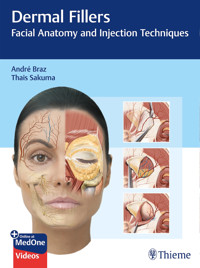
The quintessential visual guide to facial aesthetic enhancement and dermal filler injection techniques from top experts
In-depth and detailed knowledge of anatomy, different facial shapes, and ethnic origins is essential to delivering safe, effective, natural, and harmonious aesthetic facial treatment results. Dermal Fillers: Facial Anatomy and Injection Techniques is the culmination of many years of expertise decrypting facial anatomy as it applies to aesthetic enhancement of the face. This visually rich atlas is authored by internationally renowned Brazilian dermatologists André Braz, an esteemed expert in the use of botulinum toxin, fillers, and lasers; and Thais Sakuma, a distinguished lecturer in the application of botulinum toxin and hyaluronic acid fillers.
Nineteen highly practical, concise, and didactic chapters are organized consistently with structured text at the beginning of each chapter. The book encompasses the application of injection techniques for the full spectrum of indications, from softening wrinkles to facial contouring. Important topics include facial assessment, hyaluronic acid science, facial aging, and regional nerve blocks for pain management. Meticulous anatomic descriptions and images depict the relationships between superficial and deeper structures such as vasculature, thereby providing vital knowledge to help clinicians avoid potentially serious complications.
Key Features:
- Systematic organization based on aesthetic zones, from superficial to deep
- Richly illustrated, with 1664 outstanding drawings, remarkable cadaver dissection images, and patient photos
- Seventeen concise video sequences elucidate key injection techniques
- Comprehensive coverage of potential complications, such as unintended injection of filler into vasculature
- Expert discussion of safety issues, potential pitfalls, and the naturalness of expected outcomes
This is the ultimate resource for all dermatologists, plastic surgeons, and non–core practitioners who wish to expand their practices to offer complex facial cosmetic injection techniques and achieve optimal patient outcomes.
This book includes complimentary access to a digital copy on https://medone.thieme.com.
Das E-Book können Sie in Legimi-Apps oder einer beliebigen App lesen, die das folgende Format unterstützen:
Seitenzahl: 311
Veröffentlichungsjahr: 2020
Ähnliche



















To access the additional media content available with this e-book via Thieme MedOne,please use the code and follow the instructions provided at the back of the e-book.
Dermal Fillers
Facial Anatomy and Injection Techniques
André Braz, MD
Medical Director
Dermatologia Laser Cosmiatria
Rio de Janeiro, Brazil
Thais Sakuma, MD
Medical Director
Thais Sakuma Dermatologia
Mato Grosso do Sul, Brazil
1664 illustrations
Thieme
Stuttgart • New York • Delhi • Rio de Janeiro
Library of Congress Cataloging-in-Publication Data is available from the publisher
This book is an authorized translation of the 1st Portuguese edition published and copyrighted 2017 by Editora Guanabara Koogan Ltda., Rio de Janeiro, Brazil. Title of the Portuguese edition: Atlas de Anatomia e Preechimento Global da Face
Translator: Francesca Matteoda, MA, MITIMedical & Pharmaceutical TranslationsMadrid, Spain
Illustrators: Vagner Coelho, Christian Monnerat, and Renato Mello
© 2021. Thieme. All rights reserved.
Georg Thieme Verlag KGRüdigerstrasse 14, 70469 Stuttgart, Germany+49 [0]711 8931 421, [email protected]
Thieme Publishers New York333 Seventh Avenue, New York, NY 10001, USA +1-800-782-3488, [email protected]
Thieme Publishers DelhiA-12, Second Floor, Sector-2, Noida-201301Uttar Pradesh, India+91 120 45 566 00, [email protected]
Thieme Publishers RioThieme Publicações Ltda.Edifício Rodolpho de Paoli, 25º andarAv. Nilo Peçanha, 50 – Sala 2508Rio de Janeiro 20020-906 Brasil+55 21 3172 2297 / +55 21 3172 1896
Cover design: Thieme Publishing Group
Typesetting by Thomson Digital, India
Printed in Germany by CPI Books
1 2 3 4 5 6
ISBN 978-3-13-242772-3
Also available as an e-book:
eISBN 978-3-13-242773-0
Important note: Medicine is an ever-changing science undergoing continual development. Research and clinical experience are continually expanding our knowledge, in particular our knowledge of proper treatment and drug therapy. Insofar as this book mentions any dosage or application, readers may rest assured that the authors, editors, and publishers have made every effort to ensure that such references are in accordance withthe state of knowledge at the time of production of the book.
Nevertheless, this does not involve, imply, or express any guarantee or responsibility on the part of the publishers in respect to any dosage instructions and forms of applications stated in the book.Every user is requested to examine carefullythe manufacturers’ leaflets accompanying each drug and to check, if necessary in consultation with a physician or specialist, whether the dosage schedules mentioned therein or the contraindications stated by the manufacturers differ from the statements made in the present book. Such examination is particularly important with drugs that are either rarely used or have been newly released on the market. Every dosage schedule or every form of application used is entirely at the user’s own risk and responsibility. The authors and publishers request every user to report to the publishers any discrepancies or inaccuracies noticed. If errors in this work are found after publication, errata will be posted at www.thieme.com on the product description page.
Some of the product names, patents, and registered designs referred to in this book are in fact registered trademarks or proprietary names even though specific reference to this fact is not always made in the text. Therefore, the appearance of a name without designation as proprietary is not to be construed as a representation by the publisher that it is in the public domain.
This book, including all parts thereof, is legally protected by copyright. Any use, exploitation, or commercialization outside the narrow limits set by copyright legislation, without the publisher’s consent, is illegal and liable to prosecution. This applies in particular to photostat reproduction, copying, mimeographing, preparation of microfilms, and electronic data processing and storage.
Contents
Videos
Foreword
Preface
1Facial Assessment
Introduction
Cephalometry
Proportions
Golden Ratio
Male and Female Face Formats
Facial Biotypes
Mandibular Profile
Conclusion
References
2Anatomy of the Face
Fat Pads
Periorbital Fat Pads
Superficial Fat Pads
Deep Fat Pads
Fat Pads of the Middle Third of the Face
Temporolateral Fat Pad
Jowl Fat
Fat Pad of the Lips
Buccal Fat Pad (Bichat’s Fat Pad)
Vascularization
Sensory and Motor Innervation
Trigeminal Nerve
Facial Nerve
References
3Biophysical Properties of Hyaluronic Acid
Introduction
Physical and Chemical Characteristics
Molecular Weight and Concentration
Crosslinking
Viscoelasticity
Swelling
Particle Size and Extrusion Force
Types of Filler
Choice of Product
Biological Effect
Conclusion
References
4Anatomy of the Aging Process
Introduction
Bone Alterations—Remodeling of the Cranial Skeleton
Periorbital Region
Middle Third of the Face
Piriform Aperture
Lower Third of the Face
Fat Pads
Muscles
“Concertina” Effect
Conclusion
References
5Anesthetic Block
Introduction
Anatomical Structure of the Facial Foramens
Supraorbital Nerve
Supratrochlear Nerve
Infraorbital Nerve
Mental Nerve
References
6Filler Injection of the Temporal Region
Introduction
Anatomy
Technique
Superficial Technique
Deep Technique
Complications
References
7Filler Injection of the Eyebrows
Introduction
Techniques
Superficial Technique Using a Needle
Deep Technique Using a Needle
Cannula Technique
Region Below the Eyebrow
References
8Filler Injection of the Forehead
Introduction
Anatomy
Technique
Technique with Cannula Superficial to the Muscular Layer
Technique with Cannula Deep to the Muscular Layer
Technique with Supraperiosteal Needle
Technique with Intradermal Needle
Clinical Cases
Complications
References
9Filler Injection of the Glabella
Introduction
Anatomy
Intradermal Technique
Supraperiosteal Technique
Complications
References
10Filler Injection of the Malar and Zygomatic Regions
Introduction
Anatomy
Fat Pads
Vascularization
Innervation
Sensory
Motor
Malar Fold
Technique
Superficial Cannula Technique for the Malar Region
Superficial Needle Technique for the Malar Region
Deep Needle Technique for the Malar Region
Deep Cannula Technique for the Malar Region
Needle Technique for the Cheekbone Area
Cannula Technique for the Cheekbone Area
Complications
Conclusion
References
11Filler Injection of the Nasojugal Groove and Palpebromalar Groove
Introduction
Anatomy
Vascularization
Technique
Nasojugal Groove
Palpebromalar Groove
Clinical Cases
Complications
References
12Filler Injection of the Nasolabial Fold
Introduction
Anatomy
Technique
Technique with Intradermal Needle
Technique with Supraperiosteal Needle
Technique with Subcutaneous Cannula
Complications
References
13Filler Injection of the Submalar Triangle
Introduction
Anatomy
Technique
Submalar Technique with Cannula in the Deep Plane
Submalar Technique with Cannula in the Superficial Plane
Submalar Technique with Needle in the Superficial Plane
References
14Filler Injection of the Nose
Introduction
Anatomy
Structure
Vascularization
Innervation
Topography
Angles
Ethnic Variations
Aging
Technique
Nasofrontal Angle and Nasal Dorsum
Proximal Cartilage
Distal Cartilage
Nasolabial Angle, Columella, and Tip of the Nose
Piriform Sinus
Clinical Cases
Complications
Conclusion
References
15Filler Injection of the Preauricular Region and the Earlobe
Introduction
Anatomy
Technique
Preauricular Technique with Cannula
Preauricular Technique with Needle
Technique for the Earlobe with Needle
Technique for the Earlobe with Cannula
References
16Filler Injection of the Lips, Oral Commissure, and Mentolabial Sulcus
Lips
Introduction
Anatomy
Application Technique
Complications
Oral Commissure and Mentolabial Sulcus
Introduction
Technique
References
17Filler Injection of the Chin and Mandible Contour
Introduction
Anatomy
Technique
Filler Injection of the Mandibular Angle and Mandibular Ramus
Redefining the Mandibular Line
Lateral Mental Region
Chin
Mentolabial Sulcus
Clinical Cases
References
18Complications and Adverse Effects
Introduction
Ecchymosis
Edema
Immediate Edema
Antibody-mediated Edema (Angioedema)
Nonantibody-mediated Edema (Delayed Onset)
Edema Due to Congestion
Erythema
Infection
Nodules
Noninflammatory Nodules
Inflammatory Nodules
Paresthesia
Vascular Impairment
Occlusion of the Retinal Artery
Hyaluronidase
Technical Complications
Tyndall Effect
References
19Risk Areas
Introduction
Anatomical Areas at Risk
Frontal Region
Glabella
Nasal Dorsum
Nasolabial Fold
Nasojugal Groove and Malar Region
Temples
Zygomatic Region
Lower Third
Conclusion
References
Index
Videos
Video 1: Forehead—Cannula injection technique
Video 2: Temple—Needle injection technique
Video 3: Temple, forehead, and supraperiorbital region—Cannula injection technique
Video 4: Malar and zygoma—Cannula injection technique (Right side)
Video 5: Malar and zygoma—Cannula injection technique (Left side)
Video 6: Nasojugal fold, Class 1—Cannula injection technique
Video 7: Nasojugal fold, Class 2—Cannula injection technique
Video 8: Palpebromalar groove—Cannula injection technique
Video 9: Nasolabial fold—Cannula injection technique (Right side)
Video 10: Nasolabial fold—Cannula injection technique (Left side)
Video 11: Nasolabial fold—Needle injection technique
Video 12: Mentolabial sulcus—Cannula injection technique (Right side)
Video 13: Mentolabial sulcus—Cannula injection technique (Left side)
Video 14: Mentolabial sulcus—Needle injection technique
Video 15: Prejowl—Cannula injection technique
Video 16: Jawline and jaw angle—Cannula injection technique
Video 17: Jaw angle—Needle injection technique
Foreword
Since their introduction into the aesthetic arena in the mid 1990’s, the landscape of “dermal fillers” has changed dramatically. Hyaluronic acid (HA) and non-HA fillers have been systematically upgraded, enabling injectors the ability to enhance facial features nonsurgically and usually with minimal discomfort. Synthetic filler therapy has evolved beyond softening of unwanted wrinkles toward facial contouring and volume restoration. Having a profound impact on beauty is therefore no longer limited to plastic surgeons experienced in facial anatomy and aesthetics. The availability of more robust fillers intended for deeper treatment planes to practitioners unfamiliar with the attendant vital anatomy has resulted in the appearance of devastating intravascular complications.
Noncore practitioners, whose practices are outside the scope of routine surgical facial procedures, are many years removed from any experience with the vascular anatomy of the face. Compounding this deficiency is the fact that most are completely unfamiliar with the serious complications of fillers which have been reported in previous years. The combination of exuberance for applying a new technique, its seemingly easy implementation, and the lack of knowledge of the consequences of severe complications, has resulted in a large number of adverse events with high morbidity. Although serious unwanted sequelae can happen even in the hands of the most experienced injectors, the outcome can be good in the cases that are properly recognized and treated appropriately. Conversely, unrecognized intravascular deposition of product can result in seriously debilitating or mutilating injuries in those who are not immediately treated.
It is crucial that the treating physician familiarizes himself or herself with the different “safer” techniques reported to limit intravascular compromise. A 100% foolproof method of deeper plane facial injection therapy is impossible. Slow injections of small depots of filler with the least amount of pressure are definitely indicated but not infallible. Aspiration before injection in higher risk areas, although highly touted and suggested, has been shown not to be a guarantee of extravascular location, as false negatives are high. Intravascular transgression has been reported with blunt flexible microcannulae–a cavalier approach is therefore not warranted. Finally, there are numerous classifications and variations of vascular patterns reported (with their intendant percentages) for every facial region. Nonetheless, it is imperative that all injection specialists possess an intimate understanding of facial anatomy in order to limit the occurrence of disastrous adverse events. Like the authors, it is my belief that an appreciation of the location and depth of vital structures not visible beneath the surface of the skin remains the principle tenet for safe injection therapy.
Braz and Sakuma have dedicated years to decrypting facial anatomy as it applies to aesthetic enhancement. This long-awaited text, with its unparalleled illustrations and anatomical dissections, will undoubtedly remain the practitioner’s “bible” toward safer injection therapy. The authors have also contributed their expertise in chapters on aesthetic assessment, HA science, facial aging, and regional anesthetic blocks. The chapters are clinically contextual in being systematically organized according to aesthetic zones, ranging from superficial to deep. Rationales for specific injection techniques, whether by needle or cannula, are precisely described. Indisputably, Braz and Sakuma have compounded an atlas that not only familiarizes the injector with the relevant anatomy of the face but also allows the practitioner to select an appropriate technique and properly gauge the risk level of intended treatment.
Arthur Swift, MD, CM, FRCS (C)Reconstructive & Aesthetic Plastic SurgeryHead Faculty, AMI Instructional Cadaver Courses
Preface
A better understanding of the aging process of the face and the availability of stronger and longer-lasting hyaluronic acid dermal fillers have made it possible to treat the whole face in a minimally invasive manner and with minimum discomfort. It is possible to restore volume in addition to filling folds and lines, going beyond rejuvenation, with the possibility of creating new forms and contours for the face.
We believe that an in-depth and detailed knowledge of anatomy, and of different facial forms and ethnic origins, is essential and provides safe, effective, natural, and harmonious results.
We have spent 5 years planning and preparing each of the 19 chapters of Dermal Fillers: Facial Anatomy and Injection Techniques, which includes more than 1660 images. The anatomy illustrations include unprecedented images of a fresh cadaver, which has been dissected into layers, ranging from the skin to the bones. The vascular structures are also visible, and the veins and arteries have been colored differently. Moreover, we show the different filler injection techniques described in the literature for each area of the face, with needles and/or cannulas, and share our opinion on the most adequate ones, taking into account safety and the naturalness of the results.
The first edition was released in the spring of 2017 in our native language, Portuguese, which was a medical bestseller in Brazil. This year we are honored to share our professional expertise translated into English, hoping that the knowledge contained here can be useful to as many people as possible.
André Braz, MDThais Sakuma, MD
Chapter 1
Facial Assessment
Introduction
For humans, the face is an important means of communication with the outside world. The face conveys personal characteristics, such as health, emotions, and age, and strongly affects self-esteem. It is, therefore, not surprising that over the years, scientists, philosophers, artists, physicians, and other professionals have searched for the definition and characteristics of an attractive face. However, although beauty is easily recognized, it is difficult to explain, as it comprises a combination of objective, subjective, and cultural factors.
Facial esthetics is the result of a combination of bone pattern, position and volume of subcutaneous tissue, teeth morphology, and even individual personality. According to some studies, human beings prefer averageness (facial traits with average facial measurements of the population to which they belong), bilateral symmetry, harmony, proportion, and sexual dimorphism (Figs. 1.2-1.5).1,2
Cephalometry
In cephalometry, the science that studies the cranial and facial dimensions of the head, landmark points have been established to be used as basic references. These points are called craniometric or cephalometric landmarks and have been precisely determined by various authors. The landmark points are located in anatomical accidents, or in geometric positions, and are important in dermatology for facial assessment and in describing filling techniques. The following landmarks are shown in Fig. 1.6:
■Cm (columella).
■Gl (glabella): corresponds to the most prominent point in the midline, between the eyebrows, and is situated on the frontal bone.
■Gn (gnathion): located on the external contour of the mandibular symphysis; it is the most anteroinferior median point of the mandibular symphysis.
■Go (gonion): the most posterior inferior point of the mandible.
■Li (labial inferior point): this is the median point situated on the lower lip contour.
■Ls (labial superior point): this is the median point situated on the upper lip contour.
■Me (mentonian): the lowest point on the mandibular symphysis.
■N (nasion): the deepest point of the nasal root.
■Na (nasal apex): corresponds to the tip of the nose.
■Pg (pogonion): the most anterior point of the anterior contour of the mandibular symphysis.
■Sn (subnasal): the junction between the nasal septum and the philtrum.
■St (stomion): the imaginary point where the median vertical line of the face, which connects the trichion (Tr), subnasal (Sn), and gnathion (Gn), meets the horizontal line of the rim of the mouth, when the lips are lightly closed and the teeth are hidden.
■Tr (trichion): the point located at the start of the hairline, in the midline of the head.
■Trg (tragus).
Proportions
Some specialists believe that a simple way of finding the ideal width of facial structures is to divide the face into vertical fifths, so that each fifth corresponds to the width of an eye (Fig. 1.7).3
On the vertical plane, the face can be divided into three proportional sections: the upper third (between the trichion and the glabella), the middle third (between the glabella and the subnasal), and the lower third (between the subnasal and the chin). Moreover, the lower third can be further divided into two parts: one-third from the subnasal to the stomion and two-thirds from the stomion to the chin (Fig. 1.8).
Golden Ratio
The section of a line so that the shortest part is proportional to the longest part, and the longest part is proportional to the entire line, is called the golden ratio. If the shortest part is given a value of 1.0, the longest part will be 1.618 times the length of the shortest, and the shortest will be 0.618 times the length of the longest. The number 1.618 is called the golden number, or phi (Φ)— not to be confused with the number pi (Π)—and can be found in the proportions of human beings (e.g., the size of the phalanges), in nature, and in buildings that are considered beautiful. The controversial Marquardt mask derives from this proportion (Fig. 1.1).
Fig. 1.1
Male and Female Face Formats
The differences between male and female faces become more evident during puberty. In men, testosterone stimulates growth of the mandible, zygomatic bone, supraorbital ridges, and facial hair. Males have thick eyebrows and thinner lips. In women, estrogen creates more voluminous fat pads, making the malar region more rounded and giving them fuller lips (Fig. 1.9).
Facial Biotypes
Three different face types are routinely defined in the literature (Fig. 1.10). The mesofacial type expresses balance, whereas the brachyfacial and dolichofacial types are at opposite ends of the biometric scale of the face. The mesofacial type has proportionate horizontal and vertical dimensions and the brachyfacial and dolichofacial types have diametrically opposed characteristics, that is, brachyfacial type individuals have shorter and broader faces than dolichofacial type individuals. It is important to remember that this classification is academic; so on a daily basis one will encounter patients with intermediate characteristics between one biotype and another.4
Mandibular Profile
The position of the mandible in relation to the skull influences dental occlusion, chewing, speech, and facial esthetics. Most people find the orthognathic profile attractive. The retrognathic profile is generally more accepted in women, and the prognathic profile in men.
Class II profile shows increased facial convexity because of maxillary excess (rare) or mandibular deficiency. Normally, maxilla with a good expression is observed, while the lower third is deficient and the patient has a short chin–neck line. Class III profile shows reduced facial convexity, resulting in a straight profile or, more rarely, in a concave profile due to maxillary deficiency, mandibular prognathism, or a combination of both. The middle third of the face tends to appear deficient and the lower third tends to protrude, mainly in prognathism (Fig. 1.11).5
Conclusion
Beauty cannot be explained by a single principle or a mathematical formula. Sometimes, beauty is reflected in nonphysical characteristics, or beauty is perceived in a person for whom one has esteem. Happy people also tend to be considered more beautiful. The data presented in this chapter can be used to help diagnosis, prognosis, and planning of the treatment.
References
1.Sands NB, Adamson PA. Global facial beauty: approaching a unified aesthetic ideal. Facial Plast Surg 2014;30(2):93–100
2.Grammer K, Thornhill R. Human (Homo sapiens) facial attractiveness and sexual selection: the role of symmetry and averageness. J Comp Psychol 1994;108(3):233–242
3.Swift A, Remington K. BeautiPHIcation™: a global approach to facial beauty. Clin Plast Surg 2011;38(3):347–377
4.Jefferson Y. Skeletal types: key to unraveling the mystery of facial beauty and its biologic significance. J Gen Orthod 1996;7(2):7–25
5.Reis SAB, Abrão J, Capelozza Filho L, Claro CAA. Análise facial subjetiva. Rev Dent Press Ortodon Ortop Facial 2006; 11(5):159–172
Fig. 1.2 Anterior view of the face.
Fig. 1.3 Lateral view of the right side of the face.
Fig. 1.4 Anterior view of the regions of the face.
Fig. 1.5 Lateral view of the regions of the face.
Fig. 1.6 Main landmarks of the face.
Fig. 1.7 Vertical proportions of the face.
Fig. 1.8 Transversal proportions of the face.
Fig. 1.9 Differences between male and female faces.
Fig. 1.10 Facial biotypes. A. Dolichofacial. B. Mesofacial. C. Brachyfacial.
Fig. 1.11 Mandibular profile. A. Class I (normal or orthognathic mandible). B. Class II (retracted or retrognathic mandible). C. Class III (protruding or prognathic mandible).
Chapter 2
Anatomy of the Face
Fat Pads
According to some studies, the subcutaneous tissue of the face is not homogeneous, and is divided into numerous different anatomical units called fat pads. These in turn are classified as superficial and deep (Figs. 2.1–2.13). They are separated by very thin fibrous septa that are, in fact, simply projections of the superficial muscular aponeurotic system (SMAS).a Changes in volume and position of these fat pads over the years are at least partially responsible for aging of the face: In a young face, the transition between these pads is smooth, whereas aging causes an abrupt change in the contour of these regions. Consequently, understanding this anatomy makes it possible to achieve better precision, efficacy, and safety when treating patients1,2 (Figs. 2.14–2.16).
Periorbital Fat Pads
Superficial Fat Pads
The literature describes three superficial fat pads (SFPs) around the eyes: superior, inferior, and lateral. The first two are delimited externally by the orbicularis retaining ligament and are under the skin of the upper and lower eyelids, respectively. The inferior fat pad is so thin that it cannot always be found when dissecting fresh cadavers. The top of the lateral fat pad is delimited by the inferior temporal septum and the bottom by the superior malar septum (Figs. 2.17 and 2.18).3
Deep Fat Pads
The orbit is the base of the periorbital complex and is formed by the frontal and zygomatic bones, and the maxilla. It has a cone -like structure that holds the eyeball, the intraocular muscles, and the orbital fat, which principally lubricates and cushions the eyeball and intraocular muscles. Inferior orbital fat is divided into three pads—nasal, central, and lateral—which are restrained by the orbital septum that extends from the tarsus to the inferior orbital rim. Protrusion of this fat translates clinically as “fat bags” (Figs. 2.19 and 2.20).
The palpebral portion of the orbicularis oculi muscle covers the orbital septum, and inserts distally in the inferior orbital rim. The orbital portion of this muscle originates below the palpebral portion, 0.5 to 1 cm below the inferior orbital rim. It is covered by the nasolabial and superficial medial cheek fat pads and rests laterally over the suborbicularis oculi fat (SOOF), also known as prezygomatic fat. The SOOF is didactically divided into medial and lateral portions (Figs. 2.21 and 2.22).
Retroorbicularis oculi fat (ROOF) is the fat pad located deep to the orbicularis oculi muscle, which originates medially at the level of the supraorbital nerve and extends laterally over the superior orbital rim (Figs. 2.4 and 2.19).
Fat Pads of the Middle Third of the Face
The fat in the middle third of the face includes a superficial and a deep portion. The superficial portion comprises the nasolabial, medial cheek, and middle cheek fat pads, as shown in Figs. 2.23 and 2.24. The deep portion comprises the medial and lateral cheek fat pads and the SOOF, also called prezygomatic fat (Figs. 2.21 and 2.22). The SMAS lies between the superficial and the deep portions, encompassing the levator muscles of the upper lip and ala of the nose, the upper lip, the minor and major zygomatics, and the vessels and nerves (Figs. 2.25–2.27).4
Temporolateral Fat Pad
This fat pad extends from the temporal to the cervical region. The temporal region is below the skin and above the superficial temporal fascia of the temporal muscle (Figs. 2.1–2.39).4 The upper part of this region is delimited by the temporal line (prominence of the frontal bone); the lower part is delimited by the zygomatic arch; the anterior part is delimited by the external orbital rim; and the posterior part is delimited by the scalp. The superficial temporal artery is in the posterior region of this fat pad. The distal portion covers the mandibular angle and the mandibular line, resting over the parotid gland and the mandibular body (Figs. 2.28 and 2.29).
Jowl Fat
This fat pad gives a “bulldog” appearance to the lower third of the face, and is located above the inferior rim of the mandibular body. It is delimited medially by the depressor muscle of the angle of the mouth (DMAM); the upper part is delimited by the nasolabial and medial cheek fat pads, the lower part by the platysma muscle, and the posterior part by the facial pedicle. It is divided into superficial and deep fat pads (Figs. 2.30 and 2.31).5
Fat Pad of the Lips
The lips are formed by an internal portion, the labial mucosa (nonkeratinized stratified squamous epithelium and chorion rich in blood vessels and minor or accessory salivary glands), by a transition region, the vermilion border (keratinized stratified squamous epithelium without hair follicles, apocrine or salivary glands, and possibly sebaceous glands), and by an external portion comprising the skin and its appendages. The internal portion is moist, while the others are dry. The muscle fibers of the orbicularis oris muscle insert into the border between the internal portion, the labial mucosa, and the transition area, the vermilion border. The orbicularis oris muscle delimits two compartments:
■Superficial fat pad of the lips (SFPL), posterior to the vermilion border (VB) and anterior to the orbicularis oris muscle (OOM).
■Deep fat pad of the lips (DFPL), posterior to the orbicularis oris muscle (OOM) and anterior to the labial mucosa (LM)6 (Figs. 2.32 and 2.33).
Buccal Fat Pad (Bichat’s Fat Pad)
The buccal fat pad, also called Bichat’s fat pad, was first described in 1732 by Heister, who thought this tissue had a glandular origin. However, Marie François Xavier Bichat, a French anatomist and physiologist, was the one who, in 1802, recognized it as a fat pad. Bichat’s fat pad is directly related to the chewing muscles and, in childhood, it helps in sucking and confers a cherubic look.
It is a deep fat pad in the center of the submalar triangle. It has a triangular shape, with extensions between the masseter, temporal, and pterygoid muscles, and rests over a fissure above the buccinator muscle and below the SMAS. The facial artery and vein are located anteriorly to Bichat’s fat pad. The transverse facial vessels supply to its superior portion, above the parotid duct, and branches of the internal maxillary artery also contribute to vascularization.
The parotid duct and the zygomatic and buccal branches of the facial nerve are intimately related to the buccal fat pad, as shown in Figs. 2.34 to 2.39.
Vascularization
The external carotid artery divides into an average of eight branches that supply the face and structures of the neck. These are: the superior thyroid artery, ascending pharyngeal artery, lingual artery, facial artery, occipital artery, posterior auricular artery, superficial temporal artery, and maxillary artery. The internal carotid artery does not divide into branches until it enters the cranium.
After joining the facial vein, the facial artery becomes more superficial, passes over the inferior edge of the mandible at the level of the anterior rim of the masseter, and then penetrates the face (Figs. 2.40-2.44 and Fig. 2.57). The inferior labial artery originates close to the oral commissure; it branches anteriorly under the depressor muscle of the angle of the mouth and, crossing the orbicularis oris muscle, presents a tortuous path along the edge of the lower lip, between this muscle and the mucous membrane. The inferior labial artery anastomoses with the contralateral artery. The superior labial artery is larger and its overall path is more tortuous than the inferior one; it follows the same course along the edge of the upper lip, lying between the mucous membrane and the orbicularis oris muscle, as shown in Figs. 2.40, 2.41, 2.43-2.48, 2.55, 2.56, and Figs. 2.58-2.62. The superior labial artery also anastomoses with the contralateral artery and divides into a septal branch, which supplies the nasal septum, and an alar branch, which supplies the ala of the nose. After dividing into these two branches, the facial artery continues its ascending course and divides into the lateral nasal branch. This supplies the ala and nasal dorsum, and anastomoses on the contralateral side with the septal and alar branches, the dorsal nasal branch of the ophthalmic artery, and the infraorbital branch of the maxillary artery (Figs. 2.40, 2.41, and Figs. 2.43-2.45). The angular artery is the terminal part of the facial artery (Figs. 2.40, 2.41, 2.43, 2.44, 2.45, and Figs. 2.47–2.52); it ascends in the direction of the medial angle of the orbit in the midst of the fibers of the levator muscle of the upper lip and the ala of the nose, accompanied by the angular vein more laterally. The branches of the angular artery anastomose with the infraorbital artery and then, after supplying the lacrimal sac and the orbicularis oculi muscle, anastomose with the dorsal nasal branch of the ophthalmic artery (Figs. 2.40, 2.41, 2.43, 2.44, 2.45, 2.47, 2.48–2.50, and Fig. 2.53).7
The superficial temporal artery, the smaller of the two terminal branches of the external carotid, is a continuation of this vessel. It has its origin inside the parotid gland, posteriorly to the neck of the mandible. Passing over the posterior root of the zygomatic process of the temporal bone, it divides into the frontal and parietal branches, approximately 5 cm above it. Above the zygomatic process and in front of the auricular pavilion, the superficial temporal artery is shallow, and its pulse can be easily felt. The transverse artery of the face also originates in the parotid gland. It lies between the parotid duct and the inferior rim of the zygomatic arch. The transverse artery supplies the parotid gland, parotid duct, and masseter muscle. The zygomaticoorbital artery flows along the upper edge of the zygomatic arch, in the direction of the lateral angle of the orbit. It supplies the orbicularis oculi muscle, and anastomoses with the lacrimal and palpebral branches of the ophthalmic artery. The frontal branch flows in the direction of the forehead, and anastomoses with the supraorbital and frontal arteries. The parietal branch runs superiorly and posteriorly, lying superficially to the temporal fascia and anastomosing with its homologous branches on the opposite side and with the posterior auricular artery and occipital artery (Figs. 2.40, 2.41, 2.43, 2.44, 2.46, and Fig. 2.54). The maxillary artery, the larger of the terminal branches of the external carotid, originates behind the neck of the mandible, in the middle of the parotid gland tissue. It supplies the deep structures of the face and can be divided into the mandibular, pterygoid, and pterygopalatine portions. The two deep temporal branches (anterior and posterior), which are branches of the pterygoid portion, ascend between the temporal muscle and the pericranical muscle. The infraorbital artery is a branch of the pterygopalatine portion, and emerges from the cranium, together with the infraorbital nerve, through the infraorbital foramen (Figs. 2.41 and 2.43).
The inferior alveolar artery is also a branch of the maxillary artery. It descends into the mandibular foramen, crosses the entire mandibular canal up to the mental foramen, where it divides into a large collateral branch, the mental artery, which supplies the soft tissues of the chin. The inferior alveolar artery continues between the trabecular bone until it anastomoses with the artery on the other side, in the medial plane.
The internal carotid artery divides into four segments: cervical, petrous, cavernous, and cerebral. The ophthalmic artery emerges from the cavernous segment and enters the orbit through the optic canal, inferiorly and laterally to the optic nerve. From there, it passes over the nerve to reach the medial wall of the orbit; it then continues horizontally along the inferior edge of the superior oblique muscle, dividing into two terminal branches: the supratrochlear artery and the dorsal nasal artery. The dorsal nasal artery emerges from the orbit above the medial palpebral ligament and, after branching to the upper part of the lacrimal sac, divides into two branches: one crosses the root of the nose and anastomoses with the angular artery; the other runs along the nasal dorsum, supplying its outer surface and anastomosing with the artery on the opposite side and with the lateral nasal branch of the facial artery. The supraorbital artery arises from the ophthalmic artery as that vessel crosses over the optic nerve. It courses superiorly and, together with the supraorbital nerve, between the periosteum and levator muscle of the upper eyelid, and passes through the supraorbital foramen to supply the skin, muscles, and pericranium of the forehead. It anastomoses with the supratrochlear, the frontal branch of the superficial temporal, and the artery of the opposite side (Figs. 2.40, 2.41, and Fig. 2.45).7
Sensory and Motor Innervation
Trigeminal Nerve
The trigeminal nerve is the great sensory nerve of the face and is the motor nerve for the muscles of mastication. Its first of five divisions is the ophthalmic nerve, which supplies the eyeball, conjunctiva, lacrimal gland, part of the mucous membrane of the nose and paranasal sinuses, skin of the forehead, eyelids, and nose. The frontal nerve is the main branch of the ophthalmic nerve and may be considered its continuation because of its size and direction. After entering the orbit, the ophthalmic nerve divides into the supraorbital and supratrochlear branches. The maxillary nerve, or second division of the trigeminal nerve, originates in the trigeminal ganglion; it is intermediate between the other two divisions in size and position, and like the ophthalmic, is entirely sensory. It supplies the skin of the middle portion of the face, lower eyelid, side of the nose, upper lip, mucous membrane of the nasopharynx, maxillary sinus, soft palate, tonsils and palate, and gums and upper teeth. In the segment behind the orbit, it becomes the infraorbital nerve and, continuing through the face, it enters the infraorbital canal. It emerges in the face through the infraorbital foramen, where it lies deep to the levator muscle of the upper lip and divides into branches for the skin of the face, nose, lower eyelid, and upper lip. The mandibular nerve, the third and largest division of the trigeminal, is a mixed nerve, with two roots: one large sensory root originating in the trigeminal ganglion and one small motor root. The sensory fibers supply the skin of the temporal region, outer ear, external auditory meatus, cheek, lower lip and inferior portion of the face, mucous membrane of the cheek, tongue and mastoid air cells, teeth and lower gums, mandible and temporomandibular joint, and part of the dura mater and the cranium. The motor fibers supply the muscles of mastication (masseter, temporal, pterygoid). The mandibular nerve has the following branches: meningeal nerve, medial pterygoid nerve, masseteric nerve, deep temporal nerves, lateral pterygoid nerve, buccal nerve, auriculotemporal nerve, lingual nerve, and inferior alveolar nerve. The mental nerve is the terminal branch of the inferior alveolar nerve. It emerges from the mandible into the mental foramen and divides into three branches below the depressor muscle of the angle of the mouth: one covers the skin of the chin and the other two the mucous membrane of the lower lip (Figs. 2.63–2.73).7
Facial Nerve
This is the motor nerve that controls facial expressions, and supplies the scalp and outer ear, the buccinator muscle and the platysma. The terminal portion of the facial nerve runs forward in the substance of the parotid gland and divides into the temporofacial and cervicofacial trunks, from which numerous off sets are distributed, to supply the muscles of the face and upper part of the neck. The facial nerve is organized as follows (Figs. 2.74 to 2.76)7:
■Temporal branches: cross the zygomatic arch to the temporal region; the more anterior branches supply the frontal, orbicularis oculi muscle, and the corrugator.
■Zygomatic branches: cross the zygomatic arch in the direction of the lateral angle of the orbit, where they supply the orbicularis oculi muscle.
■Buccal branches: are distributed inferiorly to the orbit and around the mouth. The superficial branches are located below the skin and superficially to the muscles that they supply;some are distributed to the procerus, communicating with the infratrochlear and nasociliary branches of the ophthalmic nerve in the medial angle of the orbit. The deep branches lie deep to the zygomatic and levator muscle of the upper lip, supplying them and forming an infraorbital plexus with the infraorbital branch of the maxillary division of the trigeminal nerve. These branches also supply the small muscles of the nose. The deepest inferior branches supply the buccinator and orbicularis oris muscle.
■Mandibular branch: passes deep to the platysma and depressor muscle of the angle of the mouth , supplying the muscles of the lower lip and chin.
■Cervical branch: innervates the platysma.
References
1.Rohrich RJ, Pessa JE. The fat compartments of the face: anatomy and clinical implications for cosmetic surgery. Plast Reconstr Surg 2007;119(7):2219–2227, discussion 2228–2231
2.Ghassemi A, Prescher A, Riediger D, Axer H. Anatomy of the SMAS revisited. Aesthetic Plast Surg 2003;27(4):258–264
3.Rohrich RJ, Arbique GM, Wong C, Brown S, Pessa JE. The anatomy of suborbicularis fat: implications for periorbital rejuvenation. Plast Reconstr Surg 2009;124(3):946–951
4.Furnas DW. The retaining ligaments of the cheek. Plast Reconstr Surg 1989;83(1):11–16
5.Reece EM, Rohrich RJ. The aesthetic jaw line: management of the aging jowl. Aesthet Surg J 2008;28(6):668–674
6.




