


Erhalten Sie Zugang zu diesem und mehr als 300000 Büchern ab EUR 5,99 monatlich.
- Herausgeber: Spellmount
- Kategorie: Geisteswissenschaft
- Sprache: Englisch
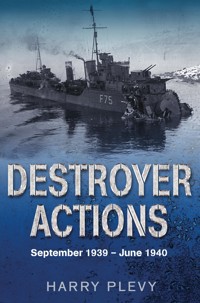
Utilising eye-witness accounts of those who participated in them, Destroyer Actions focuses on the human side of naval operations during the first eight months of the Second World War. Harry Plevy draws upon primary sources of both naval and civilian provenance, many of which are previously unpublished and therefore have never been available to the general reader. Extensively researched through comparison of British and German operational logs, and including first-hand evidence from Polish, French and Norwegian sources which reveal the true impact of the conflict at sea upon the lives of the people of all nations caught up in it, this book gives a comprehensive picture of destroyer actions at the beginning of the Second World War.
Sie lesen das E-Book in den Legimi-Apps auf:
Seitenzahl: 584
Veröffentlichungsjahr: 2016
Das E-Book (TTS) können Sie hören im Abo „Legimi Premium” in Legimi-Apps auf:
Ähnliche




















Destroyer Actions
September 1939 to June 1940
First published in the UK in 2006
This paperback edition published in 2008 by
The History Press
The Mill, Brimscombe Port
Stroud, Gloucestershire. GL5 2QG
www.thehistorypress.co.uk
This ebook edition first published in 2016
All rights reserved
© Harry Plevy 2006
The right of Harry Plevy to be identified as the author of this work has been asserted by him in accordance with the Copyright, Designs and Patents Act 1988
This ebook is copyright material and must not be copied, reproduced, transferred, distributed, leased, licensed or publicly performed or used in any way except as specifically permitted in writing by the publishers, as allowed under the terms and conditions under which it was purchased or as strictly permitted by applicable copyright law. Any unauthorised distribution or use of this text may be a direct infringement of the author’s and publisher’s rights, and those responsible may be liable in law accordingly
EPUB ISBN 978 0 7509 7954 2
eBook converted by Geethik Technologies
Contents
Acknowledgements
List of Maps
Introduction
I The Navy Prepares for War
II The Opening Days
III Fleet and Convoy Actions: Duties and Distractions
IV The Menace of the Magnetic Mine
V Collisions and Other Catastrophes
VI “The Navy’s here”: The Altmark Affair
VII The Beginning of the Norwegian Campaign.
VIII The First and Second Battles of Narvik
IX The Battle for Central Norway
X The Abandonment of the Norwegian Campaign
XI The Evacuation from France Begins
XII Dunkirk and the Fall of France
Appendices
Bibliography
Acknowledgements
I am indebted to very many organisations and people, some of whom are sadly no longer with us, for their help in the research for, and preparation of, this book. In preparing my acknowledgements I have made every effort to trace and contact copyright holders or their next of kin. However, given the passage of time since the events described in the book took place, with changes among publishing houses and organisations over the years resulting in transfers of copyright ownership, I have – despite extensive enquiries – been unable to trace a few of the copyright holders. I will make every effort to remedy the mistake or omission in any subsequent reprint or edition of the book.
The following persons have shared with me their memories of service on wartime destroyers or, as copyright owners, have allowed me to quote from the documents of relatives who did. Wherever known I have given the last title or rank of the person quoted; otherwise, I have given the title or rank at the time of the event described or of writing the memoir. I have chosen not to include honours and decorations in my acknowledgements, simply because I have been unable to guarantee the accuracy or comprehensiveness of such a listing. I hope that my contributors will understand and forgive this decision. For their permissions I am indebted to:
Mr H. Barwick
Mr M. Bell Macdonald for Captain A.M. Bell Macdonald, BEF
Mr J. Cannon
Mrs J.F. Childs for Second Engineer H. Saville
Mr D. Courage
Mr P. Court-Hampton for Lieutenant E.A. Court-Hampton
Captain R.D. Franks
Mr J.G. Gemmell
Mrs B. Grandage for Lieutenant G. Grandage
Lieutenant Commander J.F. King, for Captain H.A. King
Commander P.N.T. Lesisz
Mrs D. Lumsden, for Captain G.J.A. Lumsden
Mr R. Lush
Commander P.J. and M. Mosse for Commander J.P. Mosse
Mrs D. Neale for Lieutenant Commander J. Neale
Mrs O. Nettle for Commander S.A. Nettle
Lieutenant Commander F.C. Rice
Mr G. Sear
Mrs Y. Shelley for Mr A.H. Turner
Mrs M. Slater for Mr R. Hooke
Mr T. Slessor
Mrs W.M. Snelling, for Chief Petty Officer F. Parker
Lieutenant J.P. Tumaniszwili
Lieutenant J. Wankowski
Mr D.C. Wilkin, for Vice Admiral Sir Alistair Ewing
Mrs S. de Winton, for Captain F.S.W. de Winton
Petty Officer B. Witkowski
Mr P. Yates
I wish to acknowledge and thank the following persons, publishers, authorities and agencies for kindly giving permission to reproduce extracts from books, newspapers and journals:
M. Brown for Scapa Flow by M. Brown and P. Meehan
Commonwealth War Graves Commission
M Connell for Jack’s War by G. G. Connell
The Controller of Her Majesty’s Stationery Office for Naval Operations of the Campaign in Norway: April–June 1940 ed. D. Brown; The Evacuation from Dunkirk: Operation Dynamo, 26 May–4 June 1949 ed. W.J.R. Gardner; The Royal Navy Medical Service, Vol VII by Surgeon Captain J.L.S. Coulter; and The War at Sea 1939–1945 by Captain S.W. Roskill.
David Higham Associates for Field Marshal Lord Allanbrooke: War Diaries 1939–45 by A. Danchev.
P. Finnigan of the HMS Warspite Association
Greenhill Books Ltd for Memoirs: Ten Years and Twenty Days by Grand Admiral K. Doenitz
Harper Collins for Churchill and the Admirals by Captain S.W. Roskill; and The Navy at War by Captain S.W. Roskill
Lieutenant (Rtd) E.P. Harrison of the HMS Cossack Association
Macmillan Publishers Ltd for The Portsmouth Letters by Admiral Sir William James
News International Newspapers
Orion Publishing Group for The U-Boat Peril by Captain R.F. Whinney; and The Second World War, Vol 1: The Gathering Storm and The Second World War, Vol 2: Their Finest Hour by W.S. Churchill
The Master and Fellows of Pembroke College, Cambridge for Meredith Dewey; Diaries, Letters and Writings eds A.V. Grimstone, M.C. Lyons and V. Lyons
Pen and Sword Books Ltd for Dunkirk 1940: From Disaster to Deliverance by P. Wilson
Periscope Publishing Ltd for Destroyer Captain: Memoirs of the War 1942–1945 by Captain R. Hill Rogers
Coleridge and White Ltd, on behalf of Sir Ludovic Kennedy, for On My Way to The Club by L. Kennedy
Sheil Land Associates for An Adventurous Life by Admiral Lord Mountevans
A Suchcitz, Keeper of Archives, The Polish Institute and Sikorski Museum, London
The Telegraph Group Ltd
Mrs S Winton for Carrier Glorious by J. Winton
P. Ziegler and the Trustees of the Broadlands Archives for Mountbatten: The Official Biography by P. Ziegler
Information and quoted extracts from a number of other books and papers have also been incorporated into my writing and I wish to acknowledge their contribution. In my copyright search I have been greatly assisted by and thank: Mrs M. Ferre of the Office of Public Sector Information; Mr I. Hopkins of the Churchill Archives Centre, Churchill College, Cambridge; Mrs A. Littleboy of the Association of Royal Navy Officers; and Mr R.W.A. Suddaby, Keeper, Department of Documents, Imperial War Museum, London.
I would also like to acknowledge the authors of the following books, with thanks:
Lost Voices of the Royal Navy by M. Arthur
The Man who hit the Scharnhorst by J. Austin and N. Carter
Hitler’s Naval War by C. Bekker
The Mountains Wait by T. Broch
Prologue to War: The Navy’s part in the Norwegian Campaign by E. Brookes
Happy Odyssey by Lieutenant General Sir Adrian Carton de Wiart
Max Horton and the Western Approaches by Rear Admiral W.S. Chalmers
The Biography of Admiral Sir Bertram Home Ramsay by Rear Admiral W.S. Chalmers
The Fringes of Power: Downing Street Diaries 1939–1945 by J. Colville
Navies in Exile by A.D. Divine
The Merchant Navy Goes to War by B. Edwards
The Churchill War Papers: At the Admiralty. Vol 1 Sept 1939 to May 1940 by M. Gilbert
Everyman’s History of the Sea War by A.C. Hardy
Battleship Barham by G.P. Jones
War Diaries and Letters: Life on the Battlefield in the Words of the Ordinary Soldier ed. J.E. Lewis
Narvik by Captain D. Macintyre
Assault from the Sea by Rear Admiral L.E.H Maund
Mountbatten: Eighty Years in Pictures by Lord Louis Mountbatten
The Kelly by K. Poolman
The Battle of the River Plate by D. Pope
Action This Day by Admiral of the Fleet Sir Philip Vian
Auchinleck: The Lonely Soldier by P. Warner
Extracts from documents and papers that I wish to acknowledge, but where I am again unable to trace copyright holders, include those of:
Captain P.J. Carsdale
Stoker F.W. Earridge
Admiral Sir Ralph Edwards
Petty Officer W. Elliott
First Circle Films
Admiral J.H. Godfrey
Able Seaman D.T.W. Harris
Vice Admiral Sir Charles Hughes-Hallett
Signalman J. Knight
Lieutenant Commander R. Leggott
Report M014793/40 re HMS Whitshed
Vice Admiral Sir William Robson
Rear Admiral M.W. Searle
Captain R.S. Sherbrooke
Captain Walsham, Royal Artillery
Admiral W. Whitworth
Captain V.A. Wight-Boycott
Commander G.H.D. Williams
Translated extracts from the logs of the German battlecruisers Gneisenau and Scharnhorst
The photographs in the book are by kind permission of the Trustees of the Imperial War Museum, London; Commander J. Lubkowski of ORP Blyskawica; Polish Naval Museum, Gdynia, Poland; and Mrs M. Slater.
My thanks go also to the staff of the Department of Documents and the Photographic Archive of the Imperial War Museum, of the Churchill Archives Centre, Churchill College, Cambridge, and of Codsall and South Staffordshire Public Libraries, for their help in dealing with my many enquiries, to Mr J.E.G. White for help with translations, and to Mrs W. Troman and Dr J. Wankowski for their help in tracing Polish persons and authorities.
Finally, grateful thanks go to my long-suffering family for their patience and understanding. To my wife Pauline, who has been a tremendous supporter of my writing, been a patient listener, and given unstinting help with word processing the various drafts and final copy of the book, as well as patiently dealing with the mass of correspondence arising from my researches; to my son Neil for facilitating much of my researches, proof-reading and many helpful discussions and suggestions on content and direction; and to our daughter Julia for her encouragement and patient tolerance of my naval history obsessions.
Harry PlevyCodsall, South Staffordshire
List of Maps
1. The Norwegian Campaign: Naval Movements 7–9 April 1940.
2. The Second Battle of Narvik 13 April 1940, p. 116.
3. Sea Routes used during Evacuation from Dunkirk: 26 May–4 June 1940.
4. Ships Berthed at Dunkirk Outer Harbour 1530 hrs, 29 May 1940.
Introduction
The first nine months of the Second World War, the so called ‘Phoney War’ period prior to Dunkirk and the fall of France, were real enough to the destroyer crews of the Royal Navy. It was the Royal Navy that carried virtually the whole burden of the fight against the enemy, and it was the destroyers and their crews of that service that did the brunt of the fighting. The ill-prepared and poorly equipped small regular British Army took time to expand and equip, and was found wanting when it faced the vastly superior German Wehrmacht, firstly in Norway and then in France and the Low Countries, in the spring and early summer of 1940. From both Scandinavia and the Continent the beaten British Expeditionary Forces had to be evacuated back to Britain by ships of the Allied navies and merchant fleets, with destroyers of the Royal Navy playing a vital self-sacrificing role on each occasion. The Royal Air Force also took time to organise, only operating to a limited extent during the early months and was not called upon to play any prominent role in the early conduct of the war. Its time would come, gloriously, in the late summer of 1940 following Dunkirk and the fall of France in the Battle of Britain, when it took on and defeated the might of the German Luftwaffe.
The Royal Navy’s time came immediately with the declaration of war. Straight away, and indeed for the whole six years of the conflict, the Navy was called upon to keep open the vital shipping lanes, and it fell largely to the destroyers and their crews to escort the convoys bringing the food, raw materials and war equipment to Britain, protecting the merchant ships from German sea and air attack.
The Royal Navy began the war in September 1939 with 184 destroyers, some new, but mostly old and of World War I vintage. Nine months later, by the end of the Phoney War in June 1940 following Dunkirk, it had lost 23 of them. Very many more had been badly damaged. The ships would be repaired and replaced, but not the very many experienced officers and men who were lost with them. Among those lost were destroyers and men whose gallantry and self sacrifice shone like a beacon in the dark days when Britain was yet to come to terms with the later horrors of all-out war. Crews followed to the death the leadership and example of their captains: commanding officers like Captain Warburton-Lee and the crew of the Hardy, and Lieutenant Commander Roope and the crew of the Glowworm. Both captains were posthumously awarded the Victoria Cross in recognition of their, and their crews’, gallantry and devotion to duty. Shamefully, the same recognition was not given to the captains of two other destroyers, lost together with all their crews except for one seaman from each ship, when they tried to save the aircraft carrier Glorious from the guns of the German battle-cruisers Scharnhorst and Gneisenau. Commander Glasford and the crew of the Acasta and Lieutenant Commander Barker and the crew of the Ardent never received the recognition and honours which were their due.
Destroyer actions during the early months of the war also brought to the fore other captains whose exploits caught the public’s imagination and who would go on to high rank and commands in the Royal Navy and in State affairs. Men like Captains Vian of the Cossack and Mountbatten of the Kelly.
However, it was not all rearguard action against the overwhelming might of the German war machine in its first full flush of total supremacy in those early months of the war. While the German Wehrmacht and Luftwaffe might have swept all before them on land and in the air, at sea the German Kriegsmarine found the Royal Navy a much tougher proposition. The sea battles and encounters were much more evenly contested, especially in actions involving the destroyers of both sides. Thus while the Allied navies may have suffered heavy destroyer losses, in comparison the German Navy, with its numerically smaller destroyer force, suffered catastrophic destroyer losses. So much so that after the first and second battles of Narvik in April 1940, fought for the most part between destroyers, the German destroyer fleet was virtually eliminated. Only four serviceable destroyers remained. The German Kriegsmarine was thus in no position to escort troop transports for a sea-borne invasion of Britain two months later, following Dunkirk and the collapse of France, a factor which is frequently overlooked when evaluating why the Germans did not immediately follow up their success and invade Britain in the summer of 1940.
The men serving on destroyers, on both sides, had a hard war. Not only had they to contend with the various threats posed by the enemy, but there was always their common enemy, the sea, which posed its own trials and tribulations to the small, fragile destroyers and the men who sailed in them. This book seeks to pay tribute to those destroyers and their crews, friend and foe, who fought and died in the so-called Phoney War of 1939–1940.
I
The Navy Prepares for War
On 3 September 1939 the British and French Governments, quickly joined by Britain’s self-governing dominions Australia, Canada, South Africa and New Zealand, declared war upon Germany in support of Poland, following the invasion of that country by Germany on 1 September.
Contrary to widely held expectation, the British populace was not immediately subjected to the privations of war; there were no massive air attacks upon her cities, nor were her people faced with immediate starvation. These tribulations were yet to come. Indeed, initially there could be said to be some welcome benefits. Unemployment, for example, fell from its high pre-war levels, as the country swung onto a wartime footing and expanded its manufacturing base for the production of armaments and munitions, and as civilians of military age in non-reserved occupations were called to service in the growing armed forces. There followed some months of what American journalists termed the Phoney War; Neville Chamberlain, the then British Prime Minister, called the Twilight War; and the pugnacious Sir Adrian Carton de Wiart,1 a Boer War veteran, recalled as the Bore War.(1)
For the British Army and the Royal Air Force there were to be six months of gentle initiation into the war. Both services needed time to equip and train their new, largely conscript, servicemen and women. Within the first few days of war being declared the Royal Air Force sent squadrons and support units to France; and the British Expeditionary Force, made up of five divisions of regular home-based Army divisions, was assembled and dispatched to augment the large French Army facing the Germans behind their respective Maginot and Siegfried Lines (the Westwall). Months of stalemate then ensued on the continent. However, there was to be no gentle introduction for the Royal Navy. It alone carried the fight against-the Germans in the first year of the war. Unable militarily, and unwilling politically, to raise the stakes by a direct attack on Germany in order to assist Poland, the Allies initially placed great faith upon world opinion and diplomacy to bring about a peaceful solution to the crisis. There was a widely held view that the war could be over by Christmas. Others thought that there was no immediate danger or cause for concern. In the meantime indirect pressure, short of all-out war, would be put upon Germany by imposing an economic blockade, a policy which, it was believed, given the perceived control of the seas by the Royal Navy, would rapidly bring Germany to the conference table.
The war looks like being an immobile affair on the Western Front, with neither side bombing the other’s civilian populations for some time to come, and the real tests being whether Germany’s economic resources and the morale of her people can defeat the Navy’s blockade and the morale of the Allies. This will be dangerous because it will be boring; and in wartime boredom is certain to bring discontent at home. However I do not think the Germans will begin their proverbial “frightfulness” until they feel they are losing or winning so that London can probably sleep in peace for a good many weeks or even months to come.(2)
It was fortunate for Britain, and ultimately for the free world, that the Royal Navy was one allied service that was ready for war on the commencement of hostilities. It had been brought to a semi-war footing, and an awareness of modern wartime requirements, by the Abyssinian crisis following Italy’s invasion of that country in 1935, and then, almost immediately afterwards, by the Spanish Civil War. Both of these conflicts had given the Royal Navy experience of the evacuation of refugees and British nationals and of blockade duties against contraband and gun runners.
In 1937, with the benefit of these experiences and with Hitler and Mussolini becoming increasingly belligerent and war increasingly likely, the Royal Navy started to overhaul its organisation and resources. In the mid-summer of 1937 Vice Admiral Sir Max Horton was given command of the Reserve Fleet, charged with the task of bringing this heterogeneous collection of elderly ships, large and small, onto a wartime footing. In naval circles the Reserve Fleet was considered, both literally and metaphorically, to be in the backwater of the Navy: at that time it was made up of some 140 ships of all classes, laid up in ports and inlets around the British Isles. They were manned, at varying degrees of readiness, by skeleton crews on a ‘care and maintenance’ basis. The Navy was fortunate in its choice of Admiral Horton, a distinguished submarine commander in the First World War and later to become equally distinguished as Commander-in-Chief, Western Approaches. He was a man of great drive and organising ability. His Fleet Secretary wrote of him:
Sir Max certainly put a new spirit into the Reserve Fleet by making people feel that they were doing a worthwhile job which was likely to come to fruition very soon. He insisted that everything should be looked at from the point of view of “What would happen to this on mobilisation?” One of his earlier measures was to carry out a mobilisation exercise on paper, but the facilities for victualling, kitting up and drafting the men, and the transport and labour for delivering the stores had to be actually there. This exercise proved to be most useful in showing up deficiencies in organisation, many of which were corrected before the Munich mobilisation in 1938. In addition to the measures taken within the Reserve Fleet, Sir Max kept up a constant pressure on the Admiralty to try to get made in advance those arrangements which he foresaw would be required.(3)
Following the Munich crisis of 1938, which spurred on the naval preparations, virtually the whole Reserve Fleet was ready by mid-summer 1939 to sail as soon as the ships’ companies could be assembled.
Of the three British armed forces the Royal Navy was undoubtedly the best organised and most experienced. It was made up of dedicated, totally professional officers and men, steeped in naval tradition and highly disciplined. In the main, they were arguably more well trained than well educated, as a result of their recruitment into the service at an early age. The officers, traditionally from the middle and upper classes, joined the Navy at the age of thirteen, with a view to a lifetime career and a steady rise through the officer ranks. The apprenticeship was hard and long, the training unremitting, and the discipline harsh. Captain R. Whinney, later to become a distinguished destroyer captain and one of the Second World War’s most successful hunters of U-boats, recalled his time as a cadet in the early twenties:
In the days before World War Two, The Royal Naval College, Dartmouth, produced nearly all those officers who would later be qualified to command HM ships at sea. They joined as small boys of thirteen and a half years of age, in uniform, as young officers and gentlemen. They had naval pensioner servants, who called them ‘Sir’, who made their beds, cleaned their shoes, and sent their laundry to the wash. Conversely, they were in for four years’ sojourn of being chased around in an atmosphere of rigid (and in my day, uninspired) discipline which towards the latter months left many of them bloody minded.
They came, these young men, from fee-paying schools and were the sons of gentry, of professional men and, in some cases, of the aristocracy…the competition, the passing of the entrance exam, an interview and, of course, a medical were severe: forty-three were taken out of some two hundred applicants in my case. I passed in about twelfth but had the advantage of prep school where the alternative to working hard was a rare, effective, never resented walloping on the backside.
Dartmouth was in effect a public school run by a Captain, Royal Navy, with a naval staff and a headmaster with a civilian teaching staff…The Naval College was a vast, shiny, spotless place with highly polished floors throughout and the front of the buildings, seen from the outside, was impressive and elegant, built in red brick with white stone facings – again spotless with no sign of weathering permitted.(4)
Punishment for even minor transgressions was harsh:
A shirt folded with a button undone or a sock facing the wrong way, and the Cadet Captain made a tick in his notebook. Three ticks against anyone’s name meant three cuts with the cane. Every night, after lights out, the defaulters were called from their beds in alphabetical order and, one by one, to the noisy swish of the cane dealt with…Serious offences, such as being found in possession of cigarettes or photographs of ladies without all their clothes on were awarded ‘official cuts’. The offender was then held down over a horse-box in the gym while a Petty Officer performed the execution of six cuts.(4)
Other cadets were less concerned by the discipline but found other features of college life equally idiosyncratic:
Discipline at the College was obviously strict, but I do not consider that it was harsh. It was a full life but not unduly hard…Sports and exercise were taken very seriously at the College. Each cadet had to do an exercise log on every weekday. Participation in an organised game such as rugger or hockey constituted a whole log, while running to Black Cottage or a game of squash was only half a log. For some inexplicable reason having one’s hair cut counted as a quarter log!(5)2
The men, predominantly from the working classes or the ranks of the unemployed, usually joined at the age of sixteen and had their own shore-based training establishment, HMS Ganges at Shotley. Training and discipline were equally as severe as for the prospective officers. Signalman J. Knight, later to serve on the destroyer Kelly, retained his memories of his first days as a sixteen-year-old in the Royal Navy:
It must have been about five in the evening of 2nd November, 1936 when the train from Liverpool Street stopped at Harwich and the dozen or so of us got out to be met by a Petty Officer who said “This is it. If you’ve changed your minds you can go back now, but once across the water – tough.” I wasn’t going to change my mind, not after waiting six months since first going to the Recruiting Office in Whitehall. I was going to be a sailor, wear a blue collar and round hat, see the world, get all the girls, etc, etc.(6)
His introduction to naval life the next morning was quite literally a rude awakening:
…I must have slept in the end because the next thing I knew was a tremendous bang. There was a sort of oil-cloth table covering which was rolled up between meals, and one of the marine sentries who kept watch throughout the night had picked it up and banged it down on the table. “Come along” he yelled, “Stop sleeping, sun’s burning your eyes out.” Sun? In November? It was the start of a giddy round.(6)
After two years of training, ashore and afloat, the men signed on at the age of eighteen for an initial twelve years of service. After this they could leave the service for civilian life or transfer to the mercantile marine. They were retained by the Navy on reserve status for a set number of years, to be recalled to the service at times of national emergency. Some reservists had been called at the time of the Abyssinian crisis with Italy in 1935, and others at the time of the Munich crisis in 1938, when Germany had annexed Czechoslovakia and brought Britain to the brink of war.
The men who stayed on in the Royal Navy signed for a further ten years, leading to a full pension after twenty-two years of service. Such men, who in their second term of service had usually risen to Petty Officer or Leading Hand rank, formed the experienced and disciplined backbone of the Navy at the start of the war.
On 1 January 1939 the Royal Navy was made up of some 10,000 officers and 109,000 men. They were supported by a further 12,400 officers and men of the Royal Marines, who, in those days, manned a quarter of the armament of battleships, battlecruisers and heavy cruisers, carried out ceremonial duties, and provided, if required, landing parties for action or peace-keeping duties ashore. All the aforementioned officers, men and Royal Marines manned the ships in commission, staffed the bases and training establishments ashore, and provided ‘care and maintenance’ crews for the Reserve Fleet.
In addition, the Navy could call upon 73,000 officers and men reservists in the Royal Navy Reserve, which also included some men from the Merchant Navy and fishing fleets who, while not having served in the Royal Navy, had joined the Reserve and received some naval training and recompense for their time and commitment. There were also some 6,000 Royal Naval Volunteer Reservists, amateur ‘weekend’ sailors who, somewhat analogous to the Army’s Territorials, had undergone training and duties in their spare time. Thus the total strength of the Royal Navy at the outbreak of the war was some 200,000 men.
The next few years saw a massive expansion of these numbers. At its peak in mid-1944 the personnel of the Royal Navy totalled some 843,000 officers and sailors, including 73,500 of the Women’s Royal Naval Service (WRENS). Although the vast bulk of this increase in numbers was made up of ‘Hostilities Only’ (HO) personnel called up for National Service, it was the comparatively small body of regulars, reservists and volunteer reservists serving at the outbreak of the war in 1939 who held the Navy together, trained the recruits for the Navy’s expansion, and fought and died in the sea battles of the first year of the war.
As in 1914, so in 1939 precautions had been taken by the Navy in advance of the declaration of hostilities. On 15 June 1939 large numbers of officers and men reservists had been recalled. The Reserve Fleet, fully manned for exercises, had been inspected by the King on 9 August; and on 22 August further reservists had been recalled. On 24 August an Emergency Powers Defence Bill had been passed by Parliament and the Fleet ordered onto a war footing. The main Home Fleet had in fact been assembling for some weeks at its main base of Scapa Flow in the Orkneys.
The ships that the sailors were to man in that first year of the war comprised a mixed collection of various classes and sizes of vessel. In all, the Royal Navy had in commission, though not necessarily immediately available for service, some twelve battleships, three battle-cruisers, six aircraft carriers, fifty-two cruisers, six converted anti-aircraft cruisers, one hundred and eighty-four destroyers (see Appendix 1), fifty-five escort vessels of various kinds, and sixty-nine submarines. Most of them, especially the larger ships, were over twenty years old and were of First World War vintage; few of them had been modernised.
This was particularly so with the destroyers brought out of reserve. To their called-up crews, torn from their settled civilian life and home comforts, the prospects of life and conditions on these old ships must have been daunting. Captain P. Vian, recently appointed to take command of a flotilla of destroyers brought out of reserve, remembers of the crews:
These, when they arrived, proved to be mainly veterans of the First War; their lives had been disrupted by mobilisation, which had come upon them so quickly that those who had grown moustaches had lacked time to remove them. Few had uniforms which fitted.
As veterans, they had clear memories of life in destroyers in Atlantic winters, and here they were, facing another dose of the same medicine, in the very same ships they had left in 1918, still without baths and drying rooms, or, in fact, any amenities whatever…In the event, the fortitude with which these Reserve destroyer crews faced their new circumstances was remarkable.(7)
The veterans’ numbers were made up with young and inexperienced men. Eighteen year-old J. Knight, fresh out of Shotley, was one of their number. He joined the brand-new destroyer and flotilla leader Kelly, under the command of Captain Lord Louis Mountbatten, in August 1939.
I was in the draft which left Chatham Dockyard by special train for Hebburn-on-Tyne to commission HMS Kelly…The lower deck was cleared and Louis told us that our original store ship programme was meant to take three weeks but in view of the worsening international situation it had to be done quicker. Then came the shock! We had to do it in three days. No-one was going to sleep until it was done and then we would sail for working-up exercises at Portland. During those three days I was walking along the upper deck where I saw a pile of old-time cannonballs. ‘What on earth do we want those for?’ I wondered. Nine months later I was to find out.(6)
The nineteen-year-old, newly appointed Acting Sub-Lieutenant found his posting to a reserve fleet E class destroyer, Escort, being prepared at Chatham dockyard, equally daunting:
In most cases, two Acting Sub-Lieutenants were sent to each reserve fleet destroyer and my term mate Peter Eason joined Escort with me. I was allocated the job of navigating officer, torpedo officer and anti-submarine officer. I knew very little indeed about Asdics3 and anti-submarine work, as I had not done a course on this. Most of the ship’s company were reservists, either Royal Naval Reserve or RNVR. The RNR reservists were most experienced and mature. Some had been ‘on the beach’ for quite a while and so were pretty rusty. The Captain, Lieutenant-Commander John Bostock, was a very experienced, able and much respected destroyer captain. Besides the Captain, the First Lieutenant, we two Sub-Lieutenants, a Gunner (who happened to be an elderly Lieutenant) and a commissioned Engineer completed the officer complement.(5)
As some recompense for the harsh wartime living conditions in destroyers and other small escort craft the Admiralty paid a small ‘hard lying’ allowance to their crews. According to Captain Lionel Dawson, ‘hard lying’ was no misnomer. The term had originated from the living conditions on the first torpedo boats, forerunner of the destroyer, where:
…wooden planks were considered an admirable foundation on which to sleep at night and sit upon by day…life on the early destroyers was little better.(8)
As well as bringing into commission its reserve fleet of destroyers, the Admiralty also recalled ships from foreign stations in order to supplement the number of ships available and to concentrate them nearer home. Thus on the outbreak of war a flotilla of eight D class destroyers, built in 1932, was recalled to the Mediterranean from their China Station base at Wei Hai Wei, both to be on call nearer home, and to help counter the threat posed by Italy, should that country decide to enter the war on the side of its Axis ally Germany. The ships returned in something of a hurry. V.A. Wight-Boycott, then First Lieutenant on Delight, wrote to his mother on 4 September 1939:
…we have been steaming almost continuously at 20 knots. The ship is caked with salt from stem to stern. You can chip the salt off the funnels with a knife – (and we have) – a continued shower of spray over the whole length of the ship almost since we left.(9)
The hurried return brought other problems. Diamond, in ‘peacetime condition’, arrived in Malta complete with Chinese mess boys, twenty-two canaries, six pairs of lovebirds and two Siamese cats. As recalled by Seaman P. Yates, then serving on Diamond:
However things were very soon to change. The Italians were rattling sabres and showing signs of joining the Axis, so the birds had to go. This presented no problem at all, they were simply given to numerous ‘bar people’ in Malta. The Chinese mess boys were a very different matter. They wanted to stay with the ship and the crew. This was not possible of course, so they were ordered to pack their belongings prior to being shipped back home. This created quite a rebellion among them, so much so that one went quite berserk with a meat cleaver on the torpedomen’s messdeck. He was eventually subdued and locked in the switchboard compartment until he calmed down!(10)
The overall position with regard to destroyer availability was complicated. Despite tight Treasury purse-strings the Admiralty had managed to secure, in each of the ten years preceding the outbreak of war, sufficient funding to be able to build a complete flotilla of destroyers, usually made up of eight or nine ships, one of which was a slightly larger flotilla leader. Thus of the one hundred and sixty-four destroyers actually available for service on 3 September 1939, approximately two thirds were of relatively modern construction (see Appendix 1).
Most of the remaining third were of First World War design or vintage. One of them was Keppel, a Thorneycraft class destroyer built in 1925 and destined to become the leader of the 17th Destroyer Flotilla, made up of old V and W class destroyers. In the early summer of 1939 Captain F.S.W. de Winton was appointed Captain (D) in command of the 17th Flotilla, and of Keppel:
The flotilla consisted of the following ‘V’s and ‘W’s commissioned from the Reserve Fleet complement – Versatile, Vimy, Warwick, Whirlwind, Watchman, Vidette, Velox and Vortigern…These ships were about 1,750 tons and had complements of about 190…The flotilla was largely manned by reservists, men who had completed their twelve years in the R.N., and a certain number of pensioners. Three of the ships were commanded by retired officers and, with a few exceptions, active service officers comprised the officer complement of all ships…We were based in Portland and he [Vice Admiral Sir Max Horton, in command of the Reserve Fleet] gave me a very free hand with the ground plan and working-up to full seagoing and weapon efficiency covering a period of about three–four months.(11)
However, this apparently ample supply of destroyers was nowhere near enough to fulfil all the wartime duties required of them. Their duties had moved a long way from those originally envisaged at the time of their conception at the turn of the century. Destroyers did not have the long pedigree of battleships which went back to the days of ‘ships-of–the-line’, or of cruisers which had their origins in the frigates of Nelson’s day. Destroyers were the consequence of two technologies introduced towards the end of the nineteenth century. These were the self-propelled torpedo and the marine turbine engine. Harnessed together in the form of small, very fast, torpedo boats, capable of hitherto unheard-of speed in excess of 30 knots, and able to discharge at long range lethal self-propelled torpedoes, these boats posed a considerable threat to the larger, cumbersome ironclads of the main fleets. As a countermeasure, equally fast Torpedo Boat Catchers were developed. These quickly became known as Torpedo Boat Destroyers and then simply as Destroyers. The first flotilla of twelve boats in this class was introduced between 1905 and 1908. They were known as the Tribal class – Nubian, Maori, Zulu, Viking, Saracen, Amazon, Cossack, Mohawk, Tartar, Afridi, Gurka and Crusader. As an evolving class they were all slightly different – Tartar was a shade faster than her sister ships, Viking had six funnels and Crusader had a powerful stern winch.(12) What they had in common was a speed of the order of 34 knots, two or three 18-inch torpedo tubes, a miscellany of deck guns, usually 18-pounder (3-inch) or 4-inch, and a displacement of 865–1,000 tons. They all served with distinction in the First World War, and had an eventful war4 which, as will be seen, was to be repeated by their replacement class of Tribals in the Second World War.
By the outbreak of the First World War the destroyers’ roles had been extended. Their duties were seen as, inter alia, screening and protecting the main fleets against attack by enemy torpedo boats; scouting and searching ahead of the fleets; harassing enemy torpedo boats, especially as they left or returned to their bases; and delivering torpedo attacks against the enemy fleets.
By the outbreak of the Second World War evolving technology, modern weapons and new strategies had made additional demands on destroyers. Their roles were now perceived as providing anti-submarine and anti-torpedo boat protection for larger ships of the Royal Navy; engaging in anti-aircraft and anti-submarine convoy escort work; carrying out limited offensive operations in narrow waters and against enemy-held coasts; engaging in mine-laying duties; and supporting other, larger, ships, and acting as fleet picket boats.
Winston Churchill, restored to his First World War post of First Lord of the Admiralty on 3 September 1939, was quickly on to the question of destroyer numbers. In a memorandum of 9 September to the Third Sea Lord, Rear Admiral R.A. Frazer,(13) he complained that only nine new destroyers were scheduled for delivery in the following sixteen months. This he thought was unacceptable.
The First Lord of the Admiralty was also concerned at the increasing complexity, and hence cost and construction time, of the destroyer class of ships. On 11 September he sent a memorandum(13) to the First Sea Lord, Admiral of the Fleet Sir Dudley Pound, welcoming the decision to take over six ‘Brazilians’5 which would become available for 1940, but deploring the fact that this modern breed of increasingly complex ‘Fleet’ destroyers, intended for work in conjunction with the larger ships of the Royal Navy, was not designed or suited for the more routine convoy escort duties. By 1939 the modern British ‘Fleet’ destroyer was approaching 2,000 tons displacement with a crew of more than 200, armed with 4.7-inch guns and up to ten torpedo tubes, and capable of speeds in excess of 35 knots (see Appendix 1).
The newly commissioned Alfridi (or Tribal) J and K classes of British destroyers were formidable ships whose all-round performance matched that of any destroyers of other navies. The ‘Tribals’ in particular, heavily armed with eight 4.7-inch guns, were graceful as well as powerful. A young Sub-Lieutenant Ludovic Kennedy remembers the impression created by his first sighting of Tartar:
…a little way downstream I glimpsed her for the first time – as sleek and elegant and powerful-looking ship as I have yet seen. From the bow there rose in successively higher tiers A gun, B gun, the convex armoured wheelhouse and – the high point of the ship – the open bridge, some forty feet above the waterline. At the back of the bridge was the foremast with its aerials, aft of that the raked funnel, and then in the waist of the ship the torpedo-tubes. Up again to the pom-pom and X gun and then down to Y gun, the quarterdeck and the stack of depth charges. The whole effect was one of symmetry and grace.(14)
If British destroyers of the era had one major weakness it was their wholly inadequate anti-aircraft armament. Their 4.7-inch guns could not be elevated above 40 degrees, and the secondary 0.5-inch machine guns and 2-pounder ‘pom-poms’ would prove no deterrent to a determined dive bomber or massed air attack. Some attempts had been made to improve the anti-aircraft armament of British ships, but the procurement of suitable weapons was proving difficult as all branches of Britain’s armed forces strove to re-arm in the final years of peace. The then Lieutenant-Commander C. Hughes-Hallett, Captain of the destroyer Valorious of the 2nd Destroyer Flotilla between January 1934 and February 1936, had first-hand experience of the Admiralty’s attempts to procure heavier anti-aircraft guns for the Navy’s ships. Promoted Commander and appointed to a new staff position with the Director of Naval Operations in February 1936, he recalled:
I was brought into the DNO’s department to occupy a desk just established, responsible for all new guns being put into production, one of which in due course was the Oerlikon. I went to sea again in 1938 so that the following events occurred between 1936 and 1938. Before the Oerlikon…the Controller had endeavoured to place an order for Bofors (40mm) guns and mountings with the Swedish firm but was unable to do so because the firm’s production capacity was fully committed for months, possibly years, ahead, largely owing to a big contract they had accepted from the War Office, and they were not prepared to increase their production unless we footed the bill for a new factory.(15)
The older destroyers of First World War vintage or design were even less well protected against anti-aircraft attack. The Captain of Keppel, lead ship of the 17th Flotilla, wrote:
Although adequately armed against surface craft and U-boats, the flotilla was lamentably deficient in anti-aircraft armament. In Keppel I managed to get a couple of Lewis guns and a Maxim machine gun6 fitted on the fore bridge. Keppel’s 3-inch AA gun was quite useless, which by the drill book required nine men to man it!(11)
The relatively few modern fleet destroyers available to the Royal Navy in relation to the demands for their services, plus their increasing sophistication – and hence value – as warships, meant that when used in a convoy escort role they had become a more worthwhile strategic target for the U-boat than many of the smaller ships they were escorting. The hunter was increasingly becoming the hunted. This dichotomy between the role of the destroyer acting alone (or in concert with other destroyers or larger ships in naval actions), and that of destroyers acting as an escort for merchant ships in convoy, was becoming increasingly apparent following the Admiralty’s reintroduction, on the outbreak of war, of its First World War convoy system, in order to give collective protection to merchant ships.
In contrast to the large but varied destroyer fleet of the Royal Navy, the German Navy, with a different remit and responsibilities, had only twenty fleet destroyers at the outbreak of war (see Appendix 2). However, these were all new, with the first one Z1 Leberecht Maas being built at Kiel in 1934-35. As a class, they were larger, at 2,100 to 2,400 tons, than their British counterparts, with a complement of 315 men. They were much more heavily armed, with five 12.7mm (5.1-inch) guns and a mine-laying capability for sixty mines, a factor which was later to cause great embarrassment to the Royal Navy. It was envisaged that one of their roles would be to escort the fast new German battleships under construction, and the battle-cruisers Scharnhorst and Gneisenau, so the destroyers had a designed top speed of some 38 knots.
However, this high-speed capability was only achieved at an operational cost. For propulsion, the ships used a high-pressure steam turbine system which proved unreliable in service, with frequent boiler tube problems – euphemistically termed ‘growing pains’ by the German naval authorities. A boiler tube had only to fail, filling the engine room with scalding steam, for a ship to lose speed or even to be forced to stop for emergency repairs. The German stokers and engine room artificers learned to deal stoically with the problem of a burst water pipe:
We simply turned it off and ventilated it with cold air for twenty minutes. Though the fire-proof clay was still red-hot, one of us in heavy leather togs would then creep inside, detach the burst pipe, and put a patch over the hole. After two or three hours we might with luck get the boiler going again.(16)
The sea-going capabilities and effective range of the German destroyers were inferior to those of their British counterparts. Their forecastles were found to be too short resulting, even in medium seas, in the forward gun becoming unusable as both it and the bridge were engulfed with seas breaking over the bows. Their heavier armament also contributed to the ships becoming somewhat top-heavy and less stable in heavy seas, which necessitated the retention of a high, some 30% minimum, fuel reserve in the ships’ tanks to ensure adequate stability. This in turn reduced operational range and endurance. These design and technical problems were to bedevil the activities of the German destroyers in the first year of the war.
However, the German Navy had one important strategic advantage. As a continental country, with the bulk of its food and raw materials obtainable from neighbouring countries and without the need to bring many of these essentials from overseas, the German Navy did not have the major problem of protecting its supplies with convoy escort ships. The problem facing the Royal Navy in giving collective convoy protection to the merchant ships bringing food and supplies to the British Isles, on the other hand, was a formidable one. The British merchant fleet at that time consisted of some 2,000 vessels, with between 100 and 150 ships – British, allied and foreign – arriving from or departing to destinations all over the world every day. The ships were of different nationalities, varying sizes and types, and travelled at varying speeds of between eight and fifteen knots. To organise these diverse ships and cargoes into groups and move them in convoy, under the protection of destroyers and other escort ships, with perhaps some overhead aircraft surveillance from Coastal Command or the RAF when in coastal waters, was a colossal undertaking. The threat of attack by aircraft, surface ships or U-boats was constant.
The threat from U-boats was one that would grow as the war progressed. At the outbreak of war Germany had fifty-seven operational U-boats of modern design. By 1942 Germany had built 304 U-boats, thirty -three of which were built in the yards of occupied France or Holland. At the end of 1942 Germany and Italy together had 485 submarines in service, of which sixty-eight were Italian.(17) By the end of the war, Axis submarines, Italian and Japanese as well as German, had sunk 2,828 Allied and neutral merchant ships totalling 14,687,231 tons, of which nearly 11,500,000 tons were from the British Merchant Naval Fleet. The Merchant Navy also lost 23,000 Merchant seamen, killed as a result of U-boat sinkings. In addition, German U-boats had sunk 175 Allied warships, of which the majority were British.
It was not an entirely one-sided battle, however. Germany built a total of 1,162 U-boats between 1939 and 1945, of which 785, or two thirds, were lost. 632 of these were sunk at sea, of which 503 were accounted for by British ships and aircraft.(18)
The types and operational specification of the 57 U-boats with which Germany began the war are set out in Appendix 3. In essence these 57 submarines were developed from those in service in the German Navy at the end of the First World War. They were designed to patrol submerged at periscope depth, powered by electric motors, by day, and to patrol on the surface at night, using their diesel engines for both propulsion and to recharge their electric batteries. Later in the war larger, more advanced U-boats were introduced, capable of remaining submerged for longer periods.
Equally threatening in the early months of the war was the danger posed by powerful German surface raiders. Although the British and French navies were numerically greatly superior, in both capital ships and other surface vessels, to the German Navy in 1939, the German ships were generally speaking faster and more modern. Thus the threat from the fast 32,000-ton battle-cruisers Scharnhorst and Gneisenau, each armed with nine 11-inch, twelve 5.9-inch and fourteen 4.1-inch guns and capable of over 30 knots, plus that of the three 12,000-ton pocket battleships Deutschland (later renamed Lutzow), Admiral Scheer and Admiral Graf Spee, each armed with six 11-inch, eight 5.9-inch and six 4.1-inch guns and capable of 26 knots, was serious. Great Britain had only the three elderly battle-cruisers Hood, Renown and Repulse, and the French the new battleships Dunkerque and Strasbourg individually capable of catching and dealing with them in any running battle. In order to contain the threat of these surface raiders, the Allies had to provide shadowing task forces made up of battleships, battle-cruisers, and heavy 8-inch cruisers to protect the larger and more important convoys. This was in addition to the protection provided by the convoy’s own ‘close escort’ of destroyers and other small escort ships. These shadowing heavy escort groups, in turn, also needed their escorting anti-submarine screen of destroyers.
There was one further consideration which prevented the Allied navies from bringing their numerical superiority fully to bear. Both the French and British were concerned about the intentions of the Italians in the Mediterranean and the Japanese in the Far East. For these reasons many allied warships, including destroyers, had to be kept dispersed throughout the world in order to protect overseas positions and lines of communication and commerce. As a consequence of all these considerations, the demand for destroyers was unremitting and could not be satisfied.
Since the first call on the modern destroyers being built in the 1930s would be to work with the main fleets, an acute shortage of vessels to meet the very large demands for anti-aircraft and anti-submarine convoy escort duties was foreseen. From 1937 onwards the Admiralty took steps to combat this envisaged shortage in a number of ways. As an immediate step, six old 4,250 ton C class cruisers, launched in the First World War, and fifteen old destroyers of a similar vintage, were converted to an anti-aircraft escort role by re-arming them with 4-inch anti-aircraft guns. Even this step was to produce shortages of another kind in a Britain ill-prepared for war. The First Lord of the Admiralty’s memorandum of 8 September 1939 to the Director of Naval Operations(13) reveals that the Royal Navy had only 520 rounds of ammunition for each of its main high angle 4-inch quick-firing guns.
The Admiralty also started to introduce new classes of vessel to take over the convoy escort roles of destroyers. They ordered specialist escort vessels of the generic type to become known as sloops. Displacing 1,000–1,250 tons, and armed with 4-inch guns, these vessels were slow but had a comparatively long sea-keeping endurance. By the outbreak of war some fifty of these sloops were in service. More analogous to the traditional destroyer was the small Hunt class destroyer; the individual ships were named after fox-hunts. These were of an entirely new design, a small and fast destroyer of some 1,000 tons displacement and capable of 32 knots. They were armed with a dual-purpose main armament of six 4-inch guns but carried no torpedo tubes. Twenty of these Hunt class ships were building at the outbreak of war, and a further sixty-six were included in the next two years of naval construction. Although of short sea endurance, they performed invaluable service throughout the War, in narrow seas and along the coastal shipping routes. Lastly, the corvette, another completely new type of small long-endurance escort vessel, designed on the lines of a whale-catcher displacing some 1,000 tons, armed with one 4-inch gun, was introduced. Although their small size and lively performance in rough seas made life very uncomfortable for their crews, they went on to perform yeoman service throughout the war. Their drawback was their top speed of fifteen knots, which was too slow to enable them to overtake a surfaced U-boat of the later types.
Few of these various convoy escort vessels were available when the Royal Navy went to war on 3 September 1939 with its miscellany of modern and obsolescent destroyers (see Appendix 1). By June 1940, nine months into the war, very many of these ships would have been sunk or badly damaged.
NOTES TO SOURCES
1. Carton de Wiart, Lieutenant General Sir Adrian. Happy Odyssey (Jonathan Cape: London, 1950).
2. Colville, J. The Fringes of Power: Downing Street Diaries 1939–1945 (Hodder and Stoughton: London, 1985).
3. Chalmers, Rear Admiral W.S. Max Horton and the Western Approaches (Hodder and Stoughton: London, 1954).
4. Whinney, Captain R. The U-Boat Peril (Blandford Press: London, 1986).
5. Cardale, Captain P.J. Papers 90/23/1. Imperial War Museum, London.
6. Knight, Signalman J. ‘Memories of a Miscreant’. Papers 87/15/1. Imperial War Museum, London.
7. Vian, Admiral of the Fleet Sir Philip. Action This Day (Frederick Muller: London, 1960).
8. Dawson, Captain L. Flotillas: A Hard Lying Story (Rich and Cowan: London, 1933).
9. Wight-Boycott, Captain V.A. Papers 96/59/3. Imperial War Museum, London.
10. Yates, Seaman P. Papers 92/27. Imperial War Museum, London.
11. de Winton, Captain F.S.W. Papers 85/44/1 Imperial War Museum, London.
12. Mountevans, Admiral Lord. Adventurous Life (Hutchinson and Co: London, 1946).
13. Gilbert, M. The Churchill War Papers, Vol 1: At the Admiralty Sept 1939– May 1940 (Heinemann: London, 1993).
14. Kennedy, Sir Ludovic, On My Way to the Club (Collins: London, 1989).
15. Hughes-Hallett, Vice Admiral Sir Charles. Ref H.U.H.T., Churchill Archives Centre, Churchill College, Cambridge.
16. Bekker, C. Hitler’s Naval War Trans Ziegler, F. (Macdonald: London, 1974).
17. ‘The Battle of the Atlantic: The Official Account of the Fight against the U-boats, 1939-1945’. (HMSO: London, 1946).
18. Roskill, Captain S.W. The Navy at War, 1939-1945 (Collins: London, 1960).
1 Lieutenant-General Sir Adrian Carton de Wiart fought in five campaigns spanning the period from the Boer War in 1901 to the Narvik Campaign in 1940. Severely wounded eleven times, losing both a hand and an eye, he was much decorated, including a Victoria Cross awarded in 1916.
2 Peter Cardale, later to become a Captain in the Royal Navy, entered Dartmouth as a thirteen-year-old in January 1933.
3 Anti-submarine detection equipment named after Anti-submarine Defence Investigation Committee.
4Maori and Viking were mined and sunk and Mohawk and Viking were damaged by mines. Zulu’s stern was blown off by a mine and Nubian’s bow by a torpedo. The two good halves were salvaged and joined to form a hermaphrodite ship, HMS Zubian.(12)
5 Six destroyers being built in British shipyards on the outbreak of war for the Brazilian Navy.
6 Obsolescent light machine gun firing 0.303 small-arms ammunition.
II
The Opening Days
For the Polish and German navies, the war began in earnest on 1 September 1939. Poland’s navy was both new and small, reflecting her recent emergence as an independent country after centuries of partition and oppression by her immediate neighbours. It was formed from a small and miscellaneous collection of river gunboats, coastal patrol vessels, minesweepers and torpedo boats; but it was not until the completion of the destroyer ORP1Wicher (Wind) in 1929 that a sea-going Polish Navy emerged. Over the next ten years, up to the outbreak of war, the Polish Navy grew in strength as the almost-landlocked country sought to assert her independence and to demonstrate to her powerful neighbours Germany and Russia her determination to defend her small coastline.
A further three modern and formidable destroyers were added to the Polish Fleet between 1932 and 1938: Burza (Squall), Blyskawica (Lightning), and Grom (Thunderbolt). In addition to these four destroyers, the Polish Navy consisted of the small torpedo boat Mazur; the minelayer Gryf; five submarines, Wilk, Zbik, Rys, Orzel and Sep; eight trawler-sized minesweepers; plus a dozen or so gunboats and coastal vessels. It was a very small force to be matched against the might of the German Navy and from the outset there could only be one outcome in any confrontation.
The Mazur was sunk by German bombers at the Gdynia-Oksywic naval base at about mid-day on 1 September 1939. The Wicher, Gryf and some minesweepers put to sea later that day on a mine-laying and sweeping operation across the sea route between Pilan and Gdansk, where they were attacked by formations of German Ju 87 Stuka dive-bombers. Although damaged by near misses and bomb splinters, and suffering casualties, they fought off the attackers and made their way to the naval base at Hel. There the ships were bombed again; and on Sunday 3 September, the day when Britain and France declared war on Germany in Poland’s cause, the ships were attacked in harbour by the two German destroyers Leberecht Maas and Wolfgang Zenker. Maas fired on Wicher and Zenker engaged Gryf at a range of some 14,000 yards. Already damaged, the immobile Polish ships, aided by a shore battery of four 6-inch guns, put up a doughty fight against the fast-moving German ships. Shortly before 0700 hours the leading German destroyer was hit and severely damaged by a salvo of return fire from the shore battery. A 6-inch shell struck the starboard fore-corner of the Leberecht Maas




