


39,99 €
Mehr erfahren.
- Herausgeber: John Wiley & Sons
- Kategorie: Fachliteratur
- Sprache: Englisch
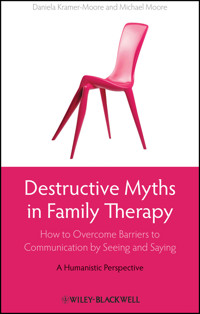
Exposes destructive patterns of communication within family cultures and provides strategies for promoting more open dialogue among family members.
- Equips family therapists to help clients see the barriers they place in the way of healthy communication, and adopt more constructive alternatives
- Provides activities designed to spark open dialogue between therapist and clients, strengthening the therapeutic relationship and facilitating family interaction
- Includes communication strategies for reversing disengagement, defusing power struggles, overcoming sibling rivalry, disentangling marital problems and more
- Offers a new understanding of family dynamics, an area in which many family therapists want to improve their skills but have struggled to find a text to guide them in doing so
Sie lesen das E-Book in den Legimi-Apps auf:
Seitenzahl: 332
Veröffentlichungsjahr: 2012
Ähnliche



















Contents
Cover
Title Page
Copyright
Dedication
Preface
Acknowledgments
Part 1: Seeing
1: Blindness, or With Eyes Wide Shut
Dangers, Taboos, and Punishments
Identified Patients
A Continuum of Blindness
Surprise, Surprise!
The Irreversibility of Seeing
Activities
2: Distortions, or It's All for the Best!
A Few Ego Defense Mechanisms
Family Defense Mechanisms
Activities
3: Insight through Therapy, or To See or Not To See
The Goals of Therapy
Stages of Therapy
Activities
4: Making Therapy Work, or Practice What You Preach
The Therapist as Client
Neutrality, Empathy, Authenticity, and Creativity
The Therapeutic Agreement
Types of Clients
Stopping and Reflecting
Implementing Change
Individual vs. Family Therapy
A Few Words on Group Psychotherapy
About the Activities
Multicultural Perspective
Activities
Part 2: Saying
5: Homeostatic Messages, or Don't Rock the Boat!
Activities
6: Lack of Authenticity, or Keep a Stiff Upper Lip
Four Conceptions of Authenticity
Authenticity as a Trait
Pseudo Living
Activities
7: Inequality, or What Can You Expect From a Man?
The Status of Children
Spousal Equality
Activities
8: Belittling, or Who Do You Think You Are?
Types of Belittling
Targets and Consequences
Activities
9: Bookkeeping, or Just You Wait
Individualism vs. Collectivism
Bookkeeping in the Family
Activities
10: Family Rivalry, or Divide and Conquer
Sibling Rivalry
Parental Rivalry
Activities
11: In Lieu of Conclusion
Activities
References
Index
This edition first published 2012
© 2012 John Wiley & Sons, Ltd.
Wiley-Blackwell is an imprint of John Wiley & Sons, formed by the merger of Wiley’s global Scientific, Technical and Medical business with Blackwell Publishing.
Registered office: John Wiley & Sons, Ltd, The Atrium, Southern Gate, Chichester, West Sussex, PO19 8SQ, UK
Editorial offices: 350 Main Street, Malden, MA 02148-5020, USA 9600 Garsington Road, Oxford, OX4 2DQ, UK The Atrium, Southern Gate, Chichester, West Sussex, PO19 8SQ, UK
For details of our global editorial offices, for customer services, and for information about how to apply for permission to reuse the copyright material in this book please see our website at www.wiley.com/wiley-blackwell.
The right of Daniela Kramer-Moore and Michael Moore to be identified as the authors of this work has been asserted in accordance with the UK Copyright, Designs and Patents Act 1988.
All rights reserved. No part of this publication may be reproduced, stored in a retrieval system, or transmitted, in any form or by any means, electronic, mechanical, photocopying, recording or otherwise, except as permitted by the UK Copyright, Designs and Patents Act 1988, without the prior permission of the publisher.
Wiley also publishes its books in a variety of electronic formats. Some content that appears in print may not be available in electronic books.
Designations used by companies to distinguish their products are often claimed as trademarks. All brand names and product names used in this book are trade names, service marks, trademarks or registered trademarks of their respective owners. The publisher is not associated with any product or vendor mentioned in this book. This publication is designed to provide accurate and authoritative information in regard to the subject matter covered. It is sold on the understanding that the publisher is not engaged in rendering professional services. If professional advice or other expert assistance is required, the services of a competent professional should be sought.
Library of Congress Cataloging-in-Publication Data
Kramer-Moore, Daniela. Destructive myths in family therapy : how to overcome barriers to communication by seeing and saying : a humanistic perspective / Daniela Kramer-Moore and Michael Moore. p. ; cm. Includes bibliographical references and index. ISBN 978-0-470-66701-9 (hardback : alk. paper) – ISBN 978-0-470-66700-2 (pbk. : alk. paper) I. Moore, Michael, 1942 Sept. 19- II. Title. [DNLM: 1. Family Therapy–methods. 2. Communication. 3. Family–psychology. 4. Family Relations. 5. Humanism. WM 430.5.F2] 616.89′156–dc23 2011053425
A catalogue record for this book is available from the British Library.
Wiley also publishes its books in a variety of electronic formats. Some content that appears in print may not be available in electronic books
With love to our children: Gilad, Karen, Ofer, Rafi, Yotam, and Yuval
Preface
In our therapy sessions, we see families in their dramas: between spouses, parents and children, vis-à-vis extended family members, between siblings. Even though most claim that they want to live in harmony with their immediate family, they keep bickering, miscommunicating, hurting one another, and ruining relationships. It is logical to presume that every young couple wants only happiness for themselves and for their future children, without causing or feeling pain and crises. Yet as therapists who meet families in pain we see them systematically destroying family events, living under much stress, ending up in divorce or even worse: chronic aversion, bringing up children with behavioral problems. Erich Fromm, social psychologist, psychoanalyst and humanistic philosopher, (1977, p. 8) suggested that “Man seeks for drama and excitement; when he cannot get satisfaction on a higher level, he creates for himself the drama of destruction.” Even those who do not want dramas, may have no choice if they do not know any better, for they have brought from their families of origin patterns of competition, one-upmanship, lack of trust in others, or a lack of awareness of their inner world. Often when they try to share or understand what is happening to them, they resort to well-practiced patterns of blaming and quarreling, ending up even more distant from each other and less capable of mutual trust. To make things more difficult, in order to progress to a mode of communication that is more nourishing, it is not enough for one person to speak effectively. Both parent figures, who serve as models for their children, need to learn how to give up dysfunctional communication patterns and to adopt a new language of trust, empathy, authenticity, and mutual respect toward each other and toward their children. Thus, we find family and couple therapy as the first step towards improving the quality of family life, with the therapist acting as a communication instructor and mediator.
In therapy both the therapist and the family are involved in a team of equals, all bringing what they know best to this project. The therapist brings knowledge of functional communication, ability to see interpersonal processes, an empathic personality, patience and tolerance, thus serving as both guide and supporter in an intricate, difficult task. However, this does not make the family change. The adults (or the couple) bring their pain and expose it as sincerely as they can, as well as honest motivation for starting to change not each other but themselves. Both of these ingredients are necessary for therapeutic changes to occur.
With this aim in mind, we offer this book to students and practitioners of family therapy, social work, and educational counseling, as well as to those members of the public who are interested in improving family communication, thereby advancing intimacy within the family unit. The need for such improvement is beyond doubt, when close to one-half of all marriages in the Western world end in divorce.
Screaming infants, totally absorbed by their immediate plight, communicate without considering the emotional needs of their listeners. We expect physical, cognitive, and emotional development to help them turn gradually into more mature individuals who are aware of the norms and expectations that pertain to the use of verbal and non-verbal communication. Increased control of vocal cords and of other organs used for communication comes naturally and needs no parental guidance. Children need to learn, however, how to use those organs, first from parents, then from an ever-widening circle of other socializing agents. All of these teachers can impart only what they know and (especially) what they practice, so that one generation of dysfunctional communicators is likely to breed another. The residues of the poor, sometimes pathogenic, communication skills one picks up during childhood last for a lifetime. Those not taught to surpass the phase of self-centeredness and lack the skill to be empathic will pay a price: they cannot have a relationship characterized by intimacy and open communication, for having hurt their audience a number of times, the latter will keep their safe distance.
Many may have noticed that they are both causing and experiencing pain related to their interpersonal communication, and that while they can have quite satisfactory conversations with strangers, talks with the most significant persons in their social environment are not successful. They feel that their words make them fail, but they lack the skill to change. They may suddenly realize that they sound like their parents, but have no tools for applying a different communication style. The intent of this book is to assist their therapists in giving them these tools.
Part I deals with the recognition of dysfunctionality and the basic steps of family therapy. Chapters and introduce readers to the importance of seeing the needs and the pains of one's family (no matter how uncomfortable it makes them feel) and to the pathogenic consequences of failing to see them. Chapter outlines the major goals and stages of family therapy, and suggests an analysis of some themes that are likely to appear in most families. In Chapter we stop between seeing and saying in order to help therapists apply their ability to stop and reflect on the family process, to establish more functional communication. Each chapter contains several highly detailed therapy activities for working with couples and families at every stage of therapy.
Part II of this book is organized around six of the most common pathological family processes, each illustrated by analyses of numerous frequently heard myths and sayings. When persistently used within the family setting, the latter undermine closeness, openness and intimacy between spouses or between parents and children. The analysis that follows each saying looks into the different possible motivations that underlie them; the therapy activities accompanying each chapter provide ways to combat them and to replace them with functional alternatives.
The nineteenth century French literary critic Sainte-Beuve has been quoted saying that critics’ first duty is to know how to read, and their second duty is to teach others to do the same (Lee, ca. 1910). We shall borrow from him and apply this maxim to (family) therapists: First learn to see and to listen, then teach these skills to others.
Acknowledgments
We would like to thank Darren Reed and Karen Shield at Wiley-Blackwell for their help and encouragement.
We gratefully acknowledge the assistance we received from the University of Warwick Psychology Department and from the University of Warwick Library's Department of Document Supply. Our thanks are also due to our clients and students, who have taught us so much.
The illustrations on pages 1, 5, 18, 33, 73, 77, 94, 111, 126, 142, 155, and 169 are by Ruth Mohos.
The illustration on p. 52 is by Tamara Aloni.
Part 1
SeeingThe Choices we Make
Eyes have they, but they see not. (Psalms 115:5)
Fay Weldon's short story (1981), Man With No Eyes, is a goldmine of pathological family processes (PFPs): A downtrodden, anxiety-ridden mother, afraid of her domineering husband, is determined to preserve her marriage for the sake of their two young daughters. The story gains special poignancy through repeated references to a scary, mysterious man with no eyes, symbolizing both her father (who had deserted his wife and daughter), her husband, who is totally blind to his family's needs, and herself, who ignores the harm that will come to her daughters if she stays in her pathogenic marriage.
Unseeing spouses and parents are not a rarity in real life; they are certainly familiar to those engaged in family therapy. Many people do not see. The consequences of such metaphorical blindness can be far reaching: when there is no insight into our own motives (and into those of others), we are on auto-pilot, we repeat our own past behaviors, dysfunctional as they may have been, unquestioningly copy the acts and opinion of others, bring unhealthy patterns of behavior from our family of origin to our nuclear family, all this without examining what builds relationships and what destroys them. Unless we stop and reflect, we cannot learn from past mistakes, and so we find ourselves in the same painful situations again and again.
It is our contention that such blindness (serving as the subject of Chapter 1) is an acquired response. For some individuals it serves as a defense against painful involvement, so common in human relationships. For them not seeing is first a choice, then a habit. Many others use blindness by default, having been surrounded by unseeing adults in their formative years. This type of learning is of special importance in the life of families. To a large extent, man's being a link in the human chain, “one segment of history,” as Erikson (1963, pp. 268–269) put it, is based on our ability to carry out observational learning or modeling. This highly effective and ubiquitous social mechanism was defined by Hogg and Vaughan (2011, p. 651) as “The tendency for a person to reproduce the actions, attitudes and emotional responses exhibited by a real-life or symbolic model.” Having observed our parent figures during the early stages of our life, each of us mirrors, to some extent, an internalized version of them. In our turn, we use the same mechanism to shape the generation that follows us: what children see and copy from their parents’ conduct, shapes their behavior toward the world in general, and toward their spouse and offspring, in particular. Such shaping is essential for the continuation of culture in all its aspects. It is also the vehicle for the transgenerational transmission of PFPs.
Here is how Erich Fromm described this facet of the principle underlying transgenerationality: “The child is usually defeated by the superior strength of the adult, but the defeat does not remain without consequences; it would seem to activate a tendency to overcome the defeat by doing actively what one was forced to endure passively: to rule when one had to obey; to beat when one was beaten; in short, to do what one was forced to suffer, or to do what one was forbidden to do” (Fromm, 1977, p. 317). Alice Miller, a Swiss psychologist and psychoanalyst, also commented on the transmission of PFPs from one generation to the next: “If these people [who were traumatized, as children] become parents, they will then often direct acts of revenge for their mistreatment in childhood against their own children, whom they use as scapegoats” (Miller, 1990, p. 282). Virginia Satir, a key figure in family therapy (1988, p. 212), used the term “family blueprint” in this context, to emphasize the crucial influence of personal history in parenting: “I have heard parents lament,” she wrote, “‘I did not want to be like my mother and father, but I am turning out exactly like them.’” Of course, we must point out that not only painful, dysfunctional behaviors are copied from the adults we meet in childhood. In functional families we learn from them to be kind, thoughtful, and empathic; we can imitate a father's sensitivity, a mother's humor, and a grandparent's endless patience, as well.
Knowing that our children grow up “in our own image”, that our behavior towards and in front of them is noted, stored, and eventually retrieved is only one aspect of seeing. The blindness vs. seeing issue concerns individuals’ responsibility for being aware of the needs of other members of their social sphere, as well: first and foremost other family members (though in this book we focus on the latter, circles widen from friends, through colleagues, to society at large). For individuals to be able to gain insight into their own situation and to help themselves and their families (on their own or through a therapist) they need first to identify what troubles them, then to arrive at sounder structure and more congruent communication, and to become aware of the existence of healthy family patterns. For spouses to be able to avoid drawing their children into their marital conflicts, even when they are under stress, they need to comprehend the significance of a healthy spousal coalition; to avoid power struggles, to know that any private victory is a defeat for the family system, they need to understand the value of equality and teamwork. And (to return to parenthood) only those parents who see that the function of families is to satisfy every member's needs for security, affection and appreciation, are in the position to ask themselves and each other, whether the family does indeed provide such satisfaction; only self-aware parents can respect their children and their children's needs, rather than use them for their own needs; only they are able to encourage a sibling coalition, instead of setting their children against each other; only they can nourish them during the critical years and let go of them when they mature.
The first part of this book therefore attempts to help the reader identify what happens to and around individuals in their family circle, to encourage them to try out various alternatives, to give them more choices, more conscious control over relationships. It is our position that one can choose not to continue on a dysfunctional path, one can unlearn what has been learned.
1
Blindness, or With Eyes Wide Shut
Go, you seer, flee away. (Amos 7:12)
It takes time for newborns to develop the ability to see the world around them, to focus on stationary objects, to follow the moving ones, and to use the information contained in patterns and colors. Developing another kind of seeing, unrelated to the optic nerve, also takes time. Here we are referring to the ability to look into oneself and into others, to see – somewhat paradoxically – of all things, those that are not apparent to the eye. The paradoxical nature of metaphorical seeing was made even more blatant by the existentialist psychotherapist Irwin Yalom (1993, p. 163), one of whose characters says that “sometimes I see better with closed eyes,” perhaps because appearances always hide some underlying stratum. Such non-physical, non-literal seeing has important implications for both intra- and interpersonal situations.
Lesen Sie weiter in der vollständigen Ausgabe!
Lesen Sie weiter in der vollständigen Ausgabe!
Lesen Sie weiter in der vollständigen Ausgabe!
Lesen Sie weiter in der vollständigen Ausgabe!
Lesen Sie weiter in der vollständigen Ausgabe!
Lesen Sie weiter in der vollständigen Ausgabe!
Lesen Sie weiter in der vollständigen Ausgabe!
Lesen Sie weiter in der vollständigen Ausgabe!
Lesen Sie weiter in der vollständigen Ausgabe!
Lesen Sie weiter in der vollständigen Ausgabe!
Lesen Sie weiter in der vollständigen Ausgabe!
Lesen Sie weiter in der vollständigen Ausgabe!
Lesen Sie weiter in der vollständigen Ausgabe!




