


60,99 €
Mehr erfahren.
- Herausgeber: John Wiley & Sons
- Kategorie: Fachliteratur
- Serie: Wiley Corporate F&A
- Sprache: Englisch
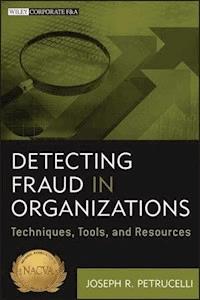
A savvy examination of where people and value meet, creating the opportunity for fraud An essential reference for all business professionals, Detecting Fraud in Organizations: Techniques, Tools, and Resources explains the process of how people commit fraud, as well as how to prevent and stop fraud from occurring in your organization. Organized by business processes which succinctly describe how fraud manifests itself on a daily basis, the authors explain ways in which everyone can help guard against fraud by familiarizing themselves with its building blocks and methods used to perpetrate and conceal it. Filled with situational examples the book is accompanied by a website featuring fraud simulations, business process maps, and other useful tools for combating fraud. * Focuses on the people who perpetrate fraud and those who are tasked with preventing and detecting it * Uniquely organized by business processes for more relevance and easier understanding by those people working within organizations * Shows how subtle factors play a large role in identifying and ferreting out fraud in addition to the traditional knowledge of fraud schemes giving people and organizations the edge they need to be successful in prevention and deterrence * Companion website includes additional fraud simulations, business process maps, and useful tools The price of fraud can be devastating to your business. Detecting Fraud in Organizations: Techniques, Tools, and Resources equips you and others in your organization with essential information and tools necessary to proactively catch fraud, reduce losses, improve efficiencies and develop actionable controls.
Sie lesen das E-Book in den Legimi-Apps auf:
Seitenzahl: 585
Veröffentlichungsjahr: 2013
Ähnliche


















Contents
Cover
Series Page
Title Page
Copyright
Preface
Acknowledgments
Introduction
THE 800-POUND FRIENDLY GORILLA
NUMBERS DON’T LIE, PEOPLE DO
AN OVERVIEW OF FRAUD
THE ONE-MINUTE FRAUD MYSTERIES
A FEW TIPS FOR DETECTING FRAUD AS YOU BEGIN
SETUP
NOTE
Chapter One: Understanding Fraud
PEOPLE ARE GREEDY—HOW GREEDY ARE YOU?
ONE-MINUTE FRAUD MYSTERY: TRUST US INC.
DISTINGUISHING AMONG DETERRENCE, PREVENTION, AND DETECTION
THE INCREASED RISK OF FRAUD LOSS
DIVERGENT AND CONVERGENT THINKING
CRITICAL THINKING REQUIRES CRITICAL QUESTIONS
THE PERSONALITY TRAITS OF A FRAUDSTER
THE MORAL COMPASS
THE ELEMENTS OF FRAUD: MIRD
EDUCATION ABOUT FRAUD
CONFUSION ABOUT RESPONSIBILITY
COMPLEXITY
SUMMARY
ONE-MINUTE FRAUD MYSTERY ANALYSIS
NOTES
Chapter Two: Fraud Detection Approaches
WHY DOESN’T ENHANCED LEGISLATIVE, REGULATORY, AND PROFESSIONAL OVERSIGHT HELP TO PREVENT FRAUD?
ONE-MINUTE FRAUD MYSTERY: BIG FISH INVESTMENT INC.
PRINCIPLES AND RULES ALONE CANNOT ELIMINATE ALL FRAUD
A REAL-WORLD PERSPECTIVE
GETTING A HANDLE ON TRANSACTIONS
THE 10 FORENSICALLY ACCEPTED GENERALLY ACCEPTED ACCOUNTING PRINCIPLE ASSUMPTIONS
SUMMARY
ONE-MINUTE FRAUD MYSTERY ANALYSIS
NOTES
Chapter Three: Deciding to Commit Fraud
ONE-MINUTE FRAUD MYSTERY: THE HOUSE OF WORSHIP
DO YOU REALLY KNOW WHAT THE PEOPLE IN YOUR ORGANIZATION ARE THINKING?
THE FOUR GENERATIONS AND MOTIVATION
PINPOINTING THE FRAUDSTER
THE THREE MOST PREVALENT TYPES OF FRAUD
AN ACCOUNTING CREED
THE CONSEQUENCES OF FRAUD
SUMMARY
ONE-MINUTE FRAUD MYSTERY ANALYSIS
NOTES
Chapter Four: How to Act Like a Fraudster
ONE-MINUTE FRAUD MYSTERY: CATCH ME IF YOU CAN INC.
THE SIX Ps OF SUCCESSFUL FRAUDSTERS
THE CHARACTERISTICS OF A FRAUDSTER
FRAUDSTERS AND THEIR ORGANIZATIONS
SUMMARY
ONE-MINUTE FRAUD MYSTERY ANALYSIS
NOTES
Chapter Five: The Dynamics of Business
ONE-MINUTE FRAUD MYSTERY: ACCRUAL INC.
CONTROL-POINT LINKS AND ACCOUNTABILITY
THE LAYERS OF TRUST
RESPONSIBILITY CHAINS
A FAILURE IN MANAGEMENT
MORE THAN THE BOTTOM LINE
OUTSIDE INFLUENCES
ORGANIZATIONAL FAILURES
UNDERSTANDING CASH FLOWS
SUMMARY
ONE-MINUTE FRAUD MYSTERY ANALYSIS
NOTES
Chapter Six: Understanding the Accounting Process
ONE-MINUTE FRAUD MYSTERY: SNEAKERS ARE US INC.
UNDERSTANDING THE SALE OF GOODS
DECEPTIVE DATA
COMPUTERIZED FRAUD TECHNIQUES
OPERATING EXPENSES
BALANCED PRINCIPLES
BALANCE SHEET COMPONENTS
STATEMENT OF CASH FLOWS
RATIO ANALYSIS
BUILDING A CASE: DOCUMENT ORGANIZATION, DATA ANALYSIS, AND LIFESTYLE ANALYSIS
SUMMARY
ONE-MINUTE FRAUD MYSTERY ANALYSIS
NOTES
Chapter Seven: It All Comes Down to Cash
ONE-MINUTE FRAUD MYSTERY:YANKEE PROPERTY MANAGEMENT
HANDLING CASH
CASH DISBURSEMENT CONTROLS
CASH AND FRAUD
CLASSIFICATIONS OF CASH AND CASH-EQUIVALENT FRAUD SCHEMES AND SCENARIOS
FRAUD CONTROL POINTS IN THE ORGANIZATIONAL PROCESS
SUMMARY
ONE-MINUTE FRAUD MYSTERY ANALYSIS
NOTES
Chapter Eight: Final Thoughts
POP: FINDING THE NEXT POTENTIAL FRAUD KERNEL IN YOUR ORGANIZATION
QUICK REFERENCES ON THE FUNDAMENTALS OF FRAUD
GAAP VERSUS FAGAAPA: A SUMMARY
FIVE CATEGORIES OF FRAUD
WHY AUDITORS AND ACCOUNTANTS FAIL TO DETECT FRAUD
RED FLAGS FOR POTENTIAL FRAUD
USING THE ACCRUALS-TO-ASSETS RATIO
A SIMPLE FRAUD RISK PLAN
CONCLUSION
NOTES
Afterword
Bibliography
About the Author
About the Website
Index
Founded in 1807, John Wiley & Sons is the oldest independent publishing company in the United States. With offices in North America, Europe, Asia, and Australia, Wiley is globally committed to developing and marketing print and electronic products and services for our customers’ professional and personal knowledge and understanding.
The Wiley Corporate F&A series provides information, tools, and insights to corporate professionals responsible for issues affecting the profitability of their company, from accounting and finance to internal controls and performance management.
Cover image: © dem 10/iStockphoto; © yystom/iStockphoto Cover design: John Wiley & Sons, Inc.
Copyright © 2012 by John Wiley & Sons, Inc. All rights reserved.
Published by John Wiley & Sons, Inc., Hoboken, New Jersey.
Published simultaneously in Canada.
No part of this publication may be reproduced, stored in a retrieval system, or transmitted in any form or by any means, electronic, mechanical, photocopying, recording, scanning, or otherwise, except as permitted under Section 107 or 108 of the 1976 United States Copyright Act, without either the prior written permission of the Publisher, or authorization through payment of the appropriate per-copy fee to the Copyright Clearance Center, Inc., 222 Rosewood Drive, Danvers, MA 01923, (978) 750-8400, fax (978) 646-8600, or on the Web at www.copyright.com. Requests to the Publisher for permission should be addressed to the Permissions Department, John Wiley & Sons, Inc., 111 River Street, Hoboken, NJ 07030, (201) 748-6011, fax (201) 748-6008, or online at http://www.wiley.com/go/permissions.
Limit of Liability/Disclaimer of Warranty: While the publisher and author have used their best efforts in preparing this book, they make no representations or warranties with respect to the accuracy or completeness of the contents of this book and specifically disclaim any implied warranties of merchantability or fitness for a particular purpose. No warranty may be created or extended by sales representatives or written sales materials. The advice and strategies contained herein may not be suitable for your situation. You should consult with a professional where appropriate. Neither the publisher nor author shall be liable for any loss of profit or any other commercial damages, including but not limited to special, incidental, consequential, or other damages.
For general information on our other products and services or for technical support, please contact our Customer Care Department within the United States at (800) 762-2974, outside the United States at (317) 572-3993 or fax (317) 572-4002.
Wiley publishes in a variety of print and electronic formats and by print-on-demand. Some material included with standard print versions of this book may not be included in e-books or in print-on-demand. If this book refers to media such as a CD or DVD that is not included in the version you purchased, you may download this material at http://booksupport.wiley.com. For more information about Wiley products, visit www.wiley.com.
Library of Congress Cataloging-in-Publication Data:
Petrucelli, Joseph R., 1960– Detecting fraud in organizations : techniques, tools, and resources / Joseph R. Petrucelli. p. cm. — (Wiley corporate F&A series) Includes bibliographical references and index. ISBN 978-1-118-10314-2 (cloth) — ISBN 978-1-118-22392-5 (ePDF) ISBN 978-1-118-26218-4 (Mobi) — ISBN 978-1-118-23735-9 (ePub) ISBN 978-1-118-55597-2 (O-BK) 1. Commercial crimes—United States. 2. Corporations— Corrupt practices—United States. 3. Fraud investigation. I. Title. HV6769.P48 2013 658.4′73—dc23 2012034377
Printed in the United States of America
Preface
IN WRITING THIS BOOK, MY goal was to keep the subject matter as simple and straightforward as possible. This book is designed to get you thinking about fraud from a new perspective, with a focus on people and proactive thinking.
When people in organizations put their own self-interest (greed) above the interests of others, it creates an atmosphere conducive to fraud. The FBI’s fiscal year 2010–2011 Financial Crimes Report to the Public states that “corporate fraud matters involving self-dealing by corporate executives, particularly utilizing companies to perpetrate large-scale, high-yield fraud schemes, continue to be an issue of concern.”1 The focus of this book is the people in today’s organizations and identifying how and where the value in those organizations is exposed to fraud.
I have spent more than 30 years in the accounting field in various positions. From my experiences and observations, I have learned that fraudsters ultimately give themselves away, through guilt, stupidity, or the obvious dissipation of assets. I have seen fraud perpetrated by the most unlikely person as well as by the most likely person in an organization. I have seen fraud in government, in private and public organizations, and domestically and internationally. One common theme has permeated my experiences of dealing with fraud: people are involved. As long as there are people with an access to something of value, the need to combat fraud will exist.
My mission in writing this book was to make learning about fraud both fun and easy. I express my concerns through cartoons, pictures, and humor. I reinforce the importance of developing the proper ethical tone with the people in your organization, from top to bottom. I hope the book will challenge you by continually posing questions and offering you brainstorming opportunities to solve multiple one-minute mysteries. I have included motivational quotes to help you maintain a positive attitude while getting through the sometimes grueling efforts and endless documents required to establish intent.
Remember that numbers don’t lie, people do. My hope is that after reading this book, you will see beyond the numbers and learn the importance of transparent and open communication with the people involved in various organizational processes. It is important to maintain independent and ethical judgments when you are called on to deal with the often gray areas that can arise in an organizational process. I believe that an 800-pound friendly gorilla awareness of fraud can aid in detecting, deterring, and preventing it. The only way to accomplish this is through the development of ethical people in organizations in order to maintain proactive rather than reactive thinking.
1 Federal Bureau of Investigation, “Financial Crimes Report to the Public: Fiscal Years 2010–2011 (October 1, 2009–September 30, 2011),” http://www.fbi.gov/stats-services/publications/financial-crimes-report-2010-2011.
Acknowledgments
WHENEVER YOU ACCOMPLISH A DREAM, it is possible only with a supporting cast. I would like to thank Mike Breon. I’m glad we had that first Jack and Diet Coke, and I appreciate all your initial input on the ideas for what would become this book.
I also want to thank Cheryl Hyder. What can I say, aside from the fact that having the same birthday makes us complement each other in all aspects of our professions. Thanks for your support and your contributions to this book.
I also want to thank James Lee for your incredible artistic contribution. Your artwork helped to shape my vision and give the book its perspective and personality.
Thank you to Brien Jones from the National Association of Certified Valuation Analysts for your continual support for this book.
Thanks to Jennifer MacDonald, Kimberly Monroe-Hill, Judith Antonelli, Judith Howarth, Brandon Dust, and John DeRemigis at John Wiley & Sons for believing in this project and for dealing with the twists and turns we encountered. Jen, I promise to “mind dump” less next time! John, I told you “I think I can” and managed to get the book done! Thanks for sticking with me and believing in me.
Thank you to my partners, Tim Piotrowski and Kevin Duffy, for your continual support and friendship and for being a big part of this book. I greatly appreciate all of your insight and input. We truly are the Three Musketeers! I want to thank our staff at PP&D Accounting: Lynn, Ian, Joey, Nicole, Matt, and Lauren. Your loyalty, integrity, and commitment to our firm have brought insight and energy into our business. I thank you for being a big part of getting this book done, too.
Thanks to all of my students at the College of Staten Island for challenging me every day and giving me the opportunity to make a difference in your lives and help you develop into professional accountants. To the Business Department at the College of Staten Island, thank you for your support and for allowing me to help create our Forensic Accounting Introduction course. Special thanks to Loretta, for believing in me, and to Professor Thomas Tellefsen.
To Professor Patricia Galletta, I thank you for taking the time to review the copyedited manuscript and your input. I appreciate your support and perspective not only in helping with this book but also as a colleague and friend at the College of Staten Island.
To Timothy G. Little, Esq., partner at Katten Muchin Rosenman, LLP. Tim, next to my family, you are one of my oldest relationships. It has spanned from being soccer teammates in grammar school to our current adult life. You are one of the smartest individuals I know, and I appreciate your taking the time to review the copyedited manuscript and provide feedback. But what I appreciate most is our lifelong friendship and the common values we share, specifically that we both live for our families.
To Sergeant Howard “Howie” Askelson, who gives me the opportunity to relive those moments when we first started our families. The expressions of love you show your children and wife make me feel as if I am looking back in time. Your ability to be an 800-pound friendly gorilla in as calming a manner as I have ever seen is a model for my 800-pound friendly gorilla spirit. Your ability to immediately take the copyedited material and make it your own amazes me. My purpose in writing the book was to capture that exact spirit. Thanks for your insight and input, but more important, the friendship we have developed.
To Robert Morrison, CPA, Hodulik & Morrison PA, thank you for taking the time to review the copyedited manuscript and provide me valuable feedback. It is not often that professionals support each other. Thank you for the wisdom you continually share and for the friendship we enjoy. You truly are an 800-pound friendly gorilla.
Thank you to my parents who taught me that I can be whatever I want to be. Mom, I think of all those times you made me read The Little Engine That Could and do my homework till I got it right. You taught me that practice and persistence lead to success. Dad, thanks for always encouraging me to make the most out of my life.
To my dog, Buddy, my miracle with paws: You are greatly missed.
To my brother, this is a professional book, so I cannot call you the names I would really like to. As your older brother, I learned to protect, help, and love. Everyone needs a little brother to act as the caboose and tag along. Thanks for always looking up to me and making me feel like a big brother.
Thanks to Spencer Rockman, my mentor, who proved to me that everything a person does is a life lesson and that life skills can be learned through soccer. Your advice over the years has been priceless. You truly are the older brother I never had.
To Rob Karabinchak, who always seems to bring me back down to earth: Thanks for the friendship and support and making me continually believe in my abilities. Rob, the numbers don’t lie with integrity like yours.
To my adopted accounting daughters, Nicole DiGeso and Lauren Komar, and my adopted son, Ian Aizenberg, thanks for the continual rereading and corrections and your youthful input to this book.
Thank you to my two sons. First, to Matt, for teaching me that it’s important to follow your dreams and not someone else’s. Thanks for all of the copying and organizational help. Second, to Joey, for being himself all the time—your genuineness is amazing. You help me to look at things from a different perspective. I could never have written this book without your help. What a great gift it is to be able to fulfill a dream with my child! I can’t wait to read your first book!
Thank you to my mother-in-law and father-in-law, who not only gave me the best soul mate and partner one could ask for but who have also provided continual support and love.
And finally, thank you to my wife, Angela, for your love, affection, amazing dedication to our family and continued support. Without you, this book could never have been written. I love you!
Introduction
I HAVE DRAWN INSPIRATION from the many people and experiences that have shaped my career and my life, and especially from the classic children’s novel The Little Engine That Could. The recurrent themes in that book are persistence, determination, and positive mental attitude. I truly believe that anybody can be what he or she wants to be by following the little train’s creed of “I think I can!”
I challenge you to become sufficiently self-aware by reflecting on the key events and influences that define you as both a professional and a person. This quest should lead to a greater insight into yourself, your ethics, and the many people who have influenced your character and who you are. Knowing yourself well and believing in yourself will inevitably assist you in learning to detect, deter, and prevent fraud.
THE 800-POUND FRIENDLY GORILLA
The “800-pound gorilla” is a concept often used to describe a person or an organization so powerful that it can act without regard for the rights of others or established principles and rules.1 In this book, we are going to adapt this metaphor for a more positive concept. The 800-pound gorilla in this book is friendly and promotes the interests of the organization in a positive manner. He or she generates effective communication with all of the people in an organization in a friendly, proactive way.
The 800-pound friendly gorilla has power, but his or her job is to ensure that people in the organization follow the rules. Our gorilla uses his or her power to ensure not only that people obey the organization’s principles and rules but also that the organization does not infringe on the rights of others and that it maintains open channels of communication. If someone commits fraud, for instance, the gorilla will not be happy, but he or she will try to understand why it took place and learn from it.
Throughout the book you will see that organizations need more than one 800-pound friendly gorilla to combat fraud. Organizations need to create a spirit that helps to develop a workforce full of 800-pound friendly gorillas. Whether investigating a potential fraud, or detecting, deterring, or preventing fraud, the 800-pound friendly gorilla seeks to understand the people in the organization in a calm, rational, and friendly manner. Start to think of who the potential 800-pound friendly gorillas are in your organization.
Organizations worldwide lose an estimated 5 percent of revenue to occupational fraud each year, according to the reports of the Association of Certified Fraud Examiners (ACFE). As a result of my professional experience, I believe the number is much higher because many frauds are not included in the ACFE estimate because of bankruptcy, failure to prosecute, insurance payments, and restitutions.
Clearly, we need to detect fraud in organizations by looking beyond the numbers and developing proactive thinking about the people in organizations. Starting with the device of our 800-pound friendly gorilla, we can communicate an organization’s principles, ensure that an organization tells the true story about its numbers, and discover any falsification or deception. To find where in an organization the business risk of fraud exists today and in the future, we will consider the following:
Lesen Sie weiter in der vollständigen Ausgabe!
Lesen Sie weiter in der vollständigen Ausgabe!
Lesen Sie weiter in der vollständigen Ausgabe!
Lesen Sie weiter in der vollständigen Ausgabe!
Lesen Sie weiter in der vollständigen Ausgabe!
Lesen Sie weiter in der vollständigen Ausgabe!
Lesen Sie weiter in der vollständigen Ausgabe!
Lesen Sie weiter in der vollständigen Ausgabe!
Lesen Sie weiter in der vollständigen Ausgabe!
Lesen Sie weiter in der vollständigen Ausgabe!
Lesen Sie weiter in der vollständigen Ausgabe!
Lesen Sie weiter in der vollständigen Ausgabe!
Lesen Sie weiter in der vollständigen Ausgabe!




