


58,99 €
Mehr erfahren.
- Herausgeber: John Wiley & Sons
- Kategorie: Fachliteratur
- Sprache: Englisch
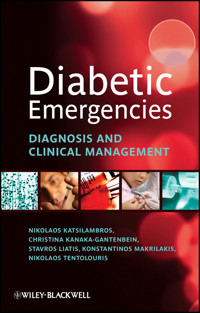
The book explores both the clinical presentation of serious diabetic emergencies (like ketoacidosis, hyperosmolar coma, and severe hyper and hypoglycemia) that consultants and hospital staff encounter in practice and the best methods of both managing the emergencies and also administering follow-up guidance/care. All chapters are clearly structured to highlight: definition of emergency; epidemiology; potential causes, diagnosis, clinical management (including problem areas), follow-up management/care; and patient advice.
There are case studies to aid clinical understanding, as well as 5-7 multiple choice questions and several key points/take-home message boxes in every chapter.
Sie lesen das E-Book in den Legimi-Apps auf:
Seitenzahl: 307
Veröffentlichungsjahr: 2011
Ähnliche



















Table of Contents
Cover
Title page
Copyright page
Preface
CHAPTER 1 Diabetic ketoacidosis in adults
Introduction
Definition and classification of DKA in adults
Predisposing factors for DKA
Pathogenesis
Clinical presentation
Laboratory findings
Differential diagnosis
Clinical management
Patient monitoring
Complications
Prevention
Case studies
CHAPTER 2 Diabetic ketoacidosis in childhood and adolescence
Definition of emergency
Potential causes
Epidemiology
Diagnosis
Clinical management
Potential complications—morbidity and mortality
Prevention of recurrent DKA
Patient advice
Case study
CHAPTER 3 Hyperosmolar non-ketotic hyperglycemia
Definition
Epidemiology
Potential causes
Diagnosis
Clinical management
Avoidance of complications
Follow-up management/care
Patient advice
Case studies
CHAPTER 4 Hypoglycemia caused by insulin
Definition of hypoglycemia
Physiology of blood glucose regulation
Hypoglycemia in diabetes
Classification of iatrogenic hypoglycemia
The frequency of iatrogenic hypoglycemia in diabetes
Clinical presentation of hypoglycemia
Predisposing factors for hypoglycemia in insulin-treated patients
Consequences of iatrogenic hypoglycemia
Management of hypoglycemia caused by insulin treatment
Case studies
CHAPTER 5 Hypoglycemia caused by insulin secretagogues
Insulin secretagogues
Prevalence of hypoglycemia caused by insulin secretagogues
Counter-regulation in hypoglycemia in Type 2 diabetes
Symptoms and signs of hypoglycemia in Type 2 diabetes
Treatment
Case studies
CHAPTER 6 Lactic acidosis in diabetes
Introduction
Pathogenesis
Clinical presentation
Classification
Diagnosis
Treatment
Case studies
CHAPTER 7 Management of hyperglycemia in the hospital
Introduction
The importance of in-hospital glycemic control
Management of hyperglycemia in critically ill patients
Management of the non-critically ill hospitalized patient with hyperglycemia
Perioperative management of hyperglycemia
Preoperative period management
Intraoperative period management
Postoperative period management
Treatment of in-hospital hyperglycemia in specific situations
Case studies
CHAPTER 8 Sick-day rules in diabetes
Definition
Epidemiology
Diagnosis
Clinical management
Follow-up management/care
Patient advice
Case studies
Multiple choice questions
Answers to multiple choice questions
Index
This edition first published 2011 © 2011 by John Wiley & Sons, Ltd.
Wiley-Blackwell is an imprint of John Wiley & Sons, formed by the merger of Wiley’s global Scientific, Technical and Medical business with Blackwell Publishing.
Registered office: John Wiley & Sons, Ltd, The Atrium, Southern Gate, Chichester, West Sussex, PO19 8SQ, UK
Editorial offices: 9600 Garsington Road, Oxford, OX4 2DQ, UK
The Atrium, Southern Gate, Chichester, West Sussex, PO19 8SQ, UK
111 River Street, Hoboken, NJ 07030-5774, USA
For details of our global editorial offices, for customer services and for information about how to apply for permission to reuse the copyright material in this book please see our website at www.wiley.com/wiley-blackwell
The right of the author to be identified as the author of this work has been asserted in accordance with the UK Copyright, Designs and Patents Act 1988.
All rights reserved. No part of this publication may be reproduced, stored in a retrieval system, or transmitted, in any form or by any means, electronic, mechanical, photocopying, recording or otherwise, except as permitted by the UK Copyright, Designs and Patents Act 1988, without the prior permission of the publisher.
Designations used by companies to distinguish their products are often claimed as trademarks. All brand names and product names used in this book are trade names, service marks, trademarks or registered trademarks of their respective owners. The publisher is not associated with any product or vendor mentioned in this book. This publication is designed to provide accurate and authoritative information in regard to the subject matter covered. It is sold on the understanding that the publisher is not engaged in rendering professional services. If professional advice or other expert assistance is required, the services of a competent professional should be sought.
The contents of this work are intended to further general scientific research, understanding, and discussion only and are not intended and should not be relied upon as recommending or promoting a specific method, diagnosis, or treatment by physicians for any particular patient. The publisher and the author make no representations or warranties with respect to the accuracy or completeness of the contents of this work and specifically disclaim all warranties, including without limitation any implied warranties of fitness for a particular purpose. In view of ongoing research, equipment modifications, changes in governmental regulations, and the constant flow of information relating to the use of medicines, equipment, and devices, the reader is urged to review and evaluate the information provided in the package insert or instructions for each medicine, equipment, or device for, among other things, any changes in the instructions or indication of usage and for added warnings and precautions. Readers should consult with a specialist where appropriate. The fact that an organization or Website is referred to in this work as a citation and/or a potential source of further information does not mean that the author or the publisher endorses the information the organization or Website may provide or recommendations it may make. Further, readers should be aware that Internet Websites listed in this work may have changed or disappeared between when this work was written and when it is read. No warranty may be created or extended by any promotional statements for this work. Neither the publisher nor the author shall be liable for any damages arising herefrom.
Library of Congress Cataloging-in-Publication Data
Diabetic emergencies : diagnosis and clinical management / Nicholas
Katsilambros ... [et al.].
p. ; cm.
Includes bibliographical references and index.
ISBN-13: 978-0-470-65591-7 (pbk. : alk. paper)
ISBN-10: 0-470-65591-7 (pbk. : alk. paper)
1. Diabetes. 2. Hyperglycemia. 3. Emergencies. I. Katsilambros, Nicholas.
[DNLM: 1. Diabetes Mellitus. 2. Diabetes Complications. 3. Diabetic Ketoacidosis. 4. Emergencies. 5. Hypoglycemia. WK 880]
RC660.D565 2011
616.4'62025–dc22
2011011046
A catalogue record for this book is available from the British Library.
This book is published in the following electronic formats: ePDF 9781119971795; Wiley Online Library 9781119971825; ePub 9781119971801; Mobi 9781119971818
Preface
Diabetes mellitus (DM) comprises a very large chapter, not only of internal medicine but of medicine as a whole. In many countries, the frequency of DM exceeds 10% of the whole population, affecting both genders and all ages. This very common disease not infrequently is accompanied by emergency situations, due both to complications of the disease itself and its treatment. In DM especially, the concept of emergency is potentially tied to the concept of death. For example, a diabetic patient undergoing a moderate-severity operation may have a very bad outcome if his diabetic control during the pre-, peri- and post-operative period is not adequate. The same is true for acute infections and a wide range of other conditions. Acute decompensation of diabetic control can sometimes lead to fatal outcomes in the form of diabetic ketoacidosis or the hyperosmolar hyperglycemic state. Consequently, not only specialists (diabetologists) but also general doctors, internists, surgeons, and other specialty physicians have an obligation to know how to diagnose and deal with such conditions.
For all these reasons it was deemed necessary that this practical book be written for the benefit of both doctors and nurses alike. The writers hope that their by no means easy efforts will be useful in everyday routine practice.
The undersigned expresses his sincere and warmest thanks to all the co-authors of this book, all specialist scientists in this specific field of medicine, for the particular diligence they have shown in dealing with specific chapters.
Many thanks are also expressed to co-author Assistant Professor Konstantinos Makrilakis for his efforts in editing the various chapters of the book and homogenizing them.
Finally, many thanks are expressed to Wiley-Blackwell for their long-standing and fruitful cooperation in publishing this book as well as other previous books concerning DM and metabolic diseases in general.
Professor Nikolaos Katsilambros, MD, PhD, FACP, SCOPE Founding Fellow
October 2011
CHAPTER 1
Diabetic ketoacidosis in adults
Nikolaos Tentolouris, Nikolaos Katsilambros
Introduction
Diabetic ketoacidosis (DKA) is an acute complication of diabetes mellitus. It is characterized by the triad of hyperglycemia, ketosis, and metabolic acidosis.1 DKA complicates mainly patients with Type 1 diabetes mellitus, where it may be the first manifestation of the disease, and rarely people with Type 2 diabetes.1 A special heterogeneous syndrome of “ketosis-prone diabetes (KPD),” in usually adult patients who may lack the typical clinical phenotype of autoimmune Type 1 diabetes, has recently been identified. While initially the condition was thought to be limited to persons of non-Caucasian ethnicity (African-Americans and Hispanics), its prevalence appears to be increasing worldwide.2 DKA is an emergency situation and hospitalization of the patient is necessary for immediate treatment. Its frequency is reported as 4.8–8.0 episodes per 1000 diabetic patients.3,4 The mortality rate is 2.5–9% and increases along with age, level of consciousness on admission, degree of hyperosmolality and acidosis, as well as severity of azotemia.5,6 In the US, hospitalizations due to DKA reach 100,000 and the cost of treatment has been reported as 1 billion dollars per year.7
Summary Box
DKA is characterized by the triad of hyperglycemia, ketosis, and acidosisDKA complicates mainly Type 1 diabetesDefinition and Classification of DKA in Adults
The criteria for the diagnosis of DKA are shown in Table 1.1.8,9 DKA can be mild, moderate, or severe. It is considered severe when the arterial blood pH is less than 7.0, the concentration of plasma bicarbonate is less than 10 mEq/L, and the anion gap is greater than 12 mEq/L. In severe DKA, the patient is in stupor or in coma. Notably, the severity of DKA does not necessarily coincide with the degree of hyperglycemia.
Table 1.1 Diagnostic criteria for diabetic ketoacidosis (DKA) and hyperosmolar hyperglycemic state (HHS)
Modified from reference 8 with permission.
*Determination of serum or urine ketone is usually based on a nitroprusside-based reaction.
Lesen Sie weiter in der vollständigen Ausgabe!
Lesen Sie weiter in der vollständigen Ausgabe!
Lesen Sie weiter in der vollständigen Ausgabe!
Lesen Sie weiter in der vollständigen Ausgabe!
Lesen Sie weiter in der vollständigen Ausgabe!
Lesen Sie weiter in der vollständigen Ausgabe!
Lesen Sie weiter in der vollständigen Ausgabe!
Lesen Sie weiter in der vollständigen Ausgabe!
Lesen Sie weiter in der vollständigen Ausgabe!
Lesen Sie weiter in der vollständigen Ausgabe!




