


4,99 €
Mehr erfahren.
- Herausgeber: The War Vault
- Kategorie: Fachliteratur
- Sprache: Englisch
During World War II, Major Richard "Dick" Ira Bong's legendary exploits at the helm of his P-38 Lightning made him a household name. Bong received the Medal of Honor for his exploits of downing 40 enemy Japanese planes in the Southwestern Pacific. His tally of 40 victories made him the highest-scoring American ace of all time, a record that is unlikely to ever be broken. Bong died at the tender age of 24 on the 6th of August 1945 in a flight accident during testing of the P-80 Shooting Star Fighter. His fame was such that news of his death vied with the atomic bomb attack on Hiroshima in the US press.
Das E-Book können Sie in Legimi-Apps oder einer beliebigen App lesen, die das folgende Format unterstützen:
Veröffentlichungsjahr: 2022
Ähnliche


















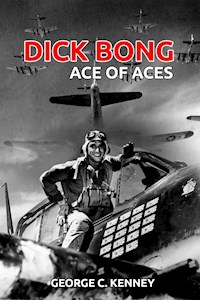
Dick Bong: Ace of Aces
George C. Kenney
Published by The War Vault, 2022.
Copyright
Dick Bong: Ace of Aces by George C. Kenney. First published in 1962. Revised edition published by The War Vault, 2022. All rights reserved.
Table of Contents
Title Page
Copyright Page
1 - I Meet Dick Bong
2 - From Farm Boy to Fighter Pilot
3 - First Victory
4 – The Score Mounts
5 - Bong’s First Trip Home
6 - The Race of the Aces
7 - Rickenbacker and I Keep a Promise
8 - Bong’s Second Trip Home
9 - Bong as Instructor
10 - Medal of Honor
11 - Bong and McGuire
12 – I Take Bong Out of Combat
13 - The Race Ends
14 - Last Flight
Epilogue
Further Reading: The Battle of the Huertgen Forest
1 - I Meet Dick Bong
My introduction to Dick Bong took place in July 1942, at my headquarters in San Francisco, where I was commanding the Fourth Air Force. The circumstances were a bit unusual, to say the least. There was nothing about that meeting that even remotely indicated that two and a half years later it would be Major Richard Ira Bong, of the United States Army Air Force, top-scoring air ace of the war, with forty official victories to his credit and decorated with every award for valor from the Congressional Medal of Honor on down.
The Fourth Air Force was charged with the air defense of the whole Pacific coast from San Diego to Seattle, maintaining a constant offshore patrol to a distance of five hundred miles out to sea and at the same time training fighter and bomber units for service in the theaters overseas. One of my most important jobs was introducing a two-engined fighter plane called the P-38 to the youngsters fresh from the individual flight-training stage. They generally came to me with no more than a hundred flying hours under their belts, all of them on single-engined aircraft. The big problem was to make combat flights, squadrons, and groups out of this material and at the same time to keep the accident rate down. The exuberance of youth in its early twenties must not be stifled, but there had to be enough discipline to keep the “wild blue yonder” fliers from killing themselves as well as to prevent them from annoying the local inhabitants and giving the Air Force a black eye.
I had just finished reading a long report concerning the exploits of one of my young pilots who had been looping the loop around the center span of the Golden Gate Bridge in a P-38 fighter plane and waving to the stenographic help in the office buildings as he flew along Market Street. The report noted that, while it had been extremely difficult to get information from the somewhat sympathetic and probably conniving witnesses, there was plenty of evidence indicating that a large part of the waving had been to people on some of the lower floors of the buildings. Streetcars had stopped, taxis had run up on the sidewalks, and pedestrians had fled to the nearest doorways to get indoors and under cover. There was even a rumor that the insurance companies were contemplating raising the rates. The fire and police departments both seemed quite concerned.
A woman on the outskirts of Oakland was quoted as saying that she didn’t need any help from my fighter pilots in removing her washing from the clotheslines unless they would like to do it on the ground. I told my secretary to get her address and telephone number and tell her that I would see to it that she wouldn’t be bothered anymore.
Considering the mass of evidence, it was surprising that more complaints had not been registered, but in any event, I would have to do something about the matter. Washington was determined to stop low-altitude flying, especially the exhibition type of low-altitude stunting, and had put out some stringent instructions about how to handle the budding young aviators who broke the rules. The investigation officer had recommended a general court-martial. If found guilty, the culprit would be dismissed from the Air Force but could still be drafted into the infantry. He could even be sentenced to a term in a federal penitentiary.
I had sent word to the pilot’s commanding officer that I wanted to see the lad in my office, and I was expecting him at any minute. I had just decided to be really tough with him and had pretty well worked myself up to that frame of mind, when my secretary opened the door and said, “Your bad boy is outside. You remember—the one you wanted to see about flying around bridges and down Market Street.”
As rough and gruff as I could make it, and loud enough so that I was sure he could hear me, I said, “Send him in.” I heard her say, “The General will see you now, Lieutenant,” and in walked one of the nicest-looking cherubs you ever saw in your life. I suspected that he was not over twenty and maybe even younger. I doubted if he was old enough to shave. He was just a little blond-haired Swedish boy about five feet six, with a round, pink baby face and the bluest, most innocent eyes now opened wide and a bit scared. Someone must have told him how serious this court-martial thing might be. He wanted to fly and he wanted to get into the war and do his stuff, but now he was finding out that they were really tough about this low-altitude “buzzing” business and it was dawning on him that the commanders all had orders really to bear down on young aviators who looped around bridges, flew down city streets, and rattled dishes in people’s houses. Why, he might be taken off flying status or even thrown out of the Air Force! He wasn’t going to try to alibi out of it, but he sure hoped this General Kenney wasn’t going to be too tough. You could actually see all this stuff going on in his head just behind those baby-blue eyes. He didn’t know it, but he had already won.
I let him stand at attention while I bawled him out for getting himself in trouble and getting me in trouble, too, besides giving people the impression that the Air Force was just a bunch of irresponsible airplane jockeys. He could see that he was in trouble just by looking at the size and thickness of the pile of papers on my desk that referred to his case. But think of all the trouble he had made for me. Now, in order to quiet down the people who didn’t approve of his exuberance, I would have to talk to the governor, the mayor, the chief of police. Luckily, I knew a lot of people in San Francisco who could be talked into a state of forgiveness, but I had a job of looking after the Fourth Air Force and I should spend my time doing that instead of running around explaining away the indiscretions of my wild-eyed pilots.
“By the way, wasn’t the air pretty rough down in that street around the second-story level?” I was really a bit curious. As I remembered, it used to be when I was first learning to fly.
“Yes, sir, it was kind of rough,” replied the cherub, “but it was easy to control the plane. The aileron control is good in the P-38 and—” He paused. Probably figured he had said enough. For a second the blue eyes had been interested more than scared. He was talking about his profession and it was more than interest. It was his life, his ambition. I would bet anything that he was an expert in a P-38 and that he wanted to be still better. We needed kids like this lad.
“Lieutenant,” I said, “there is no need for me to tell you again that this is a serious matter. If you didn’t want to loop around that bridge or fly down Market Street I wouldn’t have you in my Air Force, but you are not going to do it anymore and I mean what I say. From now on, if I hear any more reports of this kind about you, I’ll put you before a general court and if they should recommend dismissal from the service, which they probably would, I’ll approve it.”
I began slowly to tear up the report and drop the pieces of paper in the wastebasket. The blue eyes watched, a little puzzled at first, and then the scared look began to die out. I growled at him again. It wouldn’t do to let him get unscared too.
“Monday morning you check in at this address out in Oakland, and if that woman has any washing to be hung out on the line, you do it for her. Then you hang around being useful like mowing a lawn or something, and when the clothes are dry, take them off the line and bring them into the house. And don’t drop any of them on the ground or you will have to wash them over again. I want that woman to think we are good for something besides annoying people. I am going to tell her that you will be there at seven thirty, so you’d better show. Now get out of here quick before I get mad and change my mind. That’s all.”
“Yes, sir.” He didn’t dare to change his expression, but the blue eyes had gone all soft and relieved. He saluted and backed out of the office.
The door closed and I settled back in my chair thinking how wonderful it would be to be a kid in my twenties again, flying a “hot” airplane like the P-38, instead of being fifty-two and a general commanding a whole Air Force and riding herd on a lot of wonderful, enthusiastic, sparkling young pilots who had caught the same fever that I had twenty-five years before. I could still see those bridges over New York’s East River, flashing by overhead on my first solo flight, back in the summer of 1917, and I could almost hear again the bawling out that I got from the colonel commanding the field a couple of hours after I landed. For a while it had looked as though I was going to be fired out of aviation and sent back to be drafted into the infantry, but the intervention of my civilian instructor, the then already famous Bert Acosta, and the tolerance of Colonel “Mike” Kilner, my commanding officer, had allowed me to stay in the flying game and grow up to be a general. Mike had been a nice guy to me and I had always appreciated it. I hoped that in following his example I was also being a nice guy and that this towheaded youngster would also grow up to be a general someday.
My reveries were interrupted by the light flashing on the direct telephone line from my desk to General Henry H. “Hap” Arnold, the head of the Army Air Forces in Washington. We were close personal friends of more than twenty years standing and had worked together through all the growing pains that aviation had gone through before being recognized as a legitimate part of the military organization by the big brass of the Army and the Navy. We used to have lots of arguments, but we understood each other, we respected each other’s judgment, and liked each other. Hap used to call me his “troubleshooter,” and the jobs that I had done for him for years had been of that variety. I wondered what was on his mind now.
“George, pack up and come on into Washington. Be in my office at eight o’clock Monday morning. I’ll give you all the dope then. I can’t tell you any more on the telephone. Oh, yes, and let me know who you want to recommend to take over your job.”
I took off for Washington that afternoon, wondering what my new assignment was to be and where I was going. The only things I could be sure of were that Hap was in a hurry about something and that it undoubtedly was another troubleshooting job.
My estimate of the situation turned out to be right. General Douglas MacArthur, commanding the Allied Forces in the Southwest Pacific Theater, had asked for me to come out there right away and take over command of the Allied Air Force in the theater and it was a real number-one troubleshooting job.




