


13,99 €
Mehr erfahren.
- Herausgeber: The History Press
- Kategorie: Geisteswissenschaft
- Sprache: Englisch
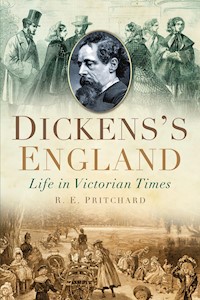
Dickens's England was a time of unprecedented energy and change which laid the foundations of our own modern society. There was a new world coming into being: new towns, new machines, new and revolutionary ideas, new songs and dances, music-halls and popular novels, as well as new wealth for the smug middle classes. For others, however, there was poverty, struggle and hard labour. Dickens's characters with whom we are so familiar - orphan Oliver and cunning Fagin, snobbish Pip, spendthrift Mr Micawber, pompous Podsnap and humourless Gradgrind - grow out of his own observation. Here, Dickens and his great contemporaries - John Ruskin, Henry Mayhew, Charles Darwin, Thomas Hardy - take us into the heart of what Elizabeth Barrett Browning called 'this live, throbbing age, that brawls, cheats, maddens, calculates, aspires'. This is the perfect book for anyone wanting to understand more about the world of our great novelist Charles Dickens.
Das E-Book können Sie in Legimi-Apps oder einer beliebigen App lesen, die das folgende Format unterstützen:
Veröffentlichungsjahr: 2011
Ähnliche




















DICKENS’S ENGLAND
Life in Victorian Times
EDITED AND INTRODUCED BY
R. E. PRITCHARD
First published in 2002
This edition first published in 2009
The History Press
The Mill, Brimscombe Port
Stroud, Gloucestershire, GL5 2QG
www.thehistorypress.co.uk
This ebook edition first published in 2011
All rights reserved
© R.E. Pritchard, 2002, 2009, 2011
The right of R.E. Pritchard, to be identified as the Author of this work has been asserted in accordance with the Copyrights, Designs and Patents Act 1988.
This ebook is copyright material and must not be copied, reproduced, transferred, distributed, leased, licensed or publicly performed or used in any way except as specifically permitted in writing by the publishers, as allowed under the terms and conditions under which it was purchased or as strictly permitted by applicable copyright law. Any unauthorised distribution or use of this text may be a direct infringement of the author’s and publisher’s rights, and those responsible may be liable in law accordingly.
EPUB ISBN 978 0 7524 7554 7
MOBI ISBN 978 0 7524 7553 0
Original typesetting by The History Press
Ebook compilation by RefineCatch Limited, Bungay, Suffolk
Contents
Acknowledgements
Introduction
ONE England and the English
TWO Ladies, Gentlemen and Others
THREE Education, Faith and Doubt
FOUR Country Life
FIVE The Labouring Nation
SIX London
SEVEN Arts and Pleasures
EIGHT Overseas
Coda
Further Reading
Acknowledgements
Extracts from Kilvert’s Diary, ed. William Plomer, published by Jonathan Cape, by permission of the Random House Group Ltd. Extracts from Diary of William Tayler, Footman, ed. Dorothy Wise, by permission of the City of Westminster Archives Centre.
Introduction
It is impossible to put the world in a nutshell . . . we have selected the most striking types, the most completely representative scenes, and the most picturesque features.
Blanchard Jerrold, London: A Pilgrimage (1872)
If Victorian London was too much for Jerrold and Gustave Doré to cope with, the England of Dickens’s time was even more varied, too multifarious, mutable and extraordinary to be confined within such an anthology as this. This does not attempt to be a social history of three-quarters of a century, but rather to provide – in Jerrold’s spirit – a collection of illuminating and entertaining accounts of the changing life of the times, as observed and interpreted by a wide range of Dickens’s contemporaries and by ‘The Inimitable’, himself one of the major social commentators and critics of the century.
As such, it includes writings from earlier in the century, before Victoria’s accession to the throne in 1837 (the year of Pickwick Papers), a period that not only shaped Dickens’s imagination but provided the foundations for the developments of mid-Victorian England. It also includes some writing from the time after his death in 1870 that deals with the world that he had known; the England of the last quarter of the century was however, as is generally recognised, increasingly unlike early and middle Victorian England, with which this book is mostly concerned.
The subjects touched on include rich and poor, men and women, faith and doubt, entertainment and education, life in the country and in the town, and responses to that strange, un-English world overseas (as Browning wrote, ‘What do they know of England who only England know?’). Excerpts are drawn from popular novels and Parliamentary reports, from serious journalistic surveys to religious disputes and accounts of sports; poems, hymns and music-hall songs reflect the imaginative and emotional responses of the people generally. Each section also has a contextual introduction derived from modern research.
The period was one of change not only in society but in language usage; conventions of spelling, punctuation and grammar changed during the century, as they have since; to avoid unnecessary distraction, spelling and punctuation have usually been modernised (except where this would detract from the effect). Obscure words and phrases have been glossed in the body of the text, in square brackets; these are usually in the writing aimed at a more popular market.
It is worth remarking that at least a quarter of all books published then were religious and devotional works – not adequately represented here. The middle classes patronised circulating libraries and authors less demanding and unsettling than George Eliot or Meredith – the ‘silver fork’ novel of refined manners was popular; despite ‘Bozmania’, Dickens was not altogether respectable. The working classes generally read little, though slowly improving education increased literacy: cheap periodicals and the ‘cheap and coarse penny novel appearing in weekly parts’ (as a contemporary reported) did well – and Dickens’s own more mainstream Household Words and serial novel publication are well known.
The better nineteenth-century writing generally is vigorous, rich and inventive, less concerned with balance and rhythm – as was the eighteenth century – than with development of vocabulary and imagery. A wide variety of styles is represented here, with writers displaying notable idiosyncracies of expression; while Biblical echoes are frequent, some writers certainly were particularly responsive to urban speech habits, providing striking phrases and lively rhythms. Powerful emotionality, moral engagement, satire and broad humour and, especially, strong responsiveness to the material world abound. Particularly noticeable is a copiousness of language, an accumulation of clauses and adjectives; there is a remarkable particularity and ‘thinginess’ in much Victorian art, whether in the paintings of the Pre-Raphaelites or in Gerard Manley Hopkins’s ‘Pied Beauty’:
Landscape plotted and pieced – fold, fallow and plough;
And all trades, their gear and tackle and trim –
or in the catalogues tumbling through descriptions by George Augustus Sala and Charles Dickens, that do so much to bring before us the living and physical detail of the material and social life of the times.
Again and again, through acute observation, vivid detail and imaginative insight, these writers, from the famous to the obscure, give us the feel of what it was like to live in the exuberant, troubling and frequently horrible seventy-odd years of this age, times ostensibly very different from but, underneath, often remarkably like our own.
Comparisons with the past are absolutely necessary to the true comprehension of all that exists today; without them, we cannot penetrate to the heart of things.
Charles Booth, Life and Labour of the People of London (1889)
ONE
England and the English
Dickens grew up in the turbulent reigns of George IV and William IV, the years of the French wars, of the Peterloo Massacre, ‘Captain Swing’ riots, the Romantic poets. When he died in 1870, England had been transformed: great smoky cities and factories, steam-engines, Gothic churches and neo-medievalism; the dumpy ‘Widow of Windsor’, soon to be proclaimed Empress of India (1876), ruled an empire so extensive that on it the sun had yet to set; the country was the richest in the world.
Nineteenth-century England experienced change – social, economic, political and cultural – to an extent and at a pace never previously known. The population increased rapidly, even overwhelmingly, from a little over 8 million in 1801 to nearly 23 million in 1871; people moved from the country to the towns, and the towns grew: at the beginning of the century, perhaps 20 per cent lived in towns of more than 5,000 people, in 1851, more than half did. Quite apart from London, ‘the great Wen’, the new industrial conurbations of the north and Midlands grew particularly quickly, with great mills, sprawling slums (so profitable for the landowners) and impressive public buildings. The industrial inventions of the late eighteenth century now bore fruit in the spectacular increase in the production of coal, iron, steel and textiles – especially cotton. Over the century, coal production increased by twenty times, pig-iron by thirty, and total industrial production quadrupled.
Railways, built by thousands of navvies powered by beef and beer, transformed the towns and landscape, with great termini, tunnels and viaducts, and hundreds of miles of line to almost every town in Britain, accelerating the rate of industrial, commercial (and social) development that led to Britain’s economic and political dominance (by the end of the 1870s, Britain had 38 per cent of world trade in manufactures). However, not having been overrun by Napoleon, Britain was now less part of the European ‘community’ as regards laws, administration, systems of measurement, and general ethos; but it had a reputation as the home of liberty.
This liberty went with a gross maldistribution of wealth and political power that was modified only slowly and with great struggle. Early in the century the traditional aristocracy was wholly dominant – 44 men each owned more than 100,000 acres; 3,000 gentry each owned between 3,000 and 10,000. A successful barrister might make £5,000 a year, the average country clergyman received £400, moderately successful shopkeepers and businessmen earned £250, a copying clerk about £75; a farmworker might get 8 or 10s a week. Parliamentary seats, controlled by wealthy landowners, were for sale, and distributed in accordance with landowning rather than middle-class manufacturing interests and population movements: in 1801, while lightly-populated Cornwall had forty-two borough MPs, Yorkshire had twenty-six, and Birmingham, Manchester, Leeds and Sheffield had none – not that many men could vote, anyway. The Reform Act of 1832, a modest victory for the middle classes, doubled the electorate to 1 million and redistributed some seats – Manchester and Birmingham got two MPs each. Other movement for political reform made little, or slow, progress: the working-class Chartist movement was suppressed, and eventually failed through lack of leadership and middle-class support. Nevertheless, the Reform Acts of 1867 and 1884 increased the electorate to 60 per cent of men in towns, and to 70 per cent in the country.
The 1830s and 1840s were desperately bad times for the working classes, overworked, underpaid, badly fed, housed and clothed, whether in the mills or on the farms; however, conditions did improve, driven by Christian concern, an increasing sense of government responsibility and, in the first half of the century at least, fear of revolution. Within a few years society felt itself more stable, with a growing sense of confidence in progress – intellectual, industrial and scientific (for example, medical anaesthetics, Bessemer’s steel processing, the electric telegraph). Prince Albert’s Great Exhibition of 1851 was an enormous success, with 6 million visitors from all classes.
By the third quarter of the century, the economy was remarkably strong, varied and complex, developing into a wide range of manufacturing, with steam engines, machine tools, shipbuilding, and small manufactured goods from Sheffield cutlery to Masefield’s ‘cheap tin trays’, while the City and financial services became increasingly important (so masking the first indications of the coming decline in industrial output and success). The middle classes – sober, industrious and earnestly Protestant – were increasingly doing well; life for the working classes was starting to improve (leisure, entertainment and education were becoming more available; wages increased and food was cheaper); manners changed, as men’s clothes became darker and their beards heavier, and society became more disciplined, decorous and respectable – what many people think of as ‘Victorian’.
* * *
THE TWO NATIONS
‘It is a community of purpose that constitutes society,’ continued the younger stranger; ‘without that, men may be drawn into contiguity, but they still continue virtually isolated.’
‘And is that their condition in cities?’
‘It is their condition everywhere; but in cities that condition is aggravated. A density of population implies a severe struggle for existence, and a consequent repulsion of elements brought into too close contact. In great cities men are brought together by the desire of gain. They are not in a state of co-operation, but of isolation, as to the making of fortunes; and for all the rest they are careless of neighbours. Christianity teaches us to love our neighbour as ourself; modern society acknowledges no neighbour.’ . . .
‘This is a new reign,’ said Egremont, ‘perhaps it is a new era.’
‘I think so,’ said the younger stranger.
‘I hope so,’ said the elder one.
‘Well, society may be in its infancy,’ said Egremont, slightly smiling; ‘but, say what you like, our Queen reigns over the greatest nation that ever existed.’
‘Which nation?’ asked the younger stranger, ‘for she reigns over two.’
The stranger paused; Egremont was silent, but looked inquiringly.
‘Yes,’ resumed the stranger after a moment’s interval. ‘Two nations; between whom there is no intercourse and no sympathy; who are as ignorant of each other’s habits, thoughts and feelings, as if they were dwellers in different zones, or inhabitants of different planets; who are formed by a different breeding, are fed by different food, are ordered by different manners, and are not governed by the same laws.’
‘You speak of — ’ said Egremont, hesitatingly.
‘THE RICH AND THE POOR.’
Benjamin Disraeli, Sybil (1845)
AN AMERICAN VIEW
As soon as you enter England, which, with Wales, is no larger than the State of Georgia (add South Carolina, and you have more than an equivalent for the area of Scotland), this little island stretches by an illusion to the dimensions of an empire.
The territory has a singular perfection. The climate is warmer by many degrees than it is entitled to by latitude. Neither hot nor cold, there is no hour in the whole year when one cannot work. . . . Then England has all the materials of a working country except wood. The constant rain – a rain with every tide, in some parts of the island – keeps its multitude of rivers full and brings agricultural production up to the highest point. It has plenty of water, of stone, of potter’s clay, of coal, of salt and of iron. The land naturally abounds with game; immense heaths and downs are paved with quails, grouse and woodcock, and the shores are animated by water-birds. The rivers and the surrounding sea spawn with fish; there are salmon for the rich and sprats and herrings for the poor. In the northern lochs, the herring are in innumerable shoals; at one season, the country people say, the lakes contain one part water and two parts fish.
The only drawback on this industrial conveniency is the darkness of its sky. The night and day are too nearly of a colour. It strains the eyes to read and write. Add the coal smoke. In the manufacturing towns, the fine soot or blacks darken the day, give white sheep the colour of black sheep, poison many plants and corrode the monuments and buildings.
The London fog aggravates the distempers of the sky, and sometimes justifies the epigram on the climate by an English wit, ‘in a fine day, looking up a chimney; in a foul day, looking down one.’ . . .
A territory large enough for independence, enriched with every seed of national power, so near that it can see the harvests of the continent, and so far that one who would cross the strait must be an expert mariner, ready for tempests. As America, Europe and Asia lie, these Britons have precisely the best commercial position in the whole planet, and are sure of a market for all the goods they can manufacture. . . .
What we think of when we talk of English traits really narrows itself to a small district. It excludes Ireland and Scotland and Wales, and reduces itself at last to London, that is, to those who come and go thither. The portraits that hang on the walls in the Academy exhibition at London, the figures in Punch’s drawings of the public men or of the club-houses, the prints in the shop-windows, are distinctive English, and not American, no, nor Scotch, nor Irish; but ’tis a very restricted nationality. As you go further north into the manufacturing and agricultural districts, and to the population that never travels; as you go into Yorkshire, as you enter Scotland, the world’s Englishman is no longer found. . . .
The English uncultured are a brutal nation. The crimes recorded in their calendars leave nothing to be desired in the way of cold malignity. Dear to the English heart is a fair stand-up fight. The brutality of the manners in the lower classes appears in the boxing, bear-baiting, cock-fighting, love of executions, and in the readiness for a set-to in the streets, delightful to the English of all classes. The costermongers of London hold cowardice in loathing: ‘we must work our fists well; we are all handy with our fists.’ The public schools are charged with being bear-gardens of brutal strength, and are liked by the people for that cause. . . . They use a plentiful and nutritious diet. The operative cannot subsist on water-cresses. Beef, mutton, wheat bread and malt liquors are universal among the first-class labourers. Good feeding is a chief part of national pride among the vulgar, and in their caricatures they represent the Frenchman as a poor, starved body. . . .
Man in England submits to be a product of political economy. On a bleak moor a mill is built, a banking-house is opened, and men come in as water in a sluice-way, and towns and cities rise. Man is made as a Birmingham button. The rapid doubling of the population dates from Watts’s steam-engine. A landlord who owns a province says, ‘The tenantry are unprofitable; let me have sheep.’ He unroofs the houses and ships the population to America. The nation is accustomed to the instantaneous creation of wealth. It is the maxim of their economists, ‘that the greater part in value of the wealth now existing in England has been produced by human hands within the last twelve months’. Meantime, three or four days’ rain will reduce hundreds to starving in London. . . .
I know not where any personal eccentricity is so freely allowed, and no man gives himself any concern with it. An Englishman walks in a pouring rain, swinging his closed umbrella like a walking-stick; wears a wig, or a shawl, or a saddle, or stands on his head, and no remark is made. And as he has been doing this for several generations, it is now in the blood. . . .
To be king of their word is their pride. When they unmask cant, they say, ‘The English of this is,’ etc.; and to give the lie is the extreme insult. The phrase of the lowest of the people is ‘honour-bright,’ and their vulgar praise, ‘His word is as good as his bond.’ . . .
The prestige of the English name warrants a certain confident bearing, which a Frenchman or Belgian could not carry. At all events, they feel themselves at liberty to assume the most extraordinary tone on the subject of English merits. An English lady on the Rhine hearing a German speaking of her party as foreigners, exclaimed, ‘No, we are not foreigners; we are English; it is you that are foreigners.’ . . .
London is the epitome of our times, and the Rome of today. . . . England is tender-hearted. Rome was not. England is not so public in its bias; private life is its place of honour. Truth in private life, untruth in public, marks these home-loving men. Their political conduct is not decided by general views, but by internal intrigues and personal and family interest. They cannot readily see beyond England. . . . ‘English principles’ mean a primary regard to the interests of property. . . . In England, the strong classes check the weaker. In the home population of near thirty millions, there are but one million voters. The Church punishes dissent, punishes education. Down to a late day, marriages performed by dissenters were illegal. A bitter class-legislation gives power to those who are rich enough to buy a law. The game laws are a proverb of oppression. Pauperism encrusts and clogs the state, and in hard times becomes hideous. In bad seasons, the porridge was diluted. . . .
It is a people of myriad personalities. Their many-headedness is owing to the advantageous position of the middle classes, who are always the source of letters and science. Hence the vast plenty of their aesthetic production. As they are many-headed, so they are many-nationed: their colonization annexes archipelagoes and continents, and their speech seems destined to be the universal language of man.
Ralph Waldo Emerson, English Traits (1856 and 1876)
RAIN
Sunday in London in the rain: the shops are shut, the streets are almost deserted; the aspect is that of an immense and a well-ordered cemetery. The few passers-by under their umbrellas, in the desert of squares and streets, have the look of uneasy spirits who have risen from their graves; it is appalling.
I had no conception of such a spectacle, which is said to be frequent in London. The rain is small, compact, pitiless; looking at it one can see no reason why it should not continue to the end of all things; one’s feet churn water, there is water everywhere, filthy water impregnated with an odour of soot. A yellow, dense fog fills the air, sweeps down to the ground; at thirty paces a house, a steam-boat appear as spots upon blotting-paper. After an hour’s walk in the Strand especially, and in the rest of the City, one has the spleen, one meditates suicide.
Hippolyte Taine (trans. W.F. Rae), Notes on England (1872)
GENTEEL ENGLAND
Once, on coming from the Continent, almost the first inscription I saw in my native English was this: ‘To let, a Genteel House, up this road.’ And it struck me forcibly, for I had not come across the idea of gentility, among the upper limestones of the Alps, for seven months; nor do I think that the Continental nations in general have the idea. They would have advertised a ‘pretty’ house, or a ‘large’ one, or a ‘convenient’ one; but they could not, by any use of the terms afforded by their several languages, have got at the English ‘genteel’. Consider, a little, all the meanness there is in that epithet, and then see, when next you cross the Channel, how scornful of it that Calais [cathedral] spire will look.
Of which spire the largeness and age are opposed exactly to the chief appearances of modern England, as one feels them on first returning to it; that marvellous smallness both of houses and scenery, so that a ploughman on the valley has his head on a level with the tops of all the hills in the neighbourhood; and a house is organised into complete establishment – parlour, kitchen, and all, with a knocker to its door, and a garret window to its roof, and a bow to its second storey – on a scale of 12 feet wide by 15 high, so that three such at least would go into the granary of an ordinary Swiss cottage; and also our serenity of perfection, our peace of conceit, everything being done that vulgar minds can conceive as wanting to be done; the spirit of well-principled housemaids everywhere, exerting itself for perpetual propriety and renovation, so that nothing is old, but only ‘old-fashioned,’ and contemporary, as it were, in date and impressiveness only with last year’s bonnets. . . . Then that spirit of trimness. The smooth paving stones; the scraped, hard, even, ruthless roads; the neat gates and plates, and essence of border and order, and spikiness and spruceness.
John Ruskin, Modern Painters, Vol. IV (1856)
PODSNAP AND THE CONSTITUTION
Hideous solidity was the characteristic of the Podsnap plate. Everything was made to look as heavy as it could, and to take up as much room as possible. Everything said boastfully, ‘Here you have as much of me in my ugliness as if I were only lead; but I am so many ounces of precious metal worth so much an ounce; – wouldn’t you like to melt me down?’ A corpulent straddling epergne, blotched all over as if it had broken out in an eruption rather than been ornamented, delivered this address from an unsightly silver platform in the centre of the table. Four silver wine-coolers, each furnished with four staring heads, each head obtrusively carrying a big silver ring in each of its ears, conveyed the sentiment up and down the table, and handed it on to the pot-bellied silver salt-cellars. All the big silver spoons and forks widened the mouths of the company expressly for the purpose of thrusting the sentiment down their throats with every morsel they ate.
The majority of the guests were like the plate, and included several heavy articles weighing ever so much. But there was a foreign gentleman among them; whom Mr Podsnap had invited after much debate with himself – believing the whole European continent to be in mortal alliance against the young person – and there was a droll disposition, not only on the part of Mr Podsnap, but of everybody else, to treat him as if he were a child who was hard of hearing.
As a delicate concession to this unfortunately-born foreigner, Mr Podsnap, in receiving him, had presented his wife as ‘Madame Podsnap’; also his daughter as ‘Mademoiselle Podsnap’, with some inclination to add ‘ma fille’, in which bold venture, however, he checked himself. The Veneerings being at that time the only other arrivals, he had added (in a condescendingly explanatory manner), ‘Monsieur Vey-nair-reeng’, and had then subsided into English.
‘How Do You Like London?’ Mr Podsnap now inquired from his station of host, as if he were administering something in the nature of a powder or potion to the deaf child; ‘London, Londres, London?’
The foreign gentleman admired it.
‘You find it Very Large?’ said Mr Podsnap, spaciously.
The foreign gentleman found it very large.
‘And Very Rich?’
The foreign gentleman found it, without doubt, enormément riche.
‘Enormously Rich, We say,’ returned Mr Podsnap, in a condescending manner. ‘Our adverbs do Not terminate in Mong, and We Pronounce the “ch” as if it were a “t” before it. We Say Ritch.’
‘Reetch,’ remarked the foreign gentleman.
‘And Do You Find, Sir,’ pursued Mr Podsnap, with dignity, ‘Many Evidences that Strike You, of our British Constitution in the Streets of the World’s Metropolis, London, Londres, London?’
The foreign gentleman begged to be pardoned, but did not altogether understand.
‘The Constitution Britannique,’ Mr Podsnap explained, as if he were teaching in an infant school. ‘We Say British, But You Say Britannique, You Know’ (forgivingly, as if that were not his fault). ‘The Constitution, Sir.’
The foreign gentleman sais, ‘Mais, yees; I know eem.’
A youngish sallowish gentleman in spectacles, with a lumpy forehead, seated in a supplementary chair at a corner of the table, here caused a profound sensation by saying, in a raised voice, ‘ESKER’, and then stopping dead.
‘Mais oui,’ said the foreign gentleman, turning towards him. ‘Est-ce-que? Quoi donc?’
But the gentleman with the lumpy forehead having for the time delivered himself of all that he found behind his lumps, spake for the time no more.
‘I Was Inquiring,’ said Mr Podsnap, resuming the thread of his discourse, ‘Whether You Have Observed in our Streets as We should say, Upon our Pavvy as You would say, any Tokens – ’
The foreign gentleman with patient courtesy entreated pardon; ‘But what was tokenz?’
‘Marks,’ said Mr Podsnap; ‘Signs, you know, Appearances – Traces.’
‘Ah! Of a Orse?’ inquired the foreign gentleman.
‘We call it Horse,’ said Mr Podsnap, with forbearance. ‘In England, Angleterr, England, We Aspirate the “H”, and We Say “Horse”. Only our Lower Classes Say “Orse”!’
‘Pardon,’ said the foreign gentleman; ‘I am alwiz wrong!’
‘Our Language,’ said Mr Podsnap, with a gracious consciousness of being always right, ‘is Difficult. Ours is a Copious Language, and Trying to Strangers. I will not Pursue my Question.’
But the lumpy gentleman, unwilling to give it up, again madly said, ‘ESKER ’, and again spake no more.
‘I merely referred,’ Mr Podsnap explained, with a sense of meritorious proprietorship, ‘to Our Constitution, Sir. We Englishmen are Very Proud of our Constitution, Sir. It Was Bestowed Upon Us By Providence. No Other Country is so Favoured as This Country.’
‘And ozer countries? – ’ the foreign gentleman was beginning, when Mr Podsnap put him right again.
‘We do not say Ozer; we say Other; the letters are “T” and “H”; you say Tay and Aish, You Know’ (still with clemency). ‘The sound is “th” – “th”!’
‘And other countries,’ said the foreign gentleman. ‘They do how?’
‘They do, Sir,’ returned Mr Podsnap, gravely shaking his head; ‘they do – I am sorry to be obliged to say it – as they do.’
‘It was a little particular of Providence,’ said the foreign gentleman, laughing; ‘for the frontier is not large.’
‘Undoubtedly,’ assented Mr Podsnap; ‘But So it is. It was the Charter of the Land. This Island was Blest, Sir, to the Direct Exclusion of such Other Countries as – as there may happen to be. And if we were all Englishmen present, I would say,’ added Mr Podsnap, looking round upon his compatriots, and sounding solemnly with his theme, ‘that there is in the Englishman a combination of qualities, a modesty, an independence, a responsibility, a repose, combined with an absence of everything calculated to call a blush into the cheek of a young person, which one would seek in vain among the Nations of the Earth.’
Having delivered this little summary, Mr Podsnap’s face flushed as he thought of the remote possibility of its being at all qualified by any prejudiced citizen of any other country; and, with his favourite right-arm flourish, he put the rest of Europe and the whole of Asia, Africa and America nowhere.
Charles Dickens, Our Mutual Friend (1865)
FROM ‘MR MOLONEY’S ACCOUNT OF THE CRYSTAL PALACE’
[In mock Irish]
With ganial foire
Thransfuse me loyre,
Ye sacred nymphs of Pindus,
The whoile I sing
That wondthrous thing,
The Palace made o’ windows! . . .
’Tis here that roams,
As well becomes
Her dignitee and stations,
VICTORIA Great,
And houlds in state
The Congress of the Nations.
Her subjects pours
From distant shores,
Her Injians and Canajians;
And also we,
Her kingdoms three,
Attind with our allagiance.
Here come likewise
Her bould allies,
Both Asian and Europian;
From East and West
They send their best
To fill her Coornucopean. . . .
There’s holy saints
And window paints,
By Maydiayval Pugin;
Alhamborough Jones
Did paint the tones
Of yellow and gambouge in. . . .
There’s Statues bright
Of marble white,
Of silver, and of copper;
And some in zinc,
And some, I think,
That isn’t over proper.
There’s staym Ingynes,
That stands in lines,
Enormous and amazing,
That squeal and snort
Like whales in sport,
Or elephants a-grazing. . . .
Look, here’s a fan
From far Japan,
A sabre from Damasco;
There’s shawls ye get
From far Thibet,
And cotton prints from Glasgow. . . .
There’s granite flints
That’s quite imminse,
There’s sacks of coals and fuels,
There’s swords and guns,
And soap in tuns,
And Ginger-bread and Jewels.
There’s taypots there,
And cannons rare;
There’s coffins filled with roses;
There’s canvass tints,
Teeth insthrumints,
And shuits of clothes by Moses. . . .
So let us raise
VICTORIA’S praise,
And ALBERT’S proud condition,
That takes his ayse
As he surveys
This Cristial Exhibition.
William Makepeace Thackeray, Punch (1851)
YOUR TRUE RELIGION
My good Yorkshire friends, you asked me down here [Bradford] among your hills that I might talk to you about this Exchange you are going to build; but, earnestly and seriously asking you to pardon me, I am going to do nothing of the kind. I cannot talk, or at least can say very little, about this same Exchange. I must talk of quite other things . . .
Now, pardon me for telling you frankly, you cannot have good architecture merely by asking people’s advice on occasion. All good architecture is the expression of national life and character; and it is produced by a prevalent and eager national taste . . .
Permit me, therefore, to fortify this old dogma of mine somewhat. Taste is not only a part and an index of morality – it is the ONLY morality. The first, and last, and closest trial question to any living creature is, ‘What do you like?’ Tell me what you like, and I’ll tell you what you are. . . .
I notice that among all the new buildings which cover your once wild hills, churches and schools are mixed in due, that is to say, in large proportion, with your mills and mansions; and I notice also that the churches and schools are almost always Gothic, and the mansions and mills are never Gothic. May I ask the meaning of this? . . . Am I to understand that you are thinking of changing your architecture back to Gothic; and that you treat your churches experimentally, because it does not matter what mistakes you make in a church? Or am I to understand that you consider Gothic a pre-eminently sacred and beautiful mode of building, which you think, like the fine frankincense, should be mixed for the tabernacle only, and reserved for your religious services? For if this be the feeling, though it may seem at first as if it were graceful and reverent, at the root of the matter, it signifies neither more nor less than that you have separated your religion from your life. . . .
I hope, now, that there is no risk of your misunderstanding me when I come to the gist of what I want to say tonight – when I repeat, that every great national architecture has been the result and exponent of a great national religion. . . .
You know we are speaking always of the real, active, continual national worship; that by which men act, while they live; not that which they talk of, when they die. Now, we have, indeed, a nominal religion, to which we devote nine-tenths of our property and six-sevenths of our time. And we dispute a great deal about the nominal religion: but we are all unanimous about this practical one; of which I think that you will admit that the ruling goddess may be best generally described as the ‘Goddess of Getting-On’, or ‘Britannia of the Market’. . . . And all your great architectural works are, of course, built to her. It is long since you built a great cathedral; and how you would laugh at me if I proposed building a cathedral on the top of one of those hills of yours, to make it an Acropolis! But your railroad mounds, vaster than the walls of Babylon; your railroad stations, vaster than the temple of Ephesus, and innumerable; your chimneys, how much more mighty and costly than cathedral spires! your harbour piers; your warehouses; your exchanges! – all these are built to your great Goddess of ‘Getting-On’; and she has formed, and will continue to form, your architecture, as long as you worship her; and it is quite vain to ask me to tell you how to build to her; you know far better than I. . . .
Examine . . . your own ideal of the state of national life which this Goddess is to evoke and maintain. . . . Your ideal of human life then is, I think, that it should be passed in a pleasant undulating world, with iron and coal everywhere underneath it. On each pleasant bank of this world is to be a beautiful mansion, with two wings; and stables, and coach-houses; a moderately-sized park; a large garden and hot-houses; and pleasant carriage drives through the shrubberies. In this mansion are to live the favoured votaries of the Goddess: the English gentleman, with his gracious wife, and his beautiful family; always able to have the boudoir and the jewels for the wife, and the beautiful ball dresses for the daughters, and hunters for the sons, and a shooting in the Highlands for himself. At the bottom of the bank is to be the mill; not less than a quarter of a mile long with one steam engine at each end, and two in the middle, and a chimney three hundred feet high. In this mill are to be in constant employment from eight hundred to a thousand workers, who never drink, never strike, always go to church on Sunday, and always express themselves in respectful language. . . .
Observe, while to one family this deity is indeed the Goddess of Getting-On, to a thousand families she is the Goddess of not Getting On. ‘Nay,’ you say, ‘they have all their chance.’
John Ruskin, The Crown of Wild Olive (1864, 1873)
‘EACH FOR HIMSELF IS STILL THE RULE’
Each for himself is still the rule,
We learn it when we go to school –
The devil take the hindmost, o!
And when the schoolboys grow to men,
In life they learn it o’er again –
The devil take the hindmost, o!
For in the church, and at the bar,
On ’Change, at court, where’er they are,
The devil take the hindmost, o!
Husband for husband, wife for wife,
Are careful that in married life
The devil take the hindmost, o!
From youth to age, whate’er the game,
The unvarying practice is the same –
The devil take the hindmost, o!
And after death, we do not know,
But scarce can doubt, where’er we go,
The devil take the hindmost, o!
Tol rol de rol, tol rol de ro,
The devil take the hindmost, o!
Arthur Hugh Clough (1852)
OUTSIDE NEWGATE GAOL
In the sixties hangings were done in public [until 1868], and anything of an unusual kind attracted large parties from the West End; this was as recognised a custom as the more modern fashion of making up a party to go to the Boat Race, or to share a coupé on a long railway journey.
And so it came about that the phenomenal sight of the execution of the seven Flowery Land pirates in ’64 created, in morbid circles, a stir rarely equalled before or since. . . . The prices paid were enormous, varying from twenty to fifty guineas a window, in accordance with the superiority of the perspective from ‘find to finish’ [a fox-hunting phrase]. . . .
The scene on a night preceding a public execution afforded a study of the dark side of nature not to be obtained under any other circumstances.
Here was to be seen the lowest scum of London densely packed together as far as the eye could reach, and estimated by ‘The Times’ at not less than 200,000. Across the entire front of Newgate heavy barricades of stout timber traversed the streets in every direction, created as a precaution against the pressure of the crowd, but which answered a purpose not wholly anticipated by the authorities.
As the crowd increased, so wholesale highway robberies were of more frequent occurrence; and victims in the hands of some two or three desperate ruffians were as far from help as though divided by a continent from the battalions of police surrounding the scaffold.
The scene that met one’s view on pulling up the windows and looking out on the black night and its still blacker accompaniments baffles description. A surging mass, with here and there a flickering torch, rolled and roared before one; above this weird scene arose the voices of men and women shouting, singing, blaspheming and, as the night advanced and the liquid gained firmer mastery, it seemed as if hell had delivered up its victims. . . . It was difficult to believe one was in the centre of a civilised capital that vaunted its religion and yet meted out justice in such a form.
The first step towards the morning’s work was the appearance of workmen about 4 a.m.; this was immediately followed by a rumbling sound, and one realised that the scaffold was being dragged round. A grim, square, box-like apparatus was now distinctly visible . . .
The tolling of St Sepulchre’s bell about 7.30 a.m. announced the approach of the hour of execution; meanwhile a steady rain was falling, though without diminishing the ever-increasing crowd. As far as the eye could reach was a sea of human faces. Roofs, windows, church-rails, and empty vans – all were pressed into service, and tightly packed with human beings eager to catch a glimpse of seven fellow-creatures on the last stage of life’s journey. The rain by this time had made the drop slippery, and necessitated precautions on behalf of the living if not of those appointed to die, so sand was thrown over a portion, not of the drop (that would have been superfluous), but on the side, the only portion that was not to give way. . . . The sand was for the benefit of the ‘ordinary’, the minister of religion, who was to offer dying consolation at 8 a.m., and breakfast at 9.
The procession now appeared, winding its way through the kitchen, and in the centre of the group walked a sickly, cadaverous group securely pinioned, and literally as white as marble. As they reached the platform a halt was necessary as each was placed one by one immediately under the hanging chains. At the end of these chains were hooks which were eventually attached to the hemp round the neck of each wretch. The concluding ceremonies did not take long, considering how feeble the aged hangman was. A white cap was first placed over every face, then the ankles were strapped together, and finally the fatal noose was put round every neck, and the end attached to the hooks. One fancies one can see Calcraft now laying the ‘slack’ of the rope that was to give the fall lightly on the doomed men’s shoulders so as to preclude the possibility of a hitch, and then stepping on tiptoe down the steps and disappearing below. . . .
The silence was now awful. One felt one’s heart literally in one’s mouth, and found oneself involuntarily saying, ‘They could be saved yet – yet – yet,’ and then a thud vibrated through the street announced that the pirates were launched into eternity. . . . Death, I should say, must have been instantaneous, for hardly a vibration occurred, and the only movement that was visible was that from the gradually-stretching ropes as the bodies kept slowly swinging round and round. . . .
The drunken again took up their ribald songs, conspicuous among which was one that had done duty pretty well through the night, and ended with, ‘Calcraft, Calcraft, He’s the Man’, but the pickpockets and highwaymen reaped the greatest benefit. It can hardly be credited that respectable old City men on their way to business – with watch-chains and scarf-pins in clean white shirt-fronts, and with unmistakable signs of having spent the night in bed – should have had the foolhardiness to venture into such a crowd; but they were there in dozens. They had not long to wait for the reward of their temerity. Gangs of ruffians at once surrounded them, and whilst one held them by each arm, another was rifling their pockets. Watches, chains and scarf-pins passed from hand to hand with the rapidity of an eel; meanwhile, their piteous shouts of ‘Murder!’, ‘Help!’, ‘Police!’ were utterly unavailing. The barriers were doing their duty too well, and the hundreds of constables within a few yards were perfectly powerless to get through the living rampart.
One of the Old Brigade [D. Shaw], London in the Sixties (1908)
ARISTOCRATS AND LAND
The great wealth of the landholders of England must always strike people from the Continent, where the landed proprietors are the poorest class, and the least protected by laws and institutions. Here everything conspires for their advantage. It is very difficult for the fundholder to acquire the free and full possession of land. Almost the whole soil is the property of the aristocracy, who generally let it only on lease; so that when a great man calls a village his, this does not mean, as with us, merely that he has the lordship (Oberherrschaft) over it, but that every house is his absolute property, and only granted to the actual inhabitants for a certain time. You may conceive what enormous and ever increasing revenues this must bring them, in a country where trade and population are continually on the increase; and may admire with me the concert and address with which this aristocracy has contrived for centuries to turn all the institutions of the country to its own advantage.
[In 1873 the ‘New Domesday Book’ reported that fewer than 7,000 people owned four-fifths of the land.]
Prince von Pückler-Muskau (trans. S. Austin), Tour by a German Prince (1832)
PARLIAMENTARY ELECTIONS
Anything like election in the plain sense of the word is unknown in England. Members are never chosen for parliament as deputies were for a Cortes, because they are the fittest persons to be deputed. Some seats are private property – that is, the right of voting belongs to a few householders, sometimes not more than half a dozen, and of course these votes are commanded by the owner of the estate. The fewer they are, the more easily they are managed. A great part of a borough in the west of England was consumed some years ago by fire, and the lord of the manor would not suffer the houses to be rebuilt for this reason. If such an estate be to be sold, it is publicly advertised as carrying with it the power of returning two members; sometimes that power is veiled under the modest phrase of a valuable appendage to the estate, or the desirable privilege of nominating seats in a certain assembly. Government hold many of these boroughs, and individuals buy in at others. . . . You will see then that the house of commons must necessarily be a manageable body. This is as it should be; the people have all the forms of freedom, and the crown governs them while they believe they govern themselves. Burleigh foresaw this, and said that to govern through a parliament was the securest method of exercising power.
In other places, where the number of voters is something greater, so as to be too many for this kind of quiet and absolute control, the business is more difficult, and sometimes more expensive. The candidate then, instead of paying a settled sum to the lord of the borough, must deal individually with the constituents, who sell themselves to the highest bidder. Remember that an oath against bribery is required! A common mode of evading the letter of the oath is to lay a wager. ‘I will bet so much,’ says the agent of the candidate, ‘that you do not vote for us.’ ‘Done,’ says the voter freeman, goes to the hustings, gives his voice, and returns to receive the money, not as the price of his suffrage, but as the bet which he has won. . . . It is said that at Aylesbury a punch-bowl full of guineas stood upon the table in the committee-room, and the voters were helped out of it. The price of votes varies according to their number. In some places it is as low as forty shillings, in others, at Ilchester for instance, it is thirty pounds. ‘Thirty pounds,’ said the apothecary of the place on his examination, ‘is the price of an Ilchester voter.’ When he was asked how he came to know the sum so accurately, he replied, that he attended the families of the voters professionally, and his bills were paid at election times with the money. A set of such constituents once waited upon the member whom they had chosen, to request that he would vote against the minister. ‘D––n you!’ was his answer; ‘What! have I not bought you? And do you think I will not sell you?’
Robert Southey, Letters from England (1807)
A BED FOR THE NIGHT
(I)
Mr Jorrocks: A Countryman Visits London
‘Hup they come, leavin’ their quiet country ’omes just as their sparrowgrass [asparagus] is ready for heatin’ and their roses begin to blow – neglectin’ their farms – maybe their families – leavin’ bulls to bail themselves, cattle to get out of the pound, and wagrants into the stocks, as they can; hup, I say, they come to town, to get stuck in garrets at inns with the use of filthy, cigar-smokin’, spitty, sandy-floored, sawdusty coffee-rooms, a ’underd and seventy-five steps below, at a price that’s perfectly appallin’. Vot misery is theirs! Down they come of a mornin’, after a restless, tumblin’, heated, noisy night, to the day den of the establishment, with little happetite for breakfast, but feelin’ the necessity of havin’ some in order to kill time. A greasy-collared, jerkin’, lank-’aired waiter casts a second-’and badly-washed web over a slip of a table, in a stewy, red-curtained box, into which the sun beats with unmitigated wengeance. A Britannia-metal teapot, a cup, a plate, a knife and a japanned tea-caddy make their appearance. Then comes a sugar-basin, followed by a swarm of flies, that ’unt it as the ’ounds would a fox, and a small jug of “sky-blue” [watered milk], which the flies use as a bath durin’ the repast on the sugar. A half-buttered muffin mounts a waterless slop-basin; a dirty egg accompanies some toasted wedges of bread; the waiter points to a lump of carrion wot he calls beef, on a dusty sideboard, and promises the Post as soon as it is out of ’and. Sixteen gents sit at sixteen slips of table, lookin’ at each other with curiosity or suspicion, but never a word is exchanged by any on them. Presently they begin to wacate their slips of wood . . . and the coffee-room is gradually emptied into the crowded streets.’
R.S. Surtees, Handley Cross (1845)
(II)
[In the Low Lodging-Houses]
‘Why, sir,’ said one man, who had filled a commercial situation of no little importance, but had, through intemperance, been reduced to utter want, ‘I myself have slept in the top room of a house not far from Drury Lane, and you could study the stars, if you were so minded, through the holes left by the slates having been blown off the roof. It was a fine summer’s night, and the openings in the roof were then rather an advantage, for they admitted air, and the room wasn’t so foul as it might have been without them.’ . . . He had slept in rooms so crammed with sleepers – he believed there were 30 where 12 would have been a proper number – that their breaths in the dead of night and in the unventilated chamber, rose (I use his own words) ‘in one foul, choking steam of stench.’ . . .
In some of these lodging-houses, the proprietor – or, I am told, it might be more correct to say, the proprietress, as there are more women than men engaged in the nefarious trade carried on in these houses – are ‘fences’, or receivers of stolen goods in a small way. Their ‘fencing’, unless as the very exception, does not extend to any plate, or jewellery, or articles of value, but is chiefly confined to provisions, and most of all to those which are of ready sale to the lodgers.
Of very ready sale are ‘fish got from the gate’ (stolen from Billingsgate); ‘sawney’ (thieved bacon), and ‘flesh found in Leadenhall’ (butcher’s meat stolen from that market). . . . Some of the ‘fences’ board, lodge and clothe two or three boys or girls, and send them out regularly to thieve, the fence usually taking all the proceeds, and if it be the young thief has been successful, he is rewarded with a trifle of pocket-money, and is allowed plenty of beer and tobacco. . . .
In some of these establishments, men and women, boys and girls – but perhaps in no case, or in very rare cases, unless they are themselves consenting parties – herd together promiscuously. . . . Boys have boastfully carried on loud conversations, and from distant parts of the room, of their triumphs over the virtue of girls, and girls have laughed at and encouraged the recital. Three, four, five, six and even more boys and girls have been packed, head and feet, into one small bed; some of them perhaps never met before. On such occasions any clothing seems often enough to be regarded as merely an incumbrance. . . . The indiscriminate admixture of the sexes among adults, in many of these places, is another evil. Even in some houses considered of the better sort, men and women, husbands and wives, old and young, strangers and acquaintances, sleep in the same apartment, and if they choose, in the same bed. Any remonstrance at some act of gross depravity, or impropriety on the part of a woman not so utterly hardened as the others, is met with abuse and derision. . . . There is no provision for purposes of decency in some of the places I have been describing, into which the sexes are herded indiscriminately, but to this matter I can only allude.
Henry Mayhew, London Labour and the London Poor (2 vols, 1852; 4 vols, 1861–2)
A COUNTRY TOWN
[Hardy’s Casterbridge, i.e., Dorchester, in the 1830s]
The travellers returned into the High Street, where there were timber houses with overhanging stories, whose small-paned lattices were screened by dimity curtains on a drawing-string, and under whose barge-boards old cobwebs waved in the breeze. There were houses of brick-nogging, which derived their chief support from those adjoining. There were slate roofs patched with tiles, and tile roofs patched with slate, with occasionally a roof of thatch. . . .
The agricultural and pastoral character of the people upon whom the town depended for its existence was shown by the class of objects displayed in the shop windows. Scythes, reap-hooks, sheep-shears, bill-hooks, spades, mattocks and hoes at the ironmonger’s; bee-hives, butter-firkins, churns, milking stools and pails, hay-rakes, field-flagons, and seed-lips at the cooper’s; cart-ropes and plough-harness at the saddler’s; carts, wheelbarrows and mill-gear at the wheelwright’s and machinist’s; horse-embrocations at the chemist’s; at the glover’s and leather-cutter’s, hedging-gloves, thatcher’s knee-caps, ploughmen’s leggings, villagers’ pattens and clogs. . . .
[Market Day]




