


13,99 €
Mehr erfahren.
- Herausgeber: Parkstone International
- Kategorie: Geisteswissenschaft
- Sprache: Englisch
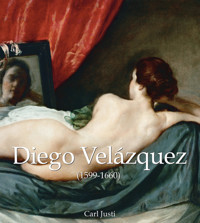
All throughout his fruitful career, Velázquez painted the powerful just as well as the ordinary Spanish people. His body of work bears the imprint of realism worthy of the greatest Flemish masters of the period, and despite outside influences, he undeniably succeeded in developing his own artistic principles. Diego Velázquez (1599-1660) is one of the world’s most famous artists. Representative of 17th-century European painting, he worked for the Spanish court and for the most important personalities, completing numerous portraits. In addition to numerous renditions of scenes of historical and cultural significance, passionate about the human figure, his oeuvreofhis long artistic career of more than forty yearsalso encompasses representations of daily life in the taverns of Spain. Considered the father of Spanish painting, Velázquez inspired entire generations of artists who followed him, including Picasso, Dalí, and Bacon. His mysterious painting Las Meninas, which contains the essence of his work, is still today an inexhaustible source for writing and research.
Das E-Book können Sie in Legimi-Apps oder einer beliebigen App lesen, die das folgende Format unterstützen:
Seitenzahl: 72
Veröffentlichungsjahr: 2018
Ähnliche

















Author: Carl Justi
Layout:
Baseline Co. Ltd
61A-63A Vo Van Tan Street
4th Floor
District 3, Ho Chi Minh City
Vietnam
© Confidential Concepts, worldwide, USA
© Parkstone Press International, New York, USA
Image-Barwww.image-bar.com
All rights reserved.
No part of this publication may be reproduced or adapted without the permission of the copyright holder, throughout the world. Unless otherwise specified, copyright on the works reproduced lies with the respective photographers, artists, heirs or estates. Despite intensive research, it has not always been possible to establish copyright ownership. Where this is the case, we would appreciate notification.
ISBN: 978-1-68325-700-4
Carl Justi
Diego Velázquez
(1599-1660)
Contents
Biography
Seville, 1599-1623
Madrid, 1623-1629
The First Trip to Italy, 1629-1631
Return to Madrid. The Buen Retiro Palace, 1630-1635
The Torre de la Parada, 1635-1640
The 1640s
Second Trip to Italy, 1649-1651
The Final Decade, 1651-1660
List of Illustrations
Self-Portrait, c. 1640
Oil on canvas, 45 x 38 cm. Museu de Belles Arts de València, Valencia
Biography
6 June 1599Christened in Seville in the Church of San Pedro.
1609-1610Trains under Francisco de Herrera the Elder.
1610Moves to the school of Francisco Pacheco.
1617Passes examination for the title of Master.
1618Marries Pacheco’s daughter, Juana de Miranda.
1622Journey to Madrid. Portrait of Don Luis de Gongora y Argote.
1623Return to Seville. Departure for Madrid. Appointed Painter to the King.
1627Participates in a competition for a painting on the subject The Expulsion of the Moors, which he wins. Appointed Gentleman Usher to the King (Uijer de cámara).
1628-1629Rubens arrives in Madrid on a diplomatic visit.
1629Rubens leaves Spain for England. Velázquez sails from Barcelona to Italy. Reaches Genoa from where he travels to Venice, Ferrara, and Rome. Prince Baltasar Carlos is born in Madrid.
1630In Rome. Paints a self-portrait (lost), Vulcan’s Forge, and Joseph’s Bloody Coat Brought to Jacob. Leaves Rome for Naples.
1631Returns to Spain.
1632Paints the portrait Don Baltasar Carlos with a Dwarf.
1633Velázquez’s fourteen-year-old daughter, Francisca, marries Juan Bautista Martínez del Mazo. Together with Vicente Carducho inspects the quality of royal portraits in the palaces.
1634Hands over his post as Gentleman Usher to Martínez del Mazo. Completes battle scenes for the Hall of the Kingdoms in the Buen Retiro Palace.
1635The triumphal entry of the Cardinal Infante Ferdinand into Antwerp. The war with France begins.
1636Receives the appointment as Gentleman of the Wardrobe (Ayuda de Guarda Ropa).
1640A fire in the Buen Retiro Palace. Travels to Old Castile with Cano in search of paintings for the Buen Retiro Palace. Rubens dies. Philip IV acquires the Flemish artist’s works at the posthumous auction. Velázquez’s grandson, Jose, is christened.
1643Receives the appointment as Gentleman of the Bedchamber (Ayuda de cámera). Count-Duke of Olivares is exiled. Martínez del Mazo is appointed Painter to Prince Baltasar Carlos.
1644Among the King’s retinue in Aragón. Portrait of Philip IV. Queen Isabel of Bourbon dies. Francisco Pacheco dies in Seville.
1649Sails from Málaga to Genoa. The new Queen, Mariana of Austria, arrives in Madrid.
1650Elected a member of the Academy of Saint Luke in Rome. Accepted into the Congregazione dei Virtuosi in Rome. In this city, paints the portraits of Pope Innocent X, Cardinal Pamphili, Cardinal Camillo Massimi, Juan de Pareja, and others.
1651Returns from his Italian journey. The Infanta Margarita is born.
1652Appointed chief Chamberlain of the Imperial Palace. Velázquez’s grandson, Melchor Julian, is born.
1654Velázquez’s daughter, Francisca, dies. Renovation of the decoration of the Escorial begins.
1655Velázquez’s family moves to the Casa del Tesoro next to the Alcázar.
1656Paints his masterpiece Las Meninas.
1658Completes works in the Hall of Mirrors.
1659Installed as a Knight of the Order of Santiago. The portraits Prince Philip Prosper and Infanta Margarita Theresa (1651-1673) in a Blue Dress are sent to Vienna.
6 August 1660Velázquez dies.
Seville, 1599-1623
Spanish art flourished and reached its highest peak in the 17th century. In the late 16th and early 17th centuries, El Greco’s art shone forth brilliantly in Toledo. He was a master, uniting both the Byzantine and Italian heritage, who found a spiritual milieu for his religious, philosophical and moral convictions on the Iberian Peninsula. In Naples, Jusepe de Ribera, one of the staunchest devotees of tenebrism, was renowned. His art was filled with true Hispanic passion and religious tension. In Seville, Francisco de Zurbarán, and later, Bartolomé Esteban Murillo, decorated numerous monasteries and churches with religious canvasses. Velázquez holds a special place in this constellation of great masters on account of the unusual versatility of his art. This is reflected in both the content and the stylistic originality of his work.
Diego Rodríguez de Silva y Velázquez, a native of Seville, the capital of Andalusia, was christened on 6 June 1599. His parents, Juan Rodríguez de Silva and Jerónima Velázquez, belonged to the minor nobility but were far from wealthy. According to the Andalusian custom, the son adopted his mother’s surname. At the beginning of the 17th century Seville was a wealthy trading port. From here, ships set out to the New World and returned with untold treasures. Seville was the leading religious centre of Andalusia with more than forty monasteries and convents, numerous churches, religious fraternities, hospitals, and alms houses. But the cathedral, of course, surpassed them all, being a veritable treasure-house of art. When he was ten, Velázquez began his training with the Sevillian painter, Francisco de Herrera the Elder. He was only there for a short time however, since in December 1610, his father approached Francisco Pacheco with regard to his son’s training. Pacheco was a respected artist in Seville who had obtained important commissions, although he demonstrated no particular talent. His merit in regard to Velázquez’s education lay in the fact that he, better than any other, was able to acquaint his pupil with the higher accomplishments of European culture.
From the 1560s, the city boasted an ‘academy’ of which Pacheco’s uncle, a canon of the Seville cathedral and who also bore the name Francisco Pacheco, was a member.
With regard to the Italian Renaissance, Francisco Pacheco was a great admirer of Leonardo da Vinci, Raphael, Michelangelo, Titian, and other famous masters. Pacheco devoted many years of his life to the writing of the book Arte de la Pintura (1649). One of Pacheco’s principal ideas – the nobility and virtue of the art of painting – played a key role in the formation of Velázquez’s profound consciousness as a painter. Whilst eulogising the classical art of the Renaissance, Pacheco nonetheless also paid tribute to the new realistic trend emerging in painting.
In Italy, Michelangelo Merisi da Caravaggio, who rapidly gained many admirers, was the movement’s principal founder. It is not known which of Caravaggio’s or his followers’ works found their way to Seville in the 1610s, but it seems fairly certain that they did appear there. It would otherwise be difficult to account for Velázquez’s early works, which clearly betray the influence of tenebrism, the use of striking effects of lighting, especially strong shadow, typical of Caravaggio.
We can also see the significance of the years Velázquez spent with Pacheco. Intensive studies probably began in 1612, since Pacheco himself wrote that Velázquez’s training lasted five years. On 14 March 1617, Velázquez took the examination to become a master painter and received the right to work independently. A year later, on 23 April 1618, he married Pacheco’s daughter, Juana de Miranda, who was then sixteen. The following year their daughter Francisca was born, followed in 1621 by another daughter, Ignacia.
The production of religious works of art was the principal task of Sevillian painters, and Velázquez was naturally trained in this field. Already in his apprentice years, however, he exhibited an unusual proclivity for the depiction of real life. Pacheco recounted how Velázquez specially hired a peasant boy so that, observing him crying at one moment and laughing the next, he could make sketches of him.
Head of a Man in Profile, c. 1616
Oil on canvas, 39.5 x 35.5 cm. The State Hermitage Museum, St Petersburg
The Luncheon (Three Men at a Table), c. 1617
Oil on canvas, 108.5 x 102 cm. The State Hermitage Museum, St Petersburg
Kitchen Maid with the Supper at Emmaus, c. 1617-1618
Oil on canvas, 55 x 118 cm. National Gallery of Ireland, Dublin
Three Musicians (Musical Trio), 1617-1618
Oil on canvas, 87 x 110 cm. Gemäldegalerie, Staatliche Museen zu Berlin, Berlin
An Old Woman Cooking Eggs, 1618




