


141,99 €
Mehr erfahren.
- Herausgeber: John Wiley & Sons
- Kategorie: Fachliteratur
- Serie: Wiley Series in Microwave and Optical Engineering
- Sprache: Englisch
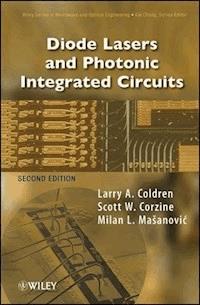
Diode Lasers and Photonic Integrated Circuits, Second Edition provides a comprehensive treatment of optical communication technology, its principles and theory, treating students as well as experienced engineers to an in-depth exploration of this field. Diode lasers are still of significant importance in the areas of optical communication, storage, and sensing. Using the the same well received theoretical foundations of the first edition, the Second Edition now introduces timely updates in the technology and in focus of the book. After 15 years of development in the field, this book will offer brand new and updated material on GaN-based and quantum-dot lasers, photonic IC technology, detectors, modulators and SOAs, DVDs and storage, eye diagrams and BER concepts, and DFB lasers. Appendices will also be expanded to include quantum-dot issues and more on the relation between spontaneous emission and gain.
Sie lesen das E-Book in den Legimi-Apps auf:
Seitenzahl: 1200
Veröffentlichungsjahr: 2012
Ähnliche



















Table of Contents
Series Page
Title Page
Copyright
Preface
Acknowledgments
List of Fundamental Constants
Chapter 1: Ingredients
1.1 Introduction
1.2 Energy Levels and Bands in Solids
1.3 Spontaneous and Stimulated Transitions: The Creation of Light
1.4 Transverse Confinement of Carriers and Photons in Diode lasers: The Double Heterostructure
1.5 Semiconductor Materials for Diode Lasers
1.6 Epitaxial Growth Technology
1.7 Lateral Confinement of Current, Carriers, and Photons for Practical Lasers
1.8 Practical Laser Examples
References
Chapter 2: A Phenomenological Approach to Diode Lasers
2.1 Introduction
2.2 Carrier Generation and Recombination in Active Regions
2.3 Spontaneous Photon Generation and LEDs
2.4 Photon Generation and Loss in Laser Cavities
2.5 Threshold or Steady-State Gain in Lasers
2.6 Threshold Current and Power Out Versus Current
2.7 Relaxation Resonance and Frequency Response
2.8 Characterizing Real Diode Lasers
References
Chapter 3: Mirrors and Resonators for Diode Lasers
3.1 Introduction
3.2 Scattering Theory
3.3 S and T Matrices for Some Common Elements
3.4 Three- and Four-Mirror Laser Cavities
3.5 Gratings
3.6 Lasers Based on DBR Mirrors
3.7 DFB Lasers
References
Chapter 4: Gain and Current Relations
4.1 Introduction
4.2 Radiative Transitions
4.3 Optical Gain
4.4 Spontaneous Emission
4.5 Nonradiative Transitions
4.6 Active Materials and Their Characteristics
References
Chapter 5: Dynamic Effects
5.1 Introduction
5.2 Review of Chapter 2
5.3 Differential Analysis of the Rate Equations
5.4 Large-Signal Analysis
5.5 Relative Intensity Noise and Linewidth
5.6 Carrier Transport Effects
5.7 Feedback Effects and Injection Locking
References
Chapter 6: Perturbation, Coupled-Mode Theory, Modal Excitation, and Applications
6.1 Introduction
6.2 Guided-Mode Power and Effective Width
6.3 Perturbation Theory
6.4 Coupled-Mode Theory: Two-Mode Coupling
6.5 Modal Excitation
6.6 Two mode interference and multimode interference
6.7 Star Couplers
6.8 Photonic Multiplexers, Demultiplexers and Routers
6.9 Conclusions
References
Chapter 7: Dielectric Waveguides
7.1 Introduction
7.2 Plane Waves Incident on a Planar Dielectric Boundary
7.3 Dielectric Waveguide Analysis Techniques
7.4 Numerical Techniques for Analyzing PICs
7.5 Goos–Hanchen Effect and Total Internal Reflection Components
7.6 Losses in Dielectric Waveguides
References
Chapter 8: Photonic Integrated Circuits
8.1 Introduction
8.2 Tunable, Widely Tunable, and Externally Modulated Lasers
8.3 Advanced PICs
8.4 PICs for Coherent Optical Communications
References
Appendix One: Review of Elementary Solid-State Physics
A1.1 A Quantum Mechanics Primer
A1.2 Elements of Solid-State Physics
References
Appendix Two: Relationships between Fermi Energy and Carrier Density and Leakage
A2.1 General Relationships
A2.2 Approximations for Bulk Materials
A2.3 Carrier Leakage Over Heterobarriers
A2.4 Internal Quantum Efficiency
References
Appendix Three: Introduction to Optical Waveguiding in Simple Double-Heterostructures
A3.1 Introduction
A3.2 Three-Layer Slab Dielectric Waveguide
A3.3 Effective Index Technique for Two-Dimensional Waveguides
A3.4 Far Fields
References
Appendix Four: Density of Optical Modes, Blackbody Radiation, and Spontaneous Emission Factor
A4.1 Optical Cavity Modes
A4.2 Blackbody Radiation
A4.3 Spontaneous Emission Factor, βsp
Reading List
Appendix Five: Modal Gain, Modal Loss, and Confinement Factors
A5.1 Introduction
A5.2 Classical Definition of Modal Gain
A5.3 Modal Gain and Confinement Factors
A5.4 Internal Modal Loss
A5.5 More Exact Analysis of the Active/Passive Section Cavity
A5.6 Effects of Dispersion on Modal Gain
Appendix Six: Einstein's Approach to Gain and Spontaneous Emission
A6.1 Introduction
A6.2 Einstein A and B Coefficients
A6.3 Thermal Equilibrium
A6.4 Calculation of Gain
A6.5 Calculation of Spontaneous Emission Rate
Reading List
Appendix Seven: Periodic Structures and the Transmission Matrix
A7.1 Introduction
A7.2 Eigenvalues and Eigenvectors
A7.3 Application to Dielectric Stacks at the Bragg Condition
A7.4 Application to Dielectric Stacks Away from the Bragg Condition
A7.5 Correspondence with Approximate Techniques
A7.6 Generalized Reflectivity at the Bragg Condition
Reading List
Appendix Eight: Electronic States in Semiconductors
A8.1 Introduction
A8.2 General Description of Electronic States
A8.3 Bloch Functions and the Momentum Matrix Element
A8.4 Band Structure in Quantum Wells
References
Appendix Nine: Fermi's Golden Rule
A9.1 Introduction
A9.2 Semiclassical Derivation of the Transition Rate
Reading List
Appendix Ten: Transition Matrix Element
A10.1 General Derivation
A10.2 Polarization-Dependent Effects
A10.3 Inclusion of Envelope Functions in Quantum Wells
Reading List
Appendix Eleven: Strained Bandgaps
A11.1 General Definitions of Stress and Strain
A11.2 Relationship Between Strain and Bandgap
A11.3 Relationship Between Strain and Band Structure
References
Appendix Twelve: Threshold Energy for Auger Processes
A12.1 CCCH Process
A12.2 CHHS and CHHL Processes
Appendix Thirteen: Langevin Noise
A13.1 Properties of Langevin Noise Sources
A13.2 Specific Langevin Noise Correlations
A13.3 Evaluation of Noise Spectral Densities
References
Appendix Fourteen: Derivation Details for Perturbation Formulas
Reading List
Appendix Fifteen: Multimode Interference
A15.1 Multimode Interference-Based Couplers
A15.2 Guided-Mode Propagation Analysis
A15.3 MMI Physical Properties
References
Appendix Sixteen: The Electro-Optic Effect
References
Appendix Seventeen: Solution of Finite Difference Problems
A17.1 Matrix Formalism
A17.2 One-Dimensional Dielectric Slab Example
Reading List
Index
Wiley Series
Copyright © 2011 by John Wiley & Sons, Inc. All rights reserved
Published by John Wiley & Sons, Inc., Hoboken, New Jersey
Published simultaneously in Canada
No part of this publication may be reproduced, stored in a retrieval system, or transmitted in any form or by any means, electronic, mechanical, photocopying, recording, scanning, or otherwise, except as permitted under Section 107 or 108 of the 1976 United States Copyright Act, without either the prior written permission of the Publisher, or authorization through payment of the appropriate per-copy fee to the Copyright Clearance Center, Inc., 222 Rosewood Drive, Danvers, MA 01923, (978) 750-8400, fax (978) 750-4470, or on the web at www.copyright.com. Requests to the Publisher for permission should be addressed to the Permissions Department, John Wiley & Sons, Inc., 111 River Street, Hoboken, NJ 07030, (201) 748-6011, fax (201) 748-6008, or online at http://www.wiley.com/go/permission.
Limit of Liability/Disclaimer of Warranty: While the publisher and author have used their best efforts in preparing this book, they make no representations or warranties with respect to the accuracy or completeness of the contents of this book and specifically disclaim any implied warranties of merchantability or fitness for a particular purpose. No warranty may be created or extended by sales representatives or written sales materials. The advice and strategies contained herein may not be suitable for your situation. You should consult with a professional where appropriate. Neither the publisher nor author shall be liable for any loss of profit or any other commercial damages, including but not limited to special, incidental, consequential, or other damages.
For general information on our other products and services or for technical support, please contact our Customer Care Department within the United States at (800) 762-2974, outside the United States at (317) 572-3993 or fax (317) 572-4002.
Wiley also publishes its books in a variety of electronic formats. Some content that appears in print may not be available in electronic formats. For more information about Wiley products, visit our web site at www.wiley.com.
Library of Congress Cataloging-in-Publication Data:
Printed in the United States of America
Coldren, L. A. (Larry A.)
Diode lasers and photonic integrated circuits / Larry A. Coldren, Scott Corzine, Milan Mashanovitch. –2nd ed.
p. cm. – (Wiley series in microwave and optical engineering ; 218)
Includes index.
ISBN 978-0-470-48412-8 (hardback)
1. Semiconductor lasers. 2. Integrated circuits. I. Corzine, S. W. (Scott W.)
II. Mashanovitch, Milan, 1974– III. Title.
TA1700.C646 2012
621.382'7–dc23
2011022712
Preface
Diode lasers and related photonic integrated circuits have become even more commercially important since the first edition of this book was published, in 1995. They are used in a wide variety of applications ranging from the readout sources in DVD and Blu-ray disk players, laser printers, mice and pointers, to the complex multiwavelength transmitters and receivers in optical fiber communication systems that carry hundreds of gigabits per second of information. New applications, such as solid-state lighting sources, or sources for high-spectral-efficiency telecommunications networks continue to emerge as the devices become more varied, reliable, manufacturable, and inexpensive.
In this edition, the GaN-based materials, which have become important in the UV/blue/green wavelength regions as well as for solid-state lighting, are included with equal emphasis to the GaAs and InP-based materials, which provide emission from the red to about 1 micron in wavelength on GaAs and over the 1.3–1.6 micron wavelength range on InP. Thus, the range of applications that can be addressed with a mastery contents of this edition is very broad.
This book has been written to be a resource for professors, graduate students, industry researchers, and design engineers dealing with the subject of diode lasers and related photonic integrated circuits for a range of applications. The depth of coverage is relatively advanced, but the initial chapters provide a working knowledge of semiconductor lasers before delving into much of the advanced material. Appendices are used both to provide a review of background material as well as some of the details of the more advanced topics. Thus, by appropriate use of the appendices, the text can support teaching the material at different academic levels, but it remains self-contained.
Significant new material has been added, to both improve on the original text, and to address important technology developments over the last decade. One of the key novel features is the addition of many worked examples throughout all the chapters to better illustrate how to apply the theory that is being covered. New homework problems have also been added to supplement the previous ones, some of which are less complex than the previous problems, because many found them too difficult for beginning students or casual reference readers.
New topics that are being covered in this second edition are more introductory material related to benefits, applications and basics of laser diodes and photonic ICs; additional methods for analytic calculation of S parameters based on Mason's rule; expanded treatment of DFB and VCSEL lasers; additional material on quantum dots, gain and other material parameters for both GaN, InP and GaAs based active regions and devices; treatment of the mode-locked lasers and injection locking; total internal reflection mirrors and beam splitters; a new appendix and section on mutimode interference effects and devices; treatment of star couplers and photonic multiplexers, demultiplexers and routers, and their design; expanded treatment of losses in dielectric waveguides; treatment of light propagation in curved waveguides; significantly expanded treatment of tunable and widely tunable laser diodes; expanded treatment of externally modulated lasers, including Mach-Zehnder modulators and semiconductor optical amplifiers; additional material on waveguide photodiodes, optical transceivers and triplexers; and a full section on basics and PICs for coherent communications.
Also available online with the second edition will be a number of password-protected tools, such as BPM and S and T matrix computation code, DFB laser code, mode solving code, as well as color versions of all figures, all of which should be useful for instructors and students, as well as other readers.
The full text is intended for use at the graduate level, although a fairly comprehensive introductory course on diode lasers at an advanced undergraduate level could be based around the material in Chapters 1 through 3 together with Appendices 1 through 7.
It is assumed that the readers have been exposed to elementary quantum mechanics, solid-state physics, and electromagnetic theory at the undergraduate level. It is also recommended that they have had an introductory optoelectronics course. Appendices 1 and 3 review most of the necessary background in just about all of the required detail. Thus, it is possible to use the book with less prior educational background, provided these review appendices are covered with some care.
For use in a more advanced graduate class, it would not be necessary to cover the material in the first seven appendices. (Of course, it would still be there for reference, and the associated homework problems could still be assigned to ensure its understanding. Nevertheless, it is still recommended that Appendix 5, which covers the definitions of modal gain and loss, be reviewed because this is not well understood by the average worker in the field.) The coverage could then move efficiently through the first three chapters and into Chapters 4 and 5, which deal with the details of gain and laser dynamics in a first course. For more focus on the gain physics some of Appendices 8 through 12 could be included in the coverage. In any event, their inclusion provides for a very self-contained treatment of this important subject matter.
Chapters 6 and 7 deal more with the electromagnetic wave aspects of photonic ICs and diode lasers. This material is essential for understanding the more advanced PIC type of devices used in modern fiber-optic links and networks. However, keeping this material to last allows the student to develop a fairly complete understanding of the operation of diode lasers without getting bogged down in the mathematical techniques necessary for the lateral waveguide analysis. Thus, a working understanding and appreciation of laser operation can be gained in only one course. Chapter 6 deals with perturbation, coupled-mode theory and modal excitation while Chapter 7 deals with dielectric waveguide analysis. Putting Chapter 6 first emphasizes the generality of this material. That is, one really does not need to know the details of the lateral mode profile to develop these powerful techniques. Using the coupled-mode results, gratings and DFB lasers are again investigated. Historically, these components were primarily analyzed with this theory. However, in this text grating-based DFB and DBR lasers are first analyzed in Chapter 3 using exact matrix multiplication techniques, from which approximate formulas identical to those derived with coupled mode theory result. The proliferation of computers and the advent of lasers using complex grating designs with many separate sections has led the authors to assert that the matrix multiplication technique should be the primary approach taught to students. The advent of the vertical-cavity laser also supports this approach. Nevertheless, it should be realized that coupled-mode theory is very important to reduce the description of the properties of complex waveguide geometries to simple analytic formulae, which are especially useful in design work. Chapter 7 also introduces some basic numerical techniques, which have become indispensable with the availability of powerful personal computers and efficient software for solving complex numerical algorithms. The finite-difference technique is introduced for optical waveguide analysis, while the beam-propagation method is discussed as a key tool for analyzing real PIC structures.
Chapter 8 pulls together most of the material in the first seven chapters by providing a comprehensive overview of the development of photonic integrated circuits, with a series of design examples of relatively complex photonic integrated circuits.
Unlike many books in this field, this book is written as an engineering text. The reader is first trained to be able to solve problems on real diode lasers, based on a phenomenological understanding, before going into the complex physical details such as the material gain process or mode-coupling in dielectric waveguides. This provides motivation for learning the underlying details as well as a toolbox of techniques to immediately apply each new advanced detail in solving real problems. Also, attention has been paid to accuracy and consistency. For example, a careful distinction between the internal quantum efficiency in LEDs and injection efficiency in lasers is made, and calculations of gain not only illustrate an analysis technique, but they actually agree with experimental data. Finally, by maintaining consistent notation throughout all of the chapters and appendices, a unique self-contained treatment of all of the included material emerges.
L. A. COLDREN
S. W. CORZINE
M. L. MAšANOVIc
Acknowledgments
The original text grew out of lecture notes developed for a graduate-level course on diode lasers and guided-wave optics (Coldren) as well as a PhD dissertation written on vertical-cavity lasers with strained quantum-well active regions at UC-Santa Barbara (Corzine). This second edition benefited from the intensive photonic integration research conducted at UC Santa Barbara, from further course notes development by Professor Coldren and Dr. Mašanovic, and from ten or so more generations of graduate students who took the class, asked important questions, and generally have helped come up with better examples and answers to homework problems. The supplemental materials on DFB and tunable lasers, MMIs, AWGRs, and injection locking were especially due to the significant efforts of Dr. Mašanovic.
Outside the classroom, and generally independent of the course in question, interactions with other faculty and students at UC Santa Barbara have contributed greatly to our understanding of the subject on which the book expounds. Original contributors include Professors Kroemer, Dagli, Bowers, Yeh, and Suemune (now at Hokkaido University), and students include Drs. Ran-Hong Yan, Randy Geels, Jeff Scott, Bruce Young, Dubravko Babic, Zuon-Min Chuang, Vijay Jayaraman, and Radha Nagarajan.
In addition, we would like to acknowledge numerous people that we have interacted and collaborated with while this edition has been formulated, including Professors Blumenthal, Bowers, and Dagli as research colleagues, Dr. Pietro Binetti for his expertise on arrayed waveguide grating routers, as well as Abirami Sivanathan, John Parker and Erik Norberg, who have all participated in grading the course and proofreading of the manuscript. Finally, our thanks go to Brian Kerr, who has provided a large portion of the excellent new illustrations for the second edition, Peter Allen, who has designed the book cover and Michael Belt, who has helped greatly with the new index.
Chapter 1
Ingredients
1.1 Introduction
Diode lasers, like most other lasers, incorporate an optical gain medium in a resonant optical cavity. The design of both the gain medium and the resonant cavity are critical in modern lasers. A sample schematic of a laser cavity and its elements is shown in Fig. 1.1. In this case, an optional mode selection filter is also added to permit only one cavity mode to lase. The gain medium consists of a material that normally absorbs incident radiation over some wavelength range of interest. But, if it is pumped by inputting either electrical or optical energy, the electrons within the material can be excited to higher, nonequilibrium energy levels, so the incident radiation can be amplified rather than absorbed by stimulating the de-excitation of these electrons along with the generation of additional radiation. The resonant optical cavity supports a number of cavity standing waves, or modes. As illustrated in Figs. 1.1b and c, these occur where the cavity length is a multiple of a half wavelength. If the resulting gain is sufficient to overcome the losses of some resonant optical mode of the cavity, this mode is said to have reached threshold, and relatively coherent light will be emitted. The resonant cavity provides the necessary positive feedback for the radiation being amplified, so that a lasing oscillation can be established and sustained above threshold pumping levels. A typical diode laser light-pump current characteristic is shown in Fig. 1.1d. The threshold can be identified on an output light power vs. pump characteristic by a sharp knee, as illustrated in Fig. 1.1d.
Figure 1.1 (a) A schematic of a simple laser diode. (b) Necessary ingredients for a single-frequency laser cavity—two mirrors, a gain medium, and a mode selection filter, which is required only for single wavelength λ operation. (c) Spectral characteristics of laser elements that get superimposed for single mode operation: cavity modes are given by , where the mode number m is an integer, and is the effective index of refraction (d) Typical light-current diode laser characteristic.
For various applications, a single lasing mode inside a laser cavity is preferred. Different methods in cavity design can be used to favor the lasing of one mode relative to others. The response of the optical mirrors can be tailored to support a single mode. Often, additional optical filtering elements will be incorporated inside the resonant cavity, to insure single mode operation of the laser. Fig. 1.1c shows the spectral response of the various elements of this cavity. This resonant optical cavity is defined by two broadband mirrors, with flat spectral responses, which define a number of cavity modes. An additional mode filtering element, with a defined bandpass optical transfer function, is included. The optical gain medium has a certain spectral response, which, in combination with the spectral response of the filter, will define which cavity mode will be singled out. As in any other oscillator, the output power level saturates at a level equal to the input minus any internal losses.
Since their discovery, lasers have been demonstrated in solid, liquid, gas and plasma materials. Today, the most important classes of lasers, besides the widespread diode/(or semiconductor) lasers are, gas, dye, solid-state, and fiber lasers, the latter really being fiber-optic versions of solid-state lasers. The helium–neon gas laser, the widely tunable flowing-dye laser, the Nd-doped YAG (yttrium–aluminum–garnet) solid-state and the Er or Yb-doped silica fiber lasers are four popular examples. Figure 1.2 shows commercial examples of Nd-YAG and dye lasers, an Er-doped fiber amplifier (EDFA), as well as a packaged diode laser for comparison. The EDFA is used in fiber-optic systems to compensate losses, and with the addition of mirrors placed in the fiber, it can also become a laser. Diode lasers are distinguished from these other types primarily by their ability to be pumped directly by an electrical current. Generally, this results in a much more efficient operation. Overall power conversion efficiencies of ∼50% are not uncommon for a diode laser, whereas efficiencies on the order of 1% are common for gas and solid-state lasers, which traditionally have been pumped by plasma excitation or an incoherent optical flashlamp source, respectively. However, in recent years diode laser pumps have been used for both bulk solid-state lasers as well as fiber lasers, and wall plug efficiencies better than 25% have been achieved. Efficiencies of some gas lasers can be somewhat higher than that of the He-Ne laser, such as in the case of the CO2 gas laser, which has a typical efficiency of over 10%. Another type of gas laser, the so-called Excimer laser, uses transitions between highly excited atomic states to produce high-power ultraviolet emission, and these are used in the medical industry for a variety of surgical procedures as well as in the semiconductor industry for patterning very fine features. Dye lasers are almost always used in a research environment because of their relatively high maintenance requirements, and they are generally pumped by other high power bench-top lasers. Their appeal is that their output wavelength can be tuned by as much as 10% for a given dye and mirror set, and by changing these, wavelengths from the near IR through much of the visible can be provided from a single commercial product.
Lesen Sie weiter in der vollständigen Ausgabe!
Lesen Sie weiter in der vollständigen Ausgabe!
Lesen Sie weiter in der vollständigen Ausgabe!
Lesen Sie weiter in der vollständigen Ausgabe!
Lesen Sie weiter in der vollständigen Ausgabe!
Lesen Sie weiter in der vollständigen Ausgabe!
Lesen Sie weiter in der vollständigen Ausgabe!
Lesen Sie weiter in der vollständigen Ausgabe!
Lesen Sie weiter in der vollständigen Ausgabe!
Lesen Sie weiter in der vollständigen Ausgabe!
Lesen Sie weiter in der vollständigen Ausgabe!
Lesen Sie weiter in der vollständigen Ausgabe!
Lesen Sie weiter in der vollständigen Ausgabe!
Lesen Sie weiter in der vollständigen Ausgabe!
Lesen Sie weiter in der vollständigen Ausgabe!
Lesen Sie weiter in der vollständigen Ausgabe!
Lesen Sie weiter in der vollständigen Ausgabe!
Lesen Sie weiter in der vollständigen Ausgabe!
Lesen Sie weiter in der vollständigen Ausgabe!
Lesen Sie weiter in der vollständigen Ausgabe!
Lesen Sie weiter in der vollständigen Ausgabe!
Lesen Sie weiter in der vollständigen Ausgabe!
Lesen Sie weiter in der vollständigen Ausgabe!
Lesen Sie weiter in der vollständigen Ausgabe!
Lesen Sie weiter in der vollständigen Ausgabe!
Lesen Sie weiter in der vollständigen Ausgabe!




