


13,00 €
Mehr erfahren.
- Herausgeber: CSA Editrice
- Kategorie: Geisteswissenschaft
- Sprache: Englisch
A fascinating journey into the world of the largest amphitheater in Roman history to explore its curiosities, stories, characters, animals, gladiators, and much more... The author will help you discover the tricks used by the Romans to build this giant of history, describe the atmosphere of the events, the animals employed, and their fate. Who was in the audience? How were death sentences executed? What happened in the hypogeum? With a compelling style the author will also describe the great and undisputed protagonists of the games: the gladiators. Where did they come from? Who were they? Why did they fight? Why did they keep their helmets on before being killed? Where did their blood go when they died? He will also take a look at some of the mistakes in the film "Gladiator", starting with the famous gesture of thumbs down... Discover the Colosseum: a monument, once abandoned, that has given shelter to criminals and prostitutes. It has been transformed into a fortress and sacred place, a bomb shelter, and huge roundabout; it has also hosted millions of spectators in its time, along with visitors, tourists, pilgrims, and the many plants that grow within its unforgettable arches. A book to read to know everything about one of the greatest monuments in the history of mankind.
Das E-Book können Sie in Legimi-Apps oder einer beliebigen App lesen, die das folgende Format unterstützen:
Veröffentlichungsjahr: 2021
Ähnliche




















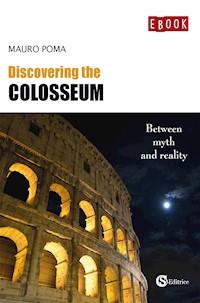
Mauro Poma
Discovering The Colosseum
Between myth and reality
Table of contents
1. The Colosseum
2. Hunting games and death sentences
3. The gladiators
4. Myths of the Colosseum
Chronology
Bibliography
Notes
DISCOVERING THE COLOSSEUM
Sottotitolo Between myth and reality
Isbn
9788893541800
Autore
Mauro Poma
Editore
CSA Editrice
Anche in cartaceo con
Isbn9788893541466
ATTENZIONE: La pirateria è un reato. Tutti i diritti sono riservati a norma di legge. Nessuna parte di questo libro può essere riprodotta con alcun mezzo senza l’autorizzazione scritta dell’Autore e dell’Editore (CSA Editrice).
È espressamente vietato trasmettere ad altri il presente libro, né in formato cartaceo né elettronico, né per denaro né a titolo gratuito, né tutto né in parte. Questo eBook contiene i dati criptati al fine di un riconoscimento in caso di pirateria.
___________________________
Proprietà letteraria riservata
© 2020 by CSA Editrice
70013 Castellana Grotte - Via Della Resistenza n. 80
Tel. +39 0802370963 – www.csaeditrice.it
Prima edizione eBook dic 2021
Paper version on
www.csaeditrice.it
L’AUTORE
Mauro Poma, romano, è laureato in Storia dell'Arte e Scienze Politiche. È una guida turistica di Roma e da 25 anni studia storia, archeologia e arte di Roma e del mondo romano. Collabora con l'associazione Dante Alighieri. Si divide tra l'Olanda e Roma, dove vive e lavora per alcuni mesi all'anno.
Mauro Poma
Discovering the Colosseum
Between myth and reality
1. The Colosseum
Before you go… tips for a visit
The Colosseum occupies a privileged position in the center of Rome. It is easily reachable by metro (Line B – blue line – stop Colosseo). Several bus lines stop just in front of it. On Sundays, Via dei Fori Imperiali, the large street connecting the Colosseum with Piazza Venezia (the largest square in the center of Rome), becomes a pleasant pedestrian area because motor traffic is banned. This is an ideal time of the week to stroll around there and enjoy the monuments and ruins. A ticket is valid for two days and allows you to enter once into the Colosseum and once into the Roman Forum. Because queues to enter the Colosseum are sometimes very long, it is better to purchase tickets from one of the entrances of the Roman Forum (Largo Romolo e Remo, Via San Gregorio, or on the opposite side of the square from where the Colosseum entrance is located).
Map of central Rome. The Colosseum is clearly visible in the center.
You can also purchase tickets online from the official Colosseum ticket seller
(http://www.coopculture.it/en/the-colosseum.cfm) and choose the time of your visit. Be aware though that for security reasons the Colosseum cannot host more than 3,000 people at once. This means that if the number of people inside the monument has reached 3,000 at the time you arrive, then you will need to wait. The best way to avoid this inconvenience and enjoying the place with relatively few people is to visit early in the morning. This is also a wise decision if you plan to visit Rome any time between June and September. Temperatures can be very high and walking in the hot sun might be exhausting. No backpacks or any kind of bulky bags are allowed, neither are bottles or glass containers, alcohol, and selfie sticks. All small bags will be checked with a metal detector, so leave behind any potentially dangerous items or you will be obliged to throw them away before entering. If you want to see the underground and the third tier, you need to book your visit either through the official website (as provided above) or rely on the services of a tour operator (some of them are excellent). At the time of writing, the Colosseum has just been reopened after 84 days of forced closure because of the pandemic caused by the Covid-19 virus. It could be that some of the rules and restrictions described above are not valid anymore or it might be that there are now different rules. The best thing to do before your visit is to regularly check the official Colosseum website as indicated above.
Be ready now to start an incredible journey into the past, to discover the most famous of the wonders built by the ancient Romans: the magnificent Colosseum.
Statistics of the Colosseum
The Colosseum as we see it today is just a third of the original structure; the remaining two-thirds have disappeared throughout the centuries. It took less than ten years for the ancient Romans to build such a magnificent monument by exploiting thousands of slaves. These men were brought to Rome by Vespasian and his son Titus after war campaigns in Palestine that ended a few months before construction of the Colosseum began (70 A.D.). The height of the outer ring of this magnificent monument is approximately 50 meters (164 ft) like a 16-story building. Its foundations are 12 meters (39 ft) deep. There were 80 arches in the outer ring over 3 levels. At ground level, 76 of these arches were used as entrances. In particular, one was only for the emperor, one for the senators, and another two for the gladiators: the first, called Porta Triumphalis (Triumphal Gate) to enter the Colosseum alive; the second, the Porta Libitinaria, to exit the Colosseum dead or injured. In total, there were 240 arches and almost certainly those of the first and second stories were decorated with statues. The Romans used 100,000 tonnes (220,462,280 lb!) of travertine and 300 tonnes (661,386 lb) of iron to make grips to secure the blocks. A special road was constructed to transport all of this travertine. It connected the quarries near Tivoli (still active today) with the site where the Colosseum was being built. The arena has an elliptical shape with two imaginary axes of 188 and 156 meters (616 and 511 ft, respectively), which form a perimeter of 527 meters (1,729 ft). The arena, which was 80 by 55 meters (262 by 180 ft) covering a total area larger than 3,600 square meters (38,750 square ft), was separated from the first row of seats by a 4 meter (13 ft) high wall. Inside the Colosseum, there were approximately 100 fountains for public use. The Romans could control a huge awning called the velarium (the same system as that used in modern stadiums) on top of the Colosseum in response to the weather. The velarium was held together by 240 posts. Inside the Colosseum there were five levels of bleachers that had a slope of 37.5 degrees, which allowed an optimal view from any position. The Colosseum could realistically accommodate between 55,000 and 60,000 people, similar to a modern soccer stadium. Perhaps surprisingly, the Romans also thought about evacuation routes as well! All of the exits, called vomitoria, could evacuate everyone in only 5 minutes in case of an emergency... a record! The Colosseum was used until 523 A.D., when the last show was reported. Emperor Titus declared 100 days of consecutive festivities for its inauguration in 80 A.D. During this time, there was a show every single day and 9,000 animals died. Trajan, some 30 years later, returning from his war campaigns in Dacia (modern Romania), exceeded those numbers with 120 days of shows and the death of 11,000 animals. Today, on average, the Colosseum is visited every year by 7.5 million people (with the notable exception of 2020 because of the Covid 19 pandemic). This makes it the second most visited archaeological site in the world after the Great Wall of China.
Once upon a time, there was a lake
July 19th, 64 A.D.: a hot day in Rome, from all perspectives! On that day, the largest fire in the history of Rome broke out: it began in the area of the Circus Maximus and spread rapidly throughout almost the entire city. About two-thirds of Rome were destroyed by that devastating and relentless fire. For nine days, the city was in the grip of flames and when the fire was finally extinguished it left piles and piles of rubble, as well as homeless, desperate people and many bodies. However, this was not the only fire in the history of Rome. Through the centuries, the city was devastated multiple times by flames. Why was Rome burning so frequently? Mainly because wood was still abundantly used. We should not imagine Rome as just the beautiful city shown in the movies, where magnificent temples alternate with idyllic squares paved with superb marble. Rome also included poor neighborhoods with insulae (condos of the time) that had balconies, posts, beams, and windows all made of wood. In the insulae (and not only there), people cooked with braziers and the risk of starting a fire was always very high. Wood was widely used in all buildings and fire, which was not only used for cooking, but also to heat spaces and illuminate streets and squares, was a constant threat. Augustus, the first Roman emperor, almost 60 years before the great fire of 64 A.D. [1], decided to actively fight this danger by instituting the so-called vigiles. These people had the double duty of patrolling the streets to prevent any situation of potential danger (as our policemen do today - see Box - Rome at night) and extinguishing any fire that should develop (exactly like our fire service). Today, in modern Italian, the word vigili indicates both the city policemen (vigili urbani) and fire service (vigili del fuoco). At that time, the firefighters used buckets, brooms, crampons, axes, ropes, ladders, wet blankets, and types of hydrants with leather piping. This equipment, although less technologically advanced, is not that different from what is used today after all. Nevertheless, despite the creation of this institution (7,000 firefighters strategically located throughout Rome), fire was still a big threat. A particularly severe fire occurred on July 19th, 64 A.D. At that time, the emperor was Nero (whose name comes from a Sabine word that means brave and strong). He was a quirky character depicted for centuries as a monster. With a squat appearance, of medium height, with a reddish beard and light-brown hair [2], Nero was fond of painting, sculpture, and above all music and singing. Even today, when you think about Nero and the fire of Rome in 64 A.D., the first image that comes to mind is one passed down the generations: Nero playing the fiddle and enjoying the show of a burning city from the top of a tower. Was it really Nero who burned Rome? Is it true that the emperor contemplated the fire while singing and playing? Although this image is still very vivid in people’s minds, it seems that it never happened. When he heard about the fire, Nero returned immediately from his seaside villa at Antium (now called Anzio, south of Rome) to arrange and personally direct help. It seems that he even seized large quantities of food destined for patricians and distributed them to those who were left with nothing and that he opened his gardens to provide shelter and aid for the homeless. Then, when the flames finally subsided, leaving only a sense of death and destruction, Nero decided to implement an innovative plan: fireproof materials for houses, wider roads as well as more porches, and more outlets for water. By exploiting a brilliant idea, he filled the marshes of Ostia with rubble to contribute to its detoxification. However, despite all of these preventative measures, he was not able to disprove rumors that he himself had set the city on fire. He then decided to blame it on the Christians, and was responsible for the first persecution against them and centuries of negative judgments on his own character. Even if he was not responsible for starting it, Nero managed to benefit greatly from the fire: he built his pharaonic Domus Aurea in one of the areas most affected. Located between the Palatine, the Oppian, and the Caelian hills, this immense property even included an artificial lake. A few years later, Flavian Vespasian built the Colosseum on the site where the lake was located. At the entrance of such a luxurious residence, Nero not just wrote his name, but commissioned a giant 35 meter high (114 ft) bronze statue of himself in the guise of the god of the Sun, Apollo. Such a large statue (the largest ever built in the antiquity, using the Colossus of Rhodes as a model) was to be called Colossus Neronis. Its name is probably the reason why, in the Middle Ages, the Flavian amphitheater, built in proximity to this statue, was renamed the Colosseum [3].
In the area of the Domus Aurea, there were halls for parties, gardens, bathrooms, gyms, groves, a zoo, nymphs, pretend caves, waterfalls, and painted porches. Salt water and sulfur springs were used in the bathrooms.




