


13,99 €
Mehr erfahren.
- Herausgeber: The History Press
- Kategorie: Geisteswissenschaft
- Sprache: Englisch
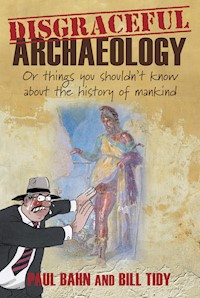
The book that all archaeology buffs have secretly been yearning for! This unique blend of text, anecdote and cartoon reveals, and revels in, those aspects of the past that have been ignored, glossed over or even suppressed — the bawdy, the scatological and the downright bizarre. Our ancestors were not always serious, downtrodden and fearful creatures. They were human like ourselves and shared our earthy sense of humour that is based on bodily functions, bawdiness and slapstick. So it's time to take the fig leaf off the past and have a long, hard look at the real past — the world that would have had the Victorians reaching for their smelling salts. So if you want to know what your average Egyptian slave thought of pharaoh, or a Roman legionary thought of his commander, you will find the answer in Disgraceful Archaeology — in hilarious graphic detail!
Das E-Book können Sie in Legimi-Apps oder einer beliebigen App lesen, die das folgende Format unterstützen:
Veröffentlichungsjahr: 2012
Ähnliche




















CONTENTS
TITLE PAGE
DEDICATION
ACKNOWLEDGEMENTS
FOREWORD
INTRODUCTION
CENSORED!
WHAT A WAY TO GO!
TRY THIS FOR THIGHS
WITH FRIENDS LIKE THESE, WHO NEEDS ENEMAS?
FRIENDS, ROMANS … BAAAARF
UNDERNEATH THE ARCHES
BROTHELS AND BATHS
MISOGYNISTS
ANIMAL LOVERS
REAL PERVERTS
BOOZE
‘I DID NOT HAVE SEX WITH THAT WOMAN…’
WIND-BREAKS — OR GONE WITH THE WIND
MALE BITS AND HOW TO USE THEM
FEMALE BITS AND HOW TO USE THEM
NUMBER ONES AND NUMBER TWOS
AMATEUR PROS
ATTITUDES TO SEX
CRIME AND PUNISHMENT
THE SHORT, THE TALL AND THE UGLY
LOOSE WOMEN
LECHERS
CESSPITS AND LATRINES
GRAFFITI
UNDERPANTS
PHILTRE TIPS
UNDER DOCTOR’S ORDURES
A FINAL NOSEGAY
VENI, VD, VICI
REFERENCES
COPYRIGHT
FOR PETER & GLYNIS BAHN, AND FOR HENRY CLEERE
ACKNOWLEDGEMENTS
For their help in putting together this ‘pot-pourri’ (in every sense!), we would like to extend our warmest thanks to the following friends and colleagues Dave Evans, Bryan Sitch, Pete Sweeney, David Gill, Simon James, Steven Snape, Chris Edens, Carol Andrews, Karen Wise, Frank & A. J. Bock, Georgia Lee, Angelo Fossati, Gina Barnes, Bert Woodhouse, Kathy Cleghorn and Jan Wisseman-Christie.
FOREWORD
I was 12 years old when Archaeology first gripped and terrified me. It was the moment when the high priest of Amun, George Zukor in his fez and blazer, incanted the spell which enabled 3000-year-old Boris Karloff to push the lid off his sarcophagus and stagger away to throttle anyone wearing an archaeologist’s uniform. From then on, any book featuring mummies was on my syllabus.
I didn’t end up as an Egyptologist because everything on Sherlock Holmes, Wilson the Wonder Runner and War was also required reading, but I fancied myself as having a fair knowledge of Pharaohs. What a tremendous let down however when, decades later, my daughter, Sylvia, after taking tourists around the treasures of Egypt, told me about some of the more unusual practices in which the Kings indulged!
How was it that I didn’t know that Seti masturbated for purposes other than fun? Gradually it seeped through to me that this fact and many others had been suppressed because, in the estimation of the great archaeologists, decent folk were not ready, and never would be, for such indecent revelations.
It was the old hypocrisy of censorship by prudery: fine for the wall-painting to show a Warrior King collecting mountains of foreskins from the fallen enemy, but absolutely forbidden to allow him to be seen exercising his own! I then began to speculate on what else had been locked away about prehistoric man, Egypt, the Maya, the Greeks, Romans and Chinese, etc; so I did a little probing, but the secrets were so well kept that only a professional would know where to dig. I called Paul Bahn, and this book was born.
Bill Tidy
At Khajuraho, India, the explicitly erotic subjects are presented with a liveliness and delicacy that deeply shocked the English colonial archaeologists who excavated the site in the early twentieth century. Guidebooks at that time discouraged visitors to the site for fear of impropriety and moral corruption,
INTRODUCTION
Archaeology is a bizarre pastime — it aims to reconstruct the past, to bring it back to life, by studying the objects and traces that have managed to survive years, centuries or millennia of decay or disturbance. Yet in the nineteenth century and the early part of our own, the picture of the past was carefully sanitised. There were endless learned books and papers devoted to the classification of objects, to the deeds and monuments of rulers, and to burials and treasures, but there was scant mention of a mass of equally fascinating aspects of ancient life, which would have served to flesh out the picture, made it more vivid and struck a chord with ordinary folk — the humorous, the scatological, and the sexual. Most of the silliness and bawdiness that helps make life worthwhile and which is such a vital part of being human was deliberately concealed or destroyed. Why?
In large measure this was due to prudishness and snobbery. It must have seemed beneath the dignity of learned scholars in the booklined groves of Academe to deal with such trivia — most of them were writing for their peers, after all, not for the great unwashed, and prudery was very much the norm through Victorian times and beyond. It resulted not only in cosmetic solutions such as the fig leaves placed over naughty bits of Classical statues, but also, at times, in outright obstruction. For example, ‘cultured persons’ are known to have destroyed many specimens of prehistoric Moche pottery from Peru depicting bestiality (primarily involving men and llamas) — which we know from sixteenth-century chroniclers was a widespread habit in highland Peru — out of misguided patriotism, in an effort to erase evidence of an abominable practice, and not wishing people to ‘get the wrong idea’ about their ancestors!
Other items are still being kept hidden — for example, the ‘Turin Papyrus’, a rare piece of sexually explicit imagery from ancient Egypt, is the most famous object in Turin’s magnificent Museum of Egyptology, yet it is not on display — allegedly to prevent ‘bambini’ from seeing it — nor is any copy of it available at the museum in book, slide or postcard!
In general today the pendulum has swung the other way, and as archaeology becomes ever more popular the public is increasingly being given a picture of the past with ‘warts and all’. Children, especially, love the scatological aspects of the past — such as multi-seated Roman toilets, or preserved turds — and it is no accident that the ‘man using the cesspit’ is the most popular bit of the Jorvik Viking Centre in York, as witnessed by the sale of its ‘scratch and sniff’ postcard .…
In putting this book together, therefore, we have unashamedly sought to put the spotlight on the more scurrilous or even shocking aspects of the past, the kind of material which would had Victorians reaching for the smelling salts or which would, until fairly recently, been published in passages of Latin or Greek to avoid shocking the uneducated!
Our brief was that we could be as obscene or politically incorrect as we wished, provided that everything we included was ‘true’. Well, we cannot guarantee that it is all true, but we can assure readers that we have not made up anything at all — you could not make up things like this! Absolutely everything in this book has been published or recorded somewhere. Our title may lead some readers to imagine that we have drawn only on what many consider to be the main focus of archaeology, that is, the artifacts and ruins that have come down to us from the past. We have certainly done this where possible but, had we limited ourselves to such sources, the book would have been far slimmer and much more speculative as we tried to guess the uses of particular objects or rooms. But since, in fact, archaeology simply means the study of ancient things, or of the material traces of the human past, it follows that the invaluable writings that have survived from our ancestors, and especially those from the Classical world, can justifiably be included here — and we have drawn on them heavily for the unique insights they provide into aspects of their societies which otherwise would be lost for ever, or which would forever remain tantalisingly ambiguous in artistic depictions.
Archaeology is a vast, multi-faceted subject, with many roles to play, but one of its major functions, as the late Glyn Daniel often emphasised, is that of providing pleasure, whether through the simple joy of learning and discovery, the contemplation of beautiful images or objects, or the sheer fun of finding out that our ancestors were not always serious, downtrodden, spiritual and fearful creatures. They had a sense of humour, they were human beings like ourselves, and it diminishes their humanity to hide the kind of material presented here. Although it is all perfectly genuine, little of it has ever found its way into popular books before. It’s time to pull off the fig leaves and take a long hard look at the real past.
Some may find this lowbrow little tome offensive. In reply, one can do no better than quote Captain John G. Bourke, the nineteenth-century American scholar whose amazing work of compilation was an invaluable source in preparing our book: ‘As a physician, to be skilful, must study his patients both in sickness and in health, so the anthropologist must study man, not alone wherein he reflects the grandeur of his Maker, but likewise in his grosser and more animal propensities’. Or, to put it another way, one may cite a brief text that appeared in several early seventeenth-century books in Tuscany: ‘Reader, if you find something that offends you in this most modest little book, don’t be surprised. Because Divine, not human, is that which hath no blemish’.
On the other hand, to those readers who are not offended by this book’s contents, may we make a plea for more material? We are sure that we have barely scratched the surface of this subject, and would greatly welcome suggestions for inclusion in future volumes .…
Paul Bahn
CENSORED!
Today some museum curators still keep archaeological material that they consider ‘indecent’ or inappropriate for public display under lock and key. Several important collections of Roman ‘brothel tokens’, small coinlike objects that depict the sexual service that has been paid for, currently lie, unpublished, in European museum basements. They convey more information than the simple existence of the different services in ancient times. At first glance, it might be hard to see why fellatio should be cheaper than vaginal intercourse from the rear, but a coin specialist from Warsaw has recently conducted a blind test on present-day prostitutes. He asked them what they charged for different positions and acts. Their scale corresponded precisely with the Roman scale. For prostitutes with many clients, one of the greatest hazards is vaginal soreness — hence deeply penetrating positions, such as sex from behind, are more painful and therefore cost more .… These tokens crossed language barriers, and prostitutes could see just what a man had paid for (1).
In 1819, the future king of Naples, Francis I, visited the Naples museum with his daughter to see the collections from Pompeii. He suggested to the curator that it would be better to restrict those items which dealt with erotic subjects to a single room, so that access could be limited to ‘persons of mature age and of proven morality’. So 102 objects were isolated which might cause offence to the prevailing moral sentiments of the times, setting up the ‘Gabinetto degli oggetti osceni’. In 1823, the name was changed to ‘Gabinetto degli oggetti riservati’, a euphemism. These works could only be shown to people who had a valid royal permit. In 1849, the doors were closed to everyone, after other nude sculptures and paintings had been added. Three years later, the entire collection was transferred to a remote corner of the museum, as if to remove all trace of it. In 1860, Dumas père was made curator by Garibaldi, and he checked and catalogued the collection, renaming it ‘Raccolta Pornografica’, the same name it has today. More works were gradually put on show, and permission to see the special collection was granted to those who applied for a permit. Casual curiosity was thus discouraged.
1
The Roos Carr images are five small wooden human figures, dating to 2500 years ago, which were found in 1836 near the River Humber, in northern England. It has recently been found that what the Victorians took to be (and fitted as) detachable stubby arms are actually downward-curving penises!
For many years, unfounded reports circulated in whispers concerning the ‘depraved habits’ of the Incas and especially of the protagonists of the Moche culture — for example Posnansky, in 1925, referred to ‘horrifying sexual pottery’. The fact that, years ago, museums did not show the ‘erotic’ pots led to legends such as ‘homosexuality was then quite prevalent’ — whereas in fact there are very few clear examples of it: there is one known depiction of homosexual anal intercourse surviving. However, early this century, a scholar mentioned the presence of ceramics with ‘scenes of sodomy or pederasty’, adding that ‘a misunderstood modesty has led many collectors to destroy them’. No lesbianism is ever depicted. The sixteenth-century Spaniards were outraged by the widespread homosexuality and transvestism they found among the indigenous American peoples, and are thought to have systematically destroyed sculptures, jewellery and monuments that depicted and celebrated such practices.
Some nineteenth-century copies of rock paintings in Southern Africa deliberately omitted details such as urination or ejaculation coming from men and animals, and apparent infibulations.




