


136,99 €
Mehr erfahren.
- Herausgeber: John Wiley & Sons
- Kategorie: Geisteswissenschaft
- Serie: Wiley Series on Personality Processes
- Sprache: Englisch
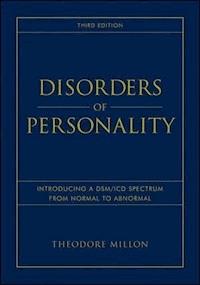
Now in its Third Edition, this book clarifies the distinctions between the vast array of personality disorders and helps clinicians make accurate diagnoses. It has been thoroughly updated to incorporate the changes in the forthcoming DSM-5. Using the classification scheme he pioneered, Dr. Millon guides clinicians through the intricate maze of personality disorders, with special attention to changes in their conceptualization over the last decade. Extensive new research is included, as well as the incorporation of over 50 new illustrative and therapeutically detailed cases. This is every mental health professional's essential volume to fully understanding personality.
Sie lesen das E-Book in den Legimi-Apps auf:
Seitenzahl: 3285
Veröffentlichungsjahr: 2011
Ähnliche



















Table of Contents
By the Same Author
Title Page
Copyright
Dedications
Preface
Part I: Historical, Theoretical, and Methodological Foundations
Chapter 1: Historical, Modern, and Contemporary Approaches to Personology
Historical Antecedents
Modern Formulations
Contemporary Proposals
Classifying Personality Severity
Chapter 2: Sources of Personologic and Psychopathologic Development
On the Interactive Nature of Developmental Pathogenesis
Pathogenic Biological Factors
Pathogenic Experiential History
Plasticity of the Maturing Biological Substrate
Neuropsychological Development
Concept of Sensitive Developmental Periods
Neuropsychological Stages
Stage-Related Developmental Tasks
Sources of Pathogenic Learning
Enduring and Pervasive Experiences
Traumatic Experience
Continuity of Early Learnings
Sociocultural Influences
Concluding Comments
Chapter 3: Clinical Methods and Instruments of Personalized Assessment
An Historical Precis of Personologic Assessment
Assessment Instruments
Future Directions
Chapter 4: Logic and Modalities of Personalized Psychotherapy
A Brief Historical Review of Modern Therapeutic Thought
Eclecticism, Common Factors, and Integration
Personalized Counseling and Psychotherapy
Chapter 5: Classification Considerations, DSM-5 Prelims, and Proposals for Personology
On the Logic and Character of Classification
Structural Models
Construction Methods
On the Structure of a Clinical Science
The Three Bipolarities of Evolution
Part II: Interpersonally Imbalanced Spectra
Chapter 6: Deferential Styles, Attached Types, Dependent Disorders: The DAD Spectrum
Prevalence
Historical Antecedents
Modern Formulations
Treatment-Oriented Trait Dimensions
DAD Spectrum Styles, Types, and Disorders
Assessing the DAD Dependent Spectrum
Pathogenic Developmental Background
Counseling and Therapeutic Interventions
Chapter 7: Sociable Styles, Pleasuring Types, Histrionic Disorders: The SPH Spectrum
Historical Antecedents
Modern Formulations
Contemporary Proposals
Treatment-Oriented Trait Dimensions
SPH Spectrum Styles, Types, and Disorders
Assessing the SPH Spectrum
Pathogenic Developmental Background
Counseling and Therapeutic Interventions
Chapter 8: Confident Styles, Egotistic Types, Narcissistic Disorders: The CEN Spectrum
Historical Antecedents
Modern Formulations
Contemporary Proposals
Treatment-Oriented Trait Dimensions
CEN Spectrum Styles, Types, and Disorders
Assessing the CEN Spectrum
Pathogenic Developmental Background
Counseling and Therapeutic Interventions
Chapter 9: Aggrandizing Styles, Devious Types, Antisocial Disorders: The ADA Spectrum
Historical Antecedents
Modern Formulations
Contemporary Proposals
Treatment-Oriented Trait Dimensions
ADA Spectrum Styles, Types, and Disorders
Assessing the Antisocial
Pathogenic Developmental Background
Counseling and Therapeutic Interventions
Part III: Intrapsychically Conflicted Spectra
Chapter 10: Reliable Styles, Constricted Types, Compulsive Disorders: The RCC Spectrum
Historical Antecedents
Modern Formulations
Contemporary Proposals
Treatment-Oriented Trait Dimensions
RCC Spectrum Styles, Types, and Disorders
Assessing the RCC
Pathogenic Developmental Background
Counseling and Therapeutic Interventions
Chapter 11: Discontented Styles, Resentful Types, Negativistic Disorders: The DRN Spectrum
Prevalence
Historical Antecedents
Modern Formulations
Contemporary Proposals
Treatment-Oriented Trait Dimensions
DRN Spectrum Styles, Types, and Disorders
Assessing the DRN Spectrum
Pathogenic Developmental Background
Counseling and Therapeutic Interventions
Chapter 12: Abused Styles, Aggrieved Types, Masochistic Disorders: The AAM Spectrum
Historical Antecedents
Modern Formulations
Contemporary Proposals
Treatment-Oriented Trait Dimensions
AAM Spectrum Styles, Types, and Disorders
Assessing the AAM Spectrum
Pathogenic Developmental Background
Counseling and Therapeutic Interventions
Chapter 13: Assertive Styles, Denigrating Types, Sadistic Disorders: The ADS Spectrum
Prevalence
Historical Antecedents
Modern Formulations
Contemporary Proposals
Treatment-Oriented Trait Dimensions
ADS Spectrum Styles, Types, and Disorder
Assessing the Sadist: Assessing the ADS Spectrum
Pathogenic Developmental Background
Counseling and Therapeutic Interventions
Part IV: Emotionally Extreme Spectra
Chapter 14: Apathetic Styles, Asocial Types, Schizoid Disorders: The AAS Spectrum
Prevalence
Historical Antecedents
Modern Formulations
Contemporary Proposals
Treatment-Oriented Trait Dimensions
AAS Spectrum Styles, Types, and Disorders
Assessing the AAS Spectrum
Pathogenic Developmental Background
Counseling and Therapeutic Interventions
Chapter 15: Shy Styles, Reticent Types, Avoidant Disorders: The SRA Spectrum
Prevalence
Historical Antecedents
Modern Formulations
Contemporary Proposals
Treatment-Oriented Trait Dimensions
SRA Spectrum Styles, Types, and Disorders
Pathogenic Developmental Background
Counseling and Therapeutic Interventions
Chapter 16: Dejected Styles, Forlorn Types, Melancholic Disorders: The DFM Spectrum
Historical Antecedents
Modern Formulations
Contemporary Proposals
Treatment-Oriented Trait Domains
DFM Spectrum Styles, Types, and Disorders
Assessing the DFM Spectrum
Pathogenic Developmental Background
Counseling and Therapeutic Interventions
Chapter 17: Ebullient Styles, Exuberant Types, Turbulent Disorders: The EET spectrum
Historical Antecedents
Modern Formulations
Contemporary Proposals
Treatment-Oriented Trait Dimensions
EET Spectrum Styles, Types, and Disorders
Pathogenic Developmental Background
Counseling and Therapeutic Interventions
Part V: Structurally Defective Spectra
Chapter 18: Eccentric Styles, Schizotypal Types, Schizophrenic Disorders: The ESS Spectrum
Applying the Spectrum Concept to Personality Structure
Historical Antecedents
Modern Formulations
Contemporary Proposals
Treatment-Oriented Trait Dimensions
ESS Spectrum Styles, Types, and Disorders
Pathogenic Developmental Background
Counseling and Therapeutic Interventions
Chapter 19: Unstable Styles, Borderline Types, Cyclophrenic Disorders: The UBC Spectrum
Historical Antecedents
Modern Formulations
Contemporary Proposals
Treatment-Oriented Trait Dimensions
UBC Spectrum Styles, Types, and Disorders
Pathogenic Developmental Background
Counseling and Therapeutic Interventions
Chapter 20: Mistrustful Styles, Paranoid Types, Paraphrenic Disorders: The MPP Spectrum
Prevalence
Historical Antecedents
Modern Formulations
Contemporary Proposals
Treatment-Oriented Trait Dimensions
MPP Spectrum Styles, Types, and Disorders
Assessing the Paranoid
Pathogenic Developmental Background
Counseling and Therapeutic Interventions
References
Author Index
Subject Index
By the Same Author
(Chronologically)
Books
Experiments in Psychology (C-A)
Theories of Psychopathology (E)
Approaches to Personality (E)
Modern Psychopathology (A)
Research Methods of Psychopathology (C-A)
Theories of Psychopathology and Personality (E)
Abnormal Behavior and Personality (C-A)
Medical Behavioral Science (E)
Disorders of Personality (A)
Handbook of Clinical Health Psychology (C-E)
Theories of Personality and Psychopathology (E)
Personality and its Disorders (C-A)
Contemporary Directions in Psychopathology (C-E)
Toward a New Personology (A)
Personality and Psychopathology (A)
Disorders of Personality-II (A)
The Millon Inventories (E)
Psychopathy (C-E)
Personality-Guided Therapy (A)
Oxford Textbook of Psychopathology (C-E)
Personality Disorders in Modern Life (C-A)
Handbook of Psychology: V (C-E)
Personality Disorders in Modern Life-II (C-A)
Masters of the Mind (A)
Overcoming Resistant Personality Disorders (C-A)
Resolving Difficult Clinical Syndromes (C-A)
Moderating Severe Personality Disorders (C-A)
The Millon Inventories-II (C-E)
Oxford Textbook of Psychopathology-II (C-E)
Contemporary Directions in Psychopathology-II (C-E)
Diagnostic Inventories
Millon Clinical Multiaxial Inventory (A)
Millon Behavioral Health Inventory (C-A)
Millon Adolescent Personality Inventory (C-A)
Millon Clinical Multiaxial Inventory-II (A)
Millon Adolescent Clinical Inventory (C-A)
Millon Clinical Multiaxial Inventory-III (A)
Millon Index of Personality Styles (C-A)
Millon Pre-Adolescent Clinical Inventory (C-A)
Millon College Counseling Inventory (C-A)
Millon Personality Spectrometer (C-A)
(A) Author, (E) Editor, (C-E) Co-Editor, (C-A) Co-Author
This book is printed on acid-free paper.
Copyright © 2011 by Theodore Millon, Author, Inc. All rights reserved.
Published by John Wiley & Sons, Inc., Hoboken, New Jersey.
Published simultaneously in Canada.
No part of this publication may be reproduced, stored in a retrieval system, or transmitted in any form or by any means, electronic, mechanical, photocopying, recording, scanning, or otherwise, except as permitted under Section 107 or 108 of the 1976 United States Copyright Act, without either the prior written permission of the Author and the Publisher, or authorization through payment of the appropriate per-copy fee to the Copyright Clearance Center, Inc., 222 Rosewood Drive, Danvers, MA 01923, (978) 750-8400, fax (978) 646-8600, or on the web at www.copyright.com. Requests to the Author or Publisher for permission should be addressed to the Permissions Department, John Wiley & Sons, Inc., 111 River Street, Hoboken, NJ 07030, (201) 748-6011, fax (201) 748-6008.
Limit of Liability/Disclaimer of Warranty: While the publisher and author have used their best efforts in preparing this book, they make no representations or warranties with respect to the accuracy or completeness of the contents of this book and specifically disclaim any implied warranties of merchantability or fitness for a particular purpose. No warranty may be created or extended by sales representatives or written sales materials. The advice and strategies contained herein may not be suitable for your situation. You should consult with a professional where appropriate. Neither the publisher nor author shall be liable for any loss of profit or any other commercial damages, including but not limited to special, incidental, consequential, or other damages.
This publication is designed to provide accurate and authoritative information in regard to the subject matter covered. It is sold with the understanding that the publisher is not engaged in rendering professional services. If legal, accounting, medical, psychological or any other expert assistance is required, the services of a competent professional person should be sought.
Designations used by companies to distinguish their products are often claimed as trademarks. In all instances where John Wiley & Sons, Inc. is aware of a claim, the product names appear in initial capital or all capital letters. Readers, however, should contact the appropriate companies for more complete information regarding trademarks and registration.
For general information on our other products and services please contact our Customer Care Department within the U.S. at (800) 762-2974, outside the United States at (317) 572-3993 or fax (317) 572-4002.
Wiley also publishes its books in a variety of electronic formats. Some content that appears in print may not be available in electronic books. For more information about Wiley products, visit our website at www.wiley.com.
Library of Congress Cataloging-in-Publication Data:
Millon, Theodore.
Disorders of personality : introducing a DSM/ICD spectrum from normal to abnormal / by Theodore Millon.—3rd ed.
p. ; cm.
Includes bibliographical references and index.
ISBN 978-0-470-04093-5 (cloth : alk. paper); ISBN 978-0-470-89092-9 (ebk); ISBN 978-0-470-89100-1 (ebk); ISBN 978-0-470-89101-8 (ebk); ISBN 978-1-118-09925-4 (obook)
1. Personality disorders. 2. Personality disorders—Classification. 3. Diagnostic and statistical manual of mental disorders. 5th ed. 4. International statistical classification of diseases and related health problems. 11th revision. I. Title.
[DNLM: 1. Diagnostic and statistical manual of mental disorders. 2. Personality Disorders. 3. International Classification of Diseases. 4. Personality Disorders—classification. WM 190 M656da 2011]
RC554.M54 2011
616.85′81—dc22
2010018069
To my mentors: Gardner Murphy, Kurt Goldstein, and Ernst Kris
Who built the foundations
To my colleagues: Mel Sabshin, Herb Reich, and Niels Strandbygaard
Who paved the way
To the APF Theodore Millon Mid-Career Awardees:
Drew Westen, Robert Bornstein, Robert Krueger, Aaron Pincus,
Mark Lenzenweger, Mark Blais, and Brent Roberts
Who, with my most scholarly and innovative students:
Michael Antoni, Caryl Bloom, Neil Bockian, Roger Davis, Seth Grossman,
Carrie Millon, Sarah Minor, Steve Strack, and Robert Tringone
Will carry our best ideas and research forward
Preface
Guiding the principles and content of this book is Darwin's concept of natural selection. In line with this “law”, personology and personality disorder are conceived as varieties of successful and failed natural selection efforts by humans as they attempt to achieve an optimal balance among the three essential elements comprising life: (1) existential survival (avoiding death/pain and enhancing life/pleasure); (2) ecological adaptation (environmental accommodation/passive and environmental modification/active); and species replication (maximizing reproduction/self and nurturing progeny/others).
The task of authoring and improving the most successful professional-level book in the field (the first two editions sold some 70,000 copies in 27 printings) is not merely to tweak prior editions or to transmit recently established knowledge, but to introduce substantive and innovative ideas that will further guide developments in the subject. I have sought to fulfill this latter role by providing a strong theoretical base for allying and integrating normal and abnormal personality spectrum concepts in accord with Darwinian evolutionary ideas, as well as to elaborate a dimensional schema of traits for therapeutic planning. I have also presented an entirely new personality classification—the ebullient/exuberant/turbulent spectrum—and have enriched the text with extensive up-to-date research literatures, as well as to incorporate more than 50 new therapeutically detailed cases.
This book may be seen as an introduction and companion volume to the forthcoming Diagnostic and Statistical Manual of Mental Disorders (DSM-5), scheduled for publication by the American Psychiatric Association in 2013. Although the DSM will be more comprehensive descriptively than its predecessors, it will not be sufficient in scope to provide fully detailed clinical or theoretical presentations of the personality styles and disorders it encompasses. The lack of such materials will continue to be especially troublesome to those seeking substantial information on the many historical, modern, and contemporary conceptions of these clinical impairments. These mental syndromes have “come of age,” having been transformed from a class of pathology possessing only incidental relevance to the diagnostic enterprise into one that is central to the DSM's multiaxial format and to professional's everyday work. Although clinicians and researchers will find considerable literature on other psychopathologic syndromes in standard texts and journals, such information has only recently begun to accumulate for a small number of the personality styles and disorders. Now that these syndromes have been assigned the status of major clinical entities, the need to develop a comprehensive and innovative professional reference and learning tool to fill the void is all the more important. It is in the sense of filling the void that this third edition text, comprising more than 1,000 double-columned pages, as compared to the DSM's much more modest Axis II section, may be seen as a needed professional's and advanced student's companion volume to both the DSM and the more likely even briefer personality section of the ICD-11, the official manual of the World Health Organization.
Not only has the DSM-5 committee altered its name to that of the Personality and Personality Disorders Work Group, but there has been an increasing recognition in the field that normal and abnormal personality conceptions be organized within a single conceptual framework. Proposing a single superordinate framework for unitizing normal and abnormal styles and disorders has been an energizing and challenging prospect among recent genetic, clinical, and statistical researchers. Intriguing and promising though these efforts have been, there is no consensus as to which of them is likely to achieve a reasonable level of accord. It is in this book where I have moved vigorously forward with the novel proposal that a coordinated structural model based on Darwinian theory can provide the overarching framework for identifying and articulating normal and clinical personality styles, types, and disorders spectra.
Given the fractionalized character of theory in personology, which heretofore has exhibited no credible consensually shared concepts, nor possessing a synthesizing framework to guide the field satisfactorily, it appeared to me that our “science” should begin to search for an overarching substantive system that would galvanize its disparate parts, a system that was built on the variegated bedrock of evolutionary principles.
Without evolution's widely accepted intellectual grounding, I believe that our field will continue to be buffeted and misled by the arcana of tangential concepts and doctrinaire hypotheses, as well as by weakly designed experiments that gain legitimacy via clever statistical manipulation of data that offer the illusion of progress.
If our field is to truly progress, however, we must not be too fearful of being too imaginative or too timid to confront digressive ideologies or absurdist methodologies. It is time to put forth innovative and powerful visions that knit together the best of our historical achievements, as well as those of other subjects that derive from the theoretical foundation of all our life sciences, that of evolution.
The thesis or rationale for this text stems from an ancient injunction to physicians: “Ask not what disease the patient has, but rather who the patient is who has the disease.” Styles, types, and disorders of personality are not medical entities; nor should they be seen as human perversities either. Viewed from an ecological and evolutionary perspective, we conceive them as problematic styles of human adaptation. They represent unique individuals whose constitutional makeup and early life experiences have not only misdirected their development, but have also constructed an unsatisfying sense of self, a problematic way of expressing thoughts and feelings, as well as a troublesome manner of behaving and relating to others. Each of the “classical” personalities, as well as their subvarieties, demonstrate for us the many complex structures and styles in which we become the persons we are.
Rather than be seen merely as a supplement to the more traditional diagnostic entities of Axis I, personality serves as a distinctive context, a constraining and shaping pattern of persistent influences that gives meaning and character to whatever clinical disorders may also be present in the individual, be it of a physical nature, such as cancer or heart disease, or a psychic one, such as schizophrenia. To illustrate within our own field, a unipolar depression will be experienced and reacted to differently in an individual with an avoidant personality than in one with a narcissistic personality. Not only will dissimilar circumstances provoke the divergent vulnerabilities that characterize each of these personalities, but they will also evoke contrasting ways of perceiving and coping with these circumstances. For these and other reasons, we believe that clinicians should be oriented to the “context of personality” when they deal with all medical diseases and all forms of psychiatric disorders.
It is no overstatement to describe the growth of the field of personality disorders as exponential since the first edition of this book was published three decades ago. The speed of both theoretical and empirical developments continues at an accelerated pace, fostered greatly by the inaugural publication of the Journal of Personality Disorders in 1987, and the formal organization of the International Society for the Study of Personality Disorders in 1988. Owing to my close participation and continued involvement in both ventures, each of which serves as a primary vehicle to advance the status and cross-cultural importance of personologic studies, I have had a front row seat as the quickening pace of this evolving field has progressed. Despite the ever-expanding nature of pertinent concepts and findings, there is little in this avalanche of information and trends to which I have not been privy.
As one of the first appointees in 1974 to the American Psychiatric Association's Task Force on Nomenclature and Statistics, the committee responsible for developing the DSM-III, I was most fortunate to participate in the group's deliberations from the very start. Especially gratifying were opportunities to persuade colleagues of the utility of an innovative multiaxial format and, substantively, to provide the initial drafts and diagnostic criteria for each of the personality disorders. Similarly, I was pleased again to be called on to serve as a full member of the DSM-IV, Axis II Work Group. Those who are acquainted with my prior writings will recognize the influence I had on the DSM-III (e.g., the concept of an Avoidant Personality) and, more recently, on the DSM-IV (e.g., the concept of a Negativistic Personality Disorder). Though not a member of DSM-5's Work Group, many of its latest developments derive part of their impetus from ideas presented in recent books and papers of mine.
It was my intent to write a sequentially unified book, one that would demonstrate how the many varieties of personality, normal and pathological, could be logically derived from a few basic concepts and principles. Most authors in psychiatry and psychology split their texts down the middle, so to speak, providing little or no continuity between the theoretical notions they presented in the early chapters of their books and the syndromes that comprised later ones.
Some authors have shaped their materials in line with narrow theoretical models, for example, neurobiologic, statistical, or psychoanalytic; inevitably, these works compressed the rich diversity of clinical data into Procrustean beds, discarding what did not suit their author's predilections. In the hope of gaining the best of both worlds—that is, of being logically and sequentially consistent—I have adapted and refashioned what appear to be divergent views to fit a coherent integrative model that coordinates normalities and abnormalities, as well as one grounded fundamentally in principles derived from evolutionary theory.
The historical and conceptual background of this integrative Darwinian model is elaborated in Chapters 1 and 5; Chapters 2, 3, and 4 provide the logic and techniques for understanding personality development, assessment, and therapy. The application of these concepts to both the diagnosis of 15 personality spectra, normal and pathological and their treatment is elaborated in Chapters 6 to 20.
Given the many advances in conceptual and empirical research these past two decades, the time has come for developing fresh and far-reaching conceptual schemas that interweave and coordinate knowledge gained in adjacent fields of scientific endeavor. Toward that end, I have devised a new classification schema of personality spectra, one constructed from its inception by coalescing principles drawn from evolutionary theory and biosocial development. Chapters 1 and 5, in addition to reviewing historically diverse conceptions of classification and deduction, provide the theoretical rationale and logic for an evolutionary approach to the origins and development of normal styles and pathological disorders of personality. Not only does the schema serve to connect personality pathology to other realms of scientific theory and research, it also demonstrates the developmental continuity of pathological functioning throughout life and the interconnections that exist among ostensibly unrelated syndromes (still considered discrete entities according to the official DSM).
I have progressed in my work from what I first labeled a “biosocial framework” to one I now term an “evolutionary model.” Despite their seeming divergence, these two conceptual schemas are both consonant and consistent. The former derives its constructs largely from learning theory and undergirds developmental ontogenesis; the latter includes constructs derived from evolutionary theory that are applicable both to phylogenesis and human adaptive styles. In this reformulation, elaborated for the reader in Chapters 1 and 5, I believe that a major step has been taken to coordinate concepts of human structure and functioning with those found in other spheres of scientific inquiry. To readers who gravitate to such admittedly more speculative, but potentially more fruitful, ventures, I suggest they read my book, Toward a New Personology: An Evolutionary Model, also published by John Wiley & Sons.
A few words should be said regarding the close parallels between several key concepts to be promulgated in the DSM-5 and the evolutionary theoretical model; these are discussed more fully in Chapters 1 and 5. For example, the DSM-5 will propose that a central role be given to the concepts of positive and negative emotionality; these correspond directly to the theory's survival bipolarity of pleasure (life enhancement) and pain (death avoidance). Similarly, the externalizing and internalizing DSM concepts parallel in most regards the theory's adaptation bipolarity of active (ecologic modification) and passive (ecologic accommodation). And the DSM's self- and interpersonal functioning dimension matches fully the theory's replication bipolarity of self (reproductive maximization) and other (reproductive nurturance). However, whereas the DSM lists these imaginative bipolar formulations as separate and uncoordinated proposals, our Darwinian-based theory shows how they interrelate and thereby generate deductively not only the classical group of DSM personality disorders, but clarify and innovate novel normal styles and historically overlooked ones as well.
I believe that a substantial expansion of the clinical Chapters 6 through 20, with its spectrum model and extensive case presentations will prove of considerable utility to all psychiatric, psychology, social work, and nurse practitioners. The current text's chapters encompass eight treatment-oriented trait domains that enable mental health professionals of rather diverse persuasions (e.g., cognitive, interpersonal, self-theory, mood-temperament) to recognize those features and symptoms with which they are most acquainted and comfortable. These eight domains also set the groundwork for selecting among matching and distinct modalities of therapy (e.g., behavioral, pharmacologic, psychoanalytic, as well as those noted earlier).
In addition to providing comprehensive reviews of each of the newer personality spectrum prototypes—for example, avoidant, narcissistic, borderline, schizotypal, melancholic, turbulent, sadistic, and masochistic, also of special use to clinicians, particularly in this day of managed care—are detailed discussions of frequent Co-morbid Axis I and Axis II diagnoses. These are presented to alert practitioners to differences in vulnerabilities among the personalities to each of the major Axis I syndromes, such as depression and anxiety. Equally useful in each chapter are sections elucidating each personality spectrum's most plausible biogenic and psychogenic origins and course.
I have undertaken the task in Chapter 3 of providing not only a rationale for what should be assessed in personality, but also an up-to-date review of the newly constructed and recently refurbished instruments available to contemporary clinicians and researchers. Of potential interest to experienced assessment psychologists are brief sections in each clinical chapter that record indices from well-known instruments, such as the Rorschach, the TAT, and the MMPI. These venerable tools may be seen as complementing the diagnostic efficacy of the MCMI and its associated diagnostic instruments, inventories designed specifically to aid in normal and pathological personality appraisals. Similarly, I have also expanded the logic of a strategic model for the “personalized treatment” of personality spectra in Chapter 4, as well as providing the reader with a focused review of the many tactical modalities that may be usefully employed to that end. Both assessment and therapy chapters lay the foundation for substantially enlarged discussions in later clinical chapters.
The overall sequence of the clinical chapters (6–20) has been realigned to represent the text's reformulated theoretical model. Personality spectra that are characterized by being “interpersonally imbalanced,” that is, strongly inclined to be oriented either to others (e.g., dependent, histrionic), or to self (e.g., narcissistic, antisocial) are the first in the sequence. The second classification group features spectra that are primarily “intrapsychically conflicted” (e.g., obsessive-compulsive, negativistic, sadistic, masochistic). The third group is noted for its “emotional extremes” (schizoid, avoidant, melancholic, and turbulent). And finally, the most severe of the personality pathologies are assembled together as a fourth group; they comprise patients whose primary personality difficulty stems from being “structurally defective” (e.g., schizotypal, borderline, paranoid).
The most innovative section in each clinical chapter concerns personality spectra subcategories, ranging from childhood variants, normal styles, abnormal types, and clinical disorders. It is my belief that our field should progress “beyond” our present conceptions of fixed personality categories, a conception that owes in part to the assumption that each is a clinically homogeneous category composed of distinctive and uniformly covariant diagnostic attributes. I believe this assumption is a misleading one, a point of view that not only narrows one's thinking, but also distorts clinical reality, especially for students with modest levels of clinical experience. Although there is a considerable measure of pedagogic utility in formulating modal or textbook prototypes, clinical experience teaches us that great diversity exists within all personality categories; some exhibit its features in essentially normal ways; others demonstrate moderate to the most problematic extremes; still others exhibit various mixtures and combinations of the basic spectral genre. Thus, in addition to the 15 basic personality “spectra” that constitute the prime focus of each clinical chapter, a further breakdown has been made among styles, types, and disorders, resulting in numerous adult subtypes, as well as several normal variants and childhood syndromes. The introduction of these subdivisions may also help resolve the pernicious categorical-dimensional debate and, perhaps more importantly, sensitize the serious reader to the many and diverse “species” that comprise each personality.
It is my belief that personality disorders can be treated effectively and efficiently; brief focused therapy can be carried out successfully and swiftly if one understands the character of these disorders accurately. Long-term treatment is not inevitable; the problem is that we spend too much time wandering hither and yon searching to find what our patients' difficulties may be. With new, brief, and personality-oriented assessment tools, plus the availability of a few solid reference works on the subject, any well-trained clinician should be able to identify the key clinical features, which, if directly resolved, should advance the health status of the patient favorably and rapidly. Knowledge of the patient's personality disorder can be of inestimable value in helping to resolve his or her Axis I clinical syndrome. The treatment focus in these conditions is not that of reworking an Axis II personality disorder, but rather in utilizing the “context of personality” for identifying the patient's core vulnerabilities quickly, vulnerabilities that undergird clinical syndromes such as depression, anxiety, marital tensions, and the like. Knowledge of personality and its disorders is now more critical than ever before because such knowledge enables the clinician to promptly address the “context” that gives meaning to the patient's syndrome or problem. Such information is all the more important now because clinicians have only a few sessions to accurately appraise and treat their “managed care” patients.
It is a pleasure to record the contributions of those who have been most directly involved in this text; there are many to whom I owe much. Foremost is my wife Renée who, as before, has contributed her distinctive editorial talents to make the text more lucid and readable, but also more humane and sensitive. It is a joy of no lesser significance to add to this editorial team my daughter Carrie, a PhD psychologist who is rapidly becoming a full partner in several of my endeavors.
Seth Grossman and Roger Davis are special recent students who deserve particular note. Not only have they co-authored substantial drafts of major books and papers that I have drawn upon here, but they have become true professional colleagues in the best sense of the word.
Over the years of writing this and earlier works, I have accumulated numerous intellectual debts to other colleagues and students. None of my theoretical writings has sprung from my mind unaided, nor was the execution of my research endeavors the product of my labors alone. As I have noted in earlier acknowledgments, there are a few who have been foremost in furnishing the stimulus of intellectual discourse and collegial encouragement so necessary to spur an author through his otherwise isolated scholarly labors. Heading this list are Bob Meagher and Addi Geist Agar, along with scores of other colleagues to whom I am deeply obliged for their unstinting support at crucial times, namely Michael Antoni, Robert Tringone, Neil Bockian, George Everly, Flo Grabel, Rose Wilansky, Audrey Melamed, Naomi Grossman, Sally Perlis, Jean Jones, Mary-Lou McGinnis, Leila Foster, JoAnn Lederman, Jeffrey Magnavita, Joseph Zubin, and Paul Meehl.
To these associates must be added my co-founding editor-in-chief of the Journal of Personality Disorders, Allen Frances; his contributions to the journal and his diplomatic talents as the DSM-IV Task Force Chairperson continues to foster advances in the field. The two 6-year stints I spent with colleagues on the DSM-III Task Force (1974–1980) and the DSM-IV, Axis II Work Group (1988–1994) were richly rewarding challenges and opportunities that I shall never forget. Among those who made the DSM-III period intellectually exciting were the innovative and polemical talents of Don Klein, Jean Endicott, Nancy Andreasen, and Bob Spitzer. Several colleagues on the DSM-IV Work Group are among the most productive thinkers and researchers in the field today, notably Larry Siever, Kathy Phillips, Tracie Shea, Tom Widiger, Bob Hirschfield, Bruce Pfohl, Roger Blashfield, and, most especially, the Work Group's sagacious and clinically astute chairperson, John Gunderson. Along with other valued colleagues at Harvard Medical School/McLean Hospital, such as Elsa Ronningstam and Mary Zanarini, leaders of the Psychosocial and Personality Treatment and Research Groups, made my visits to Cambridge and Belmont extremely fruitful. Similarly, Ed Murray, Paul Blaney, and Bob McMahon, three colleagues at the University of Miami, were among my most valued associates. Among my psychoanalytic compatriots, I must single out Otto Kernberg and Michael Stone from whose creative writings and erudite discussions I have profited greatly. Added to these people are a host of distinguished nonanalysts whom I also count as esteemed thinkers and friends, namely Lorna Benjamin, Aaron (Tim) Beck, and Gerry Klerman: their warmth and personal instruction pervade the pages of this book.
For the past several decades, I have been the recipient of numerous opportunities to share my ideas with colleagues around the world; many have been extremely generous in their welcome and I would like to record my appreciation for their kindness. Particular affection is due those who promulgated the central role of the personality disorders in Denmark: notable here are Erik Simonsen, Gunilla Øberg, Morten Birket-Smith, Bent Rosenbaum, Fini Schulsinger, and, most especially, Niels Strandbygaard, of whom I will say more shortly. In the Netherlands I have been impressed by numerous clinicians of diverse, but exceptional talent, namely Jan Derksen, Wim van den Brink, Franz Luteyn, Herman Groen, Theo Bouman, David Bernstein, and Robert Abraham. Among my most esteemed colleagues, few demonstrate the psychometric skills and inventiveness of Hedwig Sloore and Gina Rossi of the University of Brussels. At the Karolinska Institute in Stockholm, I have been both persuaded and charmed by the broad perspectives of Robert Weinryb and Marie Äsberg. The fine research and theoretical skills of Svenn Torgersen, Per and Sonya Vaglum, Bjørn Østberg, and Alv Dahl of the University of Oslo have been most illuminating. Among associates in Japan, where communication among colleagues is but a modest problem, I shall like to record the colleagueship of Masaaki Kato of Tokyo Medical College and Kazuhisa Nakao of the University of Osaka. Closer to home in Canada I have very much appreciated the friendship and highly productive contributions of W. John Livesley of the University of British Columbia, and those of Joel Paris at McGill University.
Of no minor interest to me personally was a group of “Millon Inventory Trainers,” knowledgeable and talented instructors who furnish informative workshops to clinical psychologists and other mental health professionals throughout the United States; among those who have not otherwise been noted in these pages, I am happy to record the continuing contributions of Steve Strack, Darwin Dorr, Frank Dyer, Joseph McCann, and Jim Choca. The Institute for Advanced Studies in Personology and Psychopathology has inaugurated a national and international study group program led initially by my able associate Luis Escovar. Collaboration with the leaders of these groups over the next years will be an activity to which I look forward with great enthusiasm. The management of Pearson Assessments deserves no small measure of thanks for their competence and indulgence these past several decades; deserving special note are Carol Watson, Joe Grosdidier, Theo Jolosky, Christine Carlson, Kristie Thoenen, Christine Thompson, John Kamp, Larry Weiss, and Aurelio Profitera. Also notable are the present and past leaders of psychology at John Wiley & Sons who have been instrumental in the acceptance, copyediting, and production of numerous of my books; here I think of the talents of Herb Reich, Peggy Alexander, Tisha Rossi, Kelly Franklin, Jo Ann Miller, Isabel Pratt, Judi Knott, Linda Indig, and Tracey Belmont.
Special and well-deserved thanks must be recorded here regarding two of my most devoted and competent associates at the Institute, namely Donna Meagher and Alyssa Boice. They have made the task of revising and elaborating this book so much easier and more pleasant than it might otherwise have been.
As in the first edition, I have retained my dedication to three early mentors, Gardner Murphy, Kurt Goldstein, and Ernst Kris; without their direct tuition, inspiration, and warm friendship during my student years, the foundations for this book would never have been built. In this revised edition, I have added to these early mentors three peerless colleagues who have aided me immeasurably in building on these early foundations, enabling me to move forward in all of my more mature scholarly efforts. Mel Sabshin, former medical director of the American Psychiatric Association, has been a much honored and much treasured personal associate of mine for close to a half- century. It was Mel's foresight and tenacity that opened the pathway to the trail-blazing advances of the DSM-III—a little known fact that typifies his imagination and leadership. As noted above, Herb Reich, editor-in-chief emeritus at John Wiley & Sons, has been another generous and cherished friend, no less an editor of singular talent. Not content to merely acquire worthy manuscripts, he takes on a genuinely collaborative role in overseeing the work of his many authors, ferreting out trivial facts and digressions, as well as inelegant and obscure prose, pressing always for clarity and logical consistency, but invariably with wit, grace, and gentility. Finally, my early entrée into the European community, where my writings are perhaps as well known as they are in the United States, owes much to the intellectual curiosity and creative energies of a great Dane, Niels Strandbygaard. Not only did Niels translate my work for much of Scandinavia, but he was instrumental in organizing the First Congress of the International Society for the Study of Personality Disorders; no less significant on a personal basis was his role in leading the First European Millon Study Group. My hat is off to each of these three companions “who paved the way.”
Also noted in my dedication are the several mid-career psychologists who have been the recipients of APF's Theodore Millon Award this past decade. Each is a distinguished “young” thinker and researcher who will “carry things forward”: Drew Westen, Robert Bornstein, Robert Krueger, Aaron Pincus, Mark Lenzenweger, Mark Blais, and Brent Roberts.
Equally notable are several of my former doctoral students who likewise will carry valuable ideas into the future. These young colleagues have my very best wishes for continuing their estimable careers: Mike Antoni, Caryl Bloom, Neil Bockian, Roger Davis, Seth Grossman, Carrie Millon, Sarah Minor, Steve Strack, and Robert Tringone.
Theodore Millon, PhD, DSc
Florida and New York
January, 2011
Part I
HISTORICAL, THEORETICAL, AND METHODOLOGICAL FOUNDATIONS
Chapter 1: Historical, Modern, and Contemporary Approaches to Personology
Chapter 2: Sources of Personologic and Psychopathologic Development
Chapter 3: Clinical Methods and Instruments of Personalized Assessment
Chapter 4: Logic and Modalities of Personalized Psychotherapy
Chapter 5: Classification Considerations, DSM-5 Prelims, and Proposals for Personology
Chapter 1
Historical, Modern, and Contemporary Approaches to Personology
That the incidence of both mild and severe mental disorders is strikingly high in contemporary society cannot be denied. Perhaps it reflects the strain of life at the turn of the 21st century, or what political leaders and social thinkers have noted as a time of terrorism and economic decline. Whatever the causes, the inescapable facts are that each year Americans spend billions of dollars for psychopharmaceuticals, tens of billions for liquor and aspirin, and purchase enough books promising successful personal adjustment to fill a good-size college library. One out of every seven or eight Americans, at the current rate, will be involved in counseling or therapy for personality and psychosocial difficulties these next years. For every patient who requires hospitalization there will be 20 other personally distressed and troubled Americans who will seek psychotherapy or pharmacotherapy, hence the importance of the study of personality disorders.
Some have argued that books and chapters on any history of a field be written with detachment and objectivity. Others question whether such detachment is even possible, no less desirable. As the great historian of psychiatry, Gregory Zilboorg, has written (1941), detachment suggests a certain lack of feeling, reviewing the events of the past with the cold eye of an unconcerned and unaroused observer. The events of the past in our field of study, however, derive from intense human conditions and the passions they create, emotions that are charged with anxieties, loves, hatreds, ambitions, and failures. To look on our subject's history as if it could be portrayed as a series of dots on a statistical table will miss an essential aspect of its vitality. As Lytton Strachey, the British writer and historian has noted (1931), to obtain joy and enlightenment from a history of a subject's past, one must mobilize and not anesthetize one's feelings. Being amorphously impartial is to miss the very thing that makes the history of a subject real and alive. Facts relating to the past, when collected without art, are simply compilations. And although compilations can be useful, they are no more history than butter, eggs, salt, and herbs are an omelet. The art of history-telling demands intuition, enlightened intelligence, and the ability to feel the facts, and then to absorb and reconstruct their inner character and their continuous and vivid development. As a tree with many branches, personology has been approached with numerous traditions and paradigms: philosophy, humanism, biological chemistry, society and culture, formal psychological experimentation, and so on (Millon, 2004a). Ideas and discoveries in recent decades have come at a breathtaking rate. It is wise, therefore, to look back and review the vast distance we have traveled from early times. Similarly, it is crucial to our aims that we separate major achievements from those of a more modest character while paying homage to the many thinkers and scientists who pioneered contemporary work. Our goal here is more than academic, for there is a need to place contemporary approaches in their historical perspective so as to recognize the wisest paths to follow in the future.
Lesen Sie weiter in der vollständigen Ausgabe!
Lesen Sie weiter in der vollständigen Ausgabe!
Lesen Sie weiter in der vollständigen Ausgabe!
Lesen Sie weiter in der vollständigen Ausgabe!
Lesen Sie weiter in der vollständigen Ausgabe!
Lesen Sie weiter in der vollständigen Ausgabe!
Lesen Sie weiter in der vollständigen Ausgabe!
Lesen Sie weiter in der vollständigen Ausgabe!
Lesen Sie weiter in der vollständigen Ausgabe!
Lesen Sie weiter in der vollständigen Ausgabe!
Lesen Sie weiter in der vollständigen Ausgabe!
Lesen Sie weiter in der vollständigen Ausgabe!
Lesen Sie weiter in der vollständigen Ausgabe!
Lesen Sie weiter in der vollständigen Ausgabe!
Lesen Sie weiter in der vollständigen Ausgabe!
Lesen Sie weiter in der vollständigen Ausgabe!
Lesen Sie weiter in der vollständigen Ausgabe!
Lesen Sie weiter in der vollständigen Ausgabe!
Lesen Sie weiter in der vollständigen Ausgabe!
Lesen Sie weiter in der vollständigen Ausgabe!
Lesen Sie weiter in der vollständigen Ausgabe!
Lesen Sie weiter in der vollständigen Ausgabe!
Lesen Sie weiter in der vollständigen Ausgabe!
Lesen Sie weiter in der vollständigen Ausgabe!
Lesen Sie weiter in der vollständigen Ausgabe!
Lesen Sie weiter in der vollständigen Ausgabe!




