


122,99 €
Mehr erfahren.
- Herausgeber: John Wiley & Sons
- Kategorie: Fachliteratur
- Sprache: Englisch
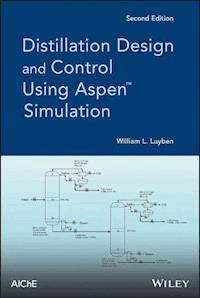
Learn how to develop optimal steady-state designs for distillation systems As the search for new energy sources grows ever more urgent, distillation remains at the forefront among separation methods in the chemical, petroleum, and energy industries. Most importantly, as renewable sources of energy and chemical feedstocks continue to be developed, distillation design and control will become ever more important in our ability to ensure global sustainability. Using the commercial simulators Aspen Plus® and Aspen Dynamics®, this text enables readers to develop optimal steady-state designs for distillation systems. Moreover, readers will discover how to develop effective control structures. While traditional distillation texts focus on the steady-state economic aspects of distillation design, this text also addresses such issues as dynamic performance in the face of disturbances. Distillation Design and Control Using Aspen(TM) Simulation introduces the current status and future implications of this vital technology from the perspectives of steady-state design and dynamics. The book begins with a discussion of vapor-liquid phase equilibrium and then explains the core methods and approaches for analyzing distillation columns. Next, the author covers such topics as: * Setting up a steady-state simulation * Distillation economic optimization * Steady-state calculations for control structure selection * Control of petroleum fractionators * Design and control of divided-wall columns * Pressure-compensated temperature control in distillation columns Synthesizing four decades of research breakthroughs and practical applications in this dynamic field, Distillation Design and Control Using Aspen(TM) Simulation is a trusted reference that enables both students and experienced engineers to solve a broad range of challenging distillation problems.
Sie lesen das E-Book in den Legimi-Apps auf:
Seitenzahl: 564
Veröffentlichungsjahr: 2013
Ähnliche

















Contents
Cover
Title Page
Copyright
Dedication
Preface to the Second Edition
Preface to the First Edition
Chapter 1: Fundamentals of Vapor–Liquid–Equilibrium (VLE)
1.1 Vapor Pressure
1.2 Binary VLE Phase Diagrams
1.3 Physical Property Methods
1.4 Relative Volatility
1.5 Bubble Point Calculations
1.6 Ternary Diagrams
1.7 VLE Nonideality
1.8 Residue Curves for Ternary Systems
1.9 Distillation Boundaries
1.10 Conclusions
Reference
Chapter 2: Analysis of Distillation Columns
2.1 Design Degrees of Freedom
2.2 Binary Mccabe–Thiele Method
2.3 Approximate Multicomponent Methods
2.4 Conclusions
Chapter 3: Setting Up a Steady-State Simulation
3.1 Configuring a New Simulation
3.2 Specifying Chemical Components and Physical Properties
3.3 Specifying Stream Properties
3.4 Specifying Parameters of Equipment
3.5 Running the Simulation
3.6 Using Design Spec/Vary Function
3.7 Finding the Optimum Feed Tray and Minimum Conditions
3.8 Column Sizing
3.9 Conceptual Design
3.10 Conclusions
Chapter 4: Distillation Economic Optimization
4.1 Heuristic Optimization
4.2 Economic Basis
4.3 Results
4.4 Operating Optimization
4.5 Optimum Pressure for Vacuum Columns
4.6 Conclusions
Chapter 5: More Complex Distillation Systems
5.1 Extractive Distillation
5.2 Ethanol Dehydration
5.3 Pressure-Swing Azeotropic Distillation
5.4 Heat-Integrated Columns
5.5 Conclusions
Chapter 6: Steady-State Calculations for Control Structure Selection
6.1 Control Structure Alternatives
6.2 Feed Composition Sensitivity Analysis (ZSA)
6.3 Temperature Control Tray Selection
6.4 Conclusions
Reference
Chapter 7: Converting From Steady-State to Dynamic Simulation
7.1 Equipment Sizing
7.2 Exporting to Aspen Dynamics
7.3 Opening the Dynamic Simulation in Aspen Dynamics
7.4 Installing Basic Controllers
7.5 Installing Temperature and Composition Controllers
7.6 Performance Evaluation
7.7 Conclusions
Chapter 8: Control of More Complex Columns
8.1 Extractive Distillation Process
8.2 Columns with Partial Condensers
8.3 Control of Heat-Integrated Distillation Columns
8.4 Control of Azeotropic Columns/Decanter System
8.5 Unusual Control Structure
8.6 Conclusions
References
Chapter 9: Reactive Distillation
9.1 Introduction
9.2 Types of Reactive Distillation Systems
9.3 Tame Process Basics
9.4 Tame Reaction Kinetics and Vle
9.5 Plantwide Control Structure
9.6 Conclusions
References
Chapter 10: Control of Sidestream Columns
10.1 Liquid Sidestream Column
10.2 Vapor Sidestream Column
10.3 Liquid Sidestream Column with Stripper
10.4 Vapor Sidestream Column with Rectifier
10.5 Sidestream Purge Column
10.6 Conclusions
Chapter 11: Control of Petroleum Fractionators
11.1 Petroleum Fractions
11.2 Characterization Crude Oil
11.3 Steady-State Design of Preflash Column
11.4 Control of Preflash Column
11.5 Steady-State Design of Pipestill
11.6 Control of Pipestill
11.7 Conclusions
References
Chapter 12: Divided-Wall (Petlyuk) Columns
12.1 Introduction
12.2 Steady-State Design
12.3 Control of the Divided-Wall Column
12.4 Control of the Conventional Column Process
12.5 Conclusions and Discussion
References
Chapter 13: Dynamic Safety Analysis
13.1 Introduction
13.2 Safety Scenarios
13.3 Process Studied
13.4 Basic Radfrac Models
13.5 Radfrac Model with Explicit Heat-Exchanger Dynamics
13.6 Dynamic Simulations
13.7 Comparison of Dynamic Responses
13.8 Other Issues
13.9 Conclusions
Reference
Chapter 14: Carbon Dioxide Capture
14.1 Carbon Dioxide Removal in Low-Pressure Air Combustion Power Plants
14.2 Carbon Dioxide Removal in High-Pressure IGCC Power Plants
14.3 Conclusions
References
Chapter 15: Distillation Turndown
15.1 Introduction
15.2 Control Problem
15.3 Process Studied
15.4 Dynamic Performance for Ramp Disturbances
15.5 Dynamic Performance for Step Disturbances
15.6 Other Control Structures
15.7 Conclusions
References
Chapter 16: Pressure-Compensated Temperature Control in Distillation Columns
16.1 Introduction
16.2 Numerical Example Studied
16.3 Conventional Control Structure Selection
16.4 Temperature/Pressure/Composition Relationships
16.5 Implementation in Aspen Dynamics
16.6 Comparison of Dynamic Results
16.7 Conclusions
References
Chapter 17: Ethanol Dehydration
17.1 Introduction
17.2 Optimization of the Beer Still (Preconcentrator)
17.3 Optimization of the Azeotropic and Recovery Columns
17.4 Optimization of the Entire Process
17.5 Cyclohexane Entrainer
17.6 Flowsheet Recycle Convergence
17.7 Conclusions
References
Chapter 18: External Reset Feedback to Prevent Reset Windup
18.1 Introduction
18.2 External Reset Feedback Circuit Implementation
18.3 Flash Tank Example
18.4 Distillation Column Example
18.5 Conclusions
References
Index
Cover design: John Wiley & Sons, Inc.
Cover image: © William L. Luyben
Copyright © 2013 by John Wiley & Sons, Inc. All rights reserved.
Published by John Wiley & Sons, Inc., Hoboken, New Jersey.
Published simultaneously in Canada.
No part of this publication may be reproduced, stored in a retrieval system, or transmitted in any form or by any means, electronic, mechanical, photocopying, recording, scanning, or otherwise, except as permitted under Section 107 or 108 of the 1976 United States Copyright Act, without either the prior written permission of the Publisher, or authorization through payment of the appropriate per-copy fee to the Copyright Clearance Center, Inc., 222 Rosewood Drive, Danvers, MA 01923, (978) 750–8400, fax (978) 750–4470, or on the web at www.copyright.com. Requests to the Publisher for permission should be addressed to the Permissions Department, John Wiley & Sons, Inc., 111 River Street, Hoboken, NJ 07030, (201) 748–6011, fax (201) 748–6008, or online at http://www.wiley.com/go/permission.
Limit of Liability/Disclaimer of Warranty: While the publisher and author have used their best efforts in preparing this book, they make no representations or warranties with respect to the accuracy or completeness of the contents of this book and specifically disclaim any implied warranties of merchantability or fitness for a particular purpose. No warranty may be created or extended by sales representatives or written sales materials. The advice and strategies contained herein may not be suitable for your situation. You should consult with a professional where appropriate. Neither the publisher nor author shall be liable for any loss of profit or any other commercial damages, including but not limited to special, incidental, consequential, or other damages.
For general information on our other products and services or for technical support, please contact our Customer Care Department within the United States at (800) 762–2974, outside the United States at (317) 572–3993 or fax (317) 572–4002.
Wiley also publishes its books in a variety of electronic formats. Some content that appears in print may not be available in electronic formats. For more information about Wiley products, visit our web site at www.wiley.com.
Library of Congress Cataloging-in-Publication Data
Luyben, William L.
Distillation design and control using Aspen simulation / William L Luyben. – 2nd ed.
p. cm.
“AIChE.”
Includes index.
ISBN 978-1-118-41143-8 (cloth)
1. Distillation apparatus–Design and construction. 2. Chemical process control–Simulation methods. 3. Petroleum–Refining. I. American Institute of Chemical Engineers. II. Title.
TP159.D5L89 2013
660’.28425–dc23
2012030047
This book is dedicated to farmers all over the world.
No Farmers, No Food!
Preface to the Second Edition
Distillation fundamentals do not change, nor does the importance of distillation in our energy-intensive society. What does change is the range of applications and methods of analysis that provide more insight and offer improvements in steady-state design and dynamic control. In the seven years since the first edition was published, a number of new concepts and applications have been developed and published in the literature.
Industrial applications of the divided-wall (Petlyuk) column have expanded, so a new chapter has been added that covers both the design and the control of these more complex coupled columns. The use of dynamic simulations to quantitatively explore the safety issues of rapid transient responses to major process upsets and failures is discussed in a new chapter. A more structured approach for selecting an appropriate control structure is outlined to help sort through the overwhelmingly large number of alternative structures. A simple distillation column has five factorial (120) alternative structures that need to be trimmed down to a workable number, so that their steady-state and dynamic performances can be compared.
Interest in carbon dioxide capture has become more widespread, so a chapter studying the design and control of the low-pressure amine absorber/stripper system and the high-pressure physical-absorption absorber/stripper system has been added. The capabilities and features in Aspen software have been updated. The importance of being able to operate columns over a wide ranges of throughputs has increased with the development of chemical plants that are coupled with power-generation processes or inherently intermittent “green” energy sources (solar and wind). A new chapter deals with column control structures that can effectively deal with these turndown issues.
I hope you find the new edition useful and understandable. The coverage is unapologetically simple and practical. Therefore, the material should have a good chance of actually being applied to real and important problems. Good luck in your distillation design and control careers. I think you will find it challenging but fun.
William L. Luyben
Preface to the First Edition
The rapid run up in the price of crude oil in recent years and the resulting “sticker shock” at the gas pump have caused the scientific and engineering communities to finally understand that it is time for some reality checks on our priorities. Energy is the real problem that the world faces, and it will not be solved by the recent fads of biotechnology or nanotechnology. Energy consumption is the main producer of carbon dioxide, so it is directly linked with the problem of global warming.
A complete reassessment of our energy supply and consumption systems is required. Our terribly inefficient use of energy in all aspects of our modern society must be halted. We waste energy in our transportation system with poor-mileage SUVs and inadequate railroad systems. We waste energy in our water systems by using energy to produce potable water, and then flush most of it down the toilet. This loads up our waste disposal plants, which consume more energy. We waste energy in our food supply system by consuming large amounts of energy for fertilizer, tillage, transporting, and packaging our food for consumer convenience. The old farmer markets provided better food at lower cost and required much less energy.
One of the most important technologies in our energy-supply system is distillation. Essentially, all our transportation fuel goes through at least one distillation column on its way from crude oil to the gasoline pump. Large distillation columns called pipestills separate the crude into various petroleum fractions based on boiling points. Intermediate fractions go directly to gasoline. Heavy fractions are catalytically or thermally “cracked” to form more gasoline. Light fractions are combined to form more gasoline. Distillation is used in all of these operations.
Even when we begin to switch to renewable sources of energy, such as biomass, the most likely transportation fuel will be methanol. The most likely process is the partial oxidation of biomass to produce synthesis gas (a mixture of hydrogen, carbon monoxide, and carbon dioxide), and the subsequent reaction of these components to produce methanol and water. Distillation to separate methanol from water is an important part of this process. Distillation is also used to produce the oxygen used in the partial oxidation reactor.
Therefore, distillation is, and will remain in the twenty-first century, the premier separation method in the chemical and petroleum industries. Its importance is unquestionable in helping to provide food, heat, shelter, clothing, and transportation in our modern society. It is involved in supplying much of our energy needs. The distillation columns in operation around the world number in the tens of thousands.
The analysis, design, operation, control, and optimization of distillation columns have been extensively studied for almost a century. Until the advent of computers, hand calculations and graphical methods were developed and widely applied in these studies. Starting from about 1950, analog and digital computer simulations began to be used for solving many engineering problems. Distillation analysis involves iterative vapor–liquid phase equilibrium calculations and tray-to-tray component balances that are ideal for digital computation.
Initially, most engineers wrote their own programs to solve both the nonlinear algebraic equations that describe the steady-state operation of a distillation column and to numerically integrate the nonlinear ordinary differential equations that describe its dynamic behavior. Many chemical and petroleum companies developed their own in-house steady-state process-simulation programs in which distillation was an important unit operation. Commercial steady-state simulators took over about two decades ago and now dominate the field.
Commercial dynamic simulators were developed quite a bit later. They had to wait for advancements in computer technology to provide the very fast computers required. The current state-of-the-art is that both steady-state and dynamic simulations of distillation columns are widely used in industry and in universities.
My own technical experience has pretty much followed this history of distillation simulation. My practical experience started back in a high-school chemistry class in which we performed batch distillations. Next came an exposure to some distillation theory and running a pilot-scale batch distillation column as an undergraduate at Penn State, learning from Arthur Rose and “Black” Mike Cannon. Then, there were five years of industrial experience in Exxon refineries as a technical service engineer on pipestills, vacuum columns, light-ends units, and alkylation units, all of which used distillation extensively.
During this period, the only use of computers that I was aware of was for solving linear programming problems associated with refinery planning and scheduling. It was not until returning to graduate school in 1960 that I personally started to use analog and digital computers. Bob Pigford taught us how to program a Bendix G12 digital computer, which used paper tape and had such limited memory that programs were severely restricted in length and memory requirements. Dave Lamb taught us analog simulation. Jack Gerster taught us distillation practice.
Next, there were four years working in the Engineering Department of DuPont on process-control problems, many of which involved distillation columns. Both analog and digital simulations were heavily used. A wealth of knowledge was available from a stable of outstanding engineers: Page Buckley, Joe Coughlin, J. B. Jones, Neal O'Brien, and Tom Keane, to mention only a few.
Finally, there have been over 35 years of teaching and research at Lehigh in which many undergraduate and graduate students have used simulations of distillation columns in isolation and in plantwide environments to learn basic distillation principles and to develop effective control structures for a variety of distillation column configurations. Both home-grown and commercial simulators have been used in graduate research and in the undergraduate senior design course.
The purpose of this book is to try to capture some of this extensive experience with distillation design and control, so that it is available to students and young engineers when they face problems with distillation columns. This book covers much more than just the mechanics of using a simulator. It uses simulation to guide in developing the optimum economic steady-state design of distillation systems, using simple and practical approaches. Then, it uses simulation to develop effective control structures for dynamic control. Questions are addressed of whether to use single-end control or dual-composition control, where to locate temperature control trays, and how excess degrees of freedom should be fixed.
There is no claim that the material is all new. The steady-state methods are discussed in most design textbooks. Most of the dynamic material is scattered around in a number of papers and books. What is claimed is that this book pulls this material together in a coordinated easily accessible way. Another unique feature is the combination of design and control of distillation columns in a single book.
There are three steps in developing a process design. The first is conceptual design in which simple approximate methods are used to develop a preliminary flowsheet. This step for distillation systems is covered very thoroughly by Doherty and Malone (Conceptual Design o f Distillation Systems, 2001, McGraw–Hill). The next step is preliminary design in which rigorous simulation methods are used to evaluate both steady-state and dynamic performance of the proposed flowsheet. The final step is detailed design in which the hardware is specified in great detail: types of trays, number of sieve tray holes, feed and reflux piping, pumps, heat-exchanger areas, valve sizes and so on. This book deals with the second stage, preliminary design.
The subject of distillation simulation is a very broad one, which would require many volumes to cover comprehensively. The resulting encyclopedic-like books would be too formidable for a beginning engineer to try to tackle. Therefore, this book is restricted in its scope to only those aspects that I have found to be the most fundamental and the most useful. Only continuous distillation columns are considered. The area of batch distillation is very extensive and should be dealt with in another book. Only staged columns are considered. They have been successfully applied for many years. Rate-based models are fundamentally more rigorous, but they require that more parameters be known or estimated.
Only rigorous simulations are used in this book. The book by Doherty and Malone is highly recommended for a detailed coverage of approximate methods for conceptual steady-state design of distillation systems.
I hope that the reader finds this book useful and readable. It is a labor of love that is aimed at taking some of the mystery and magic out of design and operating a distillation column.
W. L. L.
Chapter 1
Fundamentals of Vapor–Liquid Equilibrium (VLE)
Distillation occupies a very important position in chemical engineering. Distillation and chemical reactors represent the backbone of what distinguishes chemical engineering from other engineering disciplines. Operations involving heat transfer and fluid mechanics are common to several disciplines. But distillation is uniquely under the purview of chemical engineers.
The basis of distillation is phase equilibrium—specifically, vapor–liquid equilibrium (VLE) and in some cases vapor–liquid–liquid equilibrium (VLLE). Distillation can only effect a separation among chemical components if the compositions of the vapor and liquid phases that are in phase equilibrium with each other are different. A reasonable understanding of VLE is essential for the analysis, design, and control of distillation columns.
The fundamentals of VLE are briefly reviewed in this chapter.
1.1 Vapor Pressure
Vapor pressure is a physical property of a pure chemical component. It is the pressure that a pure component exerts at a given temperature when there are both liquid and vapor phases present. Laboratory vapor pressure data, usually generated by chemists, are available for most of the chemical components of importance in industry.
Vapor pressure depends only on temperature. It does not depend on composition because it is a pure component property. This dependence is normally a strong one, with an exponential increase in vapor pressure with increasing temperature. Figure 1.1 gives two typical vapor pressure curves, one for benzene and one for toluene. The natural log of the vapor pressures of the two components is plotted against the reciprocal of the absolute temperature. As temperature increases, we move to the left in the figure, which means a higher vapor pressure. In this particular figure, the vapor pressure PS of each component is given in units of mmHg. The temperature is given in kelvin.
Figure 1.1 Vapor pressures of pure benzene and toluene.
Looking at a vertical constant-temperature line shows that benzene has a higher vapor pressure than toluene at a given temperature. Therefore, benzene is the “lighter” component from the standpoint of volatility (not density). Looking at a constant-pressure horizontal line shows that benzene boils at a lower temperature than toluene. Therefore, benzene is the “lower-boiling” component. Notice that the vapor pressure lines for benzene and toluene are fairly parallel. This means that the ratio of the vapor pressures does not change much with temperature (or pressure). As discussed in a later section, this means that the ease or difficulty of the benzene/toluene separation (the energy required to make a specified separation) does not change much with the operating pressure of the column. Other chemical components can have temperature dependences that are quite different.
If we have a vessel containing a mixture of these two components with liquid and vapor phases present, the vapor phase will contain a higher concentration of benzene than will the liquid phase. The reverse is true for the heavier, higher-boiling toluene. Therefore, benzene and toluene can be separated in a distillation column into an overhead distillate stream that is fairly pure benzene and a bottoms stream that is fairly pure toluene.
Equations can be fitted to the experimental vapor pressure data for each component using two, three, or more parameters. For example, the two-parameter version is
The and are constants for each pure chemical component. Their numerical values depend on the units used for vapor pressure (mmHg, kPa, psia, atm, etc.) and on the units used for temperature (K or °R).
Lesen Sie weiter in der vollständigen Ausgabe!
Lesen Sie weiter in der vollständigen Ausgabe!
Lesen Sie weiter in der vollständigen Ausgabe!
Lesen Sie weiter in der vollständigen Ausgabe!
Lesen Sie weiter in der vollständigen Ausgabe!
Lesen Sie weiter in der vollständigen Ausgabe!
Lesen Sie weiter in der vollständigen Ausgabe!
Lesen Sie weiter in der vollständigen Ausgabe!
Lesen Sie weiter in der vollständigen Ausgabe!
Lesen Sie weiter in der vollständigen Ausgabe!
Lesen Sie weiter in der vollständigen Ausgabe!
Lesen Sie weiter in der vollständigen Ausgabe!
Lesen Sie weiter in der vollständigen Ausgabe!
Lesen Sie weiter in der vollständigen Ausgabe!
Lesen Sie weiter in der vollständigen Ausgabe!
Lesen Sie weiter in der vollständigen Ausgabe!
Lesen Sie weiter in der vollständigen Ausgabe!
Lesen Sie weiter in der vollständigen Ausgabe!




