


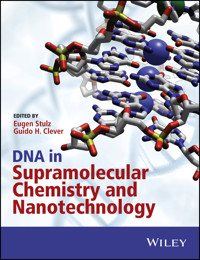
DNA in Supramolecular Chemistry and Nanotechnology E-Book
139,99 €
Mehr erfahren.
- Herausgeber: John Wiley & Sons
- Kategorie: Wissenschaft und neue Technologien
- Sprache: Englisch
This book covers the emerging topic of DNA nanotechnology and DNA supramolecular chemistry in its broader sense. By taking DNA out of its biological role, this biomolecule has become a very versatile building block in materials chemistry, supramolecular chemistry and bio-nanotechnology. Many novel structures have been realized in the past decade, which are now being used to create molecular machines, drug delivery systems, diagnosis platforms or potential electronic devices.
The book combines many aspects of DNA nanotechnology, including formation of functional structures based on covalent and non-covalent systems, DNA origami, DNA based switches, DNA machines, and alternative structures and templates. This broad coverage is very appealing since it combines both the synthesis of modified DNA as well as designer concepts to successfully plan and make DNA nanostructures.
Contributing authors have provided first a general introduction for the non-specialist reader, followed by a more in-depth analysis and presentation of their topic. In this way the book is attractive and useful for both the non-specialist who would like to have an overview of the topic, as well as the specialist reader who requires more information and inspiration to foster their own research.
Sie lesen das E-Book in den Legimi-Apps auf:
Seitenzahl: 1197
Veröffentlichungsjahr: 2015
Ähnliche




















Table of Contents
Cover
Title Page
Preface
References
List of Contributors
Part I: (Non-) Covalently Modified DNA with Novel Functions
1.1 DNA-Based Construction of Molecular Photonic Devices
1.1.1 Introduction
1.1.2 Using DNA as a template to construct discrete optoelectronic nanostructures
1.1.3 Assembly of photonic arrays based on the molecular recognition of single-stranded DNA templates
1.1.4 Assembly of photonic arrays based on the molecular recognition of double-stranded DNA templates
1.1.5 Towards the construction of photonic devices
1.1.6 Outlook
References
1.2 π-Conjugated DNA Binders: Optoelectronics, Molecular Diagnostics and Therapeutics
1.2.1 π-Conjugated compounds
1.2.2 DNA binders for different applications
1.2.3 Targeting duplex DNA
1.2.4 Examples of π-conjugated compounds interacting with hybrid duplexes and higher order nucleic acid structures
1.2.5 Conclusions
References
1.3 Metal Ion- and Perylene Diimide-Mediated DNA Architectures
1.3.1 Introduction
1.3.2 Metal ion complexes as DNA modifications: hydroquinoline and terpyridine
1.3.3 Perylene diimide-based DNA architectures
1.3.4 Conclusions
References
1.4 DNA with Metal-Mediated Base Pairs
1.4.1 Introduction
1.4.2 Metal-mediated base pairs with natural nucleobases
1.4.3 Metal-mediated base pairs with artificial nucleobases
1.4.4 Outlook
References
1.5 Metal-Aided Construction of Unusual DNA Structural Motifs
1.5.1 Introduction
1.5.2 DNA duplexes containing metal-mediated base pairs
1.5.3 Metal-aided formation of triple-stranded structures
1.5.4 Metal-aided formation of four-stranded structures
1.5.5 Metal-aided formation of DNA junction structures
1.5.6 Summary and outlook
References
Part II: DNA Wires and Electron Transport Through DNA
2.1 Gating Electrical Transport Through DNA
2.1.1 Introduction
2.1.2 DNA structure
2.1.3 Direct electrical measurements of DNA
2.1.4 Gate modulation of current flow in DNA
2.1.5 DNA transistors
References
2.2 Electrical Conductance of DNA Oligomers — A Review of Experimental Results
2.2.1 Introduction
2.2.2 DNA structures
2.2.3 Scanning probe microscopy
2.2.4 Lithographically defined junctions
2.2.5 Conclusions
References
2.3 DNA Sensors Using DNA Charge Transport Chemistry
2.3.1 Introduction
2.3.2 DNA-functionalized electrochemical sensors
2.3.3 Detection of DNA-binding proteins
2.3.4 DNA CT within the cell
2.3.5 Conclusions
Acknowledgements
References
2.4 Charge Transfer in Non-B DNA with a Tetraplex Structure
2.4.1 Introduction
2.4.2 CT in dsDNA (B-DNA)
2.4.3 CT in non-B DNA with a tetraplex structure
2.4.4 Conclusions
Acknowledgments
References
Part III: Oligonucleotides in Sensing and Diagnostic Applications
3.1 Development of Electrochemical Sensors for DNA Analysis
3.1.1 Introduction
3.1.2 Genosensors based on direct electrocactivity of nucleic bases
3.1.3 Genosensors based on electrochemical mediators
3.1.4 Genosensors based on free diffusional redox markers
3.1.5 Genosensors incorporating DNA probes modified with redox active molecules – ‘signal-off’ and ‘signal-on’ working modes
3.1.6 Genosensors for simultaneous detection of two different DNA targets
3.1.7 Conclusions
Acknowledgements
References
3.2 Oligonucleotide Based Artificial Ribonucleases (OBANs)
3.2.1 Introduction
3.2.2 Early development of OBANs
3.2.3 Metal ion based artificial nucleases
3.2.4 Non-metal ion based systems
3.2.5 Creating bulges in the RNA substrate
3.2.6 PNAzymes and creation of artificial RNA restriction enzymes
3.2.7 Conclusions
References
3.3 Exploring Nucleic Acid Conformations by Employment of Porphyrin Non-covalent and Covalent Probes and Chiroptical Analysis
3.3.1 Introduction
3.3.2 Non-covalent interaction of porphyrin–DNA complexes
3.3.3 Porphyrins covalently linked to DNA
3.3.4 Conclusions
References
3.4 Chemical Reactions Controlled by Nucleic Acids and their Applications for Detection of Nucleic Acids in Live Cells
3.4.1 Introduction
3.4.2 Intracellular nucleic acid targets
3.4.3 Methods for monitoring ribonucleic acids in live cells
3.4.4 Perspectives
References
3.5 The Biotechnological Applications of G-Quartets
3.5.1 Introduction
3.5.2 Nucleobases and H-bonds
3.5.3 Duplex-DNA mimics
3.5.4 Guanine and G-quartets
3.5.5 G-Quartets and G-quadruplexes
3.5.6 Quadruplex-DNA mimics
3.5.7 Conclusions
References
Part IV: Conjugation of DNA with Biomolecules and Nanoparticles
4.1 Nucleic Acid Controlled Reactions on Large Nucleic Acid Templates
4.1.1 Introduction
4.1.2 Nucleic acid controlled chemical reactions
4.1.3 Applications
4.1.4 Conclusions
References
4.2 Lipid Oligonucleotide Bioconjugates: Applications in Medicinal Chemistry
4.2.1 Introduction
4.2.2 Chemical approach to the synthesis of lipid–oligonucleotide conjugates
4.2.3 Biomedical applications
4.2.4 Conclusions
Acknowledgements
References
4.3 Amphiphilic Peptidyl–RNA
4.3.1 Introduction
4.3.2 Three souls alas! are dwelling in my breast [2]
4.3.3 Why RNA? Why peptides?
4.3.4 Hydrolysis-resistant amphiphilic 3′-peptidyl–RNA
4.3.5 Synthetic strategy
4.3.6 Pros’n cons
4.3.7 Alternative methods and strategies
4.3.8 Molecular properties
4.3.9 Supramolecular properties
4.3.10 Conclusions and perspectives
Acknowledgements
References
4.4 Oligonucleotide-Stabilized Silver Nanoclusters
4.4.1 Introduction
4.4.2 Sensors
4.4.3 DNA computing (logic gates)
4.4.4 Assorted examples
4.4.5 Conclusions
References
Part V: Alternative DNA Structures, Switches and Nanomachines
5.1 Structure and Stabilization of CGC
+
Triplex DNA
5.1.1 Introduction
5.1.2 Classification of DNA triplets
5.1.3 Structure of triplexes
5.1.4 Triplex stabilizing factors
5.1.5 Formation of stable CGC
+
triplex DNA
5.1.6 Summary
References
5.2 Synthetic Molecules as Guides for DNA Nanostructure Formation
5.2.1 Introduction
5.2.2 Covalent insertion of synthetic molecules into DNA
5.2.3 Non-covalently guided DNA assembly
5.2.4 Conclusions
References
5.3 DNA-Based Nanostructuring with Branched Oligonucleotide Hybrids
5.3.1 Introduction
5.3.2 Branched oligonucleotides
5.3.3 Hybrids with rigid cores
5.3.4 Second-generation hybrids with a rigid core
5.3.5 Solution-phase syntheses: Synthetic challenges
5.3.6 Hybrid materials
5.3.7 Outlook
5.3.8 Conclusions
Acknowledgements
References
5.4 DNA-Controlled Assembly of Soft Nanoparticles
5.4.1 Introduction
5.4.2 Sequence design
5.4.3 Lipid membrane anchors
5.4.4 DNA-controlled assembly studied by UV spectroscopy
5.4.5 Assembly on solid support
5.4.6 Assembly of giant unilamellar liposomes (GUVs)
5.4.7 Conclusions
Acknowledgements
References
5.5 Metal Ions in Ribozymes and Riboswitches
5.5.1 Introduction
5.5.2 Coordination chemistry of RNA
5.5.3 Ribozymes
5.5.4 Riboswitches
5.5.5 Summary
Acknowledgement
References
5.6 DNA Switches and Machines
5.6.1 Introduction
5.6.2 Ion-stimulated and photonic/electrical-triggered DNA switches
5.6.3 Switchable DNA machines
5.6.4 Applications of DNA switches and machines
5.6.5 Conclusions and perspectives
References
5.7 DNA-Based Asymmetric Catalysis
5.7.1 Introduction
5.7.2 Concept of DNA-based asymmetric catalysis
5.7.3 Design approaches in DNA-based asymmetric catalysis
5.7.4 Covalent anchoring
5.7.5 Supramolecular anchoring
5.7.6 Conclusions and perspectives
References
Index
End User License Agreement
List of Tables
Chapter 18
Table 4.4.1
The emission of AgNCs can be tuned by the selection of the oligonucleotide sequence. Selected examples are shown to illustrate this feature
Chapter 21
Table 5.3.1
UV-melting points (°C) of complexes of DNA hybrids and controls at a hybrid concentration of 4 µM and a strand concentration of 16 µM for linear controls [26, 33]
Table 5.3.2
UV-melting points (°C) of assemblies formed by branched DNA hybrids at a hybrid concentration of 10 μM [35, 36]
Chapter 22
Table 5.4.1
Influence of aza crown ether monomers
X
,
Y
on thermal DNA duplex stability
Table 5.4.2
Mismatch discrimination data from thermal denaturation experiments
List of Illustrations
Chapter 01
Figure 1.1.1
(a) Watson–Crick base-pairing is used in Nature to store genetic information and in DNA nanotechnology to direct the assembly of sophisticated multi-dimensional nanostructures. DNA analogues such as Peptide Nucleic Acids (PNA) have also been used to direct the assembly of DNA nanostructures. (b) Schematic representation of DNA origami. A single-stranded DNA template is weaved in two- and three-dimensional DNA nanostructures using a variety of oligodeoxyribonucleotide (ODN) staple strands. (c) Triplex Forming Oligonucleotides (TFOs) offer an alternative directing modality through the formation of triplex structures
Lesen Sie weiter in der vollständigen Ausgabe!
Lesen Sie weiter in der vollständigen Ausgabe!
Lesen Sie weiter in der vollständigen Ausgabe!
Lesen Sie weiter in der vollständigen Ausgabe!
Lesen Sie weiter in der vollständigen Ausgabe!
Lesen Sie weiter in der vollständigen Ausgabe!
Lesen Sie weiter in der vollständigen Ausgabe!
Lesen Sie weiter in der vollständigen Ausgabe!
Lesen Sie weiter in der vollständigen Ausgabe!
Lesen Sie weiter in der vollständigen Ausgabe!
Lesen Sie weiter in der vollständigen Ausgabe!
Lesen Sie weiter in der vollständigen Ausgabe!
Lesen Sie weiter in der vollständigen Ausgabe!
Lesen Sie weiter in der vollständigen Ausgabe!
Lesen Sie weiter in der vollständigen Ausgabe!
Lesen Sie weiter in der vollständigen Ausgabe!
Lesen Sie weiter in der vollständigen Ausgabe!
Lesen Sie weiter in der vollständigen Ausgabe!
Lesen Sie weiter in der vollständigen Ausgabe!
Lesen Sie weiter in der vollständigen Ausgabe!
Lesen Sie weiter in der vollständigen Ausgabe!
Lesen Sie weiter in der vollständigen Ausgabe!
Lesen Sie weiter in der vollständigen Ausgabe!
Lesen Sie weiter in der vollständigen Ausgabe!
Lesen Sie weiter in der vollständigen Ausgabe!
Lesen Sie weiter in der vollständigen Ausgabe!
Lesen Sie weiter in der vollständigen Ausgabe!
Lesen Sie weiter in der vollständigen Ausgabe!
Lesen Sie weiter in der vollständigen Ausgabe!
Lesen Sie weiter in der vollständigen Ausgabe!
Lesen Sie weiter in der vollständigen Ausgabe!
Lesen Sie weiter in der vollständigen Ausgabe!
Lesen Sie weiter in der vollständigen Ausgabe!
Lesen Sie weiter in der vollständigen Ausgabe!
Lesen Sie weiter in der vollständigen Ausgabe!
Lesen Sie weiter in der vollständigen Ausgabe!




