


19,99 €
Mehr erfahren.
- Herausgeber: John Wiley & Sons
- Kategorie: Fachliteratur
- Serie: J-B US non-Franchise Leadership
- Sprache: Englisch
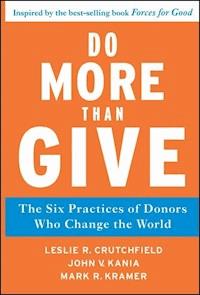
How donors change the world through the six catalytic practices of high-impact philanthropy Do More Than Give provides a blueprint for individuals, philanthropists, and foundation leaders to increase their impact. Based on Forces for Good, this groundbreaking book demonstrates how the six practices of high-impact nonprofits apply to donors aiming to advance social causes. Rather than focus on the mechanics of effective grantmaking, reporting, or evaluation, this book instead proposes that donors can become proactive catalysts for change by rising to meet the challenges of our increasingly interdependent world. Key principles include: going beyond check writing/traditional volunteering; advocating for change; leveraging business; forging peer networks; empowering individuals; leading adaptively; and developing learning organizations. * Contains robust case studies depicting every type of philanthropy (corporate, community, operating, specialized, and large private and family foundations) * Includes easy to use "Key Takeaways" tailored for donors at the "beginner" and "experienced" levels of catalytic philanthropy * Authors are internationally-acclaimed philanthropic, nonprofit, and corporate social responsibility strategy experts who frequently speak and train on high-impact philanthropy In good economic times or bad, this book provides guidance for givers to increase the impact of their charitable resources and go beyond check-writing to help solve problems and change the world.
Sie lesen das E-Book in den Legimi-Apps auf:
Seitenzahl: 394
Veröffentlichungsjahr: 2011
Ähnliche
















Table of Contents
Title Page
Copyright
Dedication
Preface
Acknowledgments
The Authors
Chapter One: Catalytic Philanthropy
Origins of Catalytic Philanthropy
Today's Golden Age
What's Different About the Catalytic Approach?
The Six Practices of Donors Who Change the World
Embracing the Future
Chapter Two: Commit to Your Cause
Getting Committed
Choosing Your Cause
Choosing Your Cause
Conclusion
Chapter Three: Practice 1: Advocate for Change
A Tale of Two Emilys
Embracing Advocacy
Corporate Lobbying—The Good Kind
Community Foundations: An Emerging Force for Policy Change
Large Private Foundations: A Long Political History
Conclusion
Chapter Four: Practice 2: Blend Profit with Purpose
Tapping Corporate Know-How
The Big Company Approach: General Electric
The Private Foundation Approach: Shell Foundation
The High-Net-Worth Individual Approach: Tom Siebel
Creating Shared Value
Investing for Impact
Using Your Vote
Using Your Cash
Conclusion
Key Principles for Blending Profit with Purpose
Chapter Five: Practice 3: Forge Nonprofit Peer Networks
The Networked Solution
The Collaborative Challenge
Amazonomics
Creating the Conditions for Change
Conclusion
Key Principles for Forging Nonprofit Peer Networks
Chapter Six: Practice 4: Empower the People
Philanthropy's Broader Picture
Hear the People Speak
The Role of Individuals in Catalytic Philanthropy
The Broader Return—And the Risks
Wiki-Philanthropy
Conclusion
Key Principles for Empowering the People
Chapter Seven: Practice 5: Lead Adaptively
Paul Grogan's Adaptive Leadership
A Broader Look at Adaptive Leadership
To Be or Not to Be an Adaptive Leader
Conclusion
Key Principles for Leading Adaptively
Chapter Eight: Practice 6: Learn in Order to Change
Learning to Learn
Learning to Help Others Learn
Conclusion
Key Principles for Learning to Change
Chapter Nine: Toward a More Catalytic Future
Appendix A: Research Methodology
Summary of the Research Process
Detailed Description of the Research Process
Appendix B: Peer Survey Questions
Appendix C: Research Advisors
Appendix D: Review of the Six Practices of High-Impact Nonprofits in Forces for Good
The Premise Behind Forces for Good
The Twelve Nonprofits Featured in Forces for Good
Appendix E: Getting Started with Catalytic Philanthropy
First, Commit to Your Cause
Practice 1: Advocate for Change
Practice 2: Blend Profit with Purpose
Practice 3: Forge Nonprofit Peer Networks
Practice 4: Empower the People
Practice 5: Lead Adaptively
Practice 6: Learn in Order to Change
Notes
Preface
Chapter One
Chapter Two
Chapter Three
Chapter Four
Chapter Five
Chapter Six
Chapter Seven
Chapter Eight
Appendix A
Appendix D
Index
Copyright © 2011 by Leslie R. Crutchfield and FSG Social Impact Advisors. All rights reserved.
Published by Jossey-Bass
A Wiley Imprint
989 Market Street, San Francisco, CA 94103-1741—www.josseybass.com
No part of this publication may be reproduced, stored in a retrieval system, or transmitted in any form or by any means, electronic, mechanical, photocopying, recording, scanning, or otherwise, except as permitted under Section 107 or 108 of the 1976 United States Copyright Act, without either the prior written permission of the publisher, or authorization through payment of the appropriate per-copy fee to the Copyright Clearance Center, Inc., 222 Rosewood Drive, Danvers, MA 01923, 978-750-8400, fax 978-646-8600, or on the Web at www.copyright.com. Requests to the publisher for permission should be addressed to the Permissions Department, John Wiley & Sons, Inc., 111 River Street, Hoboken, NJ 07030, 201-748-6011, fax 201-748-6008, or online at www.wiley.com/go/permissions.
Readers should be aware that Internet Web sites offered as citations and/or sources for further information may have changed or disappeared between the time this was written and when it is read.
Limit of Liability/Disclaimer of Warranty: While the publisher and author have used their best efforts in preparing this book, they make no representations or warranties with respect to the accuracy or completeness of the contents of this book and specifically disclaim any implied warranties of merchantability or fitness for a particular purpose. No warranty may be created or extended by sales representatives or written sales materials. The advice and strategies contained herein may not be suitable for your situation. You should consult with a professional where appropriate. Neither the publisher nor author shall be liable for any loss of profit or any other commercial damages, including but not limited to special, incidental, consequential, or other damages.
Jossey-Bass books and products are available through most bookstores. To contact Jossey-Bass directly call our Customer Care Department within the U.S. at 800-956-7739, outside the U.S. at 317-572-3986, or fax 317-572-4002.
Jossey-Bass also publishes its books in a variety of electronic formats. Some content that appears in print may not be available in electronic books.
Library of Congress Cataloging-in-Publication Data
Crutchfield, Leslie R., 1968–
Do more than give : the six practices of donors who change the world / Leslie R. Crutchfield, John V. Kania, and Mark R. Kramer.
p. cm.—(J-b us non-franchise leadership ; 390)
Includes bibliographical references and index.
ISBN 978-0-470-89144-5 (hardback)
1. Charities. 2. Charitable uses, trusts, and foundations. 3. Endowments. 4. Fund raising. 5. Social change. I. Kania, John V. II. Kramer, Mark R. III. Title.
HV40.C78 2011
361.7—dc222010053644
For Caleigh and Quinn
For Nate, Lucy, and Mia
For Toby, Elizabeth, and Benjamin
Preface
When the three of us joined together to coauthor this book, we each brought different life experiences and professional training to the project. What has united us is our urgency to find ways to make faster progress toward solving the pressing social and environmental problems that persist in the world and our shared belief that philanthropy has much to contribute to those solutions. Although countless books have been written about the difference donors and nonprofits have made in causes both local and global—advancements in understanding that we applaud and from which we have learned—we believe that donors can do even more.
For Mark, growing up in a family with a small private foundation awakened him to the idea that philanthropy could do more. He saw how isolated most family foundations were. He observed that much money could be given to hard-working nonprofits year after year with the very best of intentions but without changing much of anything. He often saw foundations that were convinced of their uniqueness and unable to learn from others' experiences. He observed family foundations that were determined to avoid overhead expense and as a result were perpetually short staffed. And he saw foundations that struggled to meet their 5 percent payout requirement—in an era when real-world needs were growing and problems were crying out for answers.
This irony—that in the face of such vast need some foundations could barely find ways to make the minimum contribution required to maintain their tax-exempt status—persuaded Mark that the system just wasn't working. These experiences formed the basis for his lifelong commitment to understanding how philanthropy's performance could be improved. In 1999, he and his friend Michael Porter established the Center for Effective Philanthropy to help define and advance foundation effectiveness, and at the same time they cofounded the consulting firm Foundation Strategy Group (FSG) to work in depth with leaders of foundations to develop and pursue effective strategies for social change. (At its founding in 1999, the consulting firm was called “Foundation Strategy Group [FSG].” The firm later officially changed its name to “FSG,” so later in the book, we refer to it as FSG.) In 2009, Mark crystallized many of the lessons he had learned from his decade of work at FSG in “Catalytic Philanthropy,” an article published in the Stanford Social Innovation Review (SSIR).1
When that edition of SSIR landed in her mailbox, Leslie was preparing to write her next book. Her first book, Forces for Good: The Six Practices of High-Impact Nonprofits, coauthored with Heather McLeod Grant, had been released in 2007. During the subsequent three years Leslie had been traveling across the United States and Canada, speaking to groups of nonprofit and philanthropic leaders about how they could achieve better outcomes if they focused on advancing larger causes and leveraging change through each sector of society—government, business, nonprofit organizations, and individuals—rather than just shoring up their own institutions. She also was advising family foundations on how to increase the impact of their giving. The more Leslie interacted with foundation leaders, the more intrigued she became with the role that philanthropy plays in creating—and sometimes holding back—social change. So she decided to write a book about applying the practices in Forces for Good to philanthropy.
At first, Leslie thought the best advice she could give donors was to use the six practices of high-impact nonprofits as a screen to guide their giving. If foundations channeled more of their funds to nonprofits that employed cross-sector approaches such as advocating for policy change or partnering with private enterprise to advance social objectives, she reasoned, they could get more bang for their charitable dollar. But she soon realized that just picking great grantees wasn't enough. She knew that donors could do more. They could fund groups that advocate, but donors were also uniquely qualified to engage in advocacy and to raise their voices on behalf of causes. Donors could support nonprofits that partner with business, but they could also leverage their business connections and know-how to advance causes.
Initially, Leslie didn't know of many good examples of this kind of giving. Then she read Mark's article on catalytic philanthropy. “This is it!” Leslie thought, “this is what high-impact philanthropy looks like.” Catalytic donors do the same things that the social entrepreneurs in Forces for Good do, they just start with a concentration of wealth rather than raising funds from scratch. So she asked Mark and also FSG managing director John Kania if they would like to team up and collaborate on this book.
John brought a final critical perspective to round out the premises in this book. He had worked for two decades in the private sector consulting to businesses. But helping companies compete for more market share wasn't fulfilling John's desire to make a meaningful difference. So shortly after the terrorist attacks on the United States on September 11, 2001, he had joined FSG to apply his strategy and organizational development background to solving social sector problems. John quickly learned just how hard it was to effect change in the social sector. Executives in business typically have much more control over the outcomes they seek to achieve than leaders in the social sector do. Making change happen in the private sector is about developing the right strategy and lining up the people inside the company to make it happen. Whereas in the social sector, change requires not only lining up the people inside an organization but also influencing the mind-set and behavior of a whole set of stakeholders outside the organization's four walls. Achieving success in the social sector requires a special type of leadership.
Recalling a divinity school course on spirituality and leadership in which he had learned about Ron Heifetz's notion of adaptive leadership, John realized that Heifetz's framework was especially applicable to addressing social and environmental challenges because social sector problems typically require adaptive rather than technical solutions. This requires leaders who can mount responses that take an organic view and that focus on system change. John coauthored (with Ron Heifetz and Mark Kramer) an article titled “Leading Boldly” that discussed how adaptive leadership ideas apply to social change,2 and he has continued to emphasize the need for this type of leadership in FSG's work with clients.
Eventually we found that the theme of leading adaptively was the common thread that bound together all of the best practices we write about in Do More Than Give. Being a catalytic donor is, at the end of the day, an act of leadership—but not the linear, command-and-control variety that most funders are used to. The best nonprofit leaders understand this, and donors who want to be equally effective agents of change embrace it as well.
This book, then, is the culmination of our attempt to codify what each of us has learned through a decade of advising donors and researching, thinking about, and experiencing philanthropy as a vehicle for social change. As you will see in the pages to come, we focus on the six highly leveraged practices that catalytic philanthropists employ to achieve systems-level change. Although we acknowledge that the concept of catalytic philanthropy itself is not new—social entrepreneurs and high-impact donors alike have been achieving wide-scale societal change for centuries—we also know that catalytic philanthropy is rare. We hope that as a result of reading this book, you will make it less so.
January 2011
Leslie Crutchfield
Washington, D.C.
John Kania
Boston, Massachusetts
Mark Kramer
Boston, Massachusetts
Acknowledgments
This book is stronger because of the combined contributions of our esteemed colleagues, trusted advisors, close friends, and family members who supported us at each step and encouraged us to complete this work.
If we were to name a fourth author to this book, that writer would not be one individual but dozens of FSG team members based around the world—from San Francisco to Seattle and from Boston to New York to Geneva—who contributed in significant ways. FSG managing directors Rebecca Graves, Fay Hanleybrown, Laura Herman, Greg Hills, Jeff Kutash, Kyle Peterson, and Marc Pfitzer were critical thought partners in the concepts, cases, and frameworks included throughout this book, and FSG executive director of strategic learning and evaluation Hallie Preskill contributed significantly to the development of our ideas on how learning happens in the social sector. We recognize FSG director of strategic communications Dana Yonchak and communications assistant Stephanie Cubell who helped disseminate our Peer Survey. And we especially thank FSG consultant Amber Johnson, whose critical insights, literate writing, and project management prowess played a significant role in every phase of our work. We also thank FSG's many clients over the past decade, whose thoughtful innovations have taught us many of the lessons that are captured in this book. It has been our great privilege to partner with and learn from such inspiring philanthropic leaders.
We extend our deep respect and gratitude to Heather McLeod Grant, who coauthored Forces for Good with Leslie. Without Heather's contributions to the development of the original six practices framework that makes up the basis for Do More Than Give, this book would not exist. Soon after the publication of Forces for Good, Heather joined Monitor Institute, where she is a senior consultant. We also extend our deep appreciation to Heather and Leslie's research partners at Duke University's Center for the Advancement of Social Entrepreneurship (C.A.S.E.) at the Fuqua School of Business, J. Gregory Dees and Beth Anderson (Beth has since moved on to work with Teach for America). And we extend our sincere thanks to Jenny Shilling Stein of the Draper Richards Foundation and to Jane Wales and Alan Abramson of the Aspen Institute.
We owe a special debt of gratitude to Paula Ellis and Alberto Ibargüen for the financial support that the Knight Foundation provided to make possible the research for Do More Than Give. And we recognize Paula for her intellectual camaraderie in codeveloping the ideas that frame this book: a former journalist and newspaper publisher, Paula brings to philanthropy a lifetime of experience in perceiving and interpreting news events as they unfold. So it is not surprising that she sees social problems as emergent, constantly changing phenomena that can't necessarily be solved through linear processes. She recommended Getting to Maybe to us—a book that expertly applies complexity theory to social innovation and that became a key influence on our thinking. We recognize our trusted thought partners whose funding also made possible this research: Paul Brest and Jacob Harold of the Hewlett Foundation; Phil Cutter, Rita Berkson, and Ben Goldhirsh of the Goldhirsh Foundation; and Sonia McCormick and Craig Pascal of PNC Bank (Craig has since moved on to another firm). We hold great admiration for the poetic and compelling insights of the authors of Getting to Maybe, Frances Westley, Brenda Zimmerman, and Michael Quinn Patton. Their research was underwritten by the J.W. McConnell Family Foundation, and we applaud that institution's bold commitment to catalyzing change nationally in Canada.
We owe very special thanks to our research advisors, who included national and global philanthropy experts who collectively devoted hundreds of hours to reviewing our online peer survey results, advising us on which examples might best illustrate catalytic approaches, and reading and commenting on manuscript drafts. These advisors were Kathy Calvin, Paula Ellis, Peter Goldmark, Jacob Harold, Darin McKeever, Tom Reis, Edward Skloot, and Diana Wells, as well as Brian Byrnes, Jack Hopkins, Dori Kreiger, Laura McKnight, and Susan Price. The ideas and the cases in this book are stronger because of each of their contributions, and we are honored to have them as our thought partners in this work.
And Leslie expresses heartfelt personal thanks to her D.C. Philanthropy Brain Trust: Katherine Bradley, Kristin Ehrhood, Ann Friedman, and Courtney Clark Pastrick. Each took the time to read and make copious comments on draft chapters, sharing her personal perspective. And to Katherine a special note of recognition is in order, for it was while consulting with CityBridge Foundation that Leslie got a first-hand glimpse of how a truly catalytic family foundation operates.
More thanks go to our friends and colleagues who gave us new ways to think about philanthropy and about framing this book—and who, as the project progressed, sympathized with our complaints and helped us devise solutions as we worked through both the creative and administrative challenges entailed in this intensive research project: Victoria Vrana, Raj Vinnakota, Trabian Shorters, Eric Kessler, Lowell Weiss, Deborah Fugenschuh, and members of Incito. Our great appreciation goes out as well to FSGers who spent countless hours working to improve and complete our manuscript: Mike Stamp, Valerie Bockstette, Tracy Foster, Matthew Rehrig, Roxann Stafford, Sadie Peckens, Mary Pietrusko, and Cathy Severance.
To our editors at Jossey-Bass/Wiley, Allison Brunner and Kathe Sweeney, and to our literary agent, Rafe Sagalyn, we extend our sincere thanks. Allison and Rafe advocated for this book from the start and supported us each step of the way. And when Allison departed Wiley, Kathe expertly carried it over the finish line. Thanks also to Wiley editors Alan Venable and Alan Shrader, who helped us sharpen our prose and streamline our thinking. And to Eric Nee and Regina Ridley of the Stanford Social Innovation Review (SSIR): We appreciate your extending to each of us opportunities to contribute to SSIR over the years and allowing us to adapt portions of these pieces for publication in this book. We are also indebted to Ron Heifetz for introducing the ground-breaking concepts of adaptive leadership to the field, and for his partnership with FSG in applying those concepts to social sector challenges.
On a personal note, we express our appreciation for and love of our spouses, Holly Kania and Anthony Macintyre, and for our extended families for giving us moral support and the scheduling flexibility to get this book done. We recognize that precious vacation days, sabbatical time, and more than one travel adventure were sacrificed in order to complete this work, and we are grateful to our loved ones for their patience with us. (They will not soon let us forget that Leslie awakened before dawn to write on her family's beach vacation, John e-mailed comments between jeep rides in Malawi, and Mark filed chapters from a sick bed in India.)
Finally, we have dedicated this book to our children: to Nate, Lucy, and Mia and to Caleigh and Quinn in the hope that they will be so fortunate as to one day be in a position to do more than give, and to Toby, Elizabeth, and Benjamin in recognition of their having already demonstrated the commitment and ability to do so.
The Authors
Leslie R. Crutchfield is an author, speaker, philanthropic and nonprofit advisor, and leading authority on scaling social innovation and high-impact philanthropy. She is a senior advisor with FSG, and coauthor with Heather McLeod Grant of the critically acclaimed book, Forces for Good: The Six Practices of High-Impact Nonprofits, recognized by the Economist on its best business books of 2007 list. Leslie guides nonprofit and philanthropic organizations in the United States and abroad on how to increase their impact. She has served as managing director and director at Ashoka, and she cofounded and ran a nonprofit social enterprise that published a national magazine for social entrepreneurs and growing nonprofits. Leslie is frequently invited to lecture at domestic and international events and to conduct workshops and private training sessions for nonprofit and philanthropic leaders. She is an active media contributor whose work has been featured in the Washington Post, Fast Company, the Chronicle of Philanthropy, and the Stanford Social Innovation Review, and she has appeared on such networks as ABC, NPR (National Public Radio), and PBS. She serves on the boards of the SEED Foundation and Kiva, and she has volunteered with Crossroads Africa. Leslie holds MBA and BA degrees from Harvard University.
John V. Kania is a managing director at FSG and brings twenty-five years' experience in advising senior management on issues of strategy, leadership, organization development, and change management. At FSG, John leads strategic planning and evaluation efforts for foundations, nonprofits, and corporate philanthropy, on issues ranging from international health, U.S. health care, and U.S. education to the environment, community development, and nonprofit capacity building. He has developed numerous applications of FSG's strategy and problem-solving tools for the social sector. Prior to joining FSG, John was a partner at both Mercer Management Consulting and Corporate Decisions, Inc. He has been published in the Stanford Social Innovation Review, the Wall Street Journal, and the Journal of Business Strategy and is a featured author of Learning from the Future. John speaks frequently on improving the impact of philanthropy and corporate social responsibility. He has an MBA degree from Northwestern University's Kellogg Graduate School of Management and a BA degree from Dartmouth College.
Mark R. Kramer is cofounder and a managing director at FSG and a Senior Fellow in the Corporate Social Responsibility Initiative at the Mossavar-Rahmani Center for Business in Government at Harvard University's Kennedy School of Government. Together with Harvard Business School Professor Michael Porter, he cofounded the Center for Effective Philanthropy and served as the center's initial board chair from 2000 to 2004. Mark has spoken and published extensively on topics in catalytic philanthropy, corporate social responsibility, evaluation, social entrepreneurship, venture philanthropy, and impact investing. He is the coauthor, with Michael Porter, of several influential Harvard Business Review articles, and has published extensively in the Stanford Social Innovation Review and in the Chronicle of Philanthropy and has been quoted by the Financial Times, the Economist, and NPR. Prior to founding FSG, Mark served for twelve years as president of Kramer Capital Management, a venture capital firm, and before that he was an associate at the law firm of Ropes & Gray in Boston. He received a BA degree from Brandeis University, an MBA degree from The Wharton School, and a JD degree from the University of Pennsylvania Law School.
About FSG. FSG is a nonprofit social impact consulting firm founded by Harvard Business School Professor Michael Porter and Mark Kramer specializing in research, strategy, and evaluation, originally founded in 2000 as Foundation Strategy Group. Today FSG works across sectors in every region of the globe—partnering with foundations, corporations, nonprofits, and governments—to develop more effective solutions to the world's most challenging issues. The FSG team is passionate about finding better ways to solve social problems by leveraging the power of philanthropy, government, and private enterprise to build a more effective social sector. With offices in Boston, Geneva, San Francisco, Seattle, and Washington, D.C., FSG has completed more than 400 consulting engagements, published articles in the Harvard Business Review and the Stanford Social Innovation Review, and produced dozens of research reports designed to advance social sector thinking and practice. Its work has been featured in the New York Times, the Wall Street Journal, the Economist, and the Financial Times and on NPR, among other media. Learn more about FSG at www.fsg.org.
Chapter One
Catalytic Philanthropy
“What business are you in?”
Peter Drucker, the renowned author and management expert, regularly posed this naive-sounding question to corporate executives whom he advised. How a donor answers this query can reveal a lot about his or her approach to philanthropy too.
Most foundation leaders and individual donors might answer that they are in the business of “giving away money.” These funders define their philanthropic purpose as making grants to worthy charities. Many do so with great thought and care. Some are exceptionally strategic in their approach, guiding their grantmaking with highly refined theories of change.
Lesen Sie weiter in der vollständigen Ausgabe!
Lesen Sie weiter in der vollständigen Ausgabe!
Lesen Sie weiter in der vollständigen Ausgabe!
Lesen Sie weiter in der vollständigen Ausgabe!
Lesen Sie weiter in der vollständigen Ausgabe!
Lesen Sie weiter in der vollständigen Ausgabe!
Lesen Sie weiter in der vollständigen Ausgabe!
Lesen Sie weiter in der vollständigen Ausgabe!
Lesen Sie weiter in der vollständigen Ausgabe!
Lesen Sie weiter in der vollständigen Ausgabe!
Lesen Sie weiter in der vollständigen Ausgabe!
Lesen Sie weiter in der vollständigen Ausgabe!
Lesen Sie weiter in der vollständigen Ausgabe!
Lesen Sie weiter in der vollständigen Ausgabe!
Lesen Sie weiter in der vollständigen Ausgabe!




