Table of Contents
Praise
The AFP Fund Development Series
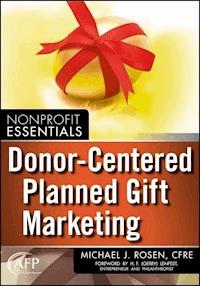
Title Page
Copyright Page
Dedication
Foreword
Preface
Acknowledgments
CHAPTER 1 - Introduction to Donor-Centered Marketing
Take Care of Donors: A Lesson from Aesop
Planned Gift Marketing for All Organizations
Percentage of Americans with a Planned Gift
Five Common Myths about Planned Giving
There Has Never Been a Better Time
An Illustration of Donor-Centered Fundraising
Proactive versus Reactive Planned Giving
Stepping Stones to a Successful Planned Giving Program
Summary
Exercises
CHAPTER 2 - Identify Who Makes Planned Gifts
Everyone Is a Planned Gift Prospect
General Characteristics of Planned Givers
The Priority-Prospect Equation
Factors That Impact Ability
Factors That Impact Propensity
Factors That Impact Social Capital
Pros and Cons of Information
Basic Prospect Data
Prospect Rating
Summary
Exercises
CHAPTER 3 - Identify What Motivates Planned Gift Donors
Manipulation versus Motivation versus Inspiration
What People Want
Demographic Factors Impacting Motivation
General Individual Motives
Organizational Factors
Bequest-specific Motives
Demotivating Factors
Summary
Exercises
CHAPTER 4 - Educate and Cultivate Planned Gift Prospects
The Need for Education and Cultivation
Create a Planned Giving Brand Identity
Fundamental Strategic Approach
Words Matter
Keep Messages Meaningful and Memorable
Existing Materials
Direct Mail
Telephone
Newsletters
Web Site
E-mail
Social Networking Technology
Events
Face-to-Face Visits
Advertising
Summary
Exercises
CHAPTER 5 - Educate and Cultivate Professional Advisors
Build Win-Win Relationships with Donor Advisors
Six Exchanges of Value
The Planned Giving Advisory Council
Defining and Evolving Roles
The Planned Gift Advisory Council and Its Members
Five Practices for Working with Donor Advisors
Summary
Exercises
CHAPTER 6 - The Ask
Good Things Come to Those Who Ask
Using Direct Mail to Ask for Gifts
Using the Telephone to Ask for Gifts
Meeting Face-to-Face for the Ask
Different Ask Scenarios When Meeting with a Prospective Donor
Donors Make Marketing Recommendations
Summary
Exercises
CHAPTER 7 - Stewardship
Stewardship Closes the Circle
Thank Donors Quickly and Frequently
Recognize Planned Gift Donors
Reporting to Donors
Internal Stewardship
Summary
Exercises
CHAPTER 8 - Getting Started
Is Your Organization Ready?
Getting Organizational Acceptance
Case for Support
Gaining Staff Acceptance
Building the Marketing Plan
Evaluating the Marketing Effort
Summary
Exercises
APPENDIX A - Planned Gift Program Potential Worksheet
APPENDIX B - Bequest Confirmation Form
APPENDIX C - Sample Internal Case for Donor-Centered Philanthropic Planning: ...
APPENDIX D - Cost to Raise a Planned Gift Dollar Worksheet
Glossary
Notes
References
About the Author
Index
Praise forDonor-Centered Planned Gift Marketing
“I would like to see nonprofit leaders, fundraisers, and their key board members embrace the essential knowledge this book contains on how to create and improve a most critical component to every organization’s development effort—a donor-centered planned gift marketing program.”
—H.F. (Gerry) Lenfest, entrepreneur and philanthropist
“Never has there been a better time to talk about planned giving. It is an effective tool for developing resources for an organization and it is a meaningful way to truly engage with one’s donors. This book provides a thorough roadmap for both the nonprofit that needs to start and the nonprofit that needs to expand their efforts in developing an effective, well-planned, and successful development effort using planned giving.”
—R. Andrew Swinney, President, The Philadelphia Foundation
“Michael’s book is the first of its kind to place the emphasis on the planned giving donor right from the start. In marketing our planned giving programs, we traditionally focus on promoting the organization, then we spotlight the donors. Jumpstart or enhance your planned giving program with this book and, no doubt, your organization will be in a wonderful position to get the planned gifts it deserves.”
—Laura Fredricks, JD, author of The ASK:How to Ask for Support for Your Nonprofit Cause,Creative Project, or Business Venture
“Rosen has artfully crafted an insightful, inspirational, and comprehensive road map for discerning planned gift donor engagement. By using the strategies and stories in Donor-Centered Planned Gift Marketing, professionals at all levels of proficiency can optimally engage and steward a donor’s passion and purpose for a better world through significant and heart-felt gift planning that will last more than their lifetime. This is a win-win book for all who care about future generations and vibrant communities.”
—Margaret May Damen, CFP, CLU, ChFC, CDFA founder, The Institute for Women and Wealth, Inc.; coauthor of Women,Wealth and Giving: The Virtuous Legacy of the Boom Generation
“Rosen writes with a clarity that displays his depth of knowledge and breadth of experience. He articulates principles that will benefit everyone from CEOs and chief development officers to experienced gift planners and part-time fund raisers. Vivid illustrations from colleagues throughout the United States make the concepts very real and practical. Donor-Centered Planned Gift Marketing is an indispensible handbook for anyone who wants to achieve planned giving success.”
—Robert E. Fogal, PhD, ACFRE, CAP, Minister of Philanthropy, Pennsylvania Southeast Conference of the United Church of Christ
“This is one of those rare books that delivers more than it promises, and it will appeal to the specialist and generalist alike. It not only makes a case for a new approach to marketing, as the title would suggest, but it is also a practical guide for the entire process of planned giving, easy to understand because of the clear style and numerous examples, and with exercises to implement what is learned.”
—Frank Minton, Senior Advisor, PG Calc; founder, Planned Giving Services; Past Chair, American Council on Gift Annuities
“The number one training topic requested by PPP members is planned gift marketing. Michael Rosen answers that need with a well-organized approach, interesting anecdotes, a reader-friendly writing style, and a wealth of practical information.”
—Tanya Howe Johnson, CAE, President and CEO, Partnership for Philanthropic Planning
“Donor-Centered Planned Gift Marketing by Michael Rosen is a comprehensive, well-researched and practical guide to the marketing of planned gifts via a donor-centered process. The book will be of interest to both those new to planned giving and those seeking to take their program to a higher level.”
—Philip B. Cubeta, CLU, ChFC, MSFS, CAP, The Sallie B. and William B. Wallace Chair of Philanthropy, The American College
“Michael Rosen’s Donor-Centered Planned Gift Marketing should become the Bible for anyone seeking to raise money from planned gifts. His donor-centered approach combined with useful examples and a wealth of practical tips and helpful hints, makes the book a must-have reference for anyone working in gift planning.”
—Phyllis Freedman, President, founder, SmartGiving; The Planned Giving Blogger
The AFP Fund Development Series
The AFP Fund Development Series is intended to provide fund development professionals and volunteers, including board members (and others interested in the nonprofit sector), with top-quality publications that help advance philanthropy as voluntary action for the public good. Our goal is to provide practical, timely guidance and information on fundraising, charitable giving, and related subjects. The Association of Fundraising Professionals (AFP) and Wiley each bring to this innovative collaboration unique and important resources that result in a whole greater than the sum of its parts. For information on other books in the series, please visit:
http://www.afpnet.org
The Association of Fundraising Professionals
The Association of Fundraising Professionals (AFP) represents over 30,000 members in more than 207 chapters throughout the United States, Canada, Mexico, and China, working to advance philanthropy through advocacy, research, education, and certification programs.
The association fosters development and growth of fundraising professionals and promotes high ethical standards in the fundraising profession. For more information or to join the world’s largest association of fundraising professionals, visit www.afpnet.org.
2010-2011 AFP Publishing Advisory Committee
CHAIR: D. C. Dreger, ACFRE
Director of Campaigns for the Americas, Habitat for Humanity International
Angela Beers, CFRE
Director of Development, Devereux Pocono Center
Nina P. Berkheiser, CFRE
Principal Consultant, Your Nonprofit Advisor
Linda L. Chew, CFRE
Development Consultant
Stephanie Cory, CFRE, CAP
Director of Development, The Arc of Chester County
Patricia L. Eldred, CFRE
Director of Development, Independent Living Inc.
Samuel N. Gough, CFRE
Principal, The AFRAM Group
Larry Hostetler, CFRE
Director of Marketing and Fund Development, Sierra Vista Child & Family Services
Audrey P. Kintzi, ACFRE
Director of Development, Courage Center
Steven P. Miller, CFRE
Director of Individual Giving, American Kidney Fund
Robert J. Mueller, CFRE
Vice President, Hospice Foundation of Louisville
Maria Elena Noriega
Director, Noriega Malo & Associates
Paula K. Parrish, CFRE
Director of Advancement, Fort Worth Country Day
Michele Pearce
Director of Development, Consumer Credit Counseling Service of Greater Atlanta
Leslie E. Weir, MA, ACFRE
Director of Family Philanthropy, The Winnipeg Foundation
Sharon R. Will, CFRE
Director of Development, South Wind Hospice
Timothy J. Willard, PhD, CFRE
Vice President for Development, Ranken Technical College
John Wiley & Sons, Inc.:
Susan McDermott
Senior Editor
AFP Staff:
Rhonda Starr
Vice President, Education and Training
Reed Stockman
AFP Staff Support
Copyright © 2011 by Michael J. Rosen. All rights reserved.
Published by John Wiley & Sons, Inc., Hoboken, New Jersey.
Published simultaneously in Canada.
No part of this publication may be reproduced, stored in a retrieval system, or transmitted in any form or by any means, electronic, mechanical, photocopying, recording, scanning, or otherwise, except as permitted under Section 107 or 108 of the 1976 United States Copyright Act, without either the prior written permission of the Publisher, or authorization through payment of the appropriate per-copy fee to the Copyright Clearance Center, Inc., 222 Rosewood Drive, Danvers, MA 01923, (978) 750-8400, fax (978) 646-8600, or on the Web at www.copyright.com. Requests to the Publisher for permission should be addressed to the Permissions Department, John Wiley & Sons, Inc., 111 River Street, Hoboken, NJ 07030, (201) 748-6011, fax (201) 748-6008, or online at http://www.wiley.com/go/permissions.
Limit of Liability/Disclaimer of Warranty: While the publisher and author have used their best efforts in preparing this book, they make no representations or warranties with respect to the accuracy or completeness of the contents of this book and specifically disclaim any implied warranties of merchantability or fitness for a particular purpose. No warranty may be created or extended by sales representatives or written sales materials. The advice and strategies contained herein may not be suitable for your situation. You should consult with a professional where appropriate. Neither the publisher nor author shall be liable for any loss of profit or any other commercial damages, including but not limited to special, incidental, consequential, or other damages.
For general information on our other products and services or for technical support, please contact our Customer Care Department within the United States at (800) 762-2974, outside the United States at (317) 572-3993 or fax (317) 572-4002.
Wiley also publishes its books in a variety of electronic formats. Some content that appears in print may not be available in electronic books. For more information about Wiley products, visit our web site at www.wiley.com.
Library of Congress Cataloging-in-Publication Data:
Rosen, Michael J.
Donor-centered planned gift marketing/Michael J. Rosen. p. cm. - (The AFP fund development series)
Includes index.
ISBN 978-0-470-58158-2 (pbk); ISBN 978-0-470-91531-8 (ebk); ISBN 978-0-470-91532-5 (ebk); ISBN 978-0-470-91533-2 (ebk)
1. Deferred giving-United States. 2. Deferred giving. 3. Fund raising. I. Title.
HV41.9.U5R.15’ 224-dc22
2010018597
This book is dedicated to my parents, Evelyn and Bernard, who were the first to teach me about the transformative power of philanthropy.
It is also dedicated to my best friend and wife, Lisa, who is both my motivation and inspiration. She reminds me every day of what is most important. “All the world . . .”
Foreword
Gerry Lenfest
Throughout my life—whether serving as an officer in the U.S. Navy, a lawyer for Walter Annenberg’s Triangle Publications, or a cable television entrepreneur—I learned that achievement comes not only from hard work but from working effectively with others. In my life, I have been very fortunate. I have been surrounded by many talented people and have enjoyed success. In more recent years, I have had the opportunity to share a fine portion of my good fortune and also share some of my insights to benefit many worthwhile nonprofit organizations. It is my hope that they were both equally valuable in advancing these various good causes.
I have seen firsthand how the staff and volunteers at most nonprofit organizations work tirelessly to improve our society whether through education, art and culture, health care, conservation, social action, or other causes. Most of these dedicated people also realize, as did I, that they cannot achieve their goals alone. Most understand that they must work effectively with staff and volunteers, of course, but also with their donors.
Through my voluntary work with nonprofit organizations, I have seen the tremendous power of planned giving. I have always known that some of the most prominent names in philanthropy—for example, Rockefeller, Carnegie, Astor and, more recently, Annenberg—have left lasting philanthropic legacies through significant planned gifts that have established or transformed nonprofit institutions. But I have also seen that the impulse to support worthwhile causes is present and also acted upon by those of more modest means.
Planned gifts are the major gifts of the middle class and such gifts, cumulatively, have a significant impact. Such gifts also have great meaning for the donors themselves. When it is part of estate planning, planned giving can offer a means to help donors take care of their families in ways not otherwise available to them, and yet still provide added support to the charitable causes they cherish.
No organization is too small to benefit from having a planned gift endeavor as a critical component of its development program. It can be very tempting for charities to focus limited resources only on immediate, annual giving, or short-term pledges such as for capital campaigns. However, for any nonprofit organization to achieve long-term sustainability, it must incorporate, at the very least, the fundamentals of a planned gift program.
Part of the beauty of planned giving is that virtually any organization and any donor can participate. While the largest nonprofit organizations may offer comprehensive gift planning programs, even the smallest charities can encourage donors to make a gift of appreciated stock, a contribution from a retirement fund, or to leave something to the organization in their will. Planned giving is not something that should be restricted to the wealthiest of philanthropists or the largest of organizations. Enabling such giving opportunities creates a win-win scenario for organizations and their donors.
So, I have long asked: If planned giving is so good for both nonprofit organizations and the donors who support them, why don’t more organizations have a planned giving program? And, among those that do, why are those programs not more effectively presented? Why do they often target only a handful of the organization’s wealthiest donors when smaller, steady donors are proven to be among the best candidates for a planned gift?
Donor-Centered Planned Gift Marketing is a book that addresses the myths that might be holding back some organizations. It encourages all organizations to engage in some level of planned giving. And then, in a well-researched and comprehensive way, the book provides useful information that will help charities new to planned giving get started. It also provides practical tips about how existing gift planning programs can achieve even greater results. This is complex information presented in a readable, compelling, and useful format. And there are some great anecdotes from professionals in the field sprinkled throughout the chapters.
Success in a planned giving program starts with a potential donor’s interest in the organization and its work. If what the organization does is not personally meaningful to the potential donor, all the planned giving techniques do not matter. This book is right on target in terms of “donor-centered marketing.”
Knowing your prospects and understanding what motivates them are two critical steps in the process. Quite simply, you cannot skip cultivation and relationship building and expect a successful outcome.
To inspire planned gift support, charities must be truly committed to a planned giving program, regardless of how sophisticated the initial structure is. This means that boards of directors must support development teams with the necessary staff and budget resources. It also means that board members and senior staff should commit to making their own planned gifts. Showing true support for planned giving by making such gifts is leadership by example. It is essential.
When my own business success and good fortune became public knowledge, the charitable causes I had been supporting were swift to include me on their short lists of important planned gift prospects. I suddenly had a lot of requests for face-to-face meetings. But I was no less inclined to create a planned gift to benefit these organizations at other steps along my career path—yet rarely did my moderate but steady support trigger an approach to discuss planned gift options. That was a lost opportunity for many of these charities. Such opportunities are lost by organizations of all sizes every day when they neglect to learn more about their steady donors of all levels and what it would take to inspire them to do something more than write an annual check.
This book underscores my own belief that the propensity to give to an organization (that is, the frequency and consistency of gifts) may be more important than the capacity to give (the wealth of the donor). In short, everyone can “leave a legacy,” not just the wealthy. And each one of those gifts will add up to some major support for an organization in the long run. So, everyone should be given the opportunity to do so. All charities need to help people understand the importance of planned giving, let people know that planned gifts are for everyone, educate people about how to make planned gifts, and ask more people for such gifts.
Once gifts are secured, it is essential that institutions find creative ways to “credit” and celebrate each planned gift donor. Remember, any planned gift donor is a major gift donor. Those of us who make planned gifts do not expect, nor do we want, lavish thank-you presents or excessive recognition. However, we do want to know that the organizations we support appreciate our philanthropy and will use our gift in the way we intend. So, do not make the mistake of forgetting about us once you receive our gift commitment. We may truly appreciate how efficiently and effectively you handle contributed funds so much that we entrust you with another planned gift. We are also in a position to influence others to do the same, so bringing together current and prospective planned gift donors for an informational event may have a very good outcome. Publishing stories—with or without the use of the donor’s name—can show prospects the many backgrounds of planned gift donors. Even a reluctant philanthropist may be urged to serve as an example for others to follow.
As you read this book, remember that if more nonprofit organizations engage in gift planning, and if those who already do begin to do a more effective job, then dramatically more dollars will be made available to charities to do their good work—now and in the future. Organizations need to commit to planned giving, put donors first, and ask more people in the right way to make planned gifts. Working together, nonprofit organizations and donors can ensure the sustainability of organizations that make our communities, our nation, and our world a better place.
I would like to see nonprofit leaders, fundraisers, and their key board members embrace the essential knowledge this book contains on how to create and improve a most critical component to every organization’s development effort—a donor-centered planned gift marketing program.
About the Foreword Author
H.F. (Gerry) Lenfest is a philanthropist and businessman who lives in the Philadelphia area. Mr. Lenfest graduated from Mercersburg Academy, Washington and Lee University, and Columbia University Law School. After practicing law as an estates and trusts attorney in New York, Mr. Lenfest joined Walter Annenberg’s Triangle Publications in 1965 where he eventually became publisher of Seventeen magazine and managed the company’s cable television operations.
In 1974, Mr. Lenfest purchased Triangle’s two cable franchises with 7,600 customers and built the new company, Suburban Cable, into one of the largest in the country with over 1 million subscribers. In 2000, the Lenfest family sold Suburban Cable to Comcast Corporation and since that time Mr. Lenfest has devoted his efforts to philanthropy and leading nonprofit organizations.
Mr. Lenfest is Chairman of the Board of The Lenfest Foundation, which he and his wife, Marguerite, founded in 2000. Through the Foundation and personally, the Lenfests have made charitable grants and gift commitments of over $800 million as of the time of this writing.
Mr. Lenfest is Chairman of the Board of the Curtis Institute of Music in Philadelphia and is Chairman of the James Madison Council of the Library of Congress in Washington, DC. He is the founding Chairman of the Board of The American Revolution Center, which will be located in Philadelphia and will be the definitive museum of the American Revolution.
Mr. Lenfest just completed nine years of service as Chairman of the Board of the Philadelphia Museum of Art and continues to chair its planned giving donors’ recognition organization, The Fiske Kimball Society.
Mr. Lenfest is a member of the Board of Trustees of Columbia University and chairs the university’s 1754 Society, its honorary society for those who have made planned gifts to the university.
Preface
Once upon a time in the long, long ago, I began to learn about philanthropy and fundraising. I was eight years old, and wanted my parents to buy me some comic books. My mother said that she would get me any “real” book I wanted but, if I wanted comic books, I would have to spend my allowance. Well, in those days, an allowance was not an entitlement; I had to earn it by doing household chores. Sadly, I was already at my maximum earning capacity. And, I had no more money for the latest edition of Superman.
Because I simply had to have the latest Superman comic book, I asked my mother if I could sell my old comic books and open up a lemonade stand to generate some quick cash. Fortunately, she granted her permission.
My first entrepreneurial effort was a terrific success. I generated what in today’s dollars would be about $150. As an eight-year-old kid, I was rich! Recognizing that I did not need to buy quite that many comic books, my mother suggested I give half of it away to charity. She further said that, if I agreed with her suggestion, I could pick whatever charity I wanted.
At the time, our local newspaper operated a fund to send “poor, inner-city” kids to summer recreational camp. I grew up in the suburbs. However, my cousin grew up in the big city. I knew how miserable summertime in the city could be for a kid. I knew how good I had it, even with our meager working-class lifestyle. I wanted other kids to enjoy the clean air and open spaces that I enjoyed. So, I took my coffee can with half of my earnings and marched into that local newsroom. The editor was so moved that he had my picture taken and put me on the front page! My little eight-year-old ego swelled. I was inspired for each of the next several summers to run a front-yard fair for that summer camp fund. The only changes were that I gave 100 percent of the revenue to the charity and the event got bigger each year. It even inspired similar efforts in other neighborhoods.
Part of my success with the fairs came from learning what the other neighborhood kids wanted and then delivering it. For example, I developed a game that allowed the older kids to purchase wet sponges. For 25 cents, they could hurl three soaking sponges at my friends and me. We taunted the big kids mercilessly. They knew they were not allowed to beat us up, so they just kept buying wet sponges to exact their vengeance. Sure, we got wet, but it was good, summertime fun and we were exacting more support from kids who enjoyed the chance to have at us. It was a win-win scenario.
I can trace the roots of both careers I have had in my adult life—journalism and development—back to that little boy’s experience. I learned a great deal about fundraising in those days, especially about what it takes to inspire donors to support a good cause. I also learned how good it feels to be philanthropic.
Even at eight years old, I instinctively knew to be donor-centered. Of course, I did not know that was what I was doing. But, I was doing it nevertheless. Throughout my professional fundraising career, I have purposely and routinely adopted a donor-centered orientation. Stephen F. Schatz, CFRE and I successfully employed donor-centered fundraising principles at Temple University in 1980, long before it was popular to do so. We felt compelled to expand and build on the model we created, and so we later cofounded The Development Center (originally known as Telefund Management, Inc.). We achieved our tremendous results, for clients across the nation, by remaining donor-centered.
Now, I want to share with you how such donor-centered gift marketing can help your prospective planned gift donors, your organization, and you.
Before I tell you what valuable tools and insights this book will provide for you, I want to share with you what this book will not do. This book will not provide a comprehensive description of how to run a planned giving program. It will not discuss how to staff a planned giving program. It will not cover how to hire and train gift planning professionals. It will not even detail the many gift planning vehicles, though it will briefly touch upon some.
I am not a planned giving expert. In fact, when I began preparations in 1993 for the Certified Fund Raising Executive exam, the one area that I had to study, in particular, was planned giving. Until then, my career had focused quite successfully on annual giving, capital campaigns, and membership marketing. As I left the CFRE exam room in 1994, the only thing I remember thinking was, “Thank goodness that’s over! Now, I can forget all that planned giving stuff I studied so hard.” I could not have been more wrong. My career as a fundraising and marketing innovator naturally evolved into planned gift marketing as I saw the opportunity to apply the principles that had worked so dramatically well in other areas of fundraising. I have now spent the last several years helping nonprofit organizations throughout the United States enhance their planned gift marketing efforts. But, I am still not a gift planning expert; what I am is a highly effective planned gift marketer whose efforts have helped nonprofit organizations generate potentially hundreds of millions of dollars in planned gifts. So, through my own expertise and that gleaned from dozens of recognized leaders in the field, what I will teach you is how to effectively market planned giving.
This book will help you understand the differences between donor-centered planned gift marketing and traditional marketing. Whether you read this book cover to cover or use it as a reference, you will learn useful ideas that will dramatically enhance your fundraising results.
If you are new to gift planning, this book will help you build an effective planned gift marketing program from the start. If your organization is already engaged in gift planning, this book will help you enhance your efforts. As you read this book, you may find it describes some techniques you are currently using; this will validate your efforts and help you justify them to those within your organization. You will also find many fresh ideas that you can put to use with confidence to enhance your results.
This book is organized according to the stages of the marketing process. Following an introductory chapter in which the donor-centered concept is presented and defined, there are chapters dealing with prospect identification, prospect motivation, education and cultivation of prospects, education and cultivation of professional advisors, the ask, stewardship, and putting it all together so you can implement your own, highly effective donor-centered planned gift marketing effort.
As you read each chapter, you will come across In the Real World, a feature box that contains true stories and examples, many generously contributed by planned giving professionals from around the nation. You will also come across Key Concepts that will provide quick tips and Executive Insights that will include important quotes offering further perspective. These “extras” have been inserted into the text at appropriate points and are intended to be read in-line to illustrate the points of the text. At the end of each chapter, you will find a number of Exercises that will help you to begin to put the material into practical use. The appendices and supplemental inclusions will provide you with additional material that you will also find of value and use.
After reading this book, I hope you will be inspired to adopt or maintain a donor-centered approach. If you do, you will have much happier, more trusting donors who will give more often and more generously than would otherwise be the case. I also hope you will be encouraged to actually ask more prospects to make a planned gift commitment. If you want more gifts, you have to ask more people. With relatively minor enhancements to the way we do planned gift marketing, we can raise dramatically more money for our organizations.
In my faith tradition, Judaism, we have the precept of tikkun olam, “repair the world,” which is incumbent upon each of us to incorporate into our everyday lives. Virtually all faiths advocate a similar concept of doing good works and helping those in need. All of us who serve the nonprofit community are doing something to improve the quality of life, now and into the future. We are repairing the world one small step at a time. Whether our organizations educate, entertain, inspire, heal, provide hope, feed, build, or work in numerous other ways, they make our communities, our country, and our world a better place. When we more successfully secure the resources necessary for these organizations to do their essential jobs more effectively, we practice tikkun olam in its many incarnations.
This book has been written to help you to be a more effective planned gift marketer. It is designed to show you how to more successfully secure the resources your organization needs by recognizing that putting the donor’s needs first will pave the way to inspiring them to make the philanthropic commitments they truly would like to make. Together, I hope we will be able to do more to make a brighter future. Tikkun olam. Together, let us always work toward achieving increased success in our endeavors to repair the world and to show others a clear path to allow them to do the same.
Acknowledgments
Writing this book has been the single greatest challenge of my professional life. I never would have undertaken such an ambitious project were it not for the invitation of Nina P. Berkheiser, CFRE, Chair, and her AFP Publishing Advisory Committee colleagues. I thank the Committee for the confidence they showed in me and the opportunity they provided for me to give back to a profession I care about so passionately.
I also want to thank legendary fundraiser and author James M. Greenfield, FAHP, ACFRE, President and CEO of J.M. Greenfield & Associates who most recently co-authored Internet Management for Nonprofits: Strategies, Tools and Trade Secrets. Jim was the first person to respond to my public call for planned giving stories and helpful tips. In addition to graciously providing material for this book, Jim also offered some simple words of encouragement that came at just the right times.
Many others have also been of enormous assistance to me on this project, offering both advice and material. Those who have been extraordinarily generous have been Roger Ellison, CFP, West Texas Rehabilitation Center Foundation; Laura Fredricks, JD, Laura Fredricks LLC and author of The Ask; Scott R.P. Janney, EdD, CFRE, RFC, PlannedGiving.com and Main Line Health; Bruce Makous, CFRE, CAP, ChFC, Barnes and Roche; Viken Mikaelian, PlannedGiving.com; James Pierson, PlannedGiving.com; Brian M. Sagrestano, JD, CFRE, Gift Planning Development; Larry Stelter, The Stelter Company and author of How to Raise Planned Gifts by Mail; Nathan Stelter, The Stelter Company; and Robert E. Wahlers, MS, CFRE, Meridian Health Affiliated Foundations. These fundraising experts have enriched this book by kindly sharing significant amounts of material which will enormously benefit readers. I thank them for their materials, their support, their open collegiality, and their friendship.
This book has also been enriched by the many stories, useful insights, and helpful tips that have been contributed by Mindy Aleman, CFRE, APR, Kent State University; Ann Barden, Oregon Health & Science University Foundation, Doernbecher Children’s Hospital Foundation; Leslie D. Bram, Esq., the University of Florida Foundation; Susan Blair Brandt, CFRE, Jupiter Medical Center Foundation; Jim Brozo, CFRE, CSPG, Grossmont Hospital Foundation; Robert J. Crandall, CFRE, Robert J. Crandall and Associates; Tom Cullinan, Schola Donum Inc.; Margaret May Damen, CFP, CLU, ChFC, The Institute for Women and Wealth and author of Women, Wealth and Giving; Elizabeth Tice Eiesland, JD, Youth & Family Services Foundation; Heather Gee, CFRE, CAP, The Philadelphia Foundation; John Gillon, Wake Forest University Baptist Medical Center; Steven C. Greaves, Quinnipiac University; Ed John, United Way Worldwide; John B. Kendrick, The George Washington University; Jane B. Kolson, The George Washington University; Donald W. Kramer, Esq., Montgomery McCracken Walker and Rhoads and Editor of “Nonprofit Issues®”; Anne T. Melvin, Harvard University; David B. Moore, Chapman University; Michelle Mulia-Howell, Natural Resources Defense Council; Philip J. Murphy, Zimmerman Lehman; Lisa A. Rosen, ML Innovations, Inc.; Rebecca Rothey, CFRE, Catholic Charities; Mark R. Seeley, University of South Carolina; Katherine Swank, JD, Target Analytics; David C. Troutman, Wabash College; Justine Van Wie, The George Washington University; Larry C. Woodard, CFRE, FAHP.
I also want to express my deep gratitude to the community of researchers who have added to our knowledge and have made this book more meaningful than it otherwise would have been. They include John J. Havens, PhD, Center on Wealth and Philanthropy at Boston College; Russell N. James, III, JD, PhD, CFP, formerly at the Institute for Nonprofit Organizations at the University of Georgia and now director of Graduate Studies in Charitable Planning at Texas Tech University; Elaine Jay, PhD, Henley Management College; Patrick M. Rooney, PhD, Center for Philanthropy at Indiana University; Adrian Sargeant, PhD, Center for Philanthropy at Indiana University; Paul G. Schervish, PhD, Center on Wealth and Philanthropy at Boston College; Jen Shang, PhD, Center for Philanthropy at Indiana University. I must also thank the Giving USA Foundation, publishers of Giving USA. I also want to express my appreciation to Adrian, Patrick, Paul, and Russell for their personal assistance with this project and, above all, their patience with me.
Barbara Yeager, Partnership for Philanthropic Planning, was very helpful to this book project. She pointed me in the right direction on a number of occasions, helped me track down material, generously granted permission for use of certain materials, and made me laugh when I needed it most. I thank her for everything she has done.
I must also recognize Dana Hines, Membership Consultants, and Patricia E. Rich, ACFRE, EMD Consulting Group. Dana and Pat are the authors of Membership Development: An Action Plan for Results. They gave me the opportunity to taste what it is like to write chapters for a book. I thank them for allowing me to participate in their book project. If I had not had the benefit of that experience, this project would have been an even greater challenge.
Stephen F. Schatz, CFRE, author of Effective Telephone Fundraising, cofounded The Development Center with me. As direct-response fundraising pioneers, we experimented for years to develop many of the donor-centered techniques that are commonplace today in direct-response fundraising. I thank Steve for being my fellow warrior in the trenches long before “donorcentered” became fashionable and for extending to me the honor of writing the foreword for his own book.
I must also express my thanks to all of the clients I have ever served, the people I have worked for, the people who have worked for me, my teachers, my mentors, and my professional and personal friends. These people have helped shape who I am in ways that I cannot even identify. As a result, they have had a profound impact on this book.
I also want to thank Judy Howarth, Adrianna Johnson, Melissa Lopez, Susan McDermott, and the rest of the superb team at John Wiley & Sons. Their patience with a new author was nothing short of amazing and inspiring. The many dozens of magazine and journal articles I have written over the years only barely prepared me for this arduous and exhilarating process. I thank them all for their trust and great assistance.
I must also thank my parents, Evelyn and Bernard, who taught me much about philanthropy though we often had very little ourselves. They showed me that no matter how little one has, there is always someone else worse off that we can help, and that we have an obligation to do so. In addition to being philanthropic in the traditional sense, they also opened our home and their hearts to numerous children in need by serving as foster parents. Others may be able to donate more money, but my parents exemplified a true philanthropic spirit. They are the greatest philanthropists I have ever known.
I also want to thank the many philanthropists whose voices are heard at various points throughout this volume. They remind us what is important. I take particular inspiration from H.F. (Gerry) Lenfest, who was gracious enough to lend his endorsement of this book’s donor-centered approach to pro-active planned giving advocacy. His contribution of the Foreword lends a balanced perspective from one of the leading philanthropists of our time. Gerry’s personal blend of passion and humility is very compelling. I thank him for his leadership and vision.
Bruce Melgary, Executive Director of The Lenfest Foundation, was the first person to read my manuscript besides my wife and the staff at Wiley. I am grateful that he took the time to read the material. His kind feedback was quite a welcome relief. After working so many months on this project, it was wonderful to learn from him that I had hit my target.
I must also thank the most important person in my life, my wife Lisa. She is a terrific fundraiser and a brilliant wordsmith. She has helped edit my manuscript, shared her wisdom with me during this project, and has remained patient despite unbelievable tests. She is my best friend. She is an inspiration. Without her, this book quite simply would have been impossible.
Finally, I want to thank you, the reader, for investing the time to study this book and for your desire to start or enhance your planned gift marketing program. I wish you the very best.
CHAPTER 1
Introduction to Donor-Centered Marketing
Lesen Sie weiter in der vollständigen Ausgabe!
Lesen Sie weiter in der vollständigen Ausgabe!
Lesen Sie weiter in der vollständigen Ausgabe!
Lesen Sie weiter in der vollständigen Ausgabe!
Lesen Sie weiter in der vollständigen Ausgabe!
Lesen Sie weiter in der vollständigen Ausgabe!
Lesen Sie weiter in der vollständigen Ausgabe!
Lesen Sie weiter in der vollständigen Ausgabe!
Lesen Sie weiter in der vollständigen Ausgabe!
Lesen Sie weiter in der vollständigen Ausgabe!
Lesen Sie weiter in der vollständigen Ausgabe!
Lesen Sie weiter in der vollständigen Ausgabe!
Lesen Sie weiter in der vollständigen Ausgabe!
Lesen Sie weiter in der vollständigen Ausgabe!
Lesen Sie weiter in der vollständigen Ausgabe!
Lesen Sie weiter in der vollständigen Ausgabe!
Lesen Sie weiter in der vollständigen Ausgabe!
Lesen Sie weiter in der vollständigen Ausgabe!
Lesen Sie weiter in der vollständigen Ausgabe!
Lesen Sie weiter in der vollständigen Ausgabe!