


Erhalten Sie Zugang zu diesem und mehr als 300000 Büchern ab EUR 5,99 monatlich.
- Herausgeber: Orenda Books
- Kategorie: Gesellschafts- und Liebesromane
- Sprache: Englisch
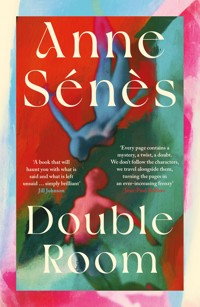
When his life falls apart after a horrific tragedy, a composer returns to his native France, where he creates an AI machine with his dead wife's voice, with unexpected, devastating consequences… `Mesmerising … Stan melds technology with the human spirit, defying the cruel randomness of his wife's death while allowing part of her to continue to exist and interact with him … a brooding, curious novel´ Foreword Reviews `A book that will haunt you with what is said and what is left unsaid … simply brilliant´ Jill Johnson `Every page contains a mystery, a twist, a doubt. We don't follow the characters, we travel alongside them, turning the pages in an ever-increasing frenzy´ Jean-Paul Delfino `Told in an achingly beautiful voice, Double Room drew me into a world full of mystery, music and bittersweet love. Every sentence is poetic, every page is captivating. I could picture, taste and smell every scene…´ Katie Allen `A beautiful, heartfelt and sensual story, written with style and grace´ Doug Johnstone ––– London, late 1990s. Stan, a young and promising French composer, is invited to arrange the music for a theatrical adaptation of The Picture of Dorian Gray. The play will never be staged, but Stan meets Liv, the love of his life, and their harmonious duo soon becomes a trio with the birth of their beloved daughter, Lisa. Stan's world is filled with vibrant colour and melodic music, and under his wife and daughter's gaze, his piano comes to life. Paris, today. After Liv's fatal accident, Stan returns to France surrounded by darkness, no longer able to compose, and living in the Rabbit Hole, a home left to him by an aunt. He shares his life with Babette, a lifeguard and mother of a boy of Lisa's age, and Laïvely, an AI machine of his own invention endowed with Liv's voice, that he spent entire nights building after her death. But Stan remains haunted by his past. As the silence gradually gives way to noises, whistles and sighs – sometimes even bursts of laughter – and Laïvely seems to take on a life of its own, memories and reality fade and blur… And Stan's new family implodes… For readers who love Laura Kasischke, David Nicholls and Kazuo Ishiguro ––––– `This spellbinding novel takes readers on a multi-sensory journey through love and loss, grief, frustration and lust … One of my favourite reads of the year´ Gill Paul `A masterful exploration of vulnerability, shifting memory and loss. Anne Sénès writes with sharp yet tender insight. Her words contain a subtle urgency that keep the pages turning´ Jill Johnson `Enchanting, beautiful, poetic … evokes the most indescribable feelings´ Babelio `Spellbinding, disconcerting and hypnotic … an amalgamation of Shakespearean tragedy, the spirit of Lewis Carroll and the vivid descriptions of Wuthering Heights´ Aurélie Dye-Pellisson `Profound and acutely moving … a rich, extraordinary sensory experience that brings to mind the novels of Kazuo Ishiguro´ Reader Review What readers are saying: `A mesmerising, unsettling story – I finished it breathless!´ `Beautiful and strange in equal measure, unlike anything I've read´ `Heartbreaking, lyrical, haunting … I'll be thinking about this for weeks´
Sie lesen das E-Book in den Legimi-Apps auf:
Seitenzahl: 223
Veröffentlichungsjahr: 2025
Das E-Book (TTS) können Sie hören im Abo „Legimi Premium” in Legimi-Apps auf:
Ähnliche


















THANK YOU FOR DOWNLOADING THIS ORENDA BOOKS EBOOK!
Join our mailing list now, to get exclusive deals, special offers, subscriber-only content, recommended reads, updates on new releases, giveaways, and so much more!
CLICK HERE TO SIGN UP
Already a subscriber? Click the link again so that we can send you details of what you like to read.
Thanks for reading!
TEAM ORENDA
i
ii
Praise For Double Room
‘A masterful exploration of vulnerability, shifting memory and loss. Anne Sénès writes with sharp yet tender insight. Her words contain a subtle urgency that keep the pages turning. Double Room is a book that will linger long after the final page. It will haunt you with what is said and what is left unsaid. It is simply brilliant’ Jill Johnson
‘Told in an achingly beautiful voice, Double Room drew me into a world full of mystery, music and bittersweet love, and wouldn’t let me go. Every sentence is poetic, every page is captivating. I could not stop reading but knew I had to slow down for fear of it being over too soon. Sénès, and her translator, Alice Banks, have a gift for bringing characters and places alive with astute observations of the tiniest details. I could picture, taste and smell every scene. A masterful translation of a stunning novel, Double Room is everything I want in a story and more – exquisitely written, populated with fascinating characters and full of surprises’ Katie Allen
‘This spellbinding novel takes readers on a multisensory journey through love and loss, grief, iiifrustration and lust … One of my favourite reads of the year’ Gill Paul
‘Every page contains a mystery, a twist, a doubt. We don’t follow the characters, we travel alongside them, turning the pages in an ever-increasing frenzy’ Jean-Paul Delfino
‘Enchanting, beautiful, poetic … This novel creates the most indescribable feelings in readers’ Babelio
‘Spellbinding, disconcerting and hypnotic … an amalgamation of Shakespearean tragedy, the spirit of Lewis Carroll and the vivid descriptions of Wuthering Heights’ Aurélie Dye-Pellisson
‘Anne Sénès offers us a “double room” in which “perfumes, colours and sounds respond to one another” in the manner of Baudelaire. Poetic and so close to reality!’ Marie Theron, Librairie Charlemagne
‘Interesting and beautiful … a unique read’ Independent Book Reviews iv
v
Double Room
Anne Sénès
Translated by Alice Banks
vi
vii
For Thomas,my link between France and England.viii
ix
‘Here everything has the adequate clarity of harmony’s delicious obscurity.’
Charles Baudelaire, The Double Room, tr. Walker Evans1
x
1https://www.metmuseum.org/art/collection/search/283741
Contents
‘Are you listening? Stan? Hello? Stan? Are you asleep?’
Asleep? How could I be asleep, when for almost twenty minutes, for what seems to me a lifetime, Babette has been soliloquising. We’ve said everything there is to say. We’ve discussed it all. My silences, my lack of involvement in our life together, my voluntary confinement, my refusal to go out more often. Stan. Stan. Stan.
Babette. Babette. Babette. Whose swimming costumes exude the scent of chlorine, which slowly permeates the walls of the house – the Rabbit Hole, as Lisa has always called it. Whose tofu- and grain-based recipes with names that are impossible to recall brighten up our day-to-day. Whose son, Téo, lives tethered to his iPhone like a suffering, shipwrecked sailor to his raft.
I sigh. ‘Listen, Bab, I know it’s difficult.’ And then, with no little hypocrisy, I add, ‘Especially for you, but…’
Now it’s Babette’s turn to sigh, ‘I know, I know…’2There’s no need to allude verbally to Liv’s death for the colours of grief to flood our bedroom. Nor to mention that Lisa has lost her mother. There’s nothing Babette can do. There’s nothing I can do. There’s nothing Lisa can do. We have to live with it – that’s just the way it is. Usually, I only have to hint at the possibility of taking the discussion in that direction and Babette gives up the pursuit. Not this evening, though. She’s back on the offensive:
‘…but the fact remains, Stan, that this can’t go on. Téo and I, we’re not second-class citizens in this methodical little life you’ve built around yourself. We need – I need – to find my place within this household. I admit that sometimes I can be a bit heavy-handed, that I’m partly to blame, but if you don’t take responsibility…’
It’stimetosleep, hums Laïvely, our automated home assistant, before abruptly switching off the lamp on my bedside table.
Babette’s body tenses at my side. I hold my breath.
It’stimetosleep, had resonated in more vermillion tones than usual. Was Laïvely losing her patience too?
London
TWENTY YEARS EARLIER
It was her laughter I discovered first. A tinkling tune with yellowed edges and a touch of taupe at the seams. Something I had never heard, never felt before.
Only her back was visible. She was leaning over the actor who was playing Dorian Gray so she could touch up his make-up, a palette of foundation in her hand. A palette that, musically, would have been a cascade of bells, the sound only slightly more high-pitched than her laughter.
I stopped at the last row of seats in the room and waited for her to straighten up. She was wearing a short skirt, black. A midnight-blue T-shirt hugged the curve of her back. No bra. Leather sandals with a worn strap. A mass of red hair, precariously held back by a hairdresser’s clip that seemed exhausted by the effort of taming the strands that were waiting to escape its scrutiny and fly off in all directions.
I saw all of this, and a lot more. The lines that her arms traced, the stroke of her wrist as she moved a 4little brush across the actor’s cheeks; he, eyes closed, surrendered to her. I saw the crease of her knee and a vein, so blue it was green, snaking up the length of her leg before disappearing under the hem of her skirt.
I saw a mark left behind by a mosquito beneath her right elbow and smudges of freckles all over her skin.
I saw…
The theatre was a little grimy and gave off the smell of dust and sweat. The upholstered seats had seen better days. The lighting was concentrated on the stage, where designers bustled about, along with two or three other guys whose roles in this strange ballet, now in its first rehearsal, I was unsure of.
I saw the garnet-red velour divan that the actor was stretched across. A lamp with a fringed shade, its light too bright. A portrait turned to face the wall.
The voices of two or three others reached me, although I didn’t understand what they were talking about. Their intonation was different to what I was used to in the small Parisian venues where I had first performed.
In the duration of a minim, I had forgotten that I was in London, that this was my first truly serious job. For me, life had begun in that exact place, at that very moment.
Everything came back to me when the girl stood up 5straight and left the stage, not to return. I still didn’t know who she was. However, I did know that I was no longer the same person.
I would never have imagined those bells could come from a girl. I’d always been particularly fond of the sound of the triangle. It reminded me of perfectly formed raindrops falling into a swollen river. A perfect bluish transparency; a magnifying mirror. Everything travelling at such speed that the imaginary took precedence over reality.
But voilà. That day, in London, I met Our Lady of the Bells. And she came into my life at such a speed that I am still trying to catch her.
Liv – that was her name – was a make-up artist for the stage. She loved pistachio ice cream, scones only when warm and stuffed with raisins, the rain when it was regular, the sun at dusk, the grey of cobblestones, literature – but nothing penned after 1937 – French vineyards, Barcelona, and the British Royal Family.
All of this I discovered little by little, as I added touches of colour to the portrait of her that took root in me over time. With Liv, image and reality often overlapped, only to then become so far apart that I no longer recognised the woman that slept at my side.
6But that July day in London, it had not yet come to that.
I had landed in the city two nights earlier. I had been hired to compose the music for a new adaptation of ThePictureofDorianGray. One of my favourite novels. One of my cult authors. A city I loved. That was all it took for me to jump at the chance, accepting all the conditions: pitiful pay, miserable accommodation, a ridiculously tiny budget. I was twenty-five years old and took myself seriously, but not so seriously that I would let such an opportunity pass me by. I had imagined myself as bilingual, thanks to proper schooling and my own painstaking efforts to learn English. I soon became disabused of this notion, but the new notes that this language promised me more than made up for the initial difficulty I had when conversing. These notes made their way through me, giving rise to new perspectives, to new associations that it took me a while to accept as my own.
I had spent the first two days of my stay taking myself on walks whichever way the wind blew, from Soho to St James’s Park, from Covent Garden to the banks of the Thames. London was noisy, lively, crazy. I passed men in sad, severe suits, girls with mauve hair pulled up into nests on top of their heads, old, 7dignified, upright ladies on their way back from Harrods, trendy couples diving into the narrow streets of Soho. On the double-decker bus, one had the feeling of living each and every bend under threat of the next branch of a London plane. The tourists let little cries slip out, the children applauded.
I delighted in all the sounds, all the colours, the hues of summer on the yellowed lawns. I was beside myself, and I couldn’t care less that the shower water was lukewarm at best, that my flatmates had a decided taste for Blur, preferably very late at night and played very loudly, that my bedroom was the size of a little bathroom in a provincial hotel in France. I was ready to gorge on Indian food, on stew, on fish and chips, on sushi, on everything offered to me by this worldly city where a cacophony of sounds, scents and colours reigned. These synthesisations were incredible. From Chelsea to Brixton, Seven Sisters to Greenwich, from Notting Hill to Piccadilly, the whole planet was there before my eyes – the dazzled eyes of a Frenchman, somewhat conformist, a little strait-laced, for whom wearing velvet trousers and a scarf around his neck felt like the height of rebellion. As for contemporary music, I had stopped at the Beatles, at Christophe, at the Stones, and I had looked no further.
8Two days of uninterrupted strolls had birthed a symphony within me that I was sure would enchant the play’s director – thrill him.
It must be said, however, that my encounter with Liv aside, the new adaptation of Wilde’s classic failed to live up to its promise.
‘Téo, get a move on, you’re going to be late!’
A grunt, heavy footsteps on the stairs and Téo appears in the kitchen, unkempt, hunched over as if he were carrying the weight of the world on his shoulders, sporting a T-shirt from the day before, and the day before that.
I open my mouth, then close it again. It’s not worth commenting on. The kid couldn’t care less.
This T-shirt, made in Bangladesh, 100% cotton, machine wash at 40°C recommended, has been worn for three consecutive days and nights. According to the World Health Organisation, it would be suitable to…
I hold back a smile that is inevitably erased when Téo strikes out at Laïvely, shutting her up. Bab, half in earnest, half in jest, pipes up, ‘Since when did that thing have eyes?’
It’s true. Since when has Laïvely been able to see us? In fact, can she see us? Or is she simply able to smell the odour that is emanating from Téo as he settles down in front of his cereal and mug of fairtrade coffee? Because, yes, he stinks. As soon as he 10lifts his mug to carry it to his lips, all the while stooping his neck to avoid too big a movement that would be detrimental to his hunched back, a sweet-and-sour aroma wafts towards my nose. But there’s no reason Laïvely should have a sense of smell. That’s not what I was aiming for when I created her.
I scrunch up my nose and avoid responding to Bab, who has already moved on to something else. She’s preparing her lunch box to take to the swimming pool with her. A few months ago, when she and Téo had just moved in, she would come back to have lunch with me. She had the time. Then, little by little, she started to take up this new habit, always with a good excuse: a break cut short due to a colleague being off sick, a private lesson that had been added to her schedule, the need to run an errand. Without me ever really realising, our lunches for two have become an exception. Now, she doesn’t return to the house until her day has come to an end. And for my part, I don’t offer to meet her for a picnic at Buttes-Chaumont, or at a brasserie in the neighbourhood so we can spend a romantic couple of hours together. I have neither the desire nor the courage.
Lisa has already left for school. I finish my coffee pensively. Two little notes have been obsessing me for days, yet I still haven’t been able to extract a melody 11from them. Maybe I would if I went for a walk? No, I’ll be better off in my studio, with my instruments. What’s more, the weather is unpredictable. There’s a risk of rain. I don’t feel like getting soaked.
Téo finishes and leaves everything spread across the table, his place adorned with varying and diverse stains. Before I can venture even the smallest criticism, his mother has already piled the dirty dishes in the sink, wiped a sponge across the table and put the milk back in the fridge.
I sigh. Is she just on autopilot, or is it a tactic to avoid yet another argument about the kids? Laïvely flickers softly. It’s like she’s winking. Having made sure that Bab’s back is truly turned, I wink back at her. On top of everything else, there’s no need to provoke a fit of jealously that a tube stuffed with electronics doesn’t merit being the object of.
‘See you this evening, Stan. Have a good day.’ Bab leans over, gives me a light peck on the lips and leaves without looking back.
The door closes behind her and Téo, who still hasn’t uttered a single word.
Laïvely lights up. It’s like a smile on the face of a loved one.
It’s my turn to leave the kitchen, happy, yet uneasy at the same time.
London
TWENTY YEARS EARLIER
‘Do you want to go for a drink?’
It had been ten days since I saw Liv for the first time. In the meantime, I had officially introduced myself and discovered her open, animated face, her green eyes, her smooth skin, the dimple on her right cheek and the beauty spot next to her right eye. Her smile had become familiar, as had the tone of her voice and her adorable accent whenever she tried to speak to me in French, her voice dropping an octave, her lips stumbling over each U, unpronounceable on that side of the channel.
I had eaten lunch with her and some members of the company several times, all of whom agreed that Max, the director, was a talentless arsehole. They also agreed that the idea that Dorian, in turning round the portrait, discovers himself in the guise of a woman was as ridiculous as it was … sexist? ill-timed? out of place? Max Canut may well have claimed that it was, on the contrary, a powerful symbol, but we all feared that audiences and critics alike would miss the point 13completely. For Max, Dorian (and therefore Oscar Wilde) was deeply terrified of his femininity, of his homosexuality (the former, latent and nothing but the fruit of Max’s imagination, and the latter, completely assumed). I wasn’t a psychologist, but I couldn’t help wondering if it wasn’t his own sexual preferences that Max was questioning, although, since Wilde, Britain had made a lot of progress on that front. The director therefore thought it normal that when Dorian confronted his portrait, it should reflect back to him a vision of the feminine in a crudely transvestite guise. Max could easily talk to us for hours about Dorian in drag – he thought his idea was ground-breaking, fantastic, marvellous. But what could have been more fantastic than having the face of the man who subscribed to all those vile acts hold on to all the charm and beauty of youth, whilst the painting, that terrible portrait of him, displayed day after day the marks of his disavowals, his vices, his crimes?
We were therefore rather dubious – myself more than anyone else, because, at the moment that was supposed to mark the climax of the story, Max wanted my music to be a mixture of punk, Gregorian chants and Red Army hymns. I couldn’t imagine what he was hoping to hear by mixing all of that together. He, on the other hand, had a very clear idea of the sound it 14would create. Unfortunately, I had so far proven myself incapable of providing him with what he was so impatiently waiting for.
One lunchtime, as we all sat outside on a lawn yellowed by the heat to eat our meals bought from the nearest McDonald’s, Laila, who worked in wardrobe – early forties, self-assured, blunt, always spoke her mind – tried to reassure me.
‘Don’t you worry. Max is always like this. It’s not the first time I’ve worked with him. Last time, at quite a niche festival in Cornwall, he put on an adaption of Shakespeare’s life transplanted into an Orwellian universe. It was super weird and confused, and the music – my god.’ She frantically waved a hand armed with a greasy fry loaded with ketchup, which flew onto her T-shirt, staining it like drops of blood.
I was unsuccessful in getting anything more out of her on the subject. Eventually, Max heard the music, but he never found anyone to transcribe it, ever.
Laila also ended up admitting that I was the third person Max had called for this job. That didn’t reassure me about my future in London as a young, French composer prodigy.
And that pushed me to invite Liv to go out for a drink. 15
‘Do you want to go for a drink?’
It was normal to invite a girl out for a drink when one was twenty-five years old. And yet…
Of course, I was already acquainted with the female body. In Paris, in bars, on nights out, young women seemed to find an unrealistic charm in my artistic side (cursed, thus penniless) and they rarely refused me. We would chat for a while, my old, velvet corduroy trousers suddenly seeming to them the height of fashion and romanticism. They would even show surprise at my sobriety (a cursed, penniless artist must surely be a drunk or an addict) before they came to the conclusion that I must be suffering from an ulcer or cirrhosis of some sort, and that even one drink would kill me. Abstinence couldn’t be a deliberate choice, because who would deprive themselves of anything at that age? Reassured by the image they had created of me, they allowed me between their sheets, between their thighs.
But often, the sun had not yet risen before I left. I found the intimacy that came in the aftermath of making love insufferable. I couldn’t stand the kind of coffee that was drunk together the morning after, the unformulated question of whether this night would be followed by another. I only had the desire to go back home, take a long, hot shower, shave and get to work. 16
Those interludes had a negative effect on me that I have never been able to explain. Far from inspiring me, they actually cut me off from any capacity to create. I would spend the day in front of my piano, growing more and more depressed hour after hour, only capable of interpreting old jazz standards or Debussy (why him and no one else? the mystery remains), as if emptied of all substance.
After several experiences of that ilk, it quickly became clear that I needed to reduce my frolicking with girls I met in bars or jazz clubs in Saint-Germain-des-Prés and Halles to a minimum. And it was also vital to recognise that it seemed I was incapable of falling in love. The act of sex killed all the music within me, although I was convinced that love, on the other hand, would increase my talent tenfold. We’re like that when we’re young. Full of certainties, rational explanations for things that are absolutely not so, on a quest for answers that we believe to be original yet are nothing more than stereotypes.
I was no different.
But Liv, she was something else.
To start with, she had never, at any moment, appeared to be attracted to or seduced by the things that made me (relatively) successful in London: my French 17accent, my laid-back approach, the silk scarf around my neck. On the contrary. When we were introduced to each other, she had quickly evaluated me, her eyes moving from my rebellious lock of hair to my suede shoes before passing once more over my face. A little smile (that I had interpreted as mocking) was sketched across the corners of her lips. She held out her slim hand to me, graceful and soft, and murmured an ‘enchantée’ of the most formal kind, before turning on her heels and heading towards the wings.
I didn’t know until later, much later, that in that moment she’d realised, at first sight, that I had the power to bring her a happiness she had never experienced before, but also to make her suffer – the other side of the eternal coin that comes with love. She had refused to experience both sides, the price of being happy too high for what she carried in her emotional baggage. At twenty-two years old she had already had her heart broken once, starting again was out of the question. Never. She preferred to let her turn pass her by, ignore the most beautiful love in the world, content as a single woman with her salt-and-vinegar crisps on a Friday night. Perhaps, one day in the distant future, she would live with a suitable man who she didn’t hate, and that would be good enough. Gone were any lyrical flights of fancy, declarations of 18love whispered in the early hours of the morning on the banks of the Thames, weekends in Brighton, holidays to the Highlands, scones at teatime in St Andrews. Gone were the promises of ‘always’ and ‘forever’. She wouldn’t fall into that trap again, she’d already given enough, thank you very much.
‘Do you want to go for a drink?’
‘Yeah, OK,’ she responded with a smile.
And my heart dropped into my stomach. Her ‘yeah’ contained the purity of a nightingale’s song, the grace of the gentle summer tide in La Baule, the lightness of the wind in the Corsican pines. It was powder pink, with a touch of raspberry red at its heart. It had the aroma of orange blossom.
I blushed, stammered, asked her to meet me outside the theatre that evening, and ran off.
Shut in my studio in the Rabbit Hole, I hum the two notes that will not leave me. But, perhaps for the first time in my life, I cannot seem to associate a single colour with them. Something that is more than unsettling.
I have always lived with these odd associations. Tastes, sounds and colours all form an amalgam within me that only music can regulate. Music is the one thing that allows them to come together, to join each other, to associate, but also to detach from each other just enough to give each element a coherence that would otherwise be lacking from the ensemble.
For a long time, I had believed that there was nothing particularly special about this phenomenon, that everyone had the same experience. When my mother introduced me to LaTraviata, which to this day remains my favourite opera, I could make out pastel rainbows, violet and orange storms, the taste of fresh strawberries and cauliflower augratin, all dependent on the act, the scene, the aria. She laughed when, as the music had flowed, I revealed what she 20called my ‘visions’. It quickly became a game that the whole family would play on Sundays when my grandparents came to visit.
I grew up in Limousin on a farm that to my young eyes was vast, the green of the pastures and the more sombre shapes of the groves dotted with cows and dogs. I was the third of five. We were free, for the most part, to occupy ourselves however we pleased, and we didn’t go without.




