


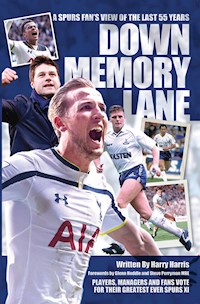
4,99 €
Mehr erfahren.
- Herausgeber: G2 Rights Ltd
- Kategorie: Lebensstil
- Sprache: Englisch
Fleet Street legend Harry Harris, who has written some 78 best-selling football books, gives a fan's eye view of life as a Spurs supporter for 65 years with unique insights into the players, managers and personalities who have shaped the club's history.
Das E-Book können Sie in Legimi-Apps oder einer beliebigen App lesen, die das folgende Format unterstützen:
Veröffentlichungsjahr: 2016
Ähnliche

















AUTHOR: Harry Harris
EDITOR: Mike Collett
DESIGNER: Paul Briggs
PUBLISHERS: Edward Adams and Jules Gammond
First published in the UK in 2009
© G2 Rights 2016
www.g2ent.co.uk
All rights reserved. No part of this work may be reproduced or utilized in any form or by any means, electronic or mechanical, including photocopying, recording or by any information storage and retrieval system, without prior written permission of the publisher.
ISBN: 978-1-78281-635-5
G2 Rights Limited hereby exclude all liability to the extent permitted by law of any errors or omissions in this book and for any loss, damage or expense (whether direct or indirect) suffered by a third party relying on any information contained in this book.
Dedicated to my (not) so mad mum Sara.
ACKNOWLEDGEMENTS
Steve Perryman, whose fierce tackle in his prime is only matched by some of the acidic words he had to say about me, together with any back handed praise. Stevie P hasn’t changed.
Thanks also to another Spurs legend, Glenn Hoddle for also penning a foreword for this book.
My thanks too, to Jules Gammond at G2 and very special thanks to editor Mike Collett, who knows a thing or two about Spurs after watching more than 1,000 Spurs matches in the last 53 years as both fan and journalist.
Thanks to former Press Officer and now the club’s historian John Fennelly. We go way back to the Tottenham Herald days, the local newspaper whose offices were a few hundred yards from the Lane. Thanks also to Victoria Howarth heading up the club’s retail department.
To Brian Reade, former Daily Mirror colleague, who suggested I wrote a book about Spurs when I congratulated him on his brilliant account of a lifetime supporting Liverpool.
My hugely supportive wife and best friend, Linda for all her invaluable support (although lots of her support goes to Chelsea!)
CONTENTS
FOREWORD BY
Glenn Hoddle
FOREWORD BY
Steve Perryman MBE
INTRODUCTION
CHAPTER ONE
Highest Premier League Finish
But In The End It All Went Just a Little “Spursy”
CHAPTER TWO
Spurs - An Early Love Affair...
CHAPTER THREE
The Nicholson Years
CHAPTER FOUR
Did It All Really Happen?
CHAPTER FIVE
Terry Neill ...Did he Play for Arsenal? Asked Chairman Sidney Wale
CHAPTER SIX
G-Men Greaves and Gilzean
Nice One Cyril Knowles And Danny Blanchflower
CHAPTER SEVEN
My First Cup Final
CHAPTER EIGHT
Ossie Ardiles and Ricky Villa ...Ossie’s Going to Wem-Bley, His knees
Have Gone All Trem-Bley, Come on You Spurs, Come on You Spurs
CHAPTER NINE
Irving Scholar, And How I signed Chris Waddle
CHAPTER TEN
Keith Burkinshaw, Peter Shreeve, The Ray Clemence Secret and the Gerry Armstrong Wind Up
CHAPTER ELEVEN
Terry Venables and The Truth About My Revelations
CHAPTER TWELVE
Gazzamania!
CHAPTER THIRTEEN
Gary Lineker
CHAPTER FOURTEEN
Robert Maxwell and The Inside Track On How He Tried To Buy Spurs
CHAPTER FIFTEEN
Glenn Hoddle, King of White Hart Lane ...And A Good Friend
CHAPTER SIXTEEN
The Day Spurs ‘Signed’ Diego Maradona
CHAPTER SEVENTEEN
Gary Mabbutt, Jürgen Klinsmann, And ...Dennis Bergkamp
CHAPTER EIGHTEEN
Sir Alan Sugar ...The Prime Minister, Sol Campbell and The Dud Managers
CHAPTER NINETEEN
Gerry Francis reveals the truth about his reign as manager and his relationship with Alan Sugar
CHAPTER TWENTY
Daniel Levy And How I Persuaded him To Buy Spurs
CHAPTER TWENTY-ONE
The Fans’ Cup Final
CHAPTER TWENTY-TWO
The Arrival of Harry Houdini
CHAPTER TWENTY-THREE
When Harry Met Harry, An Exclusive Interview
CHAPTER TWENTY-FOUR
From Andre Vilas-Boas, to Tim Sherwood and the downfall of Glenn Hoddle
CHAPTER TWENTY-FIVE
Mauricio Pochettino… a best ever Premier League finish and a new stadium on the rise
CHAPTER TWENTY-SIX
The Final Word - For Now
CHAPTER TWENTY-SEVEN
In Search Of The Greatest Ever Spurs Team
FOREWORD BY GLENN HODDLE
The one thing I have had in common with Harry, is that we are both Spurs fans, who coincidently first went to watch the team at the same age of eight.
My first game was a reserve match at the Lane against Leicester, when I went with a friend and his dad, and then my dad took me to my first big game, Spurs v Forest. I was hooked.
I don’t know why I was hooked, it was just the whole experience, the smell of the grass, the whole event of such a big stadium packed with fans, the noise, the atmosphere, and watching such talents as Jimmy Greaves.
I lived in Harlow and that was a huge catchment area for Spurs supporters, even more so then than it is now. I remember turning up at Harlow Town station to catch the train with my dad to White Hart Lane station, and Harlow was just as packed as White Hart Lane, the trains were full and it was a journey I was soon to take every Tuesday and Thursday evening once I signed schoolboy forms for the club at the age of 11.
In those days the schoolboys and apprentices were given tickets for the game, and we sat on these little benches in the front of the stand, where we had the most incredible pitch side view watching some immense talents such as Martin Chivers, Alan Mullery, Martin Peters, Phil Beal and Mike England.
We sat so close to the action, no more than a couple of yards from the white line, that you could almost touch the players, and you could even smell the liniment on their muscles. You could hear the players’ verbal exchanges with each other, and feel the crunching tackles, aspects of the game you never appreciated in the stands.
I was a skillful player who wanted to do the right things, but I was also quite small as a 10 and 11-year old, very thin, and one game watching Mike England and Peter Osgood kicking lumps out of each other gave me quite a different perspective of a profession I was determined to follow. The centre-forward and centre-half were giants who were elbowing and kicking to such an extent I could hear and virtually feel the thumps against each player’s shin pads. It made me appreciate that this game was not just all about scoring goals and making goals, but also about the physical pain that you would need to experience. For a creative player, this made an enormous impact on me at such an early age. It was a rude awakening.
My favourite player? Funnily enough, even though I was and I am still a huge Spurs fan my favourite player was George Best. He was the greatest individual I saw as a kid. It was such a great pleasure when Manchester United came to town and I could see Best. I loved to watch Best, Law and Charlton. I remember sitting behind the goal at the Lane when all three played against Spurs, it was a wonderful experience.
Bill Nicholson signed me as a youth player, and he even picked me once to sit on the bench for a European cup tie in Belgrade against Red Star and I can remember Harry when he was on the local paper, the Weekly Herald writing about me when I scored a hat-trick in the youth team.
Terry Neill was the manager when I first got selected for the first team, and Harry wrote an article about my emergence into the senior side coming through the ranks. When I made my debut coming on against Norwich, the headline in the Herald was one I shall never forget... “And You Ain’t Seen Nothing Yet...”
There was a smash hit record in the charts at the time, from Bachman Turner Overdrive and that was the catch line in it. It was typical of Harry’s kind of journalism to try to jazz things up. I loved it, but my mum loved it even more and cut it out and stuck it in a scrap book.
I felt I had a lot in common with Harry at the time as his writing emphasised the Spurs tradition of playing stylish football and that is why he pushed for me to be in the team. I’ve no idea how much he influenced Terry Neill’s decision to pick me, but he keeps telling me it was his idea!
FOREWORD BY STEVE PERRYMAN MBE
Whatever I might think of Harry, and I have some very strong opinions, there is no doubt that he changed the face of local and national journalism.
When he arrived on the local North London Weekly Herald, my first impression was this was a guy who livened up the match reports. As a player, you are always protective of your own professional performance, and as captain of the side I felt a responsibility towards the entire team. So, I did not like the way he sometimes reported our games, there was a sharp edge we had not been used to from the local paper before.
But Harry did make the local paper more professional, and you would have to say, why not? However, we didn’t sometimes like the way he stirred the waters, and of course, it didn’t do him any harm as he made his reputation and moved onto the bigger stage with national newspapers.
On the national press, with papers such as the Daily Mail, the Daily Mirror for many years, and the Daily Express, I have read his columns with interest, as he does produce some thought provoking articles.
However, I cannot be honest with him unless I also state my opinion that I felt he wielded far too much influence with certain Spurs chairmen, namely Irving Scholar and Sir Alan Sugar.
I always felt he was in Scholar’s camp when I was a player at the club, and I know they had a very close relationship so Harry had the inside track. I accept that Irving and Harry had the best interests of the club at heart as they are both Spurs fans but Irving was the first of the new breed of chairmen, and while his heart was in the right place as far as his love for Spurs, I did have my run ins with him over the 1984 UEFA Cup bonuses. Irving also drove his first manager Keith Burkinshaw potty with the amount of phone calls! That’s not to say I didn’t have my own dispute with the manager over a new contract!
As for Sugar, I felt, from working on the inside as Ossie’s assistant, that Harry was a tool for Sugar, and for that reason I took a dislike to the way Harry operated as an ally of Sugar’s which no doubt suited his career. In fairness I did have, and probably still do, have a jaundiced view of anything to do with Sugar, and I am not going to elaborate why. Perhaps Harry is a touch unfortunate that he has been dragged into it, from my view point of Sugar.
Harry used him as much as Sugar thought he was using Harry. The result was that Harry had exclusive stories and an incredible “in” with one of the most powerful men in the country. But this was MY club they were playing with, and so at times it all made me very angry.
I wouldn’t describe Harry as one of the “suits” who were infiltrating the board rooms and having far too much influence on the management of the clubs, because he was a journalist doing his job and getting some damn good stories in his papers.
The reason I took an exception is that Harry never saw the real inside story of the Sugar regime with Sugar’s appointed chief executive Claude Littner and the way he operated. The finer details of what really went on behind closed doors are for another day, when my book is published!
I was hopeful somewhere along the line someone would stand up and disagree with Sugar when it needed disagreement. Sugar had surrounded himself with too many yes men, like Littner.
Equally, I am not saying I am pro Terry Venables or anti him, nor am I saying I am pro or anti Sugar in their personal fight about what they got up to inside the club.
So, perhaps it is harsh to blame Harry for doing his job and finding out as much as he could. Sugar though, I am sure, used Harry to gain information about the wider game. Sugar loves the press when it suits him but hates things in the press when they are critical of him. If it doesn’t suit Sugar than there can be big trouble.
Also, I felt the way he ran the club put extra pressure on his manager, and it became intolerable for Ossie and myself at times. Contrast that to the way Sir Alex Ferguson used to run Manchester United, there were no directors interfering, nobody telling him who to buy or sell. One season, he had five draws in as many games at the start of the season and it might have looked like a crisis time, but it wasn’t. There was no panic and he went on to win the Premier League and the Champions League.
I had my run-ins with Sugar when I was Ossie’s assistant to the extent that I fell out of love with football and even Tottenham - that’s how bad it got for me, anyway.
I am sure Harry will give his own unique insight into what he feels went on between Venables and Sugar in this book. And, if he’s writing about 50 odd years as a Spurs fan, I am convinced it will be something no Spurs fan would want to miss. Equally, his take on the broader aspects of the game would be of immense interest to every fan of football. Even though I am sure it will be more subjective than objective!
INTRODUCTION
The first British club to win a major European trophy, the first club to win the Double in the 20th century, and a club synonymous with The Beautiful Game; there is no shame in rejoicing in Spurs’ glorious past.
It is a rich heritage of all that is good in football, the style, the attacking ethos, the philosophy of Danny Blanchflower, the grace of Alan Gilzean, the goal scoring phenomenon of Jimmy Greaves, the genius of Paul Gascoigne, the perfect passes of Glenn Hoddle, the start of the foreign revolution (Argentinian to be precise) with Ossie Ardiles and Ricky Villa.
How Ossie’s knees went all “trembley” on the way to a wonderful exhilarating FA Cup win with the ‘Wembley Goal of All-Time’ from Ricky, to ‘Walking in a Jürgen Wonderland’. Yes, even a German could become a hero in a club steeped in Jewish traditions.
Today we have come back to an Argentinian theme mixed with home-grown talent, Mauricio Pochettino, and Erik Lamela for the South American flavour once more - and Harry Kane for club and country, as ‘one of us’ and the emerging brilliance of Dele Alli.
As for me, it’s now nearly 60 years of supporting Spurs; a life time with one club, and only one club.
More than half a century of loving Spurs teams through thick and thin. At times it seems more thin than thick, but the memory often deceives; there have been some great times along the way, and we have seen many great players wearing those famous Lilywhite shirts.
That makes the tears of joy at winning trophies, and winning in style, all the more pleasurable.
It’s time to relive some wonderful memories of Spurs’ glorious past going back to the 1960s. Isolated Cup triumphs proved little more than a mirage. The reality is that the best time to be a Spurs fan was during the “Glory Glory” days, now a blur of black and white memories on television. Then, the big named ‘foreign stars’ came from Scotland, Ireland and Wales! And what great “imports” they were, with players such as Scottish tornado Dave Mackay, the elusive John White, who died far too young, flying Welsh winger Cliff Jones and the Irish anchor at the heart of the 1961 Double team, Danny Blanchflower.
Recently we have seen a procession of foreign managers, over-priced foreign players, and a deluge of false dawns. But the Glory Glory days and European nights of real consequence will come again. Tottenham are back in the Champions League. The future looks bright. Spurs were not so long ago labelled one of the Big Five. Now there is, arguably, a Big Four; Manchester United, Manchester City, Chelsea and Arsenal with Spurs hammering on the door.
Leicester City proved anything is possible last season while Liverpool, West Ham, Everton, and Southampton will be looking to build and progress and, of course, Spurs have significantly closed the gap on Arsenal.
It’s really hard to believe it has been more than eight years since I originally compiled a collection of my life and times as a Spurs fan from the outside (watching as a kid) as well as the inside (having the privileged inside track as a journalist).
Whether it was a good idea or not the book sold out in the Spurs Club shop. Then came a revolution in the print industry with the social media craze. Yes, life has changed. For the better? Who knows? But communication became more instant, the game faster, the players more athletic, and the already out-of-this-world salaries grew to astronomical levels. Oh, yes, there was the banking collapse. In fact, the entire financial world went into meltdown.
Lord David Triesman, then the FA chairman and lifelong Spurs fan, kindly penned a preface for me in the original Down Memory Lane, and since then the chairmen of the FA have changed with almost the same regularity as Spurs managers. Lord Triesman was replaced by David Bernstein, who in turn was replaced by Greg Dyke, who in turn has made way for another Greg in Greg Clarke, who was chairman of the Football League from 2010 until his appointment as the FA chairman this summer.
The managers kept on coming in and moving out of the revolving Lane door too as the club searched for the magic formula to bring back the Glory, Glory days. As each year goes by the memory tells you how much more wonderful the likes of Dave Mackay, Jimmy Greaves, Bobby Smith, Cliff Jones, Danny Blanchflower - I could go on - really were. Treasures of the golden past in a warm sea of nostalgia.
Some things, though, never change though ...the hurt.
The hurt of being a fan of a ‘nearly club’, or a ‘never club’, or seeing Leicester City buck the trend at the expense of your club. The hurt never ends.
And so, here we are. Spurs are back, or almost back to where they belong; one of the game’s Big Five. Wasn’t that hard really! Back in the Champions League, where Harry Redknapp had some classic games, memorable results, and a certain Gareth Bale. And now we even have ‘One of Our Own.’
So nothing much, after all, changed at the Lane since Down Memory Lane became the latest in a long line of a football-fan-moaning-about-his-lot style publications.
The really challenging part for Spurs, now, is staying there in the elevated company of Europe’s elite, and not dropping back into the Europa League. It certainly won’t be easy especially as no sooner than Spurs find themselves a promising up-and-coming new manager then the really big boys will be sniffing around.
Clubs such as Manchester United and Chelsea waving life-changing cheques at their targets, of which Mauricio Pochettino has become one.
They won’t be put off by a swanky new contract and all the smiles alongside Daniel Levy. As yet we know little of the break clauses, get out clauses and buy out clauses, if, of course, they exist at all. Amazing if they didn’t.
Whether we are in another false dawn or can expect Pochettino to last the course remains to be seen. For me, he is still relatively unproven, shows enormous promise, and has the players ultra-fit to play his pressing game in the Jürgen Klopp mould - I think Liverpool are ready for a resurgence under the German coach too.
But we’ve seen all this before. We went down this route before with dear old ‘Arry bless him. Redknapp took us into the Champions League with a blaze of glory kicking the arse out of Europe’s elite.
Spurs have massive support as the 85,000 who turned up at Wembley in September for the first Champions League game against Monaco proved. Their past glories still make them a big name in European football. Spurs’ time will come again. Meanwhile, for me, it is time to reflect on those past glories, those legends that made the club so great, and to tell the most revealing stories.
As a fan I have been so fortunate that my job as a football reporter has given me enviable access to the team I love. There has been so much to marvel at on the pitch through the decades but it is the action off the field that I, unlike so many other fans, have also been part of.
As a boy growing up kicking a ball around the streets of east London trying desperately to emulate my heroes I never thought for a second that one day I would be sitting in a famous Fleet Street haunt discussing death threats with Irving Scholar and trying to talk him out of selling the club, or being invited to Alan Sugar’s home when he first took over to get advise on dealing with Terry Venables or discussing with Daniel Levy his buyout of the club. I have been in the thick of it and been privy to some amazing stuff. Not many fans get that close to the heart of their clubs.
I have gone from a youngster getting in through the Boys’ Entrance to watching from the press box where I got to meet, know and befriend chairmen, managers, players and staff inside the club, and even being invited into the director’s box. There can’t be many accounts of following football where the fan has been catapulted inside the club to discover the truths other fans never see.
So where did it all begin?
There is a public bench outside of the library opposite where the famous Cockerel Clock used to be on Tottenham High Road where my mad mum would wait patiently throughout the match before collecting me for the long bus journey back home.
Together we would make the pilgrimage to White Hart Lane from our home in east London, where the two of us lived at No 13 Pauline House, on the third floor of a 17-storey block of basic facility council flats which housed the overflow from the already packed Jewish community in Brick Lane.
It was a short walk to the bus stop, but it was imperative to set off several hours before kick-off, to allow for the hour ride to Tottenham High Road on board the crowded old 149 Routemaster. It was essential to arrive by around 1pm to join the queues at the time the gates were about to open. The queues were pretty long, quite quickly. This had become a popular venue.
I loved every minute of that bus ride; I became familiar with virtually every inch of road, each landmark, every building. The closer we got to the Tottenham ground the more excited l became.
There was a spring in my step when I leapt off the bus right outside of the ground. You were straight into the ambience of the whole football-spectator experience, nothing like it is today. There was a profusion of stalls selling collections of small, tin badges representing all the clubs. There were programme sellers on every corner, the air was alive with the raucous sound of rattles, ‘graggers’ my old mum called them, that made such a din at home, but could hardly be heard above the noise of all the other rattles.
Attire was simple enough, a coveted Spurs scarf. No replica shirts with names of the stars and their numbers on the back. I did collect shirts, but they were purchased without even the club’s badge, let alone a name or number, and who would have thought of shirt sponsorship or billboard advertising? My dear old mum had to buy the badge separately and sew it on by hand or with the Singer sewing machine she used for the fur remnants. But no one thought of wearing those shirts to a game - it was far too cold.
One of my greatest pleasures was to visit the Spurs Supporters Club whose head offices were in Warmington House, adjacent to the ground. The club sold all sorts of basic memorabilia, but my favourite was the upstairs section where they sold photographs of action pictures of the matches, with a wait of around a month before the most up-to-date games were available.
I spent all of my pocket money on those pictures, and as a special treat my mum would often buy one extra one. They took pride of place on my bedroom wall, with a Spurs rug by the side of the bed as a Christmas present. The really dedicated Spurs fans who manned the shop got to know my mum quite well and even gave her some discounts on any extra pictures she bought for me.
They knew she couldn’t really afford them.
A Spurs pencil or pen was a treasure in those days, compared to the lavish items on sale now. Back then it still felt like a sport rather than the players being walking advertisements and the club only interested in turning a huge profit.
After the thrill of the game, came the enjoyment of getting back home, waiting outside the corner shop for the “pink” editions of the evening paper, a football special with the first match reports and pictures. They would be immediately cut out on returning home and stuck in the scrap book. I had dozens of scrap books, filled with the match reports of journalists such as Steve Curry and Nigel Clarke with whom I ended up working.
By far the biggest thrill was soaking up the atmosphere for the two hours before kick-off. Taking in the smell of fried onions to accompany the hot dogs from the multitude of unofficial stands. Now, of course, it’s smoked salmon bagels as well. Not that my mum ever thought about wasting money on those hot dogs; she packed sandwiches for me instead. I don’t think the fact that they weren’t Kosher put her off; it was the fact that it was far more cost effective to bring your own food.
At first I would pay the minimum entrance fee at the Boys’ Enclosure, and kept on going through that turnstile even when I was a year, maybe even two years too old. But it reached the stage, particularly as I was quite tall for my age, when there was no more fooling the gateman, or no longer could my mum persuade him to let me in for the cut price entrance fee. So my mum then came up with seats for the games. Sometimes, as I recall, she even managed to get herself into the ground without a ticket to keep a wary eye on me.
I was hooked and wanted to go to every game so it seemed a season ticket was more cost effective. However, there was a waiting list and it was highly unlikely that I would be able to get my hands on one of those coveted tickets so how my widowed mum managed to acquire one despite a 10-year long waiting list, let alone afford it, I shall never know. But she often performed acts bordering on miraculous to ensure her one and only son got what he wanted, which was a ticket to watch Spurs.
When she failed to beg, borrow or steal a Cup Final ticket in 1962 after Spurs returned to Wembley following their formidable Double triumph the year before, I could tell she was never going to let me experience such disappointment again. She could tell how much it meant to me even though she knew that I was perhaps too young to be going off to join such a crush on my own, or be alone inside the stadium.
She made sure she got her hands on a Cup Final ticket in 1967 for the all-London final between Spurs and Chelsea; it might have been on the cheap old benches at the front without the best view in the world, but it was a ticket for my first final nonetheless. Heaven.
Thankfully Spurs won with Joe Kinnear and Terry Venables in their side, a couple of players with whom I would cross swords in later life when they became managers. While I got on well enough with Venables when I first got to know him as manager of Crystal Palace, our relationship was cemented when he worked for Irving Scholar, but deteriorated during his bitter conflict with Alan Sugar. By contrast, Kinnear and I enjoyed a very sound working relationship, once or twice even meeting at social events and hitting it off.
So, it was as a fan that I idolised the likes of Kinnear, as the young glamour boy of that team, and yes, even Venables, despite the fact that he had a torrid time from most Spurs supporters who took an instant dislike to him as a player after his move from Chelsea in 1966.
So that was back in the early 1960s, and I’ve continued a journey as a fan and a journalist that has mostly centred around Spurs for all of my working life.
I’ve not missed a Cup final since, mostly in the Wembley press box, and more lately in the privileged seats, none more so than the 2008 Carling Cup final when Spurs beat Chelsea, the first League Cup final in the new lavish £800m stadium where my wife, Linda and I were guests of the Football League and sponsors Carling. My thanks for that marvellous experience goes to Steve Bradley of Hill and Knowlton the public relations company charged with organising our five-star lunch and prime location seats in the corporate sector.
So, from childhood beginnings standing for hours waiting to go into the cut price sector to the league’s own hospitality section, it’s been an unforgettable and eye-opening journey.
I have never forgotten how my love of Spurs began. Yet, sipping champagne with the movers and shakers who fashion the game always gives me a thrill and reminds me of how far one can go with sufficient will power, luck, and no doubt some degree of aptitude for the profession. Most of all, though, a passion for the sport.
It’s been a long and tough journey, supporting Spurs, with many bizarre experiences along the way. Throughout that journey my mad mum has never been far behind, perhaps not in body, but in spirit. Even when I hit the dizzy heights of travelling around the world covering matches for the Daily Mirror and winning numerous awards along the way, my mum never thought I was being indulged enough so she sent me small food parcels by post!
The jiffy bags that arrived at the office with cooked chicken in them became a source of much amusement to my Mirror colleagues. Never mind the fact that, at the peak of the Mirror’s powers, the expenses were virtually limitless, and the opportunities for fine dining immense, I knew it meant an awful lot to her to think her son was being well fed. For a good Jewish mother this was her lifelong duty.
It is now coming up to nearly 60 years of supporting Spurs and I felt the time was right to reflect on some of the stories I have come across in my time.
It’s time to look back with pride at a club that has all the right credentials to be successful once more in the future.
It’s been too long without a league title and another crack at the elusive European Cup. But still we dream on. I hope you enjoy reading the inside track on Spurs’ glorious past as much as I have enjoyed writing it!
Harry Harris
October 2016
CHAPTER ONE
Highest Premier League finish but in the end it all just went a little “spursy”
There is a new word in the 2016 Oxford English Dictionary. That word is “spursy” but Spurs fans don’t need a dictionary to look up its meaning. We know it means “to constantly fail to live up to expectations.”
Depending on your point of view the 2015-16 season ended with the glass either half full or half empty, because the champagne did not bubble all the way to the rim.
There were plenty of positives though, especially as Spurs finished third, their highest position since the start of the Premier League era and their best since their third-placed finish in 1990.
Mauricio Pochettino agreed a huge new contract and looks set to continue to build the brightest young Spurs side in decades but just when the title seemed to be in touching distance, Spurs blew it at Stamford Bridge at the beginning of May when they squandered a two-goal lead, drew 2-2 with Chelsea and handed Leicester the title.
Lesen Sie weiter in der vollständigen Ausgabe!
Lesen Sie weiter in der vollständigen Ausgabe!
Lesen Sie weiter in der vollständigen Ausgabe!
Lesen Sie weiter in der vollständigen Ausgabe!
Lesen Sie weiter in der vollständigen Ausgabe!
Lesen Sie weiter in der vollständigen Ausgabe!
Lesen Sie weiter in der vollständigen Ausgabe!
Lesen Sie weiter in der vollständigen Ausgabe!
Lesen Sie weiter in der vollständigen Ausgabe!
Lesen Sie weiter in der vollständigen Ausgabe!
Lesen Sie weiter in der vollständigen Ausgabe!
Lesen Sie weiter in der vollständigen Ausgabe!
Lesen Sie weiter in der vollständigen Ausgabe!
Lesen Sie weiter in der vollständigen Ausgabe!
Lesen Sie weiter in der vollständigen Ausgabe!
Lesen Sie weiter in der vollständigen Ausgabe!
Lesen Sie weiter in der vollständigen Ausgabe!
Lesen Sie weiter in der vollständigen Ausgabe!
Lesen Sie weiter in der vollständigen Ausgabe!
Lesen Sie weiter in der vollständigen Ausgabe!
Lesen Sie weiter in der vollständigen Ausgabe!
Lesen Sie weiter in der vollständigen Ausgabe!
Lesen Sie weiter in der vollständigen Ausgabe!
Lesen Sie weiter in der vollständigen Ausgabe!
Lesen Sie weiter in der vollständigen Ausgabe!
Lesen Sie weiter in der vollständigen Ausgabe!
Lesen Sie weiter in der vollständigen Ausgabe!
Lesen Sie weiter in der vollständigen Ausgabe!
Lesen Sie weiter in der vollständigen Ausgabe!
Lesen Sie weiter in der vollständigen Ausgabe!




