


33,99 €
Mehr erfahren.
- Herausgeber: John Wiley & Sons
- Kategorie: Geisteswissenschaft
- Serie: Architectural Design Primer
- Sprache: Englisch
How to tackle representation in landscape design
Representation is a hot topic in landscape architecture. While computerization has been a catalyst for change across many fields in design, no other design field has experienced such drastic reinvention as has landscape architecture. As the world urbanizes rapidly and our relationship with nature changes, it is vitally important that landscape designers adopt innovative forms of representation—whether digital, analog, or hybrid.
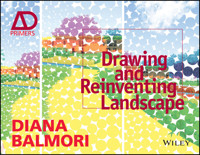
In this book, author Diana Balmori explores notions of representation in the discipline at large and across time. She takes readers from landscape design's roots in seventeenth-century France and eighteenth-century England through to modern attempts at representation made by contemporary landscape artists.
- Addresses a central topic in the discipline of landscape architecture
- Features historic works and those by leading contemporary practitioners, such as Bernard Lassus, Richard Haag, Stig L Andersson, Lawrence Halprin, and Patricia Johanson
- Written by a renowned practitioner and educator
- Features 150 full-color images
Drawing and Reinventing Landscape, AD Primer is an informative investigation of beauty in landscape design, offering inspiring creative perspectives for students and professionals.
Sie lesen das E-Book in den Legimi-Apps auf:
Seitenzahl: 245
Veröffentlichungsjahr: 2014
Ähnliche




















Contents
Cover
Half Title page
Title page
Copyright page
Epigraph
Acknowledgements
Foreword
Attuning the Mind to the Ebbs and Flows of Nature
References
Introduction
References
Chapter 1: The Contemporary Reinvention of Landscape Architecture and its Representation
Origins
Experiencing Change
Breaking with the Past
References
Chapter 2: The Pleasure of Drawing
The Act of Drawing
Drawing as Facilitator
References
Chapter 3: Notebooks, Early Sketches and Late Drawings
Notebooks
Early sketches
Late drawings
References
Chapter 4: Contemporary Landscape Architects and Landscape Artists
Landscape Urbanism
Bernard Lassus
Patricia Johanson
Richard Haag (Rich Haag Associates)
Stig L Andersson (SLA)
Lawrence Halprin (Lawrence Halprin and Associates)
Diana Balmori (Balmori Associates)
Summary
References
Chapter 5: Historical Issues in Landscape Architecture Representation
Drawing and Painting
Representation of Representation: The Theatre in the Garden and the trompe l’oeil
Representation of Space: Depth and Width
Integrated Drawings
Representation of Time
References
Chapter 6: Contemporary Issues Deriving from Change
Computing and Hybridising
From a Fixed to a Changing Arcadia
References
Project Team Credits
Bibliography
Key Search Terms
Picture Credits
End User License Agreement
Drawing and Reinventing Landscape
This edition first published 2014 Copyright © 2014 John Wiley & Sons Ltd.
Registered office John Wiley & Sons Ltd, The Atrium, Southern Gate, Chichester, West Sussex, PO19 8SQ, United Kingdom
For details of our global editorial offices, for customer services and for information about how to apply for permission to reuse the copyright material in this book please see our website at www.wiley.com.
All rights reserved. No part of this publication may be reproduced, stored in a retrieval system, or transmitted, in any form or by any means, electronic, mechanical, photocopying, recording or otherwise, except as permitted by the UK Copyright, Designs and Patents Act 1988, without the prior permission of the publisher.
Wiley publishes in a variety of print and electronic formats and by print-on-demand. Some material included with standard print versions of this book may not be included in e-books or in print-on-demand. If this book refers to media such as a CD or DVD that is not included in the version you purchased, you may download this material at http://booksupport.wiley.com. For more information about Wiley products, visit www.wiley.com.
Designations used by companies to distinguish their products are often claimed as trademarks. All brand names and product names used in this book are trade names, service marks, trademarks or registered trademarks of their respective owners. The publisher is not associated with any product or vendor mentioned in this book.
Limit of Liability/Disclaimer of Warranty: While the publisher and author have used their best efforts in preparing this book, they make no representations or warranties with respect to the accuracy or completeness of the contents of this book and specifically disclaim any implied warranties of merchantability or fitness for a particular purpose. It is sold on the understanding that the publisher is not engaged in rendering professional services and neither the publisher nor the author shall be liable for damages arising herefrom. If professional advice or other expert assistance is required, the services of a competent professional should be sought.
ISBN 978-1-119-96702-6 (paperback) ISBN 978-1-118-54117-3 (ebk) ISBN 978-1-118-54118-0 (ebk) ISBN 978-1-118-54119-7 (ebk) ISBN 978-1-118-83057-4 (ebk)
Executive Commissioning Editor: Helen Castle Project Editor: Miriam Murphy Assistant Editor: Calver Lezama
… Their elegant necks angled down as everything slopedtoward the river more than a mile across there,full of sandbars whose shapesthe water slowly rearranged, so no mapever stayed exact.
— Debra Nystrom (from ‘Pronghorn’, The New Yorker, 13 May 2013, p 37)
Acknowledgements
Many scholars and researchers have helped to put this book together and have shepherded it through the convoluted two-year path of its writing, in the face of many demands that the design work in a landscape office demands. It has been a pleasurable experience, however, and I was helped in this by my editor Helen Castle who understood and gave me some breathing room when I had to extend a deadline, and gave support to my request for a ‘landscape’ rather than a ‘portrait’ format for this book, the books on architectural representation published as part of this series being all vertical.
Michel Conan, former Director of Garden and Landscape Studies at Dumbarton Oaks, was a careful and important critic throughout the development of this manuscript. In particular I am most grateful for his insights about my own work, and for always making me go further in the expression of ideas.
Lauren Jacobi – at the start of this writing, a graduate student in Art History at the NYU Institute of Fine Arts, now starting as new faculty in Architectural History at MIT – was a critical help in finding material that I needed as well as writing to different scholars to amplify particular points, or to add new interpretations based on new research.
Noémie Lafaurie-Debany, Principal in Balmori Associates, cast her meticulous eye over the whole text and illustrations and was a most thorough critic as well as contributor in seeing the lack of some things in the text, and excessive material on others.
Elizabeth Segal has been the excellent editor to whom I always turn to force clarity out of my prose, the quality I prize more than any other. She is always my sounding board and ultimate recourse to get where I want to be.
Isabelle Desfoux, a designer in my office, helped to try out different scenarios for our design for the cover which went through many iterations and different approaches in colour, theme and composition.
Finally, Caroline Ellerby was most helpful and patient in seeking the permissions for the many illustrations, but most of all in being tenacious when we were sent alternatives of images which differed from the ones we wanted, pursuing by hook or by crook the right ones, making for a better book.
Foreword
Attuning the Mind to the Ebbs and Flows of Nature
This is a challenging book for all of us who have ears and hear not. Changes happening before our eyes, even radical changes, may be obvious and yet invisible because they are outside the frames of our understanding. Diana Balmori makes three claims: first, that our views of nature are undergoing a radical change; second, that as a result, landscape architecture is called upon to reinvent itself; and third, that drawing will be a key instrument in that reinvention. At first sight, we may dismiss outright the radicalism of these changes. Everybody, or at least every landscape architect in the Western world, knows that a global ecological awareness is transforming humans’ attitudes towards nature. After all, isn’t it an ongoing process that started about half a century ago, with Earth Day symbolising that shift? How could this be a radical change now? In truth, landscape architecture took a radical turn with Ian McHarg’s Design with Nature, which was published in 1969 – again, more than four decades ago.1 Last, and most paradoxical, is the idea that hand-drawing could be a source of professional renewal for landscape architecture when computer screens have made tracing paper obsolete, and social media are about to displace the newspaper. These are the real changes that everybody can see, and there is nothing fundamentally new happening before our eyes. Or is there?
Balmori herself was involved throughout the last third of the 20th century in American landscape architecture’s shift towards ecological and environmental awareness. She was also engaged in dialogue with her colleagues at Yale and in New York City, who participated in the transformation of ecological thinking in science, in the debates it triggered in urban planning, and in its impact upon the arts. In her eyes, it is not the idea of nature as a living system that includes human beings that is new; it is the necessity to renounce a long-held and cherished belief in nature’s capacity for self-regulation – that is, in its ability to return to its former state of balance after disruptions that have accumulated since the beginning of the industrial revolution. Nature is no longer a point of reference, a polar star towards which humans can try to steer the course of living beings, the climate and the oceans. Nature is an unfathomed becoming; and scientists, like oarsmen rowing a scull to a future to which their back is turned.
In 1638 Jacques Boyceau de la Barauderie, in a posthumously published book, recommended that before creating a garden in front of his mansion, a country lord should display the plan for the garden in the entrance hall, and then (hiding like Apelles) listen to the comments and criticisms of his guests before honing his design to perfection.2 No more. We can no longer plan or shape the earth, cities, rivers or forests like a well-ordered orchard or kitchen or pleasure garden for generations to come. Establishing tomorrow’s landscapes demands a new level of understanding of nature, focused on mutability rather than on equilibrium. We have to become aware of the forms of the changes themselves – the dynamics of floods and droughts; the courses of twisters, hurricanes, ocean currents, niños and niñas; the transformation of river beds and sea shores; and the paths towards survival of animal and plant species. It is a good time to open our understanding to what is before our eyes and draw some serious conclusions.
Landscape architects of the environmental movement under Franklin D Roosevelt concerned themselves with land erosion, river valley restoration and parkland conservation. More than three decades later, after McHarg, the focus turned to ecological restoration and to illustrating environmentalist ideas in corporate campuses and residential projects. Now we are confronting new issues. Today, cities and megalopolises are at stake. Their development is a major concern. However, city planning is mired in legal, economic and political regulations and constraints which have been developed over the last one and a half centuries, in order to build a fixed world, something like the Broadacre City proposed by Frank Lloyd Wright.3 It was a poignant utopia. It took the freedom of the Usonian family as its central concern and sought to carve a place for each home in the loose context of an everlasting nature. We can no longer relish this dream nor that of any other utopia. We have to place the dynamics of nature at the centre of our concerns in the tentative reformatting of cities and city life. This is a huge task to which landscape architecture should make a new contribution. But how?
To answer this question, Balmori takes a twofold approach. On the one hand, she looks at the long-range history of the development of landscape architecture and unravels the importance of its relationship to the arts, and in particular to theatre, painting and draughtsmanship. On the other hand, she turns her investigation towards contemporary landscape architects trying to break away from mainstream professional attitudes. Both of her inquiries are deeply encouraging. Artists are responding to some of the same issues that concern landscape architects, inviting a renewal of historical dialogues. In addition, there are myriad non-conventional approaches by landscape architects who share a sense of responsibility to the general public beyond their immediate concerns for their clients.
The diversity of their design perspectives may baffle readers who hoped for new guidelines to emerge from these landscape architects’ confrontation with the reality of constant change in nature or for the discovery of a new avant-garde ushering in a bright future for the profession. Balmori’s inquiry points to something far more meaningful than the promise of a new style or a new urbanism. She looks into the relationships between three non-linear processes: working, seeing and nature. Nature itself is a complex set of random processes, some highly predictable, others catastrophic, with which of all us, including landscape architects, have to come to terms, whether looking at or working with nature. Building upon her own experience, she explains how drawing constitutes a way of engaging the eye and the mind in an exploration of the natural world and of disentangling oneself from sophisticated and misleading habits of thought. She explains how drawing may open the draughtsman to a greater awareness of changes – both fleeting and awe-inspiring – in the environment. She also demonstrates how different contemporary landscape architects have been able to transform these experiences into a great variety of projects, triggering new public responses to nature.
Balmori’s pleas for a renewed attention to contemporary arts – inspired by fascinating dialogues between landscape and painting in past centuries – and for the cultivation of personal draughtsmanship, are not born from a reactionary rejection of the computer as a design tool. On the contrary, she calls for the development both of new programs for hand-drawing directly on the computer screen and of new skills in using those programs. Tablets should make this as inspiring for creative interaction with the physical world as manufactured chemical colours and metal paint tubes were for open-air painting in the 19th century. But it is not important which tool – brush, Chinese ink pen, pencil, chalk on paper, or finger on a touch screen – is used, although the result will be different with each medium. It is the renewal of engagement with nature and of eye–hand–brain coordination which matters.
Drawing and Reinventing Landscape does not advocate using particular drawing techniques, or even styles. It calls for drawings as functional links between the processes of change in nature and of seeing on the one hand, and between the processes of seeing and of designing on the other. In both cases, drawing helps landscape architects to develop embodied skills as they interlace what they are imagining with their observing of nature. It will enable them to carry fresh and personal experiences of engagement with the world around them into a creative mode of proposing or inventing new city-landscapes that resonate with the flows and fluxes of nature. The present generation has developed new skills through daily interaction with computers. Draughting offers landscape architects a way towards attuning themselves to the rhythms and vagaries of natural processes. Inviting us to go beyond the looking glass of final renderings and construction drawings, Drawing and Reinventing Landscape opens the door to creative imagination for landscape design in an ever-shifting world.
Michel Conan Williamsburg, 7 June 2013
References
1Ian L McHarg, Design with Nature, John Wiley & Sons, Inc (New York), 1992.
2Jacques Boyceau de la Barauderie, Traité du iardinage selon les raisons de la nature et de l’art. Ensemble divers desseins de parterres, pelouzes, bosquets et autres ornements, Michel Vanlochom (Paris), 1638.
3Frank Lloyd Wright, When Democracy Builds, University of Chicago Press (Chicago), 1945.
Introduction
There could be a no more apt introduction to the subject of this book – the representation of landscape – than the thoughts and reflections of contemporary landscape practitioners and artists. Designers in my office selected the quotations. Each chose their quote based on their sense that it accurately described the present state of the discipline. The core theme of these quotations – the upheaval and complete break with the past in terms of representation – is the essence of this book. An immediate sense of the maelstrom in the discipline can be gained by this series of snapshots.
Lesen Sie weiter in der vollständigen Ausgabe!
Lesen Sie weiter in der vollständigen Ausgabe!
Lesen Sie weiter in der vollständigen Ausgabe!
Lesen Sie weiter in der vollständigen Ausgabe!
Lesen Sie weiter in der vollständigen Ausgabe!
Lesen Sie weiter in der vollständigen Ausgabe!
Lesen Sie weiter in der vollständigen Ausgabe!
Lesen Sie weiter in der vollständigen Ausgabe!
Lesen Sie weiter in der vollständigen Ausgabe!
Lesen Sie weiter in der vollständigen Ausgabe!
Lesen Sie weiter in der vollständigen Ausgabe!




