


6,99 €
Mehr erfahren.
- Herausgeber: hockebooks
- Kategorie: Gesellschafts- und Liebesromane
- Sprache: Englisch
Set in landscapes, cities and rooms, these very short prose portraits direct the reader’s gaze towards something encompassing, far beyond what the narratives recount. The voices of an artist, a dying soldier, a scholar, a child, an employee, a monk and a young girl speak. Simultaneously surreal and existentialistic, their psyches traverse the chasm between the 20th and 21st century, leaving a poetic trail. The thoughts of each person characterized evoke an alternate imaginary space, where waking life and the dreamed can no longer be differentiated. The narratives vibrate as the visible and the invisible intertwine, disrupting the certainty of a single plane of existence.
Das E-Book können Sie in Legimi-Apps oder einer beliebigen App lesen, die das folgende Format unterstützen:
Seitenzahl: 47
Veröffentlichungsjahr: 2014
Ähnliche




















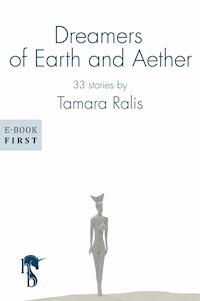
Tamara Ralis
Dreamersof Earth and Aether
33 stories
THE STORIES SPEAK FROM THE CHASM THAT SEPARATES OUR TWO CENTURIES
Forsaken Green
Just when the Age of Globalism was beginning, the Antarctic melting, top executives walking on stilts – their legs, suddenly, on different pieces of ice, each drifting in another direction – and the certainty of lifelong employment a dependable uncertainty, a schoolteacher sat in the crowded dining car of a train from Winterthur to Paris. He was eating veal with asparagus, when a thin woman with glasses asked whether she could sit down in the only vacant seat, which was across from him. He said, “Yes,” and at the very moment she was stowing her laptop, the train entered a tunnel. Something began to sing intensely, quieting all conversation for long seconds. “What is singing?” she asked. “It sounds like a mad, eerie voice.” “It is the winter wind wailing in the tunnel, madam. It is the spirit of ice trapped in the length of the tunnel.”
“Strange,” said the pale woman. “I dreamt of a high mountain. In one of the hollows lay a piece of black cloth. Suddenly, water began rushing down from all sides, the mountain turned into gushing water, an immense waterfall – and was … no longer there.” The teacher took a sip of wine and told his vis-à-vis that he found the dream interesting – the quickness of changing events reminded him of his students, who were bored with nature. On television they could see the lifespan of an animal unfold within moments: how an animal in an egg crept out of the egg, got fed by its parents, learned to fly, procreated, built a nest for its babies, fought with its enemies, and died – all within five minutes. Before the waitress could take another order of tomato soup, the white landscape disappeared, it became dark, and the icy wind sang again. “And then,” he resumed, “in reality – on the grass outside – the bird just pecks around a bit and nothing much happens, except that it eats a worm. For a quarter of an hour it doesn’t do more. No wonder children forsake the green for the Web.” The woman pondered: it would take a special child to wait and wait, if nature was so slow.
Weatherless Dialogues
A yellow cloud of humid air hung heavily between the buildings of the city. The weather was like a huge injured entity with a foreboding character, an inorganic being distantly related to the comet that had been attacked yesterday as a Fourth of July stunt. The awaited hailstorm refused to burst open and hovered like a held-back hostility in the unconscious of the population.
Trying not to inhale the suffused atmosphere, Professor Alvin Mann left his office and crossed the university grounds to teach his summer course in astronomy. He understood himself as a scholar of empirical observation and began the lecture by stating, “It is superstitious to believe that a volcanic eruption could be caused by the onslaught of scientists on a comet – as absurd as a poet’s idea that a volcano is a woman’s womb disgorging a fiery birth.” With this opening sentence, the professor tried to calm his students, who were distraught about the hubris of this infamous celebration.
Reverie River (this was her real name – her parents had imagined it when they desired to conceive her) did not go to campus that day. Instead, she sat – with the will to bring order into them – amidst hundreds of pages she had printed out from her computer, all the while thinking of the forests that were being cut to stumps daily and of homeless animals. Yet every time a non-spam email appeared, it seemed so precious – as though electronic love had flown especially to her through the air. A deep longing overcame her to see it on white paper. The messages would then look like real letters, a secret reservoir of intensities, tokens of togetherness, although no one was there. She preferred not to go out into the dissonant climate, but to dream her dialogues from a distance.
Not Just A Father
Erin’s eyes, huge like those of a starving baby, gazed spellbound at the long, red-petalled organza dress her lover had sewn for her. It was a rose queen’s gown. He had stitched the seams by hand, all the while thinking of her as a beautiful flower.
Eleven people, struck by the realization that they would probably be her last guests on Earth, sat around Erin. They tried not to be silent and not to weigh their words. Unimaginably skinny, she governed the moment with regal transparency. Somehow the atmosphere dissolved the veil between here and there and conveyed a feeling of being afloat.
When the party was over, Erin’s father kissed her and quietly ran down the stairs of the ivy-covered apartment house into a November drizzle. He glanced into the evening like an eagle – he had a meeting to attend. He had won a competition. He was an architect, not just a father.




