


17,99 €
Mehr erfahren.
- Herausgeber: John Wiley & Sons
- Kategorie: Fachliteratur
- Sprache: Englisch
Strategies for long-term social impact This important new book illustrates how to create the social breakthroughs needed to solve urgent global threats such as poverty, disease, and hunger. It then turns to three alternative, but complementary, paths to social breakthrough: social protecting, social exploring, and social advocacy, providing a detailed map of the journey from initial commitment to a world of justice and opportunity * Examines the current condition of the social impact infrastructure * Offers strategies for how to remedy the steady weakening of our social-impact infrastructure * Provides tactics to build strong social organizations and networks * Illustrates dynamic methods to respond to constant economic and social change Author Paul Light believes we should be less concerned about the tools of agitation (social entrepreneurship, social protecting, social exploring, and social advocacy) and more concerned about the disruption and replacement of the status quo. Timely in its urgency, this book describes the revolutionary social impact cycle, which provides a new approach for framing the debate about urgent threats.
Sie lesen das E-Book in den Legimi-Apps auf:
Seitenzahl: 258
Veröffentlichungsjahr: 2010
Ähnliche



















Contents
Foreword
Acknowledgments
Introduction
Chapter 1: Still Searching for Social Entrepreneurship
Building a Field
Defining Terms
Must Social Entrepreneurs Invent Alone?
Are Social Entrepreneurs Truly Different?
Are There Different Kinds of Social Entrepreneurship?
A New Inventory of Assumptions
A Lingering Question
Conclusion
Chapter 2: Agitating the Prevailing Wisdom
Social Safekeeping
Social Exploring
Social Advocacy
A Shared Job Description
Conclusion
Chapter 3: The Breakthrough Cycle
Driving Change
Exploring the Cycle
Building a Robust Breakthrough Cycle
Conclusion
Chapter 4: Prepare to Expect Wonders
Where We Have Been
Where We Should Go
Rebuilding The Infrastructure of Change
Scaling to Impact
Patience as a Virtue
A Final Point
Bibliography
Index
Driving Social Change
Copyright © 2011 by Paul C. Light. All rights reserved.
Published by John Wiley & Sons, Inc., Hoboken, New Jersey.
Published simultaneously in Canada.
No part of this publication may be reproduced, stored in a retrieval system, or transmitted in any form or by any means, electronic, mechanical, photocopying, recording, scanning, or otherwise, except as permitted under Section 107 or 108 of the 1976 United States Copyright Act, without either the prior written permission of the Publisher, or authorization through payment of the appropriate per-copy fee to the Copyright Clearance Center, Inc., 222 Rosewood Drive, Danvers, MA 01923, (978) 750-8400, fax (978) 646-8600, or on the Web at www.copyright.com. Requests to the Publisher for permission should be addressed to the Permissions Department, John Wiley & Sons, Inc., 111 River Street, Hoboken, NJ 07030, (201) 748-6011, fax (201) 748-6008, or online at http://www.wiley.com/go/permissions.
Limit of Liability/Disclaimer of Warranty: While the publisher and author have used their best efforts in preparing this book, they make no representations or warranties with respect to the accuracy or completeness of the contents of this book and specifically disclaim any implied warranties of merchantability or fitness for a particular purpose. No warranty may be created or extended by sales representatives or written sales materials. The advice and strategies contained herein may not be suitable for your situation. You should consult with a professional where appropriate. Neither the publisher nor author shall be liable for any loss of profit or any other commercial damages, including but not limited to special, incidental, consequential, or other damages.
For general information on our other products and services or for technical support, please contact our Customer Care Department within the United States at (800) 762-2974, outside the United States at (317) 572-3993 or fax (317) 572-4002.
Wiley also publishes its books in a variety of electronic formats. Some content that appears in print may not be available in electronic books. For more information about Wiley products, visit our web site at www.wiley.com.
Library of Congress Cataloging-in-Publication Data:
Light, Paul Charles.
Driving social change : how to solve the world’s toughest problems / Paul C. Light.
p. cm.
Includes bibliographical references and index.
ISBN 978-0-470-92241-5 (cloth); ISBN 978-0-470-94013-6 (ebk); ISBN 978-0-470-94012-9 (ebk); ISBN 978-0-470-94014-3 (ebk)
1. Social change. 2. Social problems. 3. Infrastructure (Economics) I. Title.
HM831.L54 2010
303.48'4—dc22
2010032315
To Ernie, who took me across the finish line
Foreword
Simply defined, social entrepreneurship creates new combinations of ideas that spur solutions to great problems. It is an essential path to doing well and doing good at the same time.
It is also a time-honored form of leadership. Social entrepreneurs do not spend their time telling others what to do. They pick up the reins. They keep the plates spinning toward achieving an impact. They have the drive to tackle social issues through all means possible. Social entrepreneurs are not cynics. They believe they can change the world.
Social entrepreneurs are not wed to any particular method, however. They do whatever is necessary to make a difference for the public good and they operate across society. Some work in nonprofit agencies, others in government, and still others in private firms.
Wherever they work, social entrepreneurs must have the business savvy, financial skills, and innovative passion to disrupt the status quo of our social problems and thereby create large-scale change. There is always something to disrupt, but not always the strategy needed for the long drive for success.
At the heart of every breakthrough is an outside-the-box visionary who had a passion for making a difference. It is true in science, the arts, education, and business—and it is true in solving social problems.
Think of the business entrepreneurs who changed the United States. Henry Ford did it with the Model T, a car for the masses. George Eastman did it with photography. A. P. Giannini did it with his branch banking idea for all citizens, rich or poor, and modern banking was the result. And a young professor of molecular biology named Herbert Boyer endured academic scorn by going into business to produce synthetic hormones and launch an ongoing biotech revolution.
Why can’t the same out-of-the-box approach be used for social problems?
What if we found people with the same drive and courage as Herb Boyer to address widespread social ills?
Paul C. Light has important answers to these questions. Like me, he believes in the power of the individual to make a difference. Like me, he believes in the power of innovation to make a difference. And, like me, he believes that social change is not only possible, but essential for addressing the great problems that surround us.
Let me highlight three change agents, true social entrepreneurs who embody this potent combination.
A social entrepreneur from Bangladesh, Muhammad Yunus, won the Nobel Peace Prize for creating and expanding his trailblazing use of small loans, or microcredit, to bring about social change. Loans as low as $9 have helped beggars start small businesses and poor women buy basket-weaving materials.
As the Nobel Committee said in its citation, “Lasting peace cannot be achieved unless large population groups find ways in which to break out of poverty. Microcredit is one such means.”
The founder of the American Association of Retired Persons (now AARP), Ethel Percy Andrus, was an equally important but less visible social entrepreneur. She saw the need to bring older persons out of their isolation and back into the mainstream of American life and created AARP to achieve her goal. Today, AARP has 40 million members who receive a variety of benefits that have improved the quality of their lives and the economic vitality of the United States. Andrus gave voice to the needs and opportunities of millions of older Americans.
My friend Wendy Kopp, for her senior thesis as an undergraduate at Princeton University, envisioned a movement that would fill the empty classrooms in the nation’s most needy schools. She turned her thesis into the organization Teach for America, which now places more than 7,000 corps members in classrooms across the nation. Over the past 20 years, Teach for America alumni have reached approximately three million students. In doing so, she touched a nerve with college students who want to make a difference in American education.
Why did the world get so excited when Warren Buffett said he was going to give $31 billion of his stock to the Bill & Melinda Gates Foundation? I have thought about that a good deal. The excitement was not just about the money—after all, government has much more money that either Buffett or Gates.
Rather, it was about new ways to meet old social problems. It was also about supporting new ideas for tackling large problems. And it was about creating and expanding big ideas.
Let me tell you about the nature of social entrepreneurs by relating a story about the behavior of birds.
There was an article a number of years ago in the Harvard Business Review that had to do with successful companies. One interesting analogy the author used regarded the behavior of two species of birds, brown titmice and red robins, in Great Britain.
In the late 1800s, milkmen left open bottles of milk on people’s doorsteps. The rich cream would rise to the top, and the titmice and robins would consume the cream.
In the 1930s, after the birds had been enjoying the cream for about 50 years, the British began to put aluminum seals on the bottles. By the early 1950s, the entire population of an estimated one million titmice had learned to pierce the seals. The robins never acquired that skill.
Now why is that? The answer is that robins are territorial. There is a great deal of communication among them but it is usually of the “keep out of my territory” variety. The titmice, in contrast, like to flock. And birds that flock learn faster.
Social entrepreneurs are like titmice. Yes, entrepreneurs are independent birds, but they do flock—they flock toward new ideas and others of their kind who have new ideas.
They share. They compare. They experiment. They try this. They try that. They cock their heads and look at the seal until they figure out how to break it and get the cream.
Light’s new book shows us how social entrepreneurs and other change agents can use the same kind of creative collaboration to achieve social change. Like social entrepreneurs, he is not wed to any one path to having an impact.
He believes that change can come from the kind of visible heroes my foundation supports through the Academy of Achievement, from pathbreaking institutions such as Teach for America, from teams of talented individuals who work together toward sustaining and protecting social breakthroughs, and from collections of change agents who form networks for sharing ideas and promoting impact. And perhaps most important, he believes that power is an essential resource in creating change.
His book offers a number of important insights for creating future breakthroughs toward economic, social, and political progress. He rightly argues that our fundamental purpose must be to change the world. Social entrepreneurship has never been about personal glory, though glory sometimes follows. It is about the tough work of change.
Light also rightly argues that there are many partners in successful change. There is almost always a visible figure at the front of the march, but there must be others walking side by side. Change rarely occurs through the simple power of a good idea—it requires hard work by many people who share the same goal. The path to change must follow the ultimate goal, not vice versa.
Finally, Light argues that we must learn more about how to make the best use of our change agents. They face many obstacles on the path to success. As I have learned firsthand, the status quo often uses every means possible, including the aggressive use of power, to resist change. That is how it remains the status quo.
Light’s book offers other insights about how change occurs, including the need for constant vigilance regarding past achievements such as women’s rights, environmental protection, and reducing disease. We must simultaneously push forward with new solutions to old problems, while protecting past breakthroughs that continue to produce progress. As Light argues, this is not an either-or world. We must alter the future even as we celebrate the past.
I commend Light’s book to anyone dedicated to social change. His questions deserve answers, his insights demand attention, and his faith in the possible will resonate with the future leaders who are already taking the reins of power needed for solving the world’s toughest problems.
Catherine B. Reynolds
Chairman of the Board
Catherine B. Reynolds Foundation
July 31, 2010
Acknowledgments
This book is the inaugural contribution of my New York University Center for Global Public Service and Social Change. The center is jointly sponsored by New York University and the government of the United Arab Emirates. Its mission is to promote public service and social change across the globe, and it will draw upon research, case studies, and networks to advance efforts to address the world’s toughest problems, which are often called urgent threats.
This book could not have been written without support for the new center. This support was awarded through a competitive process at New York University, and benefited greatly from input from senior New York University officers, most notably Provost David McLaughlin and Deputy Provost Ron Robin. This work also benefited from the support of the dean of the Robert F. Wagner School of Public Service, Ellen Schall, and associate deans Rogan Kersh and Tyra Liebmann, and the talented staff that provided the administrative support for this work. I also received significant encouragement from the director of the Catherine B. Reynolds Program in Social Entrepreneurship and its director, Gabriel Brodbar, and interactions with colleagues at Duke University and Oxford University’s 2010 Research Forum on Social Entrepreneurship.
I am also grateful to the many colleagues who have participated in conversations about social change, including Paul Davis, Susan Davis, J. Gregory Dees, James Dewar, Bill Drayton, Cynthia Gibson, Peter Goldberg, Rich Harwood, Robert Lempert, Joe Magee, Ruth McCambridge, Ellen McGrath, Jonathan Morduch, Sonia Ospina, Ed Skloot, Dan Smith, and Dennis Smith, and to the many students who have shaped my thinking through their tough questions. I am particularly thankful for ongoing encouragement from my friend and mentor Joel Fleishman.
I owe a special debt of gratitude to my alma matter, Macalester College, which invited me to present an earlier version of this book in February 2010. My former professors at “Mac” were instrumental in teaching me how to think about social change, in no small measure because Mac created a learning culture for its students.
Ultimately, this book could not have been written without frequent questions from my talented research team, which is ably led by my deputy, Clara Janis, and my research assistants, Nick Farrell and Steven Friday. I also deeply appreciate the team at John Wiley & Sons, who acted with speed and great attention to quality. As always, however, this book is mine and mine alone. I am responsible for errors, assertions, and facts herein.
Introduction
The world faces an onslaught of urgent threats. Poverty continues to corrode hope and opportunity, disease threatens lives and well-being, intolerance marginalizes hundreds of millions and fuels genocide, political instability and corruption produce failed states and genocide, global warming continues its onward march toward environmental devastation, the global recession maintains a tight grip on inequality, and the world remains vulnerable to a host of known and yet-to-be-known catastrophes.
These threats are urgent if only because the world has little time to act before reaching tipping points that will create decades, if not centuries, of havoc. They threaten the very fabric of the world’s social, economic, and political systems, and almost certainly guarantee a declining quality of life for every citizen. They must be tackled soon.
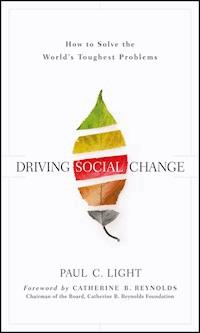
The cover of this book makes this point perfectly. The leaves of social breakthroughs are part of the trees of new and still-vibrant breakthroughs alike, and the trees are part of the forest of change. Every leaf is nurtured by the forest as a whole, and is linked in some way to the broader effort to move from the darkness of winter through the many colors leading to a vibrant spring. The challenge is to reach the green and hold it, in part by supporting the forest as a whole.
This book is based on the notion that intractable problems can be solved if agents of change have the purpose and perseverance to confront the status quo. The path to a more just, tolerant, and equitable world is never easy, but its twists and turns can be marked and informed.
Drawing upon my own research and new insights from recent studies, the book asks three sets of questions.
First, are we relying too heavily on lone wolves to produce social entrepreneurship and change? How do we end the definitional debate about what does and does not constitute change? And what is the entrepreneur’s role in protecting past breakthroughs? Simply asked, are we overselling social entrepreneurship as the primary, or even only, driver of social breakthroughs?Second, what are other drivers that can be used for social change? How do they work? What is their role in pushing through the key stages of impact? And where do they fit in the breakthrough cycle? Simply asked, have we neglected other actors in both challenging the prevailing wisdom, addressing urgent threats, and honoring the promises we make?Third, how do breakthroughs actually occur? What are the key steps in creating momentum toward disruption, breakthrough, and durable social change? What are the most promising targets for further research and investment? And what are the essential characteristics of robust movement through the breakthrough cycle? Simply asked, how can collaboration advance success?Although each chapter stands separately, they all relate to the breakthrough cycle discussed in Chapter 3. Social entrepreneurship is a critically important part of the agitation needed for change, as are social safekeeping, exploring, and advocating. So is the infrastructure of change that supports social breakthrough. Viewed as a whole, this book focuses on the overall pieces that must come together to solve the world’s toughest problems.
Along the way, the book focuses on the need to protect past social breakthroughs from complacency and counterattack. Unlike business breakthroughs that sweep away entire industries with a single product, social breakthroughs rarely destroy the industries of deprivation that profit from human suffering. These industries not only survive most breakthroughs; they sometimes return to power in the very next election or war.
Defining Breakthrough
Social breakthrough is a nearly perfect term for describing the ultimate output of social action. When successful, social breakthrough pushes a fundamental change in the prevailing wisdom about who gets what, when, where, and how from a society. Social breakthrough occurs when the demand for an end to deprivation, marginalization, and inequality finally overwhelms the resistance. Some breakthroughs involve the faithful execution of new laws and treaties, others create measurable changes in public behavior, and still others actually dismantle a whole industry of deprivation by restoring human rights and liberties.
However, social breakthrough is not a synonym for social entrepreneurship or innovation. Rather, it is the destination of all social action, and involves a cycle of engagement that can act as a map for deploying resources and energy. Although a breakthrough can come from the new combinations of ideas that underpin innovation (social entrepreneurship), it can also come from the aggressive defense, delivery, and expansion of past breakthroughs (social safekeeping), careful research on trends and solutions (social exploring), and the unrelenting demand for change embedded in social networks (social advocacy). The choice of one driver over another depends entirely on the problem to be solved, not the popularity of a particular approach. The urgent threat comes first, while the choice of a particular driver for achieving impact comes second. Form follows function, path follows purpose, and driver follows destination, not vice versa.
As such, we must search for change through all means possible, whether beneath the lamppost that illuminates individual heroes or just beyond the light among those who aggregate the pressure for change. If our purpose is to change the world, we must concentrate on every driver possible, not just the ones we can see.
A Sheldonian Moment
Ironically perhaps, I came to this conclusion after attending the three-day 2009 Skoll World Forum on Social Entrepreneurship, which took place in Oxford, England. It was a remarkable event—intense, inspiring, and engaging. All the people I admire were there—Bill Drayton, Pamela Hartigan, Darell Hammond, Victoria Hale, Sally Osberg, Larry Brilliant, and even Jeff Skoll himself. I attended the forum ready to embrace social entrepreneurship as the key driver of social breakthrough and did everything I could to make the conversion. But the event convinced me otherwise.
On the one hand, the forum offered plenty of inspiration through stories and films about the heroes who work so hard to achieve social breakthroughs. The forum also featured grants to a host of social entrepreneurs, such as Bart Weetjans of Apopo, Nader Khateeb and Gidon Bromberg from EcoPeace, Martin von Hildebrand from Foudación Gaia Amazonas, Nina Smith from GoodWeave (formerly known as Rugmart International), and Jordan Kassalow from VisionSpring (formerly known as Scojo).
On the other hand, the forum was unsettling. Perhaps it was just the contrarian in me. Or perhaps it was Jeff Skoll’s speech about the state of the world. The more Skoll talked about the urgent threats facing the world, the more I wanted to be anywhere but in the historic Sheldonian Theatre where he spoke. So much money and celebration for so many wonderful start-ups—but so many frightening problems and so much deep uncertainty about the future.
The two themes are now coming together, in part because Skoll and other funders are focusing more closely on collaboration. As the Skoll Foundation argued in announcing its 2010 world forum, heroes will always be an essential source of new combinations of ideas, but catalytic collaboration is the key to eventual impact:
More and more social entrepreneurship is not only about the power of the brilliant individual; increasingly it’s about the power of partnerships, the coalitions that take the solutions you envision and bring the impact of those solutions to scale, not necessarily one organization to scale, the impact of the solution to scale. This is the direction we are headed, toward a dynamic open-source model of social breakthrough.
Catalytic collaboration is also an essential tool for achieving scale, which means harnessing enough momentum and power to bring about change. Scale is not about becoming a supersized organization, but about achieving impact. Defined as such, scaling involves a very different set of skills beyond fund-raising and organizational development. It involves “swarming a target,” playing political hardball, setting the agenda, exploiting leverage points, creating coalition where credit is shared rather than hoarded, and fighting back when the old equilibrium begins its inevitable counterattack. Social entrepreneurs surely know how to take punches—this is part of challenging the prevailing wisdom. They need to know how to deliver punches, too.
By definition, an open-source model is both porous and flexible. It cannot be an invitation-only mechanism restricted just to social entrepreneurs. It must involve every source of energy—the entrepreneurs who create new combinations of ideas; the social explorers who monitor the trends and opportunities; the social advocates who twist arms and count votes; and the social safekeepers who protect, repair, reinvent, and implement great breakthroughs.
Structure of the Book
This book is best read as my latest report from the conversation about social change. Although the book focuses first on the role of social entrepreneurship as a powerful source of new ideas, it also examines other, equally powerful drivers of social change that participate in the social breakthrough cycle.
According to many advocates of change, social entrepreneurship is the primary tool for challenging the prevailing wisdom about the human condition. But there are also old ideas that merit protection, innovation, and expansion. There has already been great progress on pulling individuals out of poverty, treating life-threatening diseases, and addressing barriers to equal rights. Social entrepreneurship offers hope for new ways of achieving great social goals, but so do social safekeeping, exploring, and advocacy.
Chapter 1: Still Searching for Social Entrepreneurship
This first chapter of this book addresses the rapidly changing definition of social entrepreneurship. Having studied the term for nearly eight years now, I remain committed to the concept. New combinations of ideas matter. However, the more I study the term, and its links to other terms such as social innovation, which I wrote about in the early 1990s, the more I resist the exclusive approach often used in the field.
My definition of the new social entrepreneurship (circa 2011) is as simple as possible: Social entrepreneurship is an essential but not exclusive driver of innovative social breakthrough. Again, it is an important driver, to be sure, and one with great potential. At the same time, it is not always the best driver for solving a given problem. Again, driver follows destination.
The chapter also explores the assumptions that underpin our understanding of social entrepreneurship—for example, the notion that social entrepreneurs usually work alone, are different from other high achievers, work in similar ways, and produce their greatest impact in new, small, and often isolated organizations. While several of these assumptions are true—social entrepreneurs do have special skills for change, for example—several are still in play.
As the chapter argues, for example, social entrepreneurship may actually come in several flavors, including “Type A” social entrepreneurship driven by the heroic, 24/7 lone wolf working within a start-up organization, and the less prominent “Type B” social entrepreneurship ignited by collaborative creativity across teams working within an existing setting. The choice of one type over another should depend entirely on the overall strategy for achieving social breakthrough—again, driver follows destination.
Chapter 2: Agitating the Prevailing Wisdom
The second chapter of this book argues that social entrepreneurship exists in a world of many options for change, including three other powerful, often neglected drivers of social breakthrough: social safekeeping, social exploring, and social advocacy. When combined with social entrepreneurship, the three increase the odds that new and old ideas alike will actually penetrate the prevailing equilibrium and survive.
Each of these four drivers has its own role in social change:
1. If the breakthrough requires a new combination of ideas for change, then social entrepreneurship is likely to be the preferred driver.
2. If the breakthrough demands the protection, repair, maintenance, fine-tuning, expansion, and further innovation of past breakthroughs, then social safekeeping is likely to be at the forefront.
3. If the breakthrough stands on an effort to anticipate key threats, monitor trends, and evaluate what does and does not work, then social exploring is likely to be the means to the end.
4. If the breakthrough achieves ultimate policy impact through lobbying, pressure, partisanship, and long-lasting social movement, then social advocacy must be engaged.
This second chapter begins with a definition of social safekeeping as a contributor to social change. The term is particularly appealing as an alternative to social service provision, which is often used to describe the day-to-day delivery of public goods and services. Contrasted with the heroic social entrepreneur, social service providers become little more than metaphorical cafeteria workers of a kind who serve the same tired food on metal trays each morning. Safekeeping challenges this traditional, sometimes unintended but still dismissive image through a job description that includes the execution, defense, repair, innovation, and expansion of breakthroughs. On the notion that the best offense is a good defense, social safekeepers must be proactive in defending the past but never protect it from needed change.
The chapter then introduces the concept of social exploring, which encompasses a range of tools for understanding past successes, anticipating alternative futures, and testing vulnerable assumptions. These exploratory tools are central for creating, hedging, and shaping strategies for achieving desired futures. They are also essential for avoiding surprise. As a professor of mine once told me, “It’s what you don’t even know that you don’t know that can hurt you.” Social exploring provides the tools for knowing.
The chapter continues with a short discussion of social advocacy as a tool for creating breakthroughs, and turns to the concept of blended agitation as a way to bring together the unique strengths of all four drivers of social change.
The chapter ends with a discussion of the need to protect the great breakthroughs that social entrepreneurs have already created. Past breakthroughs do not sustain themselves, especially in an era of retrenchment and complacency. We too often assume that past breakthroughs will take care of themselves, but unlike business entrepreneurship, which often renders existing products obsolete for good, social change is painfully easy to reverse.
Chapter 3: The Breakthrough Cycle
The third chapter of this book describes the social breakthrough cycle, which provides a new approach for framing the debate about urgent threats. The cycle is built rather like the traditional links in a logic chain, albeit with a continuous plan-do-check-act rotation. However, unlike a traditional logic chain composed of inputs, activities, outputs, and outcomes, the social breakthrough cycle involves nine stages:
1. Committing to social change through personal purpose and perseverance against potential resistance.
2. Mapping the assets and obstacles surrounding success, while developing strategies for exploiting the former and surmounting the latter.
3. Sorting the potential components of a breakthrough proposal.
4. Designing a breakthrough proposal and finding an organizational home for pursuing change.
5. Agitating the prevailing wisdom through social entrepreneurship, safekeeping, exploring, and/or advocacy.
6. Aggregating pressure for change through the creation of robust breakthrough networks.
7. Disrupting the prevailing wisdom by exploiting opportunities for impact and planning for effects.
8. Securing the breakthrough through formal and informal enactment of the breakthrough idea, whether in the form of significant policy change or new norms and expectations for a just world.
9. Protecting the breakthrough from counterattack.
This breakthrough cycle is anything but linear—there are starts and stops along the way, fine-tuning, reassessments of earlier decisions, and new calibrations of strategy in response to changing opportunities and conditions.
The chapter continues with discussions of five particularly important leverage points for creating a new prevailing wisdom: committing, mapping, designing, aggregating, and disrupting. It is nearly impossible, for example, to activate the social breakthrough cycle without a basic commitment to making a difference, nor create momentum forward without assets such as civic demand for change, basic freedom to act, government responsiveness, and faithful execution of the laws.
The chapter ends with a discussion of how to build a robust breakthrough cycle. Some cycles lack the basic capacity to succeed—they lack the alertness to anticipate emerging trends, the agility to exploit opportunities and react to counterattacks, the adaptability to alter strategy midstream, and the alignment to pull disparate interests into a sum greater than the parts.
Chapter 4: Prepare to Expect Wonders
The final chapter provides a short list of findings and recommendations for steering the conversation about social breakthrough. If I have a single recommendation at the top of this book, it is to stop drawing sharp lines between the four drivers of lasting change (social entrepreneurship, safekeeping, exploring, and advocacy), and start building the social networks that play such a key role in the breakthrough cycle. It is no longer enough to imagine and launch bold ideas for solving tough problems. We must also turn possibilities into deep disruptions and breakthroughs.
The conclusion also examines the current condition of the social breakthrough infrastructure, which is essential to both creating and sustaining breakthroughs. Social change does not occur in a vacuum—it is incubated, expanded, and accelerated by a larger infrastructure. Unfortunately, the infrastructure of change is under siege. It is often the first cut and the last investment during periods of intense economic stress.
Lessons Learned
This book draws upon my own journey through the thicket of social change over the past 30 years. If this journey has taught me one thing, it is that social change does not occur in any one sector with any single driver at any specific moment. Change involves an ongoing effort both within and across the sector boundaries, the four drivers, and a long-haul philosophy.
This is only one of the many lessons I learned from my sawtooth journey. Consider six others.




