


18,99 €
Mehr erfahren.
- Herausgeber: John Wiley & Sons
- Kategorie: Geisteswissenschaft
- Serie: Key Contemporary Thinkers
- Sprache: Englisch
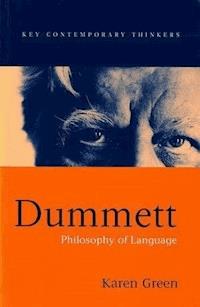
Michael Dummett stands out among his generation as the only British philosopher of language to rival in stature the Americans, Davidson and Quine. In conjunction with them he has been responsible for much of the framework within which questions concerning meaning and understanding are raised and answered in the late twentieth-century Anglo-American tradition. Dummett's output has been prolific and highly influential, but not always as accessible as it deserves to be. This book sets out to rectify this situation.
Karen Green offers the first comprehensive introduction to Dummett's philosophy of language, providing an overview and summary of his most important arguments. She argues that Dummett should not be understood as a determined advocate of anti-realism, but that his greatest contribution to the philosophy of language is to have set out the strengths and weaknesses of the three most influential positions within contemporary theory of meaning - realism, as epitomised by Frege, the holism to be found in Wittgenstein, Quine and Davidson and the constructivism which can be extracted from Brouwer. It demonstrates that analytic philosophy as Dummett practices it, is by no means an outmoded approach to thinking about language, but that it is relevant both to cognitive science and to phenomenology.
Sie lesen das E-Book in den Legimi-Apps auf:
Seitenzahl: 494
Veröffentlichungsjahr: 2013
Ähnliche




















Table of Contents
Cover
Title page
Copyright page
Key Contemporary Thinkers
Preface
Introduction
1 Fregean Foundations
Sense and Reference in Frege and Dummett
Truth, Assertion and the Central Argument against Bivalence
Frege’s Platonism
Frege’s Kantian Connections
The Context Principle
2 Wittgenstein and Quine
The Manifestability Constraint and Rejection of Mentalism
Dummett and Quine
Two Challenges: Holism and Strict Finitism
The Manifestability Constraint and the Priority of Language
How do Anti-Mentalism and Anti-Psychologism Stand to Each Other?
3 The Influence of Intuitionism
Brouwer’s Intuitionism
The Intuitionist’s Case against Bivalence
Metaphysical Debates and the Theory of Meaning
The Traditional Case for Nominalism and Subjective Idealism
Moderate Idealism and the Denial of Bivalence
The Case against Strict Finitism
Pure vs Mediated Constructivism, Truth Theories and Semantics
A Common-Sense Realist Appropriation of the Argument against Bivalence
4 The Reality of the Past
Anti-Realism with Respect to the Past
Anti-Realism with Respect to the Future
5 What do we Know when we Know a Language?
Languages and Idiolects
Davidson on Malapropism and the Social Character of Meaning
6 Psychologism, Phenomenology and Philosophy of Mind
On the Relationship of Phenomenology to Analytic Philosophy
How Close are Frege and Husserl on Sense and Reference?
Wittgenstein and Intentionality
Conclusion
References and Bibliography
Index
Copyright © Karen Green 2001
The right of Karen Green to be identified as author of this work has been asserted in accordance with the Copyright, Designs and Patents Act 1988.
First published in 2001 by Polity Press in association with Blackwell Publishers Ltd.
Editorial office:
Polity Press
65 Bridge Street
Cambridge CB2 1UR, UK
Marketing and production:
Blackwell Publishers Ltd
108 Cowley Road
Oxford OX4 1JF, UK
All rights reserved. Except for the quotation of short passages for the purposes of criticism and review, no part of this publication may be reproduced, stored in a retrieval system, or transmitted, in any form or by any means, electronic, mechanical, photocopying, recording or otherwise, without the prior permission of the publisher.
Except in the United States of America, this book is sold subject to the condition that it shall not, by way of trade or otherwise, be lent, re-sold, hired out, or otherwise circulated without the publisher’s prior consent in any form of binding or cover other than that in which it is published and without a similar condition including this condition being imposed on the subsequent purchaser.
A catalogue record for this book is available from the British Library.
Library of Congress Cataloging-in-Publication Data
Green, Karen, 1951–
Dummett: philosophy of language/Karen Green.
p. cm.
Includes bibliographical references and index.
ISBN 0–7456–2294–1 — ISBN 0–7456–2295–X (pbk.)
ISBN 978-0-7456-6671-6 (epub)
1. Dummett, Michael A. E.—Contributions in philosophy of language. 2. Language and languages—Philosophy. I. Title.
B1626.D854 G74 2001
121′.68′092—dc21
2001021061
Key Contemporary Thinkers
Published
Jeremy Ahearne, Michel de Certeau: Interpretation and its Other
Peter Burke, The French Historical Revolution: The Annales School 1929–1989
Michael Caesar, Umberto Eco: Philosophy, Semiotics and the Work of Fiction
Colin Davis, Levinas: An Introduction
Simon Evnine, Donald Davidson
Edward Fullbrook and Kate Fullbrook, Simone de Beauvoir: A Critical Introduction
Andrew Gamble, Hayek: The Iron Cage of Liberty
Karen Green, Dummett: Philosophy of Language
Phillip Hansen, Hannah Arendt: Politics, History and Citizenship
Sean Homer, Fredric Jameson: Marxism, Hermeneutics, Postmodernism
Christopher Hookway, Quine: Language, Experience and Reality
Christina Howells, Derrida: Deconstruction from Phenomenology to Ethics
Fred Inglis, Clifford Geertz: Culture, Custom and Ethics
Simon Jarvis, Adorno: A Critical Introduction
Douglas Kellner, Jean Baudrillard: From Marxism to Post-Modernism and Beyond
Valerie Kennedy, Edward Said: A Critical Introduction
Chandran Kukathas and Philip Pettit, Rawls: A Theory of Justice and its Critics
James McGilvray, Chomsky: Language, Mind, and Politics
Lois McNay, Foucault: A Critical Introduction
Philip Manning, Erving Goffman and Modern Sociology
Michael Moriarty, Roland Barthes
Harold W. Noonan, Frege: A Critical Introduction
William Outhwaite, Habermas: A Critical Introduction
John Preston, Feyerabend: Philosophy, Science and Society
Susan Sellers, Hélène Cixous: Authorship, Autobiography and Love
David Silverman, Harvey Sacks: Social Science and Conversation Analysis
Dennis Smith, Zygmunt Bauman: Prophet of Postmodernity
Geoffrey Stokes, Popper: Philosophy, Politics and Scientific Method
Georgia Warnke, Gadamer: Hermeneutics, Tradition and Reason
James Williams, Lyotard: Towards a Postmodern Philosophy
Jonathan Wolff, Robert Nozick: Property, Justice and the Minimal State
Forthcoming
Maria Baghramian, Hilary Putnam
Sara Beardsworth, Kristeva
Mark Cain, Fodor: Language, Mind and Philosophy
James Carey, Innis and McLuhan
Rosemary Cowan, Cornell West: The Politics of Redemption
George Crowder, Isaiah Berlin: Liberty, Pluralism and Liberalism
Thomas D’Andrea, Alasdair MacIntyre
Eric Dunning, Norbert Elias
Jocelyn Dunphy, Paul Ricoeur
Matthew Elton, Daniel Dennett
Nigel Gibson, Frantz Fanon
Graeme Gilloch, Walter Benjamin
Espen Hammer, Stanley Cavell
Keith Hart, C. L. R. James
Sarah Kay, Žižek: A Critical Introduction
Paul Kelly, Ronald Dworkin
Carl Levy, Antonio Gramsci
Moya Lloyd, Judith Butler
Dermot Moran, Edmund Husserl
Steve Redhead, Paul Virilio: Theorist for an Accelerated Culture
Chris Rojek, Stuart Hall and Cultural Studies
Wes Sharrock and Rupert Read, Kuhn
Nick Smith, Charles Taylor
Nicholas Walker, Heidegger
Preface
In the latter part of the twentieth century Michael Dummett’s name has epitomized the debate between realists and anti-realists, and his formulation of this issue has exerted a profound influence within the analytic tradition. This has been particularly true in Oxford, where he taught for much of the period, and from this centre his influence has spread to both the United States and Europe. Many of the foremost contemporary British analytic philosophers have been influenced by him, including Simon Blackburn, John McDowell, Christopher Peacocke, Timothy Williamson, Crispin Wright and the late Gareth Evans.1 Yet none of these thinkers could be classed as his disciples.
It is difficult to exactly define the scope of Dummett’s influence. He is often, slightly inaccurately, thought of as a determined advocate of an original brand of anti-realism which involves the rejection of classical bivalent logic and the adoption of intui-tionist styles of reasoning. When his philosophy is characterized in this fashion, it has seemed to some that, despite a prolific output, he has been rather ineffectual in stating his case.2 Moreover, the sheer bulk of this output and the complexity of many of the issues addressed mean that it is difficult for younger philosophers to come to grips with his work, with the result that it is in danger of being read less than it deserves. In a philosophical climate in which a high priority is placed on quick publication, it is more profitable for young philosophers to concentrate on more manageable authors, whose positions can easily be stated and criticized. Those of us who have always been impressed by the integrity and seriousness of Dummett’s philosophy find this unfortunate.
Dummett’s project involves an attempt to understand what understanding a language consists in. Our capacity to reason, communicate and represent reality through language remains difficult to comprehend. Perhaps this is inevitable, for at some level the precondition of the possibility of understanding a language may resist capture within language. Those influenced by Wittgenstein and by various forms of holism will be inclined to say that at some point the explanation of understanding must stop. We can do no more than say that that is how we go on. Dummett, by contrast, believes that we should aim to do more than this. But the account of what understanding consists in that he provides comes at a price; for it suggests that we will have to acknowledge that there are some features of our current linguistic practice which cannot be justified or made genuinely comprehensible. In particular, the general acceptance of the principle of bivalence (which says that every meaningful sentence is either true or false) is difficult to justify from the perspective of this account. Dummett equates acceptance of this principle with realism, and the denial of bivalence with anti-realism. For the time being I will follow this usage, though later in the book I will argue that the denial of bivalence brings with it only a very attenuated form of anti-realism.
The aim of this book is to make Dummett’s thought more accessible, by providing an overview to orientate senior students of philosophy and a resource for those interested in following the implications of his thought further. Inevitably, the overview reflects my own preoccupations, but I have attempted to make the exposition as faithful to Dummett’s own position as possible, and I am grateful to him for having generously read and commented on some of the draft material for the book.
Barry Taylor, Greg Currie, Sam Butchart, Helen Prosser, Mark English and Stephen Barker also deserve thanks for having read and commented on drafts of various stages of the book. Obviously they are not responsible for any flaws which remain. I would like to thank Denis Robinson who has been a generous source of encouragement for my philosophical efforts over many years. Michael Devitt should be credited with having provided the immediate stimulus which led me to write this book. Many years ago he supervised my Ph.D. thesis on Dummett and Frege, even though he did not share my enthusiasm for Dummett’s thought. The naturalistic slant which I have brought to my reading of Dummett is no doubt due to him, and many of the arguments in this work implicitly respond to his challenges. Even earlier in my philosophical career, Christopher Peacocke, Crispin Wright, David Bostock and Simon Blackburn pulled apart my first efforts at dealing with some of the issues addressed here, when they were my tutors at Oxford in the mid-1970s. It was Michael Woods who was responsible for sending me to such an interesting selection of tutors to read for the various papers in the B.Phil. It is, perhaps most importantly, thanks to Aubrey Townsend that, as a fourth-year student, at Monash, in 1973, I acquired a copy of Michael Dummett’s Frege: Philosophy of Language and began a lifetime’s fascination with Dummett, Frege and the philosophy of language.
Notes
1 Some testimonials to this influence are to be found in Heck 1997.
2 Thus, in a review of The Logical Basis of Metaphysics, Gregory Currie complains: ‘the case as he has stated it has had very much the appearance of work in progress. It has often been presented as tangential to the central topic (as in his writings on Frege), it has not been easy to understand, and it has had about it the air of something incomplete – some part of the argument seems to be missing’ (1993, p. 465).




