


25,99 €
Mehr erfahren.
- Herausgeber: Thieme Revinter
- Kategorie: Fachliteratur
- Sprache: Englisch
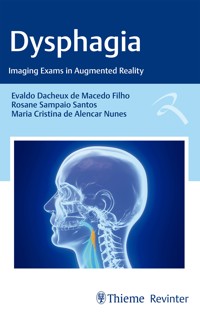
This book was designed to provide access to an up-to-date scientific text in the field of Dysphagia, with carefully selected image examinations and illustrations of Videofluoroscopy and Videoendoscopy of Swallowing, enriched with the great novelty: videos with Augmented Reality (AR) formatting, which allow modern interaction with the academic content. Dysphagia management, from screening procedures to diagnostic methods and therapeutic approaches, is about to bring new technologies and innovative processes to education. AR is a tool that has revolutionized the didactic transmission of knowledge and allows digital elements to be superimposed on the physical environment using smartphones and tablets. With this technology we can bring the experience we have at the Dysphagia Diagnosis and Rehabilitation Center to the multi-professional team, favoring study and facilitating continuing education with our patients. AR in healthcare can generate more diagnostic precision and facilitate the best therapeutic approach.
Sie lesen das E-Book in den Legimi-Apps auf:
Seitenzahl: 117
Veröffentlichungsjahr: 2023
Ähnliche



















Cataloging-In-Publication (CIP) (eDOC BRASIL)
M141d
Macedo Filho, Evaldo Dacheux de
Otolaringology, Speech Therapy, Radiology/Evaldo Dacheux de Macedo Filho, Rosane Sampaio Santos, Maria Cristina de Alencar Nunes. – Rio de Janeiro, Brazil: Thieme Revinter, 2024.
Format: ePUB
System requirements: Adobe Digital Editions
Access mode: World Wide Web
Includes bibliography
Original title: Disfagia: Exames por Imagem em Realidade Aumentada
ISBN 978-65-5572-261-1
1. Speech-Language Pathology and Audiology. 2. Otorhinolaryngology. 3. Swallowing disorders. I. Santos, Rosane Sampaio. II. Nunes, Maria Cristina de Alencar. III. Title.
DDC 616.32
Note: Medical knowledge is constantly evolving. As research and clinical experience broaden our knowledge, it may be necessary to change methods of treatment and medication. The authors and editors of this material have consulted sources believed to be reliable in order to provide complete information in accordance with the standards accepted at the time of publication. However, in view of the possibility of human error on the part of the authors, editors or the publishing house bringing this work to light, or of changes in medical knowledge, neither the authors, editors, publishing house nor any other party involved in the preparation of this material warrant that the information contained herein is totally accurate or complete; nor are they liable for any errors or omissions or for the results obtained as a result of the use of such information. Readers are advised to check the information contained herein with other sources. It is suggested, for example, that they check the package leaflet for each medicine they intend to take, to ensure that the information contained in this publication is accurate and that there have been no changes to the recommended dose or contraindications. This recommendation is especially important in the case of new or little-used medicines. Some of the product names, patents and designs referred to in this book are actually registered trademarks or names protected by intellectual property legislation, although the text does not always specifically mention this. Therefore, the occurrence of a name without the designation of its ownership should not be interpreted as an indication on the part of the publisher that it is in the public domain.
Prepared by Maurício Amormino Júnior – CRB6/2422
Original title: Disfagia: exames por imagem em realidade aumentada
Copyright © 2022 de Thieme Revinter
ISBN 978-65-5572-157-7
© 2024 Thieme. All rights reserved.
Thieme Revinter Publicações Ltd
Rua do Matoso, 170
Rio de Janeiro, RJ
CEP 20270-135, Brasil
http://www.ThiemeRevinter.com.br
Thieme USA
http://www.thieme.com
Cover Design:: © Thieme
Cover Image Credits:: Patrick Braga – Med Pixel
eISBN 978-65-5572-261-1
All rights reserved. No part of this publication may be reproduced or transmitted in any form or by any means, printed, electronic or mechanical, including photocopying, recording or any other type of information storage and transmission system, without prior written permission.
We would like to thank all those who supported us in making this book a reality: our families, patients and institutions. In particular to Motion Designer Mauro Castro, Radiology Technologist Karin Cristiane Ferreira from Complexo Hospital de Clínicas, Prof. Dr. Roberta Gonçalves da Silva, Dr. João Luiz Garcia de Faria and NEP - Research Center of IPO Hospital.
The area of dysphagia is one of the most challenging in any aspect that can be observed. From a mere symptom, it has come to be considered as part of a multidimensional syndrome, and then evolved into an area of concentration of specialties with different postgraduate levels, mainly in Speech Therapy and Otorhinolaryngology courses. The great evolution of the quality of scientific publications, national and international, revealed the growth of this specialty area, mainly due to the development of accurate diagnostic methods and new therapeutic techniques, which impacted the entire specialty in favor of the care of our patients. The application of Evidence-Based Medicine concepts reinforces the conceptualization and seriousness of this area of activity. Since DYSPHAGIA is now a growing specialty, it has to be based on a necessary interdisciplinary integration. This evolutionary moment in our country culminates with the creation of the Brazilian Academy of Dysphagia (ABD – Academia Brasileira de Disfagia), whose objective and mission are to aggregate and foster interdisciplinarity, and above all, the improvement of the field of the scientific community linked to DYSPHAGIAa.
The authors come from different educational institutions, including the Department of Otorhinolaryngology and the Speech and Hearing Therapy Service of the Clinical Hospital Complex of the Federal University of Paraná, the Master’s and Doctoral Program in Communication Disorders of the Tuiuti University of Paraná and the IPO Hospital, through its Teaching and Research Center (NEP – Núcleo de Ensino e Pesquisa). In the latter institution we started a large Augmented Reality (AR) project, having already produced 9 books on this disruptive technology. The authors, jointly or in parallel, have participated directly in the training of many specialists in DYSPHAGIA, whether local or from different states of our country. We realize our responsibility in the quality of the transmission of updated, rational knowledge with adequate scientific foundation.
We have divided our book Dysphagia: Augmented Reality Imaging (Disfagia: Exames por Imagem em Realidade Aumentada)into 7 chapters, starting with the concepts of dysphagia and anatomophysiology of the airway and its relationship with swallowing processes. In the following chapters, we detail the diagnostic methods most used in the identification of dysphagia, notably Videofluoroscopy, Videoendoscopy of Swallowing and finally the Analysis of Swallowing Sounds. In each chapter we present a detailed description of the use of these instrumental techniques, their practical application and interpretation, which will guide their daily use and interpretation.
The construction of this book was designed so that you have access to an updated scientific text, with carefully selected graphic images and also with great novelty, the presence of videos with AR formatting, allowing a modern interaction with the academic content. We reinforce that AR is a tool that has revolutionized the didactics of knowledge transmission.
With this academic contribution, we hope to foster the interest of young audiologists, otorhinolaryngologists and other related specialties in the field of dysphagia, which has been growing worldwide. Brazil, with its professors, researchers and specialists, is a reference in this international scientific community.
We thank all the people in different areas and stages who contributed to the final outcome of this book. It has been a privilege to be part of this journey together.
ENJOY!
Evaldo Dacheux de Macedo Filho
Maria Cristina de Alencar Nunes
Rosane Sampaio Santo
In the context of the use of technologies in the area of oropharyngeal dysphagia, we have been following the evidence over the decades on the numerous resources available for
diagnostic and rehabilitation practices. Since the 1980s there has been research supported by technologies with the most varied equipment such as X-rays and endoscopy, surface electromyography, muscle strength measurers, equipment for acoustic analysis, neurostimulators, among many others, however, this inclusion has always been focused on contributions to clinical practices.
On the other hand, throughout the health area, innovation in technologies has taken on aspects that will transform reality as we know it, including augmented reality, virtual reality and, before long, metaverse. In the area of oropharyngeal dysphagia, this technological inclusion in the context of health education is still a challenge. And on this path, I am not surprised that one of the most precursor groups working with oropharyngeal dysphagia in the country has prepared such a complete book on the subject in 2022 and prioritized augmented reality. This publication will certainly be a milestone for the area of education in oropharyngeal dysphagia, allowing both the challenges of the complex neuromotor control of oropharyngeal swallowing, as well as aspects of diagnosis and even rehabilitation, to be unveiled in such a didactic way. We are moving in the area of health technologies towards the complete capture of our brain, where perceiving, engramming and learning will be centered on the experiences of the metaverse.
And clearly, aware of their commitment to education in the field, the authors present in the book the possibility of visualizing in minute detail the practices with video endoscopy, videofluoroscopy and acoustic analysis of swallowing in a format that, for now, only augmented reality allows to visualize. I invite the readers, the entire interdisciplinary team that works with oropharyngeal dysphagia, to prepare for the reading of this book, and this time, with all the possible visual receptors that each of us can have to enjoy the learning enhanced by augmented reality.
Prof. Dr. Roberta Gonçalves da Silva
Professor of Undergraduate and Graduate Studies, Department of
Speech and Hearing Therapy, Universidade Estadual
Paulista (Unesp) - Marília Campus.
President of the Brazilian Academy of Dysphagia
According to the World Health Organization,1 the frequency, severity, need for prompt recognition and appropriate treatment of oropharyngeal dysphagia (OD) are a challenge because of the impact on health as well as the repercussions on people’s lives and their families.
Dysphagia can cause damage to nutritional aspects, hydration, pulmonary status, eating pleasure and the individual’s social balance.
Undiagnosed and untreated OD increases the risk of serious complications such as prolonged hospitalization, pneumonia, malnutrition, dehydration and death. On the one hand, OD increases healthcare costs due to its complications. On the other hand, dysphagia has a negative impact on the patient’s quality of life.2,3
Considering adults, the prevalence range of dysphagia is affected by the diagnostic method, with high detection when assessed by an instrumental evaluation, such as videofluoroscopy, videoendoscopy of swallowing or associated with clinical evaluation with validated protocols and associated with a measurable method, such as acoustic analysis of swallowing, electromyography among others.4
Previous systematic reviews have observed variability in prevalence, ranging from 8.1% to 80.0% in post-stroke patients; 11.0% to 81.0% in patients with Parkinson’s disease; and 27.0% to 30.0% in post-traumatic brain injury.5
The importance of diagnosing dysphagia is emphasized so that decisions can be made about its treatment as quickly as possible, avoiding possible complications and worsening of the clinical conditions of the patients.
A clinical evaluation associated with complementary examinations is essential for an accurate diagnosis and effective planning, allowing the best definition of short, medium and long term prognosis.
The management of dysphagia, from screening procedures, diagnostic methods and therapeutic approach has been advancing and much with the introduction of technology and allowing the area of education to expand the look with virtual reality.6
This change is driven not only by major breakthroughs in medicine or physiology, but also by advances in electronics, data science and the close collaboration and cross pollination between these disciplines. This is reflected in the way we will work with these concepts in education.
Interacting with book pages through augmented reality and with the help of apps is no longer fiction. These are technologies that produce an immersive experience to bring to life the labels and stories of a book respectively.
Augmented reality technology also already allows you to create your own 3D digital version, which is able to walk around the real environment. By directing the smartphone to the pages, the characters of the story appear in augmented reality on top of the book - in this way, the content should become more interactive and impactful, increasing curiosity, desire and learning capacity.7
With this technology, we can bring the experience that we live in diagnostic centers, to students in the classroom and in clinical care. Augmented reality in healthcare can generate more diagnostic accuracy and facilitate the best therapeutic approach. Augmented reality in health allows a real time combination of images never before achieved, generating new possibilities in the diagnosis of diseases and can increase the precision of surgical procedures. In other words, it has the potential to improve the quality of life of patients.
Technology is a great ally of telemedicine. For example, specialists can instruct other doctors remotely in more complex operations. Another aspect is diagnostic medicine, as the patient can better understand the diagnosis and the recommended treatment.
We invite you to enter this universe to better understand the imaging tests used in the approach to OD.
REFERENCES
1. Organização Mundial da Saúde (OMS). Definições de assistência domiciliar. In: Lopes JMC (Org.). Manual de assistência domiciliar na atenção primária à saúde. Porto Alegre: Serviço de Saúde Comunitária do Grupo Hospitalar Conceição, 2003.
2. Martino R, Foley N, Bhogal S, Diamant N, Speechley, Teasell, R. Dysphagia after stroke. incidence, diagnosis, and pulmonary complications. Dysphagia After Stroke.36(12):2756–63.
3. Marin S, Serra-Prat M, Ortega O, Clave P. Healthcare-related cost of oropharyngeal dysphagia and its complications pneumonia and malnutrition after stroke: a systematic review. BMJ Open 2020;10:e031629.
4. Finestone H, AID, Linda S. Greene-Finestone, MSc, RD, Elizabeth S. Wilson, BSc, Robert W. Teasell, AID. Prolonged Length of Stay and Reduced Functional Improvement Rate in Malnourished Stroke Rehabilitation Patients. Arch Phys Med Rehabil. 1996;77:340–5.
5. Takizawa C, Gemmell E, Kenworthy J, Speyer R. A systematic review of the prevalence of oropharyngeal dysphagia in stroke, Parkinson’s disease, Alzheimer’s disease, head injury, and pneumonia. Dysphagia 2016;31:434-41.
6. Sejdić E, khalifa Y, Mahoney A, Coyle J. Artificial intelligence and dysphagia: novel solutions to old problems. Arq. Gastroenterol. 2020: 57(4): 343-46.
7. Bai X, Song Z, Zhou Y, Wang X, Wang Y, Zhang D. Bibliometrics and Visual Analysis of the Research Status and Trends of Postpartum Depression From 2000 to 2020. Frontiers in Psychology 2021;12.
1 FUNCTIONAL SWALLOWING
Functional swallowing
2 PHASES OF SWALLOWING AND INNERVATION
Oropharyngeal dysphagia
3 INSTRUMENTAL METHODS OF SWALLOWING ASSESSMENT
Comparison between videofluoroscopy and videoendoscopy of swallowing
Videofluoroscopy of Swallowing
Before the Videofluoroscopy Examination
Functional examination
Altered exam
Laryngeal sensitivity
4 OROPHARYNGEAL DYSPHAGIA
Clinical signs suggesting the presence of dysphagia
Functional examination vs. altered examination
5 VIDEOFLUOROSCOPY EXAMINATION FINDINGS AND VIDEOENDOSCOPY OF SWALLOWING
What to observe during the videofluoroscopic swallowing examination?
Oral and oral preparatory phases
Pharyngeal phase
WHAT TO OBSERVE DURING THE VIDEOENDOSCOPIC SWALLOWING EXAMINATION?
Oral phase
Pharyngeal phase
6 THERAPEUTIC STRATEGIES
Swallowing postures
Swallowing maneuvers
Swallowing postures
Masako maneuver
7 AUXILIARY EXAMINATION IN THE CLINICAL EVALUATION OF SWALLOWING – ACOUSTIC ANALYSIS OF SWALLOWING
Introduction
Digital cervical auscultation
Analysis of swallowing sounds
Protocol
Discussion
Conclusion
Annex




