


119,99 €
Mehr erfahren.
- Herausgeber: Thieme
- Kategorie: Fachliteratur
- Sprache: Englisch
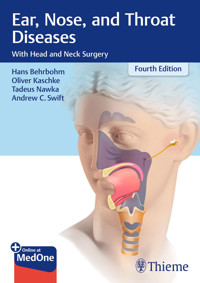
Essential knowledge and advanced insights for otolaryngology practice
Now in its fully revised and updated 4th edition, Ear, Nose, and Throat Diseases: With Head and Neck Surgery remains a trusted reference for medical students, residents, and specialists. It continues to provide a concise yet comprehensive overview of ENT diseases, clinical findings, diagnostics, and the latest medical and surgical treatments. Integrating current classifications, guidelines, and technological advances, this edition provides both essential knowledge and insights for advanced clinical practice.
Key Features
- Expert clinical pearls and best practices for diagnosing and managing otolaryngologic conditions
- Strong emphasis on visual diagnosis, examination, and both medical and surgical procedures according to the latest clinical and technical standards
- More than 850 full-color illustrations and clinical photographs to enhance understanding and application
An essential resource for medical students, otolaryngology residents, fellows, and specialists, this textbook also serves as an invaluable reference for trainees in related fields seeking a deeper understanding of otolaryngologic diagnosis and treatment.
This print book includes a scratch off code to access a complimentary digital copy on MedOne.
Publisher's Note: Products purchased from Third Party sellers are not guaranteed by the publisher for quality, authenticity, or access to any online entitlements included with the product.
Das E-Book können Sie in Legimi-Apps oder einer beliebigen App lesen, die das folgende Format unterstützen:
Seitenzahl: 1231
Veröffentlichungsjahr: 2025
Ähnliche

















Ear, Nose, and Throat Diseases
With Head and Neck Surgery
Edited by
Hans Behrbohm; Oliver Kaschke; Tadeus Nawka and Andrew C. Swift
Contributed by
Hans Behrbohm; Maren Böge; Petra Brüggemann; Dr. Christian Dobel; Marie Therese Ernst; Oliver Kaschke; Barbara Kurzidim; Birgit Mazurek; Tadeus Nawka; Heidi Olze; Shahed Quraishi; Andrew C. Swift and Thomas Verse
4th edition
857 illustrations
Contents
Title Page
1 Ear
1.1 Applied Anatomy and Physiology
1.1.1 Embryology
1.1.2 Basic Anatomy
1.1.3 Physiology and Pathophysiology of Hearing and Inner
1.2 Methods of Investigation
1.2.1 Inspection, Palpation, Otoscopy
1.2.2 Diagnostic Imaging
1.2.3 Functional Assessment of the Eustachian Tube
1.2.4 Hearing Investigations
1.2.5 Vestibular Function Tests
1.2.6 Investigation of the Facial Nerve
1.3 Clinical Aspects of Diseases of the External Ear
1.3.1 Congenital Anomalies
1.3.2 Inflammations of the External Ear
1.3.3 Otomycosis and Eczema
1.3.4 Trauma
1.3.5 Wax and Foreign Bodies
1.3.6 Tumors
1.4 Clinical Aspects of Diseases of the Middle and Inner Ear
1.4.1 Disorders of Ventilation and Drainage of the Middle Ear
1.4.2 Nonspecific Inflammation of the Middle Ear and Mastoid
1.4.3 Specific Types of Inflammation of the Middle Ear and Mastoid
1.4.4 Otogenic Infective Complications
1.4.5 Specific Diseases of the Middle Ear and Mastoid Process
1.4.6 Noninflammatory Diseases of the Labyrinthine Capsule
1.4.7 Trauma of the Middle and Inner Ear
1.4.8 Tumors and Lesions of the Lateral Skull Base: Middle and Inner Ear, Vestibulocochlear Nerve, Facial Nerve, and Petrous Apex
1.4.9 Congenital Anomalies of the Middle and Inner Ear
1.5 Clinical Aspects of Cochleovestibular Disorders
1.5.1 Toxic Damage to the Hearing and Balance Apparatus
1.5.2 Inflammatory Lesions of the Hearing and Balance Apparatus
1.5.3 Immunologic Diseases of the Inner Ear
1.5.4 Trauma
1.5.5 Vestibular Disorders
1.5.6 Sensorineural Hearing Disorders
1.6 Clinical Aspects of Central Hearing Disorders
1.6.1 Acoustic Agnosia
1.6.2 Hearing Impairment with Normal Pure-Tone Auditory Thresholds
1.6.3 Tinnitus
1.7 Rehabilitation of Hearing Disorders with Hearing Aids
1.8 Pediatric Hearing Disorders (Pediatric Audiology)
1.8.1 Audiomutism
1.8.2 Classification and Effects of Hearing Disorders Depending on the Degree of Severity
1.8.3 The Completely Deaf Child
1.8.4 Cochlear Implantation
1.9 Clinical Aspects of Disorders of the Facial Nerve
1.9.1 Inflammatory or Otogenic Facial Paralysis
1.9.2 Idiopathic Facial Paralysis (Bell’s Palsy)
1.9.3 Traumatic Facial Paralysis
1.9.4 Reconstructive Surgery after Facial Paralysis
1.10 Synopsis of Ear Symptoms
2 Nose, Nasal Sinuses, and Face
2.1 Applied Anatomy and Physiology
2.1.1 Basic Anatomy
2.1.2 Basic Physiology and Pathophysiology
2.2 Methods of Examining the Nose, Paranasal Sinuses, and Face
2.2.1 External Inspection and Palpation
2.2.2 Anterior Rhinoscopy
2.2.3 Posterior Rhinoscopy
2.2.4 Nasal Endoscopy
2.2.5 Assessment of Nasal Patency
2.2.6 Olfactometry
2.2.7 Diagnostic Imaging of the Nose and Sinuses
2.2.8 Lavage of the Sinuses
2.2.9 Specific Diagnostic Methods
2.3 Dermatologic Principles for the Otolaryngologist
2.3.1 Skin Type
2.3.2 Types of Lesion
2.3.3 Basics of Topical Dermatologic Therapy
2.4 Clinical Aspects of Diseases of the Nose, Sinuses, and Face
2.4.1 Inflammatory Diseases of the Nose and Paranasal Sinuses
2.4.2 Epistaxis
2.4.3 Diseases of the Septum
2.4.4 Trauma to the Nose, Paranasal Sinuses, and Facial Skeleton
2.4.5 Congenital Anomalies and Deformities of the Nose
2.4.6 Basic Plastic Reconstruction Procedures in the Head and Neck
2.4.7 Tumors of the Nose and Sinuses
3 Mouth and Pharynx
3.1 Applied Anatomy and Physiology
3.1.1 Basic Anatomy
3.1.2 Physiologic and Pathophysiologic Principles
3.2 Methods of Investigation
3.2.1 Inspection, Palpation, and Examination
3.2.2 Endoscopy
3.2.3 Imaging Studies
3.2.4 Examination of the Saliva
3.2.5 Gustometry
3.2.6 Specific Diagnostic Procedures
3.3 Clinical Aspects of Diseases of the Mouth and Pharynx
3.3.1 Hyperplasia of the Lymphoepithelial Organs
3.3.2 Dysphagia
3.3.3 Inflammatory Diseases
3.3.4 Basic Conservative Treatment of the Mucosa
3.3.5 Trauma in the Mouth and Pharynx
3.3.6 Neurogenic Disorders
3.3.7 Pharyngeal Pouch
3.3.8 Anomalies of the Mouth and Pharynx
3.3.9 Tumors of the Mouth and Pharynx
3.3.10 Obstructive Sleep-Related Breathing Disorders
4 Larynx and Hypopharynx
4.1 Larynx—Applied Anatomy and Physiology
4.1.1 Basic Anatomy and Physiology
4.2 Methods of Examination
4.2.1 Inspection
4.2.2 Palpation
4.2.3 Laryngoscopy
4.2.4 Diagnostic Imaging
4.2.5 Stroboscopy
4.2.6 Other Special Techniques
4.3 Clinical Aspects
4.3.1 Congenital Anomalies
4.3.2 Organic Functional Disorders
4.3.3 Trauma
4.3.4 Inflammation
4.3.5 Tumors
4.3.6 Hypopharynx
5 Voice, Speech, and Language
5.1 Voice
5.1.1 Voice Production
5.1.2 Voice Diagnosis
5.1.3 Regulatory Voice Disorders
5.2 Speech Sound and Fluency Disorders
5.2.1 Articulation Disorder
5.2.2 Phonological Disorder
5.2.3 Stuttering
5.3 Language
5.3.1 Normal Language Development
5.3.2 Developmental Language Disorder
5.3.3 Aphasia
6 Tracheobronchial Tree
6.1 Applied Anatomy and Physiology
6.1.1 Basic Anatomy
6.1.2 Basic Physiology
6.2 Method of Investigation: Tracheobronchoscopy
6.3 Clinical Aspects
6.3.1 Tracheobronchial Stenoses
6.3.2 Tracheotomy (Tracheostomy), Cricothyrotomy, and Intubation
6.4 Foreign Bodies and Trauma
6.4.1 Foreign Bodies
6.5 Tracheal Trauma
6.6 Tracheal Infections
6.6.1 Tracheitis
6.6.2 Acute Laryngotracheobronchitis in Children, Subglottic Laryngitis, Croup
6.6.3 Diphtheritic Tracheitis
6.6.4 Tracheitis Sicca
6.7 Congenital and Hereditary Anomalies
6.7.1 Bronchiectasis
6.8 Tracheal Tumors
6.8.1 Benign Tracheal Tumors
6.8.2 Malignant Tracheal Tumors
7 Esophagus and Swallowing
7.1 Applied Anatomy
7.2 Physiology and Pathophysiology
7.3 Investigation Methods
7.3.1 Clinical Examination
7.3.2 Diagnostic Imaging
7.4 Esophagoscopy
7.4.1 Esophageal Manometry and Esophageal pH-Metry (Ambulatory pH-Monitoring)
7.5 Clinical Aspects
7.5.1 Trauma
7.5.2 Esophageal and Swallowing Disorders
7.5.3 Esophageal Involvement in Diseases of Neighboring Organs
7.5.4 Congenital Anomalies and Fistulas
7.5.5 Tumors of the Esophagus
7.6 Swallowing
7.6.1 Physiologic Principles
7.6.2 Eating, Preparation of Food, and Swallowing
7.6.3 Central Control of Swallowing
7.6.4 Phases ofSwallowing
7.6.5 Etiologyof Dysphagia
7.6.6 Investigation Procedures
7.6.7 Treatment
8 Neck and Thyroid Gland
8.1 Applied Anatomy and Physiology
8.1.1 Basic Anatomy
8.1.2 Basic Physiology
8.2 Methods of Investigation
8.2.1 Specific History
8.2.2 Inspection of the Neck Region
8.2.3 Palpation
8.2.4 Diagnostic Imaging
8.2.5 Biopsy
8.3 Clinical Aspects of the Neck Region
8.3.1 Inflammatory Diseases of the Neck
8.3.2 Inflammatory Cervical Lymphadenopathy
8.4 Cervical Syndrome/Cervical Spine Syndrome
8.5 Neck Trauma
8.5.1 Injuries to the Cervical Spine
8.5.2 Injuries to the Aerodigestive Tract
8.5.3 Vascular Injuries
8.6 Congenital Anomalies of the Neck
8.6.1 Thyroglossal Duct Cysts and Fistulas
8.6.2 Branchial Cysts and Fistulas
8.7 Musculoskeletal Defects of the Neck
8.7.1 Klippel-Feil Syndrome
8.7.2 Oculoauriculovertebral Dysplasia (Goldenhar Syndrome)
8.7.3 Cervical Rib, Costoclavicular Compression Syndrome, and Scalenus Syndrome (Naffziger Syndrome)
8.7.4 Torticollis
8.8 Vascular Malformations and Neoplasia of the Neck
8.8.1 Hemangiomas
8.8.2 Vascular Malformations
8.8.3 Lymphangioma
8.8.4 Aneurysms
8.8.5 Paragangliomas and Carotid Body Tumors
8.9 Tumors of the Neck Region
8.9.1 Benign Tumors
8.9.2 Malignant Tumors of the Cervical Lymph Nodes
8.9.3 Lymph-Node Metastases
8.9.4 Carcinoma of Unknown Primary (CUP) Origin/Carcinoma of Occult Primary (COP)
8.10 Principles of Surgery
8.10.1 Mediastinoscopy and Biopsy
8.10.2 Neck Dissection
8.11 Thyroid Gland
8.11.1 Topographic Anatomy of the Thyroid Gland
8.11.2 Diagnostic Procedures in Thyroid Disorders
8.11.3 Specific Thyroid Conditions
8.11.4 Parathyroid Glands
9 Salivary Glands
9.1 Embryology, Structure, and Congenital Anomalies
9.2 Anatomy and Physiology of the Major and Minor Salivary Glands
9.2.1 Parotid Gland
9.2.2 Submandibular Gland
9.2.3 Sublingual Gland
9.2.4 Minor Salivary Glands
9.3 Formation and Function of Saliva
9.3.1 Physiologic Functions of the Saliva
9.4 Methods of Investigation
9.4.1 Examples of Salivary Gland Dysfunction
9.4.2 Age-Dependent Conditions
9.4.3 Diagnostic Imaging
9.4.4 Function Studies
9.4.5 Biopsy
9.5 Clinical Aspects
9.5.1 Inflammatory Diseases
9.5.2 Sialolithiasis
9.5.3 Cysts
9.5.4 Sialadenosis
9.5.5 Trauma
9.5.6 Salivary Tumors
10 Appendix A: Essential Information for Infection and Prevention Control
10.1 Introduction
10.2 Infection Prevention and Control Responses by Government Health Institutions
10.2.1 Antibiotic Resistance and Stewardship
10.2.2 Dangerous Infectious Pathogens
10.2.3 Methicillin-Resistant Staphylococcus Aureus (MRSA)
10.2.4 Prescribing Recommendations for Treating Infections of the Head and Neck Region
10.2.5 Key Facts about Antibiotics
10.2.6 Macrolides, Azalides, Ketolides
10.2.7 Lincosamide
10.2.8 Fluoroquinolones
10.3 Trimethoprim/Sulfonamide Combinations
10.3.1 Tetracycline
10.4 Aminoglycoside Antibiotics
10.4.1 Metronidazole
10.5 Reserve Antibiotics for Special Situations
10.5.1 Glycylcyclines
10.5.2 Glycopeptide Antibiotics
10.5.3 Oxazolidinone
10.5.4 Fosfomycin
11 Appendix B: ENT Practice in the COVID-19 Era
12 References
Contributors
Index
Copyright




