


27,99 €
Mehr erfahren.
- Herausgeber: John Wiley & Sons
- Kategorie: Fachliteratur
- Sprache: Englisch
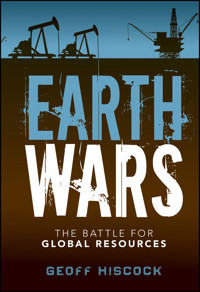
A fascinating insight into the global battle for our energy future
The global competition for scarce natural resources that pits the West against the super-hot economies of China and India, plus a clutch of other contenders including Russia, Brazil, and Indonesia, has become one of the biggest issues facing the world today. Whether it is the rare metal lithium found in salt pans in the Andes, gas from the Caspian Sea, oil off the coast of Brazil, coal from Africa's Zambezi River, or uranium from Kazakhstan, China and India are desperate to ensure the security of their future energy supplies. The same goes for food and water, as contamination and over-use take their toll, the need to provide continued access for the next generation and beyond has increased exponentially. In Earth Wars: The Battle for Global Resources, international business journalist Geoff Hiscock explores the problems, potential solutions, and inevitable tensions in this ongoing scramble for finite natural resources.
Going beyond "big power" politics to explore resource ownership and the use of innovative technology to get the most out of them, the book takes a forward-looking approach to this pressing issue. Written in clear, jargon-free language, it tells the global resources story in a fresh and engaging way that anyone can understand.
- Includes insightful, up-to-the-minute coverage of the most pressing debates over resource allocations
- Discusses the major Chinese and Indian businesses that are just becoming known to those in the West (Sinopec, CNOOC, CNPC, Indian Oil, ONGC, Reliance, Coal India, SAIL, and many others)
- Presents resource- and region-specific chapters to help readers view the pertinent issues from multiple angles
As the economies of China and India grow to challenge those of the West, the battle over natural resources will continue to heat up. Earth Wars looks at this very real problem in-depth, presenting a definitive look at one of the greatest challenges of our time.
Sie lesen das E-Book in den Legimi-Apps auf:
Seitenzahl: 515
Veröffentlichungsjahr: 2012
Ähnliche


















Contents
Maps
Introduction
Chapter 1: The Four Essentials
Clean Energy Technologies
Lithium Triangle of the Andes
Bolivia’s Ambitious Pitch
Multitude of Factors
New Products for Old Trading Routes
The World in 2050
Chapter 2: Geographical Flashpoints
Long Trading History
The Opium Wars
China’s Northern Borders
Caspian’s Strategic Significance
Arctic Ocean Disputes
Chapter 3: The Key Players
Commodity Trading Skills
Russia’s Billionaire Oligarchs
The AAR Connection
Money in Metals
World’s Most Valuable Companies
Chinese Miners on the Prowl
Rapid Emergence on the Global Stage
Chapter 4: Food and Water
Challenge for India, Pakistan
Taming the Yangzi
Aral Sea’s Damage
Waters of the Nile
High Food Prices
Frozen Fresh Water
Pressure on Prices
Chapter 5: “Going Out” for Energy
U.S. Gas Revolution
Tunisia Heralds Arab Spring
China the Biggest User
Facing Political Pressure
Pipelines Open New Markets
India Makes Modest Forays
Refining Shifts out of Europe
Chapter 6: Old Coal Still Burning Brightly
Busiest Coal Port
China’s Energy Plan
Russia’s Massive Reserves
Kazakhstan’s Resource Scramble
Colombia a New Exporter
Indonesia’s Contribution on the Rise
Coal’s Technological Response
Chapter 7: Going Nuclear in a Post-Fukushima World
Long History on the Nuclear Road
Efficient, Low-Cost Fuel
Uranium’s Many Supply Sources
India’s Complicated Outlook
China’s 70 GW Goal
Worrying Past
Canada’s Productive Mines
Africa, the Next Big Player?
South Korea’s Plant Expertise
Russia, a Strong Proponent
France, the Nuclear Champion
UK Momentum Shifts
Brazil’s Enrichment Role
New Reactor Technology
Chapter 8: New Energy—Clean, Green, and Expensive
Power Storage Ability
Europe’s Renewable Commitment
Facing the Intermittency Factor
Big Geographic Variations
Hydropower’s Role
Interest in Biofuel
Chapter 9: Coppery Red, the Colour of Earth’s True Love
Olympic Dam a Bargain Buy
Mongolia’s Oyu Tolgoi Promise
India’s Big Three Producers
China’s Production Shortfall
“Deal of the Century”
Alternatives to Copper
Chapter 10: Finding Steel’s Essential Ingredients
China Looking to Diversify
China’s “Big Five” Steel Producers
African Projects on the Move
Two Deals Change the Picture
ArcelorMittal’s Liberia and Canada projects
Indian Consumption Rising
Supply Shortage Looms
Chapter 11: U.S. Energy
Swing to Unconventional Resources
International Interest in Shale
Pipeline Projects in the Mix
Gulf of Mexico Prospects
The Cuba–China Connection
Opening the U.S. Investment Door
Chapter 12: Japan after the Deluge
Political Shifts in North Asia
Player of Consequence
Equity Partners around the Globe
JX Holdings Builds Energy, Metals Business
SoftBank’s “New Energy” Vision
Renewable Potential
Chapter 13: BRACQK (Brazil, Russia, Australia, Canada, Qatar, Kazakhstan) Is the New BRIC
Uncertainty for Foreign Investment
Brazil’s Pre-Salt Independence
Australia’s Foot on the Gas
Canada’s Athabasca Challenge
Qatar Fires up Its LNG Trains
Kazakhstan’s Fields of Dreams
Chapter 14: The Up and Comers
Turkey: A Pivotal Position
Iran: Rich in Oil and Gas, but Lacking Technology and International Friends
Indonesia: Growing Spending Power
Mexico: Exploiting the Potential
Chapter 15: What Happens Next
Significant Developments Ahead
Survive and Prosper
Challenges for China, India Replicated
Conclusion
Bibliography
Acknowledgments
About the Author
Index
List of Illustrations
Maps
Africa
Asia
Southeast Asia
Australia
Middle East
Europe
North America
South America
Chapter 01
Exhibit 1.1 BGS Supply Risk List 2011 (1 = very low risk, 10 = very high risk)
Chapter 02
Exhibit 2.1 World’s Top Container Ports (millions of TEUs in 2010)
Chapter 03
Exhibit 3.1 Top commodities traders in energy and agriculture (ranked by turnover in 2010; excludes Japanese trading companies)
Exhibit 3.2 Japanese general trading companies (sōgō shōsha) (turnover in FY ended March 2011)
Exhibit 3.3 Russia’s top 10 oil and gas companies (by turnover)
Exhibit 3.4 Major Russian metals companies
Exhibit 3.5 World’s top mining companies by revenue
Chapter 05
Exhibit 5.1 World’s biggest producers of crude oil (by percentage share)
Exhibit 5.2 World’s biggest importers of crude oil (in millions of tonnes)
Chapter 06
Exhibit 6.1 World’s leading coal-producing companies (millions of tonnes, 2009)
Exhibit 6.2 World’s biggest coal-producing nations (millions of tonnes, 2010)
Exhibit 6.3 World’s biggest coal-exporting nations (millions of tonnes, 2009)
Exhibit 6.4 Countries with biggest coal reserves, proven reserves at end of 2009 (billions of tonnes)
Exhibit 6.5 World’s biggest emitters of CO
2
from fuel combustion (in millions of tonnes, 2008)
Chapter 07
Exhibit 7.1 Top 10 nuclear electricity generators (in net TWh, 2009)
Exhibit 7.2 Major uranium producing countries (Tonnes U, 2010)
Chapter 08
Exhibit 8.1 Top 10 global wind power companies
Exhibit 8.2 Top 10 solar module producers (by MW shipped in 2010)
Exhibit 8.3 World’s largest hydropower plants
Chapter 09
Exhibit 9.1 Top 10 copper producing countries (2010, thousand tonnes of copper concentrates and SX-EW*)
Exhibit 9.2 Top 10 copper mining companies
Exhibit 9.3 Ten mines of the future
Chapter 10
Exhibit 10.1 Top 10 steel producing nations 2010 [million tonnes, 2009 figures in brackets]
Exhibit 10.2 Top 10 steel producers in 2010 [million tonnes, 2009 figures in brackets]
Chapter 11
Exhibit 11.1 Proven natural gas reserves by country (billion cubic metres)
Chapter 12
Exhibit 12.1 The world’s biggest trade flows in goods and services (for 2010 calendar year)
Chapter 15
Exhibit 15.1 Group of 20 membership
Guide
Cover
Title Page
Table of Contents
Pages
iii
iv
vii
viii
ix
x
xi
xii
xiii
xiv
xv
1
2
3
4
5
6
7
8
9
10
11
12
13
14
15
16
17
19
20
21
22
23
24
25
26
27
28
29
30
31
32
33
34
35
37
38
39
40
41
42
43
44
45
46
47
48
49
50
51
52
53
54
55
56
57
58
59
60
61
62
63
64
65
66
67
68
69
70
71
72
73
74
75
76
77
78
79
80
81
82
83
84
85
86
87
88
89
91
92
93
94
95
96
97
98
99
100
101
102
103
104
105
106
107
108
109
110
111
112
113
114
115
116
117
118
119
120
121
122
123
124
125
126
127
128
129
130
131
132
133
134
135
136
137
138
139
140
141
142
143
144
145
146
147
148
149
150
151
152
153
154
155
156
157
158
159
160
161
162
163
164
165
166
167
168
169
170
171
173
174
175
176
177
178
179
180
181
182
183
184
185
186
187
189
190
191
192
193
194
195
196
197
198
199
200
201
202
203
204
205
206
207
208
209
210
211
212
213
214
215
216
217
218
219
220
221
222
223
224
225
226
227
228
229
230
231
232
233
234
235
236
237
238
239
240
241
242
243
244
245
246
247
248
249
250
251
252
253
254
255
256
257
258
259
260
261
263
264
265
266
267
268
269
270
271
273
275
276
277
278
279
280
281
282
283
284
285
286
Earth Wars
THE BATTLE FOR GLOBAL RESOURCES
Geoff Hiscock
John Wiley & Sons Singapore Pte. Ltd.
Copyright © 2012 John Wiley & Sons Singapore Pte. Ltd.
Published in 2012 by John Wiley & Sons Singapore Pte. Ltd. 1 Fusionopolis Walk, #07-01, Solaris South Tower, Singapore 138628
The right of the author to be identified as the author of this work has been asserted in accordance with the Copyright, Designs and Patents Act 1988.
All other rights reserved.
No part of this publication may be reproduced, stored in a retrieval system, or transmitted in any form or by any means, electronic, mechanical, photocopying, recording, scanning, or otherwise, except as expressly permitted by law, without either the prior written permission of the Publisher, or authorization through payment of the appropriate photocopy fee to the Copyright Clearance Center. Requests for permission should be addressed to the Publisher, John Wiley & Sons Singapore Pte. Ltd., 1 Fusionopolis Walk, #07-01, Solaris South Tower, Singapore 138628, tel: 65–6643–8000, fax: 65–6643–8008, e-mail: [email protected].
This publication is designed to provide accurate and authoritative information in regard to the subject matter covered. It is sold with the understanding that the Publisher is not engaged in rendering professional services. If professional advice or other expert assistance is required, the services of a competent professional person should be sought. Neither the author nor the Publisher is liable for any actions prompted or caused by the information presented in this book. Any views expressed herein are those of the author and do not represent the views of the organizations he works for.
Other Wiley Editorial Offices
John Wiley & Sons, 111 River Street, Hoboken, NJ 07030, USA
John Wiley & Sons, The Atrium, Southern Gate, Chichester, West Sussex, P019 8SQ, United Kingdom
John Wiley & Sons (Canada) Ltd., 5353 Dundas Street West, Suite 400, Toronto, Ontario, M9B 6HB, Canada
John Wiley & Sons Australia Ltd., 42 McDougall Street, Milton, Queensland 4064, Australia
Wiley-VCH, Boschstrasse 12, D-69469 Weinheim, Germany
ISBN 978-1-118-15288-1 (Cloth)
ISBN 978-1-118-15291-1 (ePDF)
ISBN 978-1-118-15290-4 (Mobi)
ISBN 978-1-118-15289-8 (ePub)
Maps
Africa
Asia
Southeast Asia
Australia
Middle East
Europe
North America
South America
Introduction
What we are experiencing with the transformation of China is a once in a century or more event. It really is the start of a global rebalancing—a rebalancing that will continue to unfold over many decades.
—BHP Billiton Chairman Jac Nasser, 9 May 2011
Six hundred years ago, China neither needed nor wanted anything from the West. It was the Middle Kingdom, the centre of the world, the seat of all that a civilization could possibly need to advance and prosper. India viewed itself through a similar prism—one rich in culture, religion, and resources. There was trading, of course: seafarers from the Mediterranean, the Persian Gulf, the east coast of Africa, and the islands of Southeast Asia bought and sold all manner of spices, timber, textiles, gems, and opium along a route that stretched from Venice to Calicut in India and on to Guangzhou in China.
Then came the great age of European exploration, as fleets from Portugal, Spain, Holland, and England sailed out into the oceans in search of new worlds to conquer. By the twentieth century, China and India were supplicants to the dominant colonialists of Europe, America, and Japan, seemingly beaten by their technology and their industrial might. After decades spent throwing off the colonial yoke and then trying to catch up economically, the two Asian giants are now poised to become the drivers of global growth in the first half of the twenty-first century. Demography is helping shape their destiny: A massive population base of 2.5 billion people, all eager to savour the full fruits of modern living, means there is increasing competition for scarce resources.
Whether it is lithium from a salt pan in the Andes, gas from the Caspian Sea, oil from a deepwater well off the coast of Brazil, coal from Africa’s Zambezi River region, iron ore from the Australian outback, potash from Canada, or uranium from a Kazakhstan mine, China and India are keen to ensure the security of their future resources supply. Renewable energy from multiple sources and technologies can help, which is why the Asian duo are among the world’s leading developers and users of solar, wind, and hydro power. Along with their urgent quest for control of natural resource projects around the globe, China and India know they must better nurture what they have at home. Each has substantial energy, food, and water supply capabilities, but pollution, contamination, and overuse are taking their toll of farmlands, river systems, and air quality.
In the race for global resources, tensions inevitably emerge. There are flashpoints everywhere—high food prices, for example, had a role to play in the violent political upheavals of the 2010–2011 Arab Spring. The world needs the sea lanes to stay open for trade, but maritime boundaries are a constant source of friction, and piracy adds an unwelcome element of danger for mariners. The oil and gas reserves of the South China Sea, for example, give an extra edge to China’s territorial disputes with Japan, Vietnam, and other Asian neighbours over island groups such as the Senkaku, the Paracels, and the Spratlys. India has its own territorial issues with China over Aksai Chin on the Tibetan Plateau, and resource-rich Arunachal Pradesh in the eastern Himalayas. In 1953, India’s then-Prime Minister Jawaharlal Nehru declared after a trip to China that the Chinese people cherished in their hearts the greatest of love for India, and wished to “maintain the friendliest of relations” with it. Nine years later, the two countries would be at war. While China–India economic ties have strengthened considerably since then, the edginess continues. At the same time, the United States, Europe, Russia, Japan, South Korea, Brazil, and half a dozen big, emerging economies such as Indonesia, Iran, Turkey, Mexico, Nigeria, and Saudi Arabia have their own interests to promote and protect.
On the political front, there are multiple changes ahead among the biggest economies. In China, Xi Jinping is likely to become chief of the Communist Party in October 2012 and president in 2013, with Li Keqiang his likely running mate as premier. Barack Obama may well be a one-term U.S. president, while India’s Prime Minister Manmohan Singh will remain until 2014 before a possible transition to Rahul Gandhi. Angela Merkel may run again for the German chancellor’s job in 2013, and we have already seen massive changes in other European administrations such as Italy and Greece in 2011. As for Japan, who knows? Since the end of the Koizumi administration in 2006, it has had six prime ministers. There will be a new president in South Korea in 2013, and in Indonesia in 2014. In Turkey, Prime Minister Recep Tayyip Erdogan’s term runs until 2015, as does that of Brazil’s President Dilma Rousseff. In Russia, Vladimir Putin could be ensconced in the leadership until 2024.
Worldwide, energy is the key requirement to keep economies growing and living standards improving. But the era of easy energy is over. The cheap and easily accessible oil of past decades is used up or locked up in strategic reserves. Now the world has an energy choice, but what a choice. The remaining oil is too political, coal’s too dirty, nuclear’s too dangerous, wind’s too fickle, solar’s too expensive, hydro’s too dislocating, geothermal is too hard to wrangle, and fracked gas is too divisive. Even so, many of the world’s top resources companies see gas as the great savior over the next 20 years, in what the International Energy Agency calls the impending “golden age of gas” in its World Energy Outlook. Russia already sends Siberian gas to Germany via a 1,200 km undersea pipeline in a foretaste of how that golden era may play out. Something similar is happening in Central Asia, where gas is being piped to China from Turkmenistan, with Uzbekistan and Kazakhstan soon to follow as suppliers. Elsewhere, we’re in the era of deepwater drilling in pristine Arctic environments, and getting to grips with the logistics of “pre-salt” geology off Brazil’s coast in the South Atlantic. Some energy companies see potential in the tar sands of Canada and Venezuela, though this unconventional oil comes with its own set of environmental challenges. In the United States, technology investors are busy pouring molten salt into the pipes of solar concentrators to store energy overnight, or creating giant offshore wind farms that won’t run out of puff at an inopportune moment. China pumps out solar panels at a rate and cost that has bitten deep into the viability of German producers. In Europe, the focus is on integrated power grids that will make the best use of renewable energy’s potential. And all the time, we worry about the Pacific Ocean’s volcanic ring of fire—or where best to put our next earthquake-proof and tsunami-proof nuclear power stations.
Earth Wars is an attempt to show just how interconnected our world has become in terms of the supply and demand for all sorts of resources, as living standards rise and energy consumption grows in advanced and emerging economies. As such, it is simply a snapshot of the conditions prevailing at the start of 2012, and some thoughts on where we are headed. China dominates the resources conversation, but the many challenges facing it are not to be minimised. Just keeping the country together is a constant battle for the leadership in Beijing, who must be ever mindful of the compact they have with the Chinese masses to deliver economic development in return for a delay in greater individual liberty. In India, democracy bumps up against the social frustrations of caste, color, corruption, religion, ethnicity, and gender every day, but the country’s optimism about the future is undiminished.
Geoff Hiscock
January 2012
CHAPTER 1The Four EssentialsFood, Water, Energy, Metals
China has a foreign exchange reserve of $3 trillion and it is not surprising to think $1 trillion will be employed in assets outside of China within the next five to 10 years.
—Nomura China Chairman Yang Zhizhong, at the Boao Resources Forum in Perth, Australia, 12 July 2011
Food, water, energy, and metals: Keep up the supply of those four essentials, throw in some clean air and a peaceful disposition, and—short of a Hollywood-style 2012 cataclysm—the world will run smoothly forever. That’s the theory, anyway, for twenty-first century optimists. The reality is that a secure supply of the first four essentials is far from assured. Big-power rivalry, surging demand for commodities, a rise in living standards for hundreds of millions of people eager to savour the delights of their first car, TV, computer, or mobile phone—or in the case of a billion poorer people, enjoy a second daily meal—means that the pressure on the planet’s finite resources is rising rapidly. There is no easy safety valve to release. The 1.3 billion people in China, another 1.2 billion in India, and hundreds of millions in fast-growing, emerging economies such as Brazil, Russia, Indonesia, Turkey, Mexico, Poland, Nigeria, and Vietnam do not want to be denied the fruits of their labours. They want what consumers in North America, Europe, and Japan already have. That is why the great battle for control of the world’s resources is well and truly underway.
There are many fronts in this war. One starts deep in the desert country of the West Australian outback, where the sun beats down remorselessly on a forbidding landscape of salt pans, shifting red sand dunes, spinifex, and rocky protrusions. This is the heartland of the Yilgarn Craton, a massive block of weathered rock that takes up a vast swathe of inland Australia, underpinning its claim as the world’s oldest continent. The mineral-rich craton is a crust created 2.7 billion years ago, pushed upward from the ocean floor as the earth began forming into the continents we know today.
A thousand kilometres (600 miles) by road northeast from the state capital of Perth stands one of the Yilgarn Craton’s most significant place names: Mount Weld, the remnant of a volcano that blew up eons ago. At its central core, perhaps three kilometres (2 miles) in diameter, is a rich pipe of carbonatite, the host rock for something much more valuable. Mount Weld is a hot zone, repository of what may be the most important mining deposit outside of China: 24 million tonnes of rare earths resource, resulting in 1.9 million tonnes of rare earths oxide. More importantly, by the middle of 2012, it will offer one of the first new sources of rare earths supply outside China in a decade.
Around Mount Weld, the high-summer temperature regularly tops 38°C (100°F), crisping the sparse vegetation. The dry lakes are thick with salt, a legacy from millions of years of sea spray borne on the winds of the Indian Ocean and deposited hundreds of kilometres inland from the western coast.
On the surface, the land looks unforgiving and potentially fatal for a wayward traveller. But it is the treasure below ground that lures people into this harsh environment. Fortune seekers from Britain, America, and China came in their thousands in the late nineteenth century to search for gold in an area now believed to contain almost a third of the world’s known gold reserves. A hundred years later, prospectors big and small pegged out claims for tenements rich in nickel, iron ore, copper, and zinc.
Now there is a new lure—rare earths: the 17 chemical elements that one day may prove the biggest mining bonanza of them all. Their names—scandium, yttrium, and the 15 lanthanides such as lanthanum and cerium—are yet to loom large in the public consciousness. But in the ongoing battle for control of the world’s most valuable resources, rare earths and rare metals sit alongside oil, gas, uranium, coal, iron ore, copper, and gold as the materials that countries, companies, and consumers must have. Rare earths are in everything that is technologically hot: batteries for hybrid and electric cars, iPads, iPods, Blackberries and other smartphones, LED televisions, energy-efficient lights, lasers, camera lenses, permanent magnets, highly refractive glass, fluid catalytic cracking catalysts for oil refineries, catalytic converters for motor vehicle exhausts, X-ray machines, phosphors, computer memories, sophisticated military items such as night-vision goggles and missile guidance systems—the list goes on. In December 2010, the U.S. Department of Energy released its Critical Materials Strategy report that found five rare earth metals—dysprosium, neodymium, terbium, europium, and yttrium, as well as a processed rare metal, indium—were “most critical” in terms of supply for the United States over the next five years.1 The big demand drivers are permanent magnets and battery alloy; by 2014, when global demand for rare earth oxides reaches 191,000 tonnes, about 55 percent will go to these two applications alone. The British Geological Survey’s own Supply Risk List (see Exhibit 1.1) has rare earth elements as fifth on its list, with niobium behind antimony, mercury, tungsten, and the six platinum group elements (iridium, palladium, platinum, osmium, rhodium, and ruthenium). China is the leading producer of 28 of the 52 elements on the list, including antimony, mercury, tungsten, and rare earths.
Exhibit 1.1 BGS Supply Risk List 2011 (1 = very low risk, 10 = very high risk)
Source: British Geological Survey, October 2011
Getting a secure supply of rare earths is exercising the minds of politicians, prospectors, and investors around the globe, particularly after China—which accounts for 97 percent of global production—cut back its exports in 2010 and again in 2011 to make it clear that the needs of its domestic users would take priority over exports. Japanese electronics and precision equipment makers in particular are heavily reliant on rare earths. Although they are able to recycle some from discarded computers, mobile phones, and other electronic detritus, they get most of their supply from China. In fact, between 50 and 60 percent of China’s rare earth exports go to Japanese buyers. But in September 2010, the buyers suffered something akin to a mini “oil shock.” Their supplies from China slowed to a crawl, tied down by the sort of bureaucratic double-shuffling that the Japanese themselves once employed as a nontariff barrier against unwanted imports. There was no export ban, the Chinese declared, but the result was the same: shipments ground to a halt, and the Japanese electronics industry got very nervous. Japan’s crime was to arrest the skipper of a Chinese fishing boat that collided with two Japanese coast guard vessels near a group of uninhabited islands in the East China Sea. The islands, known to Japan as the Senkaku and to China as the Diaoyu, are claimed by both sides. That there may also be oil and gas riches in the surrounding waters adds another economic dimension to their dispute.
One result from that confrontation was a quick deal by the Japanese trading house Sojitz to form a strategic alliance with the owner of the Mount Weld rare earths, the small Australian mining company Lynas Corp. Lynas, which bought the Mount Weld mining rights from global mining giant Rio Tinto in 2001, struck an agreement to supply its products to Sojitz and to accelerate its project’s expansion with Sojitz’s backing. It also has a joint venture with Germany’s Siemens for future production of neodymium-based rare-earth magnets. According to Executive Chairman Nicholas Curtis, Lynas owns the world’s richest known deposit of rare earths outside China. It claims an advantage in grade and composition over China’s massive 40-million-tonne reserves at the Bayan Obo mines in Baotou, part of Inner Mongolia. According to Lynas, three of the most valuable rare earth elements—dysprosium, europium, and terbium, worth between $1.4 million and $3.8 million a tonne at January 2012 prices—are found at Mount Weld in concentrations at least double that found in the Baotou reserve.
That makes Mount Weld one of the global markers for rare earths. Apart from China, others are in South Africa, the United States, India, Mongolia, Kyrgyzstan, Vietnam, Canada, Brazil, Sweden, and Greenland, meaning that rare earths are not as rare as their name implies. But they are hard to extract economically. Many of the deposits found so far lack the concentrations that would make them a viable proposition. Others are in difficult or environmentally sensitive locations. Lead times to bring a mine into production can take up to a decade, plus the processing of rare earths ore is a dirty business, one that needs lots of water and leaves a lot of mess to clean up. Pollution is a major problem at Baotou, and few governments are prepared to sanction new projects because of the environmental issues. Lynas says its isolated Mount Weld operation, which began mining ore in mid-2011, meets international safety and environmental standards. It runs the crushed ore through a concentration plant on-site before stockpiling it for shipping to an advanced materials plant being built at Kuantan in the Malaysian state of Pahang, where it will be processed into separated rare earths products. Its first-phase production target of 11,000 tonnes in 2012 is expected to double in phase two to 22,000 tonnes.
China came close to buying Lynas in 2009, but a $500 million bid by the state-owned China Nonferrous Metal Mining (Group) Co., known as CNMC, to take a majority stake collapsed in the face of stringent conditions imposed by Australia’s Foreign Investment Review Board. The Australian government insisted the Chinese company keep its stake below 50 percent and take only a minority of board seats—a stance that was unacceptable to CNMC. But why would China want to buy a smaller rival when it already has 97 percent of the market and its Baotou reserve has enough for 200 to 300 years of supply?
Clean Energy Technologies
One reason is the future demand for clean energy technologies. China, along with India, is fast becoming a global leader in wind and solar power. Large-scale wind turbines rely on permanent magnets, built from critical materials such as dysprosium, neodymium, praseodymium, and samarium. The same holds true for the thin films used in a solar panel’s photovoltaic cells. The critical materials here are indium, gallium, and tellurium.
Lynas is not the only new candidate for a place at the rare earths top table. North American explorer Ucore hopes to have its Bokan Mountain project in Alaska, based on an old uranium mine, producing in 2015. Canada-listed Great Western Minerals has its Steenkampskrall project in South Africa, where an old Anglo-American thorium mine that closed in 1965 is to be recommissioned for its rare earth resource, with first output likely in 2013. Stans Energy has a similar plan and timetable for its Kutessay II mine in Kyrgyzstan, a past producer of heavy rare earth elements in the Soviet era. Greenland Minerals and Energy, another Australian-listed rare earths hopeful, has a multielement deposit of rare earths, uranium, and zinc at its Kvanefjeld project, on the southwest tip of Greenland. It says the reserve could sustain a large-scale mining operation for decades, with the potential to supply 20 percent of global demand for rare earths at low cost because of the revenue from uranium and zinc. But Greenland is a delicate environment, with more than its share of logistical challenges. Nothing is likely to emerge from Kvanefjeld until 2015 at the earliest.
Well before then, a U.S. contender—Molycorp’s rare earths plant at Mountain Pass, California—will be back in production after being mothballed in 2002 under the weight of cut-price Chinese competition and an increasingly onerous set of environmental regulations. When Molycorp hits its stride at the end of 2012, it expects to be processing 20,000 tonnes a year of oxide, in what it calls its “mines to magnets” strategy. Molycorp also owns a rare-earth processing facility in Estonia, one of only two such plants in Europe. The United States is keen to see a steady supply of strategically critical materials coming from its own mines or from friendly nations. “Diversified global supply chains and multiple sources of materials are required to manage supply risk,” the Department of Energy noted in its December 2010 report. “This means taking steps to facilitate extraction, refining and manufacturing here in the United States, as well as encouraging additional supplies around the world.”2 Industry expert Jack Lifton of Technology Metals Research says that whatever actions the United States takes, the focus must be on the security of the U.S. supply chain for rare earths, and their availability. “America has all of the technology to transform rare-earth ore concentrates, the first item in the rare-earth end-use product supply chain, into finished magnets and CFLs (compact fluorescent lamps),” he argues. “Yet we have simply abandoned these industrial steps, all of them, actually, for momentary cheaper prices.”3 Lifton also wants the world to be aware that there is a clear difference between light and heavy rare-earth elements in terms of supply. “The LREEs (light) are not rare . . . just too expensive to produce against the Chinese supply chain. On the other hand, HREEs (heavy) are scarce even in China . . .,” he wrote in December 2011.4
For resource seekers, a similarly strategic story is unfolding in South America, where the massive lithium deposits in the salars (salt pans) of the Andean plateau present what some analysts believe is the opportunity of a lifetime. Soft and silvery-white in colour, lithium is the lightest of all metals. It is used in ceramics, glasses, lubricants, pharmaceuticals, and, crucially, in lithium-ion batteries that power everything from watches, smartphones, iPods, and portable computers to hybrids and full electric vehicles (EVs). If the long-range forecasts are right, by 2020, up to 25 percent of the cars on the global auto market will be hybrids or EVs. That should mean a large market for batteries and consequent demand for lithium, though supply competition is likely to be fierce, with a likely oversupply until at least 2013.
Lithium Triangle of the Andes
In truth, there is no great shortage of lithium, but extracting it economically from salt-pan brines or hard rock can be another matter. Suppliers in South America, the United States, Australia, and China are working on a variety of resources and extraction techniques. For now, the cost advantage lies with lithium produced from brines, where the sun’s evaporative power does most of the work. High in the Andes, in a part of the world subject to intense solar radiation and known as the lithium triangle, the flat, white salars that extend across Bolivia, Chile, and Argentina are deemed to be the world’s richest source of lithium brines. Salar de Atacama in Chile, the adjoining Cauchari and Olaroz salars in Argentina and the massive 10,000-sq km Salar de Uyuni in Bolivia are the focus of global attention from investors, miners, and industrial groups keen to ensure they have a handle on lithium supply if—and this is a big if, given the recharging and recycling infrastructure required—demand for electric vehicles (EVs) takes off in the way some forecasters suggest, and if EV makers continue to use lithium in their batteries.
Lithium consumption in 2011 is around 120,000 tonnes of lithium carbonate equivalent (LCE). Only about 6,000 tonnes a year of LCE is for the batteries used in electric vehicles, but that ratio could change dramatically over the next decade if the long-awaited electric car age reaches critical momentum. In the view of metals consultancy SignumBOX, the consumption figure for the automotive industry could reach 180,000 tonnes of LCE by 2025.5 Another analysis by the world’s biggest hard-rock lithium producer, Australia-based Talison Lithium, suggests demand for all applications, including transport, could reach between 350,000 and 500,000 tonnes of LCE by 2020. According to the U.S. Geological Service, global lithium supply in 2015 will be about 250,000 tonnes of LCE. The British Geological Survey’s 2011 supply risk list of 52 valuable metals confirms that lithium supply should not really be an issue. It puts lithium in the middle of the pack, ranked 23, equal to manganese, cobalt, gold, and cadmium, with a supply risk rating of 5.5 out of 10.6
The relatively plentiful supply of lithium has not stopped a cavalcade of contenders for South America’s lithium brine resources. The players are many and varied, covering European, Japanese, Korean, Chinese, North American, Brazilian, and Australian interests. They include Japanese trading houses such as Toyota Tsusho, which has a stake in the Salar de Olaroz project with Australian miner Orocobre in Argentina; the South Korean trio of state-owned Korean Resources Corp. (Kores), trading house LG International and energy company GS Caltex, which are partners with Canadian explorer Lithium One in the Sal de Vida brine project in Argentina; Chilean fertiliser and mining group SQM (Sociedad Quimica y Minera de Chile), which mines Salar de Atacama in Chile and is the world’s biggest producer of lithium from brine; Frankfurt-based Chemetall, which also operates at Salar de Atacama; and Chinese investment house Citic, which aims to work with state-owned Bolivia Mining Corp. (Comibol) in developing the Uyuni resource. Comibol also has Kores and steel giant Posco as potential partners in taking Uyuni lithium further to processing and eventual manufacture of lithium batteries in Bolivia.
Bolivia’s Ambitious Pitch
Bolivia’s President Evo Morales, who upset some of the world’s biggest companies when he nationalized the country’s oil and gas resources after he came to power in 2006, has consistently maintained he is not interested in Bolivia being just the starting point in the global lithium supply chain; he wants to develop a domestic battery industry and potentially a plant to make electric vehicles. In its ambitious pitch to investors, Comibol says Bolivia holds 70 percent of the world’s lithium reserves, with 100 million tonnes in the Uyuni, Coipasa, and other salt pans. It says that in comparison, Chile has 30 million tonnes, China 3 million tonnes, Argentina 2 million tonnes, and the rest of the world 7 million tonnes.7 That’s not a view shared by the U.S. Department of Energy, which in its Critical Materials Strategy Report of December 2010 and its update a year later, sees new low-cost lithium coming from Argentina, Chile, and the geothermal brines of the western United States, while noting that “currently and for the foreseeable future, Bolivia’s lithium is only an uneconomic resource.”8
The U.S. view tallies with the way Canadian company Lithium Americas sees its low-cost resource in Argentina on the Puna Plateau. There, Lithium Americas, which has EV maker Mitsubishi Motors and auto component supplier Magna International as its strategic partners, says its site straddling the Cauchari-Olaroz salt pans is the world’s third-largest known lithium brine resource. It lies about 200 km east of the front-runner, Chile’s Salar de Atacama, and about 200 km north of second-ranked Salar del Hombre Muerto, where U.S.-listed FMC Lithium operates. For now, SQM, Chemetall and FMC are the big three of brine-based lithium production, while Talison dominates hard-rock production from its Greenbushes plant in Western Australia. Between them, they account for more than 80 percent of all lithium production, though China is looking to exploit its own high-altitude salt pans in the Qaidam Basin, and the United States has its long-running Kings Mountain mine in North Carolina, plus Silver Peak and other deposits in Nevada. A host of junior miners are seeking to make an impression in the lithium marketplace, but the going is tough. In November 2010, Edward R. Anderson, the president of metals consultant TRU Group, warned: “Competition through 2020 will be increasingly fierce, making it virtually impossible for aspiring lithium businesses to ever turn a profit. Millions of dollars invested in these companies will be lost by unsuspecting investors.”9
The lithium brine producers have the cost and quality advantage, but not time—the evaporation process can take up to 18 months. Hard-rock producers, who mine spodumene or petalite and then process the ore with heat and acid to extract lithium, can get their product into the market more quickly, but at a higher cost. And just possibly, there is something new in the lithium wings: U.S. startup Simbol Materials aims to process brine used by geothermal power stations in California’s Salton Sea and extract lithium chloride in just 90 minutes. Simbol’s professed goal is to “fundamentally transform the critical materials supply chain.”10 Its partner in this ambitious undertaking is the Japanese trading house ITOCHU Corp. TRU’s Anderson is skeptical of the Simbol claim, calling it a “very tall order” that does not change his view of the lithium supply-demand situation. In its 2010 report on electric vehicle batteries, the Boston Consulting Group predicted 14 million of the new cars sold in China, Japan, the United States, and Europe in 2020 would be EVs or hybrids.11 Of these, 11 million would have lithium-ion batteries. BCG said this battery market would be worth about $25 billion. But lithium is a very small part of a battery’s cost. The 20 kg of lithium likely to be found in an EV battery with a range of 160 km (100 miles) is worth about $100—hardly a critical factor in a vehicle selling for $30,000 plus. So why the rush to bring new supplies to market? The answer is that be it lithium, uranium, rare-earth elements, hydrocarbons, food, or water, everyone with a view longer than the next quarterly report wants to control the supply chain.
Multitude of Factors
Lithium and rare earths represent just a tiny part of the picture emerging in the early twenty-first century of a global struggle for resources between the big advanced economies (United States, Europe, and Japan) and the emerging economies of China, India, Brazil, and Russia. The search is breathtakingly broad in scope and geographic spread as each of the major players seeks control and security of supply over a string of valuable commodities. It reflects a multitude of factors coming together in the last few years to create a fear that someone somewhere is going to miss out. Those factors include the following:
Very high economic growth rates of 7 to 10 percent a year in the world’s two most populous countries of China and India are pushing up demand for the commodities needed to supply the twin building blocks of their industrial and agricultural economies: power and steel.
The growth of a middle class is creating a huge demand for motor vehicles in these same two economies and in the “second wave” of emerging economies such as Mexico, Brazil, Russia, Indonesia, Turkey, Vietnam, the Philippines, Malaysia, and Thailand.
The global debate on climate change, emissions controls, and carbon taxes is accelerating the search for clean energy technologies such as wave, wind, and solar power, and a commitment by the coal industry and coal-fired power station operators to explore “clean coal” solutions.
Hundreds of millions of people are being lifted out of poverty in Africa, Asia, and Latin America, allowing them to buy a second meal for the day. These higher living standards across the world mean greater consumption of food and water (and as a consequence, greater use of farming inputs such as fertiliser), raising fears that clean food and water will become scarce.
Territorial ambitions and border disputes are intensifying as big powers jockey for potential oil and gas reserves in offshore zones of influence.
Political upheaval in the Middle East and North Africa is changing relationships within the Organization of Petroleum Exporting Countries (OPEC).
Big energy users such as China, the United States, India, Russia, and Japan are concerned about the security of their maritime supply lines. About 70 percent of the world’s trade moves across the Indian Ocean between the Middle East and the Asia Pacific. A quarter of the world’s crude oil trade passes through the Strait of Malacca, the 800-km (500-mile) stretch of water between the Indonesian island of Sumatra and the Malay peninsula that narrows to just 2.4 km (1.5 miles) wide at the Strait of Singapore, leading to the South China Sea.
These security concerns are driving a resource diversification scramble. Africa, Indonesia, South America, the Central Asian states of Kazakhstan, Tajikistan, Kyrgyzstan, Uzbekistan, Turkmenistan, and the waters of the Arctic are all the subject of investment interest from global oil companies and miners. China is helping to build ports and rail lines in Africa, investing in Brazil’s gas and power sector, and hoping to tie up more of Australia’s iron ore and coal. India harbours the same ambitions.
To understand China and India’s thinking, it helps to realise that an economy that grows at an average 10 percent a year doubles its size in seven years, and one that grows at 7 percent a year takes 10 years to double its size. China’s average GDP growth for the seven years 2004 to 2010 was 11.0 percent, meaning its economy comfortably doubled in size during that time. For India, the figure was 8.1 percent. Brazil came in at 4.5 percent, even with a small contraction in 2009 because of the global financial crisis. Russia averaged 4.7 percent, after a 7 percent fall in 2009. For the United States and Japan, the comparable five-year figures were 1.6 percent and 0.8 percent, respectively, again with contractions in 2009. The Eurozone contains the big economies of Germany and France, but problems in Italy (and on the periphery in Greece, Ireland, Portugal, and elsewhere) leave the EU looking lacklustre at best. The old twentieth-century world order is giving way to an Asian-led expansion.
As a consequence of its rapid growth over the past two decades, China now consumes more energy, sells more cars, and produces more steel than the United States. It uses more iron ore, copper, lead, zinc, aluminium, chromium, tungsten, titanium, and rare earths than any other nation. By 2020, its high-speed rail network—even with the setbacks of its mid-2011 crash—will have likely grown to 16,000 km (10,000 miles), whisking passengers and high-value cargo at 320 km/h (200 mph) between every major Chinese city. Building this mammoth network and the rolling stock to run on it involves a huge amount of raw materials, including steel.
It is a similar growth story for India, although at a less frenetic pace. Again, steel and power are the sectors where the most activity is bubbling. Even with the push toward cleaner energy, coal will remain the backbone of India’s power generation until at least 2025, meaning that its demand for coal will continue to rise. State-owned Coal India Ltd., already the world’s biggest coal producer with output in 2010 of around 460 million tonnes, is scouring the world for more coal mines in Africa, Indonesia, Australia, and the United States. On the nuclear front, some of India’s ambitions have been delayed because it is not a signatory to the Non-Proliferation Treaty. Despite the Fukushima nuclear crisis in Japan, India wants to build more nuclear power plants. Russia is happy to oblige India with its construction technology and is eager to stay ahead of competition from France and more recently from the United States with the signing of the U.S.–India nuclear agreements. Indeed, Russia is happy to supply India with energy (and arms) in a multitude of forms. A gas pipeline from Russia through the Central Asian nation of Turkmenistan—which has the world’s fourth-largest reserves of natural gas—is a long-held dream for both parties, but the political realities of a hostile Pakistan and an Afghanistan constantly at war make this hard to achieve. The same obstacles apply for a gas pipeline from Iran to Pakistan and on to India.
According to the U.S. Energy Information Administration (EIA), Russia holds the world’s largest natural gas reserves, the second largest coal reserves, and the eighth largest crude oil reserves.12 In 2010–2011 it was the world’s largest producer of crude oil, surpassing Saudi Arabia. Most of the oil it exports goes to European customers such as Germany and Holland. There is immense potential for further oil and gas developments in Arctic waters, Siberia, and the Sakhalin region, where China, Japan, and South Korea are natural customers. Japan once held half of Sakhalin, there is a large Korean population, and Chinese influence everywhere in the Russian Far East is growing.
Halfway around the world in South America, the hydrocarbons boom is picking up speed. In 2006, Brazil’s Petrobras and its partners discovered the Tupi oil and gas field in the Santos Basin, an area of the South Atlantic Ocean about 250 km (160 miles) south of Rio de Janeiro. Further recent discoveries mean the area may prove to be the largest find made anywhere in the past 10 years. According to the EIA, these “pre-salt” oil deposits, found in rocks beneath the salt layer at combined water, salt, and rock depths of up to 6,700 metres (22,000 feet), have the potential to transform Brazil into one of the largest oil producers in the world.13 Venezuela, a founder member of the Organization of Petroleum Exporting Countries (OPEC), has bigger reserves and is the world’s seventh largest oil producer, but since President Hugo Chavez’s nationalization of the oil industry in 2007, output has declined. Colombia, Peru, Bolivia, Argentina, Chile, and Ecuador all produce oil and are the subject of interest from national and global oil companies. Colombia is growing its role as a coal exporter, too, with more supply earmarked for China and India.
New Products for Old Trading Routes
In a sense, this scramble for resources is simply a continuation of history—only the players and the products have changed. The Romans had been trading with India since before the first century, either via the overland caravan route through Persia, or by boat through the Red Sea. Indian trade extended east to China and Southeast Asia, as well as west to Africa and beyond. In 1514, when the first Portuguese explorers sailed up the Pearl River to the port we now know as Guangzhou on the South China coast, adventurers and merchants from Africa, India, Persia, and the Arabian Peninsula had been living and trading there for more than 700 years. Spices, textiles, gems, opium, and timber were to be found in the holds of all manner of sailing craft riding the monsoon winds around the coasts of Southeast Asia and India across the Arabian Sea to Africa, Persia, and Arabia. From the port of Aden at the entrance to the Red Sea, some Asian traders ventured as far as Cairo, Alexandria, the Mediterranean and Venice. From Europe, the intrepid Franciscan monk Giovanni da Pian del Carpine had travelled overland to the Mongol court in 1246, and Marco Polo, his father, and uncle (probably) had been as far as the Chinese imperial capital of Beijing by the late thirteenth century. In the other direction, the Ming dynasty emperor Yongle had sent massive fleets from China west to India and beyond, beginning in 1405 with a 62-ship convoy that reached Calicut on the southwest coast of India. At least seven fleets under the overall command of Admiral Zheng He sailed out from the China coast in search of treasure, tribute, and geographic knowledge, reaching as far west as the coast of Africa, into the Red Sea, the Arabian Peninsula, and the Persian Gulf. The last voyage set out in 1432 and returned to Nanjing in 1434 after reaching Hormuz at the entrance to the Persian Gulf. Zheng He died in 1433 on the return leg. China clearly had the technology to mount massive voyages of discovery, but there was no religious or commercial imperative to do so. It was simply a question of prestige: to impress on other civilizations that the Middle Kingdom truly was the centre of the world and tribute was expected.
For resource-hungry Europe, it was a different matter altogether. Opening up a sea route around the southern tip of Africa to Asia at the end of the fifteenth century offered the prospect of a rich trade in spices, silks, and porcelain, and the opportunity to control new lands. The Portuguese were in the vanguard, but by 1521, seafarers from the other great European maritime power of the day, Spain, landed in the Philippines, and within 50 years had set up a Spanish capital at Manila. Under two treaties of 1494 and 1529, the Portuguese and the Spanish had already decided how they would carve up the “new worlds” they believed they were discovering in South America and in the Asia Pacific. The Portuguese and the Spanish were just the first wave of European colonizers. By the early 1600s, the Dutch were in Java, seeking to tie up the spice trade through the Dutch East India Company. Although the Portuguese had reached Calicut and Goa in 1498, it was the British and French, along with the Dutch and the Danes, who vied to establish trading posts along the coast of India in the early seventeenth century. By the end of the eighteenth century, Britain was the dominant colonial power in India and had also been able to establish a solid foothold at Guangzhou, which was rapidly becoming one of the world’s busiest trading hubs.
When British demand for tea from China rocketed in the early 1800s, there was no item the Chinese wanted from the West that would balance the trade position—until Indian raw cotton and then Indian opium took on this role. The opium trade, with its deleterious effect on Chinese users and its attraction for criminal elements, sparked trouble between Britain and China, leading to what became known as the Opium Wars of 1839 and 1856. As a consequence, China was forced to open more of its ports. Merchants, missionaries, administrators, and assorted soldiers of fortune from Europe, America, Japan, and Russia poured into these enclaves up and down the China coast, eager to make their mark. It would be more than a century before China could free itself from their advances and another 70 years on top of that before it would approach its fifteenth-century position as the centre of the world.
The World in 2050
In January 2011, the global bank HSBC—which traces its history to the formation of two bank branches in Hong Kong and Shanghai in 1865—issued a report titled “The World in 2050.”14 It concluded that by 2050, the emerging world—including China and India—will have increased its output fivefold and will be larger than the developed world. Nineteen of the top 30 economies by gross domestic product (GDP) will be countries that it currently labels as emerging. China and India will be the largest and third-largest economies, with the United States as No. 2. Japan will be fourth, followed by Germany, United Kingdom, Brazil, Mexico, France, and Canada in the top 10. Russia would rank fifteenth. HSBC predicted that “substantial progress” would be made by a host of other emerging economies, including Turkey, Indonesia, Egypt, Malaysia, Thailand, Colombia, and Venezuela, all of which would rank in the top 30.15 China, with its massive pile of foreign reserves ($3.2 trillion at October 2011), has the money to buy virtually whatever it wants—assuming it can keep its society together. With $320 billion, India has only a tenth of China’s reserves, but it is pursuing the same determined scramble for resource security. The United States, Europe, and Japan are not likely to give up easily in their own pursuit of ever-higher living standards through investments in technology and productive growth.
And what of the food, energy, water, and other natural resource constraints that might apply in 2050? HSBC says that the world is already in a period of “ecological deficit” where it is depleting natural resources faster than they can be replenished.16 Short of a major change in the way the world operates, the depletion rate is destined to grow. This is the fundamental challenge for the biggest users, given that the impact of their decisions flows well beyond their own borders. The global resources war has a long way to run yet.
Notes
1
. U.S. Department of Energy, “Critical Materials Strategy Report” (15 December 2010),
http://energy.gov/downloads/us-department-energy-critical-materials-strategy-0
.
2
. Ibid.
3
. Jack Lifton, Technology Metals Research, “Heavy Rare Earths in America, Crystal Balls and Brass Balls” (4 August 2011),
www.techmetalsresearch.com/2011/08/heavy-rare-earths-in-america-crystal-balls-brass-balls/
.
4
. Ibid.
5
. Analysis by SignumBOX, Santiago, “Lithium, Batteries and Vehicles: Perspectives and Trends” (1 October 2011).
www.signumbox.com/signumbox-analysis/
.
6
. British Geological Service, “BGS Risk List 2011” (October 2011),
www.bgs.ac.uk
.
7
. Bolivia Mining Corporation (Comibol) presentation at President Evo Morales press conference, La Paz, “National Strategy for the Bolivian Evaporative Resources Industrialization”(21 October 2010).
8
. U.S. Department of Energy, “Critical Materials Strategy Report.”
9
. Edward R. Anderson, TRU Group, “Shocking Future Battering the Lithium Industry through 2020” (5 November 2010),
http://trugroup.com/whitepapers/TRU-Lithium-Outlook-2020.pdf
.
10
. Simbol Materials media release, “Simbol Materials Advances U.S. EV Battery Material Production” (28 September 2011),
www.prnewswire.com/news-releases/simbol-materials-advances-us-ev-battery-material-production-introduces-worlds-highest-purity-lithium-130682848.xhtml
.
11
. Boston Consulting Group, Detroit, “Batteries for Electric Cars: Challenges, Opportunities, and the Outlook to 2020” (7 January 2010),
www.bcg.com/documents/file36615.pdf
.
12
. U.S. Energy Information Administration, Russia Country Analysis Brief (November 2010),
www.eia.gov/countries/country-data.cfm?fips=RS
.
13
. U.S. Energy Information Administration, Brazil Country Analysis Brief (January 2011),
www.eia.gov/countries/country-data.cfm?fips=BR
.
14
. HSBC, “The World in 2050” (4 January 2011),
www.hsbcnet.com/gbm/global-insights/insights/2011/world-in-2050.xhtml
.
15
. Ibid.
16
. Ibid.
CHAPTER 2Geographical FlashpointsThe Trouble with Lines on a Map
For to win one hundred victories in one hundred battles is not the acme of skill. To subdue the enemy without fighting is the acme of skill.
—Chinese military strategist Sun Tzu (The Art of War, circa 500 bce)
Deep in the western Himalayan mountains stands the high-altitude desert of Aksai Chin, one of the flashpoints that set off the short, sharp border war that India and China fought in late 1962. It is a part of the world where boundaries have never been precisely demarcated, and where the geopolitical intrigues of Russia and Britain in the nineteenth and twentieth centuries could see the borders of India, Afghanistan, Tibet, and China shift back and forth with the political tide of the day. During the British India era that ended in 1947, no military outposts marked the extent of the Aksai Chin claim—it was merely a civil servant’s line on a map. Nonetheless, India sees it as an integral part of its territory, and claims that the 38,000 sq km of Aksai Chin held by China is part of Indian Kashmir and must be returned.
Although Aksai Chin has no mineral wealth, it is strategically important. China’s seizure of the area allowed it to defend the “secret road” it had built to connect its westernmost territory of Xinjiang with Tibet, the better to open up Tibet’s mineral resources to greater exploitation. Today, a whole series of roads link Tibet with China, and Aksai Chin’s importance may have more to do with keeping control of the eastern flank of the Karakoram Pass, where an old (now closed) caravan route once ran into China from Ladakh in India. The ill-defined border with India’s arch-enemy Pakistan is about 100 km to the west, near the Siachen Glacier where Indian and Pakistani forces have faced off over the years on what is the world’s highest, coldest, and most forbidding battlefield. Further to the northwest, China and Pakistan have their own border crossing at the Khunjerab Pass on the Karakoram Highway linking Gilgit in Pakistan with Kashgar in Xinjiang, China.
Thousands of kilometres to the east of Aksai Chin is the other main front for the 1962 war—an area in the eastern Himalayas known by India as Arunachal Pradesh. One of the Arunachal Pradesh districts occupied by Chinese troops during the war is Tawang, an important trading town that sits below the seventeenth-century Tawang Monastery. China maintains that Tawang and the other districts of Arunachal Pradesh are actually part of South Tibet, given up illegally by autonomous Tibet under the 1914 Simla Accord. This territorial agreement between Britain (represented by Sir Henry McMahon) and Tibet (represented by Lochen Shatra), but never accepted by the Chinese representative at the talks in the Indian hill town of Shimla, set out the McMahon Line as the notional border between India and Tibet. But its status was hazy from the outset, and it was not until 1937 that a Survey of India map for the first time showed the McMahon Line incorporating Tawang into India as the official boundary.




