


Erhalten Sie Zugang zu diesem und mehr als 300000 Büchern ab EUR 5,99 monatlich.
- Herausgeber: Cepe editora
- Kategorie: Geisteswissenschaft
- Sprache: Englisch
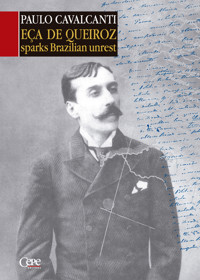
Rescues the libertarian sentiment of the late 19th century , when addressing the last rebellion in Goiana , Pernambuco province. Paulo Cavalcanti examines how the Pernambuco reacted against the will and the Portuguese rule , and his report addresses the crucial moment in 1871, marked by political crises and the great dissatisfaction with the Portuguese monopoly on trade, which has remained unchanged even after several insurgent movements.
Sie lesen das E-Book in den Legimi-Apps auf:
Seitenzahl: 527
Veröffentlichungsjahr: 2015
Das E-Book (TTS) können Sie hören im Abo „Legimi Premium” in Legimi-Apps auf:
Ähnliche




















© 2015 Companhia Editora de Pernambuco
Direitos reservados à
Companhia Editora de Pernambuco – Cepe
Rua Coelho Leite, 530 – Santo Amaro
CEP 50100-140 – Recife – PE
Fone: 81 3183.2700
*
Cavalcanti, Paulo1915-1995
Eça de Queiroz : sparks Brazilian unrest / Paulo Cavalcanti ;
translation Silvio Rolim. – Recife : Cepe, 2015.
Includes annex.
Includes bibliography.
Esta obra foi traduzida da 4ª edição revista e ampliada de 2009.
1. Pernambuco – História. 2. Farpas (Revista). 3. Revistas literárias.
4. Jornais – Recife (PE). 5. Queiroz, Eça de, 1845-1900 – Crítica e
interpretação. 6. Literatura brasileira – Influências portuguesas.
7. História social – Brasil. I. Rolim, Silvio. II. Título.
*
ISBN: 978-85-7858-286-9
Governo do Estado de Pernambuco
Governador: Paulo Henrique Saraiva Câmara
Vice-Governador: Raul Jean Louis Henry Júnior
Secretário da Casa Civil: Antônio Carlos dos Santos Figueira
Companhia Editora de Pernambuco
Presidente: Ricardo Leitão
Diretor de Produção e Edição: Ricardo Melo
Diretor Administrativo e Financeiro: Bráulio Mendonça Meneses
Conselho Editorial:
Everardo Norões (Presidente)
Lourival Holanda
Nelly Medeiros de Carvalho
Pedro Américo de Farias
Produção Editorial: Marco Polo Guimarães
Direção de Arte: Luiz Arrais
Coordenação de Projetos Digitais: Rodolfo Galvão
Designer do Projeto Digital:
Chronicle of a Rebellion
Eça de Queiroz Sparks Brazilian Unrest is a work that widens the understanding of the final rebellion in Goiana, a town in the province of Pernambuco, as well as the causes and aims of the liberal movements that took place in the province throughout the 19th century. It is also a highly innovative way of reporting the events, departing from a linear approach and proceeding in terms of content, in the analysis of the way the inhabitants of Pernambuco reacted against the arbitrary exercise by the Portuguese of their dominant role in the Empire.
It reflects Paulo Cavalcanti’s coherence as a writer, his way of understanding history, which he does not see as a neutral subject, and his belief in fulfilling a mission, reviving hitherto unknown facts and incidents so as to recover the strength of “the nativist movement, the patriotic struggles in Pernambuco and Brazil” and their relevance as “instances of citizenship” and “moments of irreverence and humour”. Following this path, he questions “the ruling classes and their scribes, whose aim is to sanctify their ideology, dressing it in spectacular attire, in an illegitimate attitude of claiming for themselves everything that happened in the past – from the libertarian campaigns to the consolidation of Brazilian nationhood, including the abolition of slavery and the proclamation of Republic.”
The account begins with an analysis of the 1871 political moment, the crisis of the monarchy, the rejection of successive ministries, the undefined stand of the government in relation to the campaign for the abolition of slavery, the reform of the Judiciary and electoral reform. It continues with the uneasiness at Portuguese domination, the monopoly of commerce, that did not change following rebellions such as the 1817 Revolução Pernambucana, the 1824 Confederation of the Equator, the 1848 Revolução Praieira, as well as the 1821 and 1823 rebellions and the disturbances of 1831 and 1832.
At the time, the political and economic situation fostered unrest in the then prosperous city of Goiana, reverberating in Recife. It was then that As Farpas (The Barbs) were first published. The periodical, written by Eça de Queiroz and Ramalho Ortigão, contained chronicles ridiculing Dom Pedro II. The Emperor was then in Europe, meeting with writers and officials. The publishers of the Farpas seized the opportunity to turn his travels into “a grotesque circus spectacle, caricaturing everything the monarch did or said, as the most distinguished traveller from his country”. The Goiana and Recife papers reprinted the articles by Eça and Ortigão, thus escalating the quarrel, with the Pernambucanos using the publications as a political weapon.
The long-established province, which had always played a major part in the struggle for the country’s sovereignty, once again became the focal point of the turbulence, outdoing the rest of the country. The “damned Pernambucano steamer” once again led the reaction against the Portuguese economic ascendancy, particularly the commerical monopoly, mobilising the sectors of society that were most disenchanted with the concentration of property and the situation of the majority of the population, mainly inland, where the poor were “tenant farmers, sharecroppers, dependants or whatever, whose fate is not unlike that of the glebe serfs of old,” as the President of the Province, Diogo Velho Cavalcanti de Albuquerque, expressed it in 1871.
The critical and satirical pieces by Eça de Queiroz, published in Goiana and Recife, stirred up the Pernambucanos and the “yellow men” of Goiana – an offensive term referring to the yellowish complexion that was common in the area, resulting from malnutrition and disease – and irritated the “Galegos” or “Galicians” – an aggressive term used against the Portuguese and foreigners in general, as long as they were white and fair-skinned. Eça de Queiroz and Ramalho Ortigão, however, already annoyed by the unauthorised reprinting of their articles, began to ridicule Brazilians in general, whether monarchists or republicans, with insulting satire and mockery.
The dispute spread, increasing the animosity between “Galegos” and “yellows”. That was when José Soares Pinto Correia Júnior launched his paper A Crise, making fun of Eça and Ortigão as well as of the King of Portugal, Dom Luís I. The periodical As Frechas (The Arrows) first appeared at about the same time, attacking the Portuguese, whom it accused of teaching Brazilians nothing but “prostitution, adultery and polygamy” or, even worse, “the coining of counterfeit money” and certain bookkeeping methods designed to facilitate fraudulent declarations of bankruptcy.
It was at this controversial stage that the population of Goiana turned to attacks and personal insults. By July 1872, animosity was increasing. In the papers, pamphlets, at rallies in the streets and squares, Portuguese and Pernambucanos, “Galegos” and “yellows”, exchanged accusations at the same time that a new issue came to life: the Religious Question. Discussions and debates involving Catholics and Freemasons helped to deepen the crisis between 1872 and 1873, with the Bishop of Olinda, Dom Vital, attacking the Freemasons and generating a discord that resulted in unrest and disturbances in Recife. Dom Vital’s stand lead to a reaction by the Council of State (Aprígio Guimarães, Franklin Távora, José Mariano and Joaquim Nabuco) in defence of religious freedom, whereas Tobias Barreto attacked the Goiana “yellows”, who were defended by journalists Pinto Correia and Romualdo de Oliveira, founding editor of O Comércio a Retalho (The Retail Trade).
It was in this turbulent period that, in the evening of July 31, 1872, the Goiana “yellows” attempted to beat up a Portuguese merchant. The attack was prevented but the rebellion, known as the “Mata-mata marinheiro”, started the following day with the Portuguese being severely cudgelled. Disorder spread all over the town and commerce, controlled by the Portuguese, came to an almost complete halt, a situation that lasted a full week, until August 6. Once the situation had been brought under control, the ringleaders of the movement were prosecuted, but the Pernambucanos reacted in 1875, preventing the authorities from punishing them.
At that stage, Eça de Queiroz, accused of influencing the discord and rioting, reacted indignantly: “Thus, in addition to the influence of the Farpas, there is something else. [...] There have always been regular and periodical conflicts between Pernambucanos and the Portuguese; the fact is that Pernambuco’s retail trade is in the hands and coffers of the Portuguese, who, being more active or more intelligent, have taken it out of the coffers and hands of the Pernambucanos. The fact is that Pernambuco cannot stand this community that takes possession, thanks to the superior wealth of its country of origin, while the natives sink into subservience.”
Throughout his narrative, Paulo Cavalcanti, who praises Eça de Queiroz but also makes critical remarks on his style, which was also criticized by Machado de Assis, highlights his influence on Brazilian writers. And he goes further, pointing out the role of the press, the papers then published in Recife and Goiana, and the political and cultural ebullition in the city, which was to draw punishment by the end of that century, signalling the beginning of its economic, political and cultural decline.
Altogether, written in a dense, light and pleasant style, the chapters of this Eça de Queiroz Sparks Brazilian Unrest (1st Edition, 1945), can be read as interlinked stories, free from the old linear technique and rigid sequence. At the end, Paulo Cavalcanti quotes a remark made by Eça de Queiroz, commenting on a sum of money bequeathed by a wealthy Brazilian in his will for the benefit of intellectuals. In Portugal, Eça said, no writer had ever received anything at all from anybody. “The only Portuguese writers who ever received anything by post from an anonymous sender were Ramalho Ortigão and myself, at the time we were writing As Farpas: then we regularly received promises of beatings from Brazil.”
by Nagib Jorge Neto
INTRODUCTION
No foreign novelist has been more influential in Brazil than Eça de Queiroz. Throughout his life, at the peak of his literary career, the recognition of his name as a writer reached exceptional proportions. Many writers hastened to copy his style, adopting his language patterns, the so-called “barbarism” of his prose, the hues of an art which, by making the language more lively and malleable, had given Portuguese-Brazilian literature, at the time romanticism was being left behind, a sense of true rejuvenation.
Scientific discoveries, the progress of technology, the changes in the economic and social systems, everything that the 19th century had set free from the past, opening up the world to the broad prospects arising from the Industrial Revolution, reassessing life and aesthetic concepts, all this found in Eça de Queiroz the instrument that was to mould art in the image of the unrest of the time.
Rebelling against bourgeois liberalism, he did not prescribe any panacea, neither did he feel constrained by irrelevant dogmas. As a social novelist, he did what seemed to him most licit: to reveal the truth, fustigating the framework of a world that had become fossilised by the accumulation of mistakes and vices; he worried about injustices, disguising his weapons of rebellion in the bright colours of his verve.
An artist to whom art should be the history of man, not the man subjugated by prejudice, stupefied by customs, deformed by institutions, but – as he unsubmissively expressed it – “the free man, placed in free nature, among free passions”,1 he knew how to play his role as a writer, incorporating in his novels a vast documentary of reality and irony, the evidence of which could help to reconcile, in the future, the most sensitive links of a stage of human history, without the schematism of the conceptions of the facts and phenomena of life, but as an expression of all that is most essential to and typical of a developing society.
“What do we want with Realism?” he had already asked himself during the time he worked as a consul in Newcastle. “To produce the picture of the modern world, according to what is most evil in it, through its insistence on educating itself in accordance with the past; we want to produce the photograph, I nearly said the caricature, of the old bourgeois world, sentimental, devout, Catholic, exploitative, aristocratic, etc. And by holding it up to derision, to the laughter and contempt of the modern and democratic world – to pave the way for its ruin. An art with this purpose – he emphasized – is not an art à la Feuillet or à la Sandeau. It is a powerful aid to revolutionary science.2
From this perspective, which goes beyond the classic limits of critical realism, the work of Eça de Queiroz constitutes one of the best progressive traditions of the 19th century, in the vehemence of his denunciations and in the deep individualization of his characters, through which he revealed his own ideas and feelings.
Developing under the influence of social life, his art did not hesitate, even for an instant, to pursue the objectives he had set himself, namely to improve, by means of contrasting reactions, the old habits of the Portuguese land, managing to make it emerge once more from the junk-room to the deserved eminence for which the nation and the people had been longing.
And the renovation he introduced in the canons of Portuguese literary expression was, above all, a demand for his own art – as Álvaro Lins has observed.3
Commenting on Balzac’s The Human Comedy, Engels used to say that it had been worth more, as a contribution to the study of French life in the years 1816 to 1848, than all the compendia by professional historians, economists and statisticians of the era.
Eça’s novels similarly constitute a repository of Portuguese life at the end of the century. And the sense of realism that gave shape to his work, presupposes in the man a profound knowledge of social values.
Taking from art the most restoring objectives, he made his books “an instrument of social experimentation against the transitory products which perpetuate themselves beyond the moment that had justified their creation and – in his opinion – had changed from social forces into public impediments”.4
Before Eça, Portuguese literature had not made any adjustments to the changes of the age, counterfeiting itself before men and things, by adopting strict principles of a false legality, to the point of servility, concerning everything related to the so-called established order. “It is all very well,” he wrote sarcastically, “to talk about order, respect for property, a sense of reverence for the law, etc., but when thousands of men see their families without a fire in their hearth, without a crust of bread, their children dying from privation, while their prosperous and satiated masters buy properties, paintings, bet on horses and hold balls costing hundreds of pounds, good God, it is difficult to talk to the underprivileged about the rules of political economy and persuade them that, according to the greatest experts in economics, they need to spend a few more months living on air and warming themselves by the whitewashed walls.”5
As an interpreter of this reality, eliminating from his art any anachronistic means of expression, Eça de Queiroz strongly influenced Brazilian literature, at a time when romanticism began to be seen as a “public handicap”.
The words of Portuguese writer Alberto de Oliveira translated very well the impact of Eça’s novels on Portuguese-Brazilian culture, at the time it was striving to become an autonomous and original literature: “Our literature was living and growing mouldy in a stuffy old house; and although it had already been lit by the rebellious genius of Camilo, it did not know which way to go. Eça de Queiroz opened its windows to the sun and the open air, sweeping from it, as if it were mould, any contact or trace of staleness. This was his demolishing and reactive work, born out of the circumstances and also from fashion.”6
Before Eça, the dominance of liberalism in art, as romanticism was defined by Victor Hugo, had subjected Brazilian literature to the repetition of imported artistic clichés, schools, trends that often helped writers to outdo themselves in the use of affectation, in an attempt to make up for the lack of feeling by means of a high-flown language. The truth is that, together with valuable manifestations of cultural autonomy, in works of manifestly local form and content, Brazilian romanticism had been nearly restricted to the “chorões reais” (royal weepies) referred to by Sílvio Romero.
In the period of its decadence, however, the aimless overflowing of artistic creation had given rise to absurd value concepts. It was the time of the virtuosi, the iconoclasts, those who, concerned with the avalanche of the new, in their extravagance and arbitrariness turned their backs on the social foundations of thought.
According to Sílvio Romero, the main argument of these “scoundrels” was their own youth. “Instead of ideas, doctrines, systems, theories... they rolled themselves up in their birth certificates and aimed their invective against the unwary.”7
It was then that Eça de Queiroz took us by surprise: “the writer of his time, deprived of all technical superstitions, freely exercising upon the thrilling reality of the live world his personal talent for analysis and feeling.”8
Eça followed a path cleared for him by a whole generation involved in scientific debate, social criticism and philosophical discussion – Tobias Barreto, José Veríssimo, Sílvio Romero, Aluízio and Artur Azevedo, Paula Ney, Celso de Magalhães, Araripe Júnior, Olavo Bilac, Raimundo Correia, Emílio de Meneses, Raul Pompéia, Capistrano de Abreu, Machado de Assis, Eduardo Prado, Joaquim Nabuco, Lafaiete Rodrigues Pereira, Gaspar Silveira Martins, Domício da Gama, Oliveira Lima, João Ribeiro, Ferreira Viana, José de Alencar, Goulart de Andrade – polemicists, historians, poets, novelists, playwrights and politicians, some of whom were later to become his personal friends.
Many of them acknowledged Eça’s work as an instrument for renewal of language and style, ironing out a certain harshness in Portuguese, lending plasticity to reasoning, shaping feelings to produce new expressive effects. These characteristics of Eça de Queiroz have been evidently and continuously present in Brazilian literature since then, constituting an extraordinary power to extract the most ingenious artifices from a pompous and hardened language; these unmistakable secrets of his singular way of writing can be identified in the best modern Brazilian novelists, in critical journalism, in theatre, lectures, parliamentary speeches, poetry, court pleadings, subtleties of humour, in the shape of jokes, in the reaction to ridicule, in all this varied range covered by Eça’s work, which gets better and better as time goes on.
No student of his influence on contemporary and future generations has yet singled out for study the impact of his work on the great mass of his readers, the intermediate layers of Brazilian society at the end of the 19th century, who took him as a model of aesthetic renewal and who imitated his tastes and preferences; who instantly recognised scenes from his novels and the names of characters, and applied Eça’s characterisitcs to public figures of their day – the politician, the minister, the priest, the honoured citizen, the lady concert-goer.
“There were even people who could recite by heart whole passages from the books. Scenes from Os Maias, its most coruscating quips, its most typical characters were excitedly quoted, commented on, analysed as much by the youth of Rio de Janeiro, São Paulo or Recife, as that of Lisbon, Oporto and Coimbra”9
The “literary and moral bomb” which went off in Portugal when Eça’s Primo Basílio (Cousin Basílio) was published, or the “white scandal” concerning the appearance of his O Crime do Padre Amaro (The Crime of Father Amaro) similarly accompanied the launch these same books in Brazil. One could imagine the contrasting reaction of readers used to the quaint narratives of romanticism – in which characters and emotions were put in their proper places and the novel would slide smoothly, squeezed between the purity of form on the one hand and the indulgent conflict of soul on the other – and the instantaneous discernment of life in Eça’s work, the raging susceptibility, the ardent ridicule of situations, the laughter, the derision, the unrestrained passions, the commotion in an art “capable of translating in all nuances the new realities that the writer, in his heart, felt summoned to express.”10
With his style, in the lively irreverence of his criticism, Eça de Queiroz conquered Brazil. The laughter, to start with; then the grave comprehension of the aims of his art, savaging characters in their sentimentality and conventionalism.
In Bohemian circles at the end of the century in Rio de Janeiro, São Paulo and Recife, intellectuals adopted him as their literary standard. Eça’s work became fashionable, the ecstasy of minds eager for the latest models from Europe.
In Maranhão, Clóvis Ramalhete11 remembers, a group of writers, after reading his early novels, went so far as to create an “Eça de Queiroz Spiritual Bakery”. And from Cuiabá, then a remote and modest outpost, “in the brutality of the jungle, among Indians and missionary priests”,12 a Brazilian reader – “a fanatical admirer of yours” – wrote to him in 1898 to report a mistake, when, in A Relíquia (The Relic), on page 339 of the second edition, Eça had put over the black mountains of Gilead, where Teodorico was travelling, a “full moon”, after having said, a few pages before, that “the moon appeared thin and arched,” meaning that it was waning.
Eduardo and Paulo Prado, Domício da Gama, Olavo Bilac, the Baron of Rio Branco and many others were not the only Brazilians who felt a close affinity to Eça Portuguese for his thinking and intelligence. Martins Fontes, who never met him, talked about his affection, in a moment of reminiscence: “Throughout his life, Eça de Queiroz had been with us, illuminating our literary circles”.13
Young Alberto de Oliveira, spotting him in the city of Oporto, in the Rua das Carmelitas, felt as if he were contemplating a little god. “It was he! Tall, slender, dressed in severe mourning, sporting a high-crowned hat which made him even taller, spectacles (instead of the expected monocle) veiling his eyes, the face as pale as old ivory, a finished harmony both in his clothes and the outline and movement of his body and a bearing both Olympic and defeated, contemptuous and resigned, ironical and melancholic, reminding me of the cold and haughty sadness of cypresses.”14
The interest in the writer went beyond the limits of mere artistic curiosity. Anyone returning from a visit to Portugal was immediately asked if they had seen Eça in person, or had been to the Casa Havanesa or the Café Martinho...
“If I were to say that, since my adolescence, Eça de Queiroz, has been one of my favourite authors, I would not be telling the whole truth,” conceded Ribeiro Couto, in a moment of sheer evocation, emphasizing: “In fact, I will say nothing at all. To me and to the young men of my time... he was a window wide open to the living world” (Livro do Centenário de Eça de Queiroz (Book of the Centenary of Eça de Queiroz), p. 694).
Following his death, the places in Lisbon mentioned in his books became associated with his name and memory, reminders of scenes from his novels, bringing to life his dialogues and characters in the new colours with which he had depicted Portuguese life.
Two decades after having seen him, together with Ramalho, attending a musical soirée at the Teatro Trindade, José Veríssimo had not forgotten his appearance: “tall, slender, not as thin as he became later, dressed up as an Englishman, his monocle set between his aquiline nose and his penetrating wide-open eye, commanding the juvenile rustic admiration of a newly-arrived provincial Brazilian.”15
For years on end, the worship of Eça de Queiroz would follow the reissue of his works. In 1945, José Maria Belo, from Pernambuco, admitted in a moving confession: “I remember with nostalgia, the same nostalgia I felt when I followed Emma Bovary’s itinerary through Rouen, the many times I wandered through the Chiado, Belém, Janelas Verdes in Lisbon, and made my way to Sintra, to relive the images with which Eça had filled my adolescence.”16
Even today, 114 years after his birth, groups of admirers in Rio, São Paulo, Porto Alegre and Recife gather to study his life and work. In 1948, together with Silvino Lopes, I decided to set up the Association of Friends of Eça de Queiroz. Our attempt was frustrated, however, when frightened admirers of Eça, because of unfounded political fears, decided to drop the idea.
Of all the cities in Brazil, Recife is the one where the worship of Eça de Queiroz has been most firmly rooted and long-lasting. Pernambucanos early learned his name as he himself had learned the name of Pernambuco, among the first words he uttered. Born on November 25, 1845, in Póvoa do Varzim, the son of unmarried parents – José Maria de Almeida Teixeira de Queiroz, a naturalized Brazilian, and Carolina Augusta Pereira de Eça – he was brought up by Ana Joaquina Leal de Barros, a Brazilian dressmaker born in Pernambuco, a friend of the writer’s paternal grandparents, living in Vila do Conde.17
The friendship between the poor dressmaker of Vila do Conde and the Teixeira de Queiroz family may have started during the time that Eça’s grandfather, Joaquim José de Queiroz e Almeida, lived as an exile in Brazil, where his son, José Maria de Almeida Teixeira de Queiroz, Eça’s father, was born.
Ana Joaquina Leal de Barros, daughter of Ana Maria da Conceição and an unknown father,18 must have been related to the Leal de Barros family of Pernambuco. The head of the family was a Portuguese merchant, Joaquim Leal de Barros, who had moved to Recife in the early years of the 19th century. From this Leal de Barros, who became rich supplying pork to ships stopping at the port of Recife, was descended Antônio Leal de Barros, who had a son, Joaquim Cavalcanti Leal de Barros, a teacher of the old Ginásio Pernambucano, in Recife. From the relationship between Joaquim and Maria Carmelita Lins was born the future minister João Alberto Lins de Barros.
One cannot exclude the possibility that Ana Joaquina was the daughter of the Portuguese Joaquim Leal de Barros with the slave Ana Maria da Conceição, having being baptised with both their Christian names.
In the first years of their life in Brazil, many Portuguese cohabited with black or mulatto women, who helped them to get rich, carrying out the hardest tasks of the daily routine. After becoming wealthy, they would marry white women, who then took their husband’s surname. Joaquim Leal de Barros may have sent home to Portugal, as the illegitimate offspring of his loves in Recife, Ana Joaquina Leal de Barros, who was later to become Eça’s godmother and helped to raise him.19
Speculations about the origins of the dressmaker from Vila do Conde apart, what is certain is that Eça learned to speak listening to Brazilian-accented Portuguese during his four years in the company of Ana Joaquina, who used to sing him lullabies and tell him fairy tales from the Northeast of Brazil. No one can underestimate the influence of the “Pernambucana” Leal de Barros in the development of the language and style of Eça de Queiroz, whose processes of literary expression brought about a true revolution in the canons of the Portuguese language. Certain characteristics of Eça’s prose – his attachment to the sonority of words, his un-Portuguese positioning of pronouns, his tendency to the use of spontaneous expressions, going so far as to alter the structure of the language – may have originated from these childhood influences.
Eça himself says that his earliest childhood memory was “sitting on the knees of an old black servant,20 who was a great reader of cordel popular literature, listening to the stories he used to tell me.”21 The language of these Pernambucanos would never cease to impress Eça de Queiroz, for whom the Portuguese spoken in Brazil was a “Portuguese with sugar”. In its essence, his style resembles the gentle, sing-song speech of certain Brazilian regions.
He had always been familiar with the name Pernambuco. In his short story, “Singularidades de uma Rapariga Loura” (“Singularities of a Blonde Girl”), written in the first stage of his literary career, there is an interesting reference to facts of his childhood in his memory of a Brazilian song he possibly heard sung by his godmother or a servant. That was in the Rua dos Calafates, at the house of a very rich notary where the Vilaças used to go on Saturdays, when “singers of motets were accompanied at the harpsichord, topics were made into songs and the guests played games of forfeits from the times of Dona Maria I”:
Later, precious Dona Jerônima da Piedade e Sande, seated at the harpsichord in a moving posture, sang in her coarse voice the old aria by Lully:
O Richard, O my king,
The world abandons you,
which led the terrible Gaudêncio, a democrat from the 20s and an admirer of Robespierre, to rancorously growl close to Macário:
“Kings! ...Vipers!”
Afterwards, Canon Saavedra sang a song from Pernambuco, Pretty Girls, Pretty Girls, quite popular in the time of Dom João VI. 22
Eça de Queiroz’s ties with the Pernambucanos, dating from his earliest childhood, became even closer during the time he was writing for the Farpas. I shall describe in this book how, in 1872, the articles by Eça and Ramalho Ortigão aroused the ire of Pernambuco against Portuguese subjects, in a protest following the publication of passages written about Emperor Pedro II’s travels in Europe.
The names of both writers, especially Eça’s, are associated with events such as press debates, street protests, beatings, shootings, arson, the military occupation of towns, the armed forces placed on alert, judicial incidents, the banning of civic marches, government crises, the escape of criminals, the dismissals of public officials, and the appearance of subversive pamphlets, all of which took place in Recife and Goiana in the 1870s following the publication of the Farpas.
The aim of this book is to tell the story of the nativist movement, retrieving facts and incidents which were omitted from earlier histories. Not a single reference, circumstance or quotation included in this work, however minor, has been rejected as unconvincing by archives, libraries and sources of oral tradition.
Without a doubt, the greatest merit of this book, the fruit of long and patient research, is that it establishes a connection between all the links in an interesting chain of events, which ought to be regarded as part of a history of patriotic struggles in Pernambuco and in Brazil, as an instance of civic pride, and also as a most enjoyable experience of irreverence and humour.
The inputs on which I drew to reconstruct one of the most expressive periods of the political and social development in Pernambuco, to which have been added, as a “pretext” for this great undertaking, the name of Eça de Queiroz and the Farpas, have never been published before. This is the first time that many official documents – manuscripts pertaining to the government of Pernambuco, judicial authorities in the province and the foreign consular body – are being made public. On the other hand, some passages from Eça’s works, concerning the controversy with the people of Pernambuco, were omitted from his collected works and have been lying forgotten for over eighty years in the original edition of the Farpas.
Until now, no study published either in Brazil or Portugal has recorded these facts, now restored in their full extent.23
Drawing on data collected during ten years’ research of old newspapers, manuscripts and books in the Pernambuco Public Library and the State Public Archives, I have been able to re-establish, not missing a single link, the landmarks of this most interesting historical-literary movement which I offer my readers as a full-length portrait, against the background of other disturbances of the time.
The admiration of Brazilians and Pernambucanos for Eça de Queiroz has always lacked a material element that might make it more effective. With this book, which retrieves from the past the origins and the narrative of one of the most exciting episodes of our struggles against the Portuguese, not recorded by official historians, I am convinced that Eça’s name will cease to be what it has been until now: the object of a distant worship, although lively and passionate, but spatially evanescent and abstract.
Now let us move back eighty-seven years to tell the story.
PAULO CAVALCANTI
Recife, July 1959
1Barbarous Prose, p. 137.
2Letters of Eça de Queiroz, p. 49.
3Literary History of Eça de Queiroz, 1st edition, p. 254.
4 Letter from Eça to Teófilo Braga, dated March 12, 1878, in Cousin Basílio.
5London Chronicles, p. 266.
6 EÇA DE QUEIROZ, Memoirs, p. 72.
7History of Brazilian Literature, vol. 5, p. 248.
8 RAMALHO ORTIGÃO, inEça de Queiroz as seen by his contemporaries, p. 338.
9 ALBERTO DE OLIVEIRA, op.cit., p. 166.
10 AURÉLIO BUARQUE DE HOLANDA, “Language and Style of Eça de Queiroz”, in The Book of the Centenary of Eça de Queiroz, p. 61.
11Eça de Queiroz, p. 18.
12Eça de Queiroz, p. 18.
13Dom Casmurro, a literary journal published in Rio de Janeiro, May 1945.
14Op. cit., p. 28.
15Foreign Men and Things, vol. 1, p. 347.
16Portrait of Eça de Queiroz, p. 287.
17 Cf. JOÃO GASPAR SIMÕES, Eça de Queiroz, the Man and the Artist.
18Id.
19 In an excellent book, Eça and Brazil, vol. 358 of the Brasiliana Collection, Companhia Editora Nacional, São Paulo, 1977, Arnaldo Faro, despite describing my work on the repercussion of the Farpas in Brazil as “remarkable”, rejects the hypothesis that Ana Joaquina might have gone to Europe at her father’s initiative. He writes: “After giving birth, female slaves were not sent to Portugal. They remained in the senzala (the slaves’ living quarters) and the new-born child itself became a slave.” (p. 34). Gilberto Freyre, an expert on the subject, lists countless examples of children of slaves and European white men or mascates (Portuguese peddlers) who, after their concubinage, gained a new social status, becoming “aristocratized” mulatto men or women, whose blood “has not always agreed with the purity of European blood.” (See Sobrados e Mucambos(Mansion Houses and Huts), vol. 2, from p. 544). Ana Joaquina’s occupation as a dressmaker was, according to Gilberto Freyre, quite common among liberated female slaves – “excellent dressmakers, by the way”. The same applied, he says, “in the case of female slaves and daughters of slaves living in concubinage with white European aristocrats, not only Portuguese, but English as well.” (Ibid.).
20 Reviewing the first edition of this book, João Gaspar Simões, the great biographer of Eça, confirmed the influence of Brazilian servants and nursemaids not only on his infancy, in Vila do Conde, but also on his later childhood at his grandmother’s, in Verdemilho – as formative elements of his language. “Black Pernambucanos abounded in that family environment”, says the Portuguese reviewer (critic??).
21Last Pages, pp. 398/399.
22Short Stories, p. 17.
23 AURÉLIO DOMINGUES, in the book Past and in an article published in Literatura, Rio, November 1945; ÃNGELO JORDÃO, in notes in the Almanack de Goiana, 1929; OCTÁVIO PINTO, in an article in the Folha da Manhã, Recife, June 27, 1948; and EDUARDO DE LIMA CASTRO, in Memoirs of a Politician from Pernambuco, all made references to several aspects of the struggle against the Portuguese in Pernambuco in 1872.
CHAPTER ONE
DOM PEDRO II’S FIRST JOURNEY TO EUROPE THE ABOLITIONIST CAMPAIGN ADVANCES FROM GLADSTONE TO THE “PIG’S EARS” THE TRAVELLER’S SUITCASE AND HIS VORACITY FOR HEBREW THE EMPEROR OF BRAZIL IN THE EYES OF THE FARPAS.
In 1871, the Empire of Brazil was in a state of political crisis. The ideas of the abolition of slavery, electoral and judicial reform, and the newly-launched Republican Manifesto, signed by some of the most highly regarded men in the country, together with the forceful movements against the succession of cabinets that were being entrusted with the destinies of the government, spurred progressive thought, providing a new framework for social struggles in that stage of the Second Reign.
Both in Rio de Janeiro, then still the capital, and in the leading provinces, the people were actively participating in civic campaigns, publishing newspapers, taking to the streets and discussing the problems of freedom and the abolition of slave labour. “Emancipation was a national aspiration, and the reforms of the electoral and judicial system a necessity.”11
The “black stain” of slavery was beginning to be seen under a perspective other than simple human compassion, having become an obstacle to the country’s economic development itself, hindering its material progress, as Nabuco argued.22
To replace the failed São Vicente cabinet, a new one took office on March 7. It was headed by José Maria da Silva Paranhos, the Viscount of Rio Branco, who was determined to face, with a cool head, the difficulties of the Throne, especially the storm unleashed by the campaign for the abolition of slavery. The Conservative Party, in power, was disintegrating under the impact of the world’s new ideas. Electoral support for the pro-government groups in the provinces swung back and forth, with each political leader opting for the way best suited to local circumstances. The lack of ideological consistency was to lead to a split as the conservative leaders themselves, even in the highest Court circles, held conflicting views about day-to-day problems.
The Liberal Party, disunited in the application of its theses, tried to turn the “Free Labour and Free Vote” formula into the core of its activities. They were fully aware of the government’s weakness and the way people were receptive to such promises, at a moment when life itself put in the order of the day the fundamental issues related to liberty. Clearly, simple demands for electoral reform could not fulfil the promises of deep changes in the structure of the ruling political regime. That was why the liberal Tavares Bastos raised his voice to demand more sense of realism in the program of his party:
As a matter of fact, what is the use of free suffrage (conceding that it functions satisfactorily) if the powers with which the Crown dominates the highest state bodies and all social interests and relations ensure the passivity of the Senate and hold the promise of loyalty of the temporary Chamber? Today all the Emperor’s government has to do is brutally interfere in the elections; tomorrow, without renouncing this option which it could advantageously exercise on the less fortunate classes of the people, on the depraved mercantilism of the cities and the centralized civil service, tomorrow, besides this poor resource, it will be solicitous to regiment devoted majorities inside the Parliament. And the match would start with the game already half-won: it would enter the struggle counting on a near unanimity in the Senate.33
Tavares Bastos’ reasoning went further. Electoral reform for its own sake, retaining the rule that senators were chosen by the Emperor for life, would not meet the demands of those who wanted sweeping changes in the political processes then in force. Thus, it would be better that the Liberal Party adopted a different course of action, including economic changes, without which the superficial changes would have no value.
Taking into account “the acceleration of the emancipation movement and the supplementary measures required by the transformation of work,” not forgetting “to consecrate the freedom of opinion and beliefs, and promote the moral improvement of the people”, Tavares Bastos suggested drawing up a new program, which would also include “the full right of association, without any preventive measures; the boost to domestic trade, or rather, to the national communion, that would be provided by favourable economic measures and fast means of communication; the abolition of additional taxes on imports and exports introduced during the war; the gradual decrease of our permanent customs tariffs, whereby higher consumption goods are subject to taxes which, considering the recent changes, today amount to 50%; the suspension of the general import tax; the lowering of the highly onerous land sales tax, a nearly prohibitive levy; expenditure cuts, especially in the military budgets, to make provision for the release of slaves and public schooling.4
Taking all this into account, the response of the Conservative Party could not be restricted to the acknowledgment of the outstanding achievements of the regime, especially as regards the idea of maintenance of slave labour, which had already been abolished by nearly all civilized nations in the world. Since 1886, Pedro II had in hands the draft of a bill by Pimenta Bueno, contemplating gradual steps for the end of slavery. The ruling classes, however, did not look upon these plans with favour. The end of the slave trade between Africa and Brazil, which came into force in 1850, had been brought about more for the fear of an international conflict with Britain, which had boldly decided to seize any slave ship found on the high seas, than for any political or humanitarian reasons concerning issues such as freedom.
The position of most of the social forces which supported the Emperor could be translated in the words of the Marquis of Olinda before the State Council: “A single word even suggesting the idea of emancipation, no matter how embellished it may be, will open the way to thousands of misfortunes.”5
The argument that the Empire, having just had come out of a five-year war, was in no condition to face the abolition issue, due to the impoverishment of its finances and the party political crisis, was no more than an excuse for the pro-slavery conservatives to defend the continuation of the odious system. The Viscount of Sinimbu, for instance, justified the “juridical validity” of slavery with the odd allegation that, as “slaves were a property guaranteed by the laws of the Empire”, one could not “act against [the laws] without safeguarding the rights of their owners.”6
It was at this time of heated debates on abolition that Pedro II decided to make his first trip to Europe. The Visconde do Rio Branco, then the president of the cabinet, had just presented his “Ventre Livre” (“Free Womb”) bill to Parliament.
Freedom for the offspring of female slaves, despite Joaquim Nabuco’s attempts to present it as “an act of national sovereignty,”7 was no more than a transaction between the State and slave-owners, a manoeuvre to undermine the impetus for full freedom, a diversion to split the great civic front of abolitionism.
Even so, the Rio Branco bill exposed the government to the most insulting recriminations, mainly from the social classes favourable to the retention of the slavery system.
The Emperor’s trip, notwithstanding the different versions given by official chronicles, hardly disguised Pedro II’s political manoeuvre, handing the sceptre to a 25-year-old princess, thus avoiding the need to resolutely face the wave of indignation of reactionary circles and, perhaps, getting rid of the criticism that threatened the stability of the Throne. Of course Dom Pedro had plenty of reasons to justify his leaving Brazil at that specific moment. The long war with Paraguay had left him physically exhausted; the Empress Teresa Cristina was ill; his younger daughter, the Duchess of Saxe, had died recently; and even private reasons such as the idea of meeting in Europe his friend and confidant, Luísa Margarida Portugal de Barros, the Countess of Barral, could be used as reasonable pretexts to explain his leave of absence from the government.
In any case, Pedro II’s trip aroused the disapproval of both conservatives and liberals. José de Alencar, a monarchist deputy, strongly opposed the Emperor’s departure, although the position of the eminent man of letters had been seen as retaliation, as Dom Pedro had refused to appoint him to a seat in the Senate. Counsellor Joaquim Nabuco deplored the fact that the Emperor had left them, the political leaders, “under these circumstances, taking with him his great prestige and his great experience, which could not be transferred.”8 Andrade Figueira took the opportunity to reveal the naked truth, imputing to the Emperor’s trip a populist intent “to gain the applause of European abolitionists”9 following the imminent triumph of the liberation of newborn children of slave mothers.
Finally, on May 25, 1871, aboard the English steamer Douro, Dom Pedro left with an entourage of fifteen people, calling at the Brazilian ports of Salvador and Recife.
On June 12, Dom Pedro arrived in Lisbon, from where he would travel to Spain, England, Belgium, Germany, visiting cities such as Prague, Vienna, Budapest, Venice, Trieste and Milan. During a fifteen-day stay in Egypt, he visited the newly-opened Suez Canal. On September 28, in Alexandria, he received the news that the Free Womb bill had been sanctioned.
During his extensive travels in the Old World, Pedro II had made a point of personally meeting, as he usually did, the most eminent figures in politics, science, literature and the arts. The list included names such as Disraeli, Thiers, Gladstone, Queen Victoria, the Emperors Franz Josef and Wilhelm I, Pasteur, Camilo Castelo Branco, Alexandre Herculano, Mendes Leal, Inocêncio Francisco da Silva, Afonso Karr, Wagner, and Alessandro Manzoni, among others. In a single list compiled by Gobineau, in France, we can find the names of all these people, to whom the Emperor of Brazil was to be introduced: Renan, Alexandre Dumas, Berthelot, Taine, Claude Bernard, Guizot and Théophile Gauthier. The Emperor was also received by Pope Pius IX in a special audience.
Temples, libraries, museums, cultural institutions, universities – all these works of human civilization were the focus of the Emperor’s attention, where he spent his time. “He wanted to see everything, although nearly always he would do that superficially, asking questions and seeming willing to do anything to examine a ruin, to tread the streets of an old town, to climb the tower of a castle or to become enraptured by a beautiful landscape.”10
The days he spent in Portugal, upon his return, however, would be bitterly disappointing. Having met some of the most important personalities in the world, he came to Lisbon to face Eça de Queiroz and Ramalho Ortigão, the mentors of the monthly journal As Farpas (“Barbs”), “a combative paper, a mordant paper, cruel, incisive, biting and, above all, a revolutionary paper.”11 It was published in monthly 100-page issues jointly written by the young writers, Ramalho being, then, more familiar with literary issues than Eça. Both resorted to satire as a form of social criticism. “Ramalho is the mallet, Eça the stinging nettle.”12
The Farpas turned the Emperor of Brazil’s triumphant journey to Europe into a grotesque circus spectacle, caricaturing everything Dom Pedro had done or said as his country’s leading traveller. The Emperor’s name, his titles, his peripatetic baggage, his literary predilections, his appetite for learning foreign languages, the receptions he attended, the tributes paid to him, his appetite for certain foods, the clothes he wore, his calculated modesty – the Farpas heaped merciless mockery upon it all.
In their first column on Pedro II’s visit, Eça and Ramalho introduced themselves:
We are, Sir, the only men Your Majesty did not see in Portugal. Countless are the titles that, in this occasion, we could display – and which we do not have. And we proceed to list them: we are not deputies of the nation; we are not civil servants; we are not academicians; we are not merchants; we are not landowners. Your Majesty has before his eyes two fellows who are – nothing at all.
Your Majesty will certainly be amazed that in this kingdom there could be two Portuguese men as remarkably illustrious as ourselves. We deeply acknowledge Your Majesty’s amiable surprise.13
Eça de Queiroz was to stress this jest in another column:
Your attention, please! The Emperor of Brazil, while was among us (an even far from us) was, alternatively and contradictorily – Pedro d’Alcântara and Dom Pedro II. As soon as receptions, anthems and banquets were produced to glorify Dom Pedro II – he hastened to declare himself to be just Pedro d’Alcântara. When the railway timetables, the library regulations or the familiarity of the citizens would treat him as Pedro d’Alcântara – he would make it clear that he was Dom Pedro II. So, if we were to say that Pedro d’Alcântara had stayed among us we would be making a mistake – as he had asserted himself to be Dom Pedro II. If we feel flattered for having had Dom Pedro II as our guest, we would be misled – as he had asserted himself to be Pedro d’Alcântara.14
The Emperor disembarked in Lisbon dressed as a commoner, mingling with the members of his retinue. “The clothes and the manners of the Emperor were, as usual, unpretentious and simple: black suit, a low hat, a black-and-white checked scarf round his neck; a black leather suitcase in his right hand, an umbrella in his left, a bundle of papers under the arm did not set him apart from the natural simplicity of any other traveller.”15 Commenting on Pedro II’s apparel, Eça especially satirized his suitcase:
It is a small suitcase, made of dark leather, with two handles that fold together. He uses them to carry it. In his other hand he sometimes held an umbrella, under his arm he would squeeze a bundle of papers. He often put aside the umbrella, sometimes the papers – but never the suitcase! Paris, London, Berlin, Vienna, Florence, Rome, Madrid and Cairo – they all know it. It became as popular in Europe as the little hat of Napoleon the Great or the great cowardice of Napoleon the Little. But the celebrity of the suitcase clouds the glory of the prince. As Béranger remarked about the Battle of Austerlitz: ‘For a long time they will talk about it under the chandeliers of the palaces and under the roofs of the cottages.’ About him – less!
The cruel satirist used Dom Pedro’s suitcase for a series of malicious interpretations:
The suitcase means that he not only does not have the sceptre in his hand, but he carries his luggage in his hand: that he not only left his royalty behind in Brazil, but has adopted unceremoniousness in Europe! The suitcase is the signboard of his incognito! The suitcase says: “Shake my hand, address me as Pedro, and do not play me the anthem.”
Commenting on the presence of the Emperor, one Lisbon newspaper praised his taste for Hebrew. On the subject, Eça de Queiroz wrote:
He is a glutton for the Hebrew language. As far as Hebrew is concerned, he wipes his plate and licks his fingers. And, in an inexplicable act of negligence, His Majesty has nor brought with him a single man of the Hebrew race, not even a Hebraizing Christian or a teacher of Hebrew! So that in the long lazy days in the steamer, in the tedious hours in the railway carriages – His Majesty suffers cruel deprivation of Hebrew! That is the reason why he is always hungry for Hebrew; and having hardly entered the hall of the hotels, still carrying his suitcase through the corridors, he would break into gluttonous yelps, nearly in a fit of fury, asking for his Hebrew!
The admiration of the head of the Brazilian government for the writer Alexandre Herculano was longstanding. Dom Pedro had already corresponded with the Portuguese historian and novelist and the idea of visiting him was most agreeable to him. Both on his way out and back, Dom Pedro met Herculano. The meeting between the two old friends was an emotional moment. In his “Travel Diary”, the Emperor wrote: “Yesterday I had a long conversation with Alexandre Herculano on Portuguese particularities and affairs. He has already written a large part of the fifth volume of his History, as well as other works, among them a narrative in which he described the state of Portugal. But he was horrified and tore the manuscript to pieces. In his hours of leisure he translates Ariosto, whose work, in his opinion, makes more pleasant reading in blank verse.”16
This is how the meeting between Pedro II and Herculano was described in the jeering vision of Eça:
His Imperial Majesty visited Mr. Alexandre Herculano. The fact in itself is undeniable. On this point, all agree and History is at peace. Opinions radically disagree, however, as to the place where the Brazilian Emperor’s visit to the Portuguese historian actually took place. The Diário de Notícias says that the Emperor went to Mr. Herculano’s home. The Diário Popular, on the contrary, says that the Emperor has been to the eminent kingdom of the man that… Mr. Silva Túlio, however, declared that the Emperor visited Herculano’s “hovel” (although he contradicted himself a few lines later by confessing that the Emperor has actually been to the illustrious historian’s “retreat”. A report in an Oporto newspaper asserts that the Emperor went to the man’s “fold”... Some of the Lisbon papers, in their turn, teach us that His Majesty has been to the man’s “den”... Others, however, confirm that His Majesty went to the “hermitage” of the eminent figure, while another maintains that the Emperor went to the venerable citizen’s “exile.” Now, amid all this, it seems to us that something terrible may have happened: His Majesty had simply forgotten to go to Mr. Alexandre Herculano’s house!17
During his stay in Lisbon, only once Pedro II wore a dress coat. It was for a social evening at the Royal Palace. This time, Ramalho was the one to interpret the event:
He did well not wearing a dress coat except for the concert at the Palace, and absolutely never wearing a white tie. Thus Your Majesty proved his profound knowledge of the country he was visiting, a place in which the most rancorous divergences vexing the institutions originate chiefly in the particular way each man ties his bow tie. Your Majesty has certainly noted that the only prominent man whom all political parties favour is the Marquis de Ávila: the reason is that this gentleman has, throughout his life, concealed his tie beneath an ingenious silk scarf.
During a banquet in the Portuguese capital, Pedro II was served, at his own request, a national dish: pig’s ears with haricot beans. Thus Ramalho “savoured” the imperial repast:
Your Majesty did well in so earnestly requesting that pig’s ears with haricot beans were to be served for his suppers. Pig’s ears are actually more than a delicacy. Pig’s ears – especially with haricot beans – are a national institution: a philosophy. And we will go further, Sir: pig’s ears are as much a geographical fate as climate and soil. Half of what happens in Portugal can be explained by climatic conditions, by the situation and configuration of the country: everything else is explained by the pig’s ears and the haricot beans.
Not forgetting to mention the types and races the Emperor had seen in Europe – the English, stout and sturdy, the French, restless and nervous, the Italian, from the dandy clergyman to the noble tenor, the Spanish, simultaneously handling the tambourine and the knife, the fandango and the revolution – Ramalho called Dom Pedro’s attention to the following Lusitanian traits:
In Portugal, Your Majesty met a sad, lymphatic, fat, slack, indolent population; in literature and poetry, old-fashioned pedants; in the sciences doubtful, hesitant old fogeys; lugubrious in their attire; silent and gloomy in their social intercourse; conservative and constitutional in politics; always the determinative outcome of the traditional and patriotic combination of pig’s ears and haricot beans, so agreeable, as the newspapers report, to Your Majesty’s imperial taste.
And thus Ramalho went on considering the “influence” of the Lusitanian people’s national dish:
At the core of the vital substance of every Portuguese there is an organic centre of beans and pig’s ears. In some, the swine prevails: in others, the farinaceous portion triumphs. We have simple temperaments – beans or pig’s ears – and we have composite temperaments, pig’s ears with beans and beans with pig’s ears. Mr. Barros e Cunha, for example, is pure haricot beans, while Osório de Vasconcelos is an extreme case of pig’s ears. In the reformist party the influence of the pig’s ears prevails; see the Bishop of Viseu. In the historical party the haricot beans rise to the top: witness Mr. Anselmo Braamcamp.
Explaining the purpose of the Farpas, Eça’s companion told the Emperor that the journal’s writers were not “malevolent or arrogant, as he had been told, but modest, reasonable and sincere.” As far as the Farpas were concerned – Ramalho pointed out – “this is what they always are: a small quantity of iron, which we usually do not serve in the form of a dagger, as is given to murderers, but in tiny pills to be taken with vanilla-flavoured cream, as is prescribed to fragile and anaemic ladies.”
Eça and Ramalho’s scathing satire must have left the Emperor annoyed and resentful. The mocking chronicle of his trip was more than a writers’ joke, becoming a true affront towards the Empire of Brazil. What pleased Pedro II, always willing to accept the flattery and praise of his courtiers, were passages such as Pedro Calmon was to write, many decades later, on the monarch’s journey to Europe: “He talked with scholars, discussed mathematics, archaeology, the arts, Hellenism and Hebrew, in a circle of courteous old scholars who marvelled at that learned and curious sovereign, flattered by all that adulation, enjoying it far more than the honours and ceremonies of the two courts then present [in Lisbon].”18
Rafael Bordalo Pinheiro, the great Portuguese caricaturist and painter, who belonged to the same intellectual group of Eça and Ramalho, also mocked the figure of Pedro II. In a drawing that was to become famous, published in the “Album of Glories”, Bordalo showed Dom Pedro in a comic position: standing, stroking his beard while trying, with his other hand, to hide behind his back a bursting suitcase from which the carelessly packed imperial mantle is poking out. Beside him, on a chair, lie the crown and the sceptre, as if they had been abandoned there.
In Portugal, however, it was not only the pro-government press that had become enraged with the Farpas’ attacks. From his retreat in São Miguel de Seide, near Oporto, Camilo Castelo Branco came out in defence of the imperial visitor. Writing to a friend in Lisbon, Camilo opened his heart: “I became aware through the news in the gazettes papers that they [Eça and Ramalho] have published pamphlets against the Emperor. Adding insult to theft!”19
To what “theft” was the great novelist referring? Could it had been the incident in The Mystery of the Road to Sintra, a serial jointly written by Eça and Ramalho in l870 for Lisbon’s Diário de Notícias, for which they were accused of plagiarism?
In the same letter Camilo asked his friend: “What will the Brazilian newspapers say when they see the affable pamphlets of this gaggle of fools among whom the Emperor passed by, as we would pass by the horse races on a market day, quickly and cautiously!”
In another missive, dated April 1, 1872, once again the writer gave vent to his sorrows, this time in a heartbroken mood: “I have been reading with amazement,and even with tears in my heart,what has been printed against the Emperor. The Farpas’ writings are not even entertaining enough for us to make allowance for their childish pranks.” And he added, ashamed of his own country: “What an unfortunate idea the Emperor had to come to this barnyard.”20
Leaving behind the buffoonery of the Farpas, Pedro II returned to Brazil. He hardly knew that he would be soon facing the repercussion of the incident, first seized upon by his political opponents as an opportunity to belittle the Empire; and later, used to inspire ideas of nativism against the Portuguese, in one of the most singular and picturesque episodes in Portuguese–Brazilian relations.
1 DOMINGOS ANTÔNIO ALVES RIBEIRO, Um conto político, p. 91.
2 JOAQUIM NABUCO, O Abolicionismo, p. 112.
3A Situação e o Partido Liberal, p. 21.
4A Situação e o Partido Liberal, pp. 35/36.
5 JOAQUIM NABUCO, Um Estadista do Império, vol.2, p. 390.
6 CRAVEIRO COSTA, O Visconde de Sinimbu, p. 333.
7Minha Formação, p. 74.
8 JOAQUIM NABUCO, op.cit., vol. 3, p. 213.
9 HEITOR LYRA, História de Dom Pedro II, vol. 2, p. 272.
10 HEITOR LYRA, op.cit., vol. 2, p. 266.
11 Letter from Eça to the poet João Penha; cf. ANTÔNIO CABRAL, Eça de Queiroz, p. 227.
12 VIANA MOOG, Eça de Queiroz e o século XIX, p. 179.
13 RAMALHO ORTIGÃO, As Farpas, vol. 10, p. 5.
14 EÇA DE QUEIROZ, Uma Campanha Alegre, vol. 2, pp. 73-74.
15 JOSÉ ALBERTO CORTE REAL and others, Viagens dos Imperadores do Brasil em Portugal, p. 98.
16 Cf. HEITOR LYRA, op. cit., vol. 2, p. 280.
17




