


6,99 €
Mehr erfahren.
- Herausgeber: Cheapest Books
- Kategorie: Religion und Spiritualität
- Sprache: Englisch
The collections of living animals, now popularly known as Zoological Gardens, are of considerable antiquity. We read of such gardens in China as far back as 2,000 years; but they consisted chiefly of some favourite animals, such as stags, fish, and tortoises. The Greeks, under Pericles, introduced peacocks in large numbers from India. The Romans had their elephants; and the first giraffe in Rome, under Cæsar, was as great an event in the history of zoological gardens at its time as the arrival in 1849 of the Hippopotamus was in London. The first zoological garden of which we have any detailed account is that in the reign of the Chinese Emperor, Wen Wang, founded by him about 1150 A.D., and named by him "The Park of Intelligence;" it contained mammalia, birds, fish, and amphibia. The zoological gardens of former times served their masters occasionally as hunting-grounds. This was constantly the case in Persia; and in Germany, so late as 1576, the Emperor Maximilian II. kept such a park for different animals near his castle, Neugebah, in which he frequently chased. Alexander the Great possessed his zoological gardens. We find from Pliny that Alexander had given orders.
Das E-Book können Sie in Legimi-Apps oder einer beliebigen App lesen, die das folgende Format unterstützen:
Seitenzahl: 429
Veröffentlichungsjahr: 2026
Ähnliche



















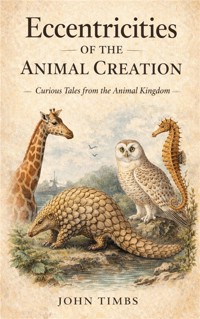
Eccentricities of the Animal Creation
(Illustrated)
By
John Timbs
ILLUSTRATED &PUBLISHED
BY
CHEAPEST BOOKS
www.cheapestboooks.com
Copyright, 2026
KING PENGUINS
ECCENTRICITIES OF THE ANIMAL CREATION
BY JOHN TIMBS.
AUTHOR OF "THINGS NOT GENERALLY KNOWN."
WITH EIGHT ENGRAVINGS.
Introductory
—Curiosities of Zoology
URIOUS creatures of Animal Life have been objects of interest to mankind in all ages and countries; the universality of which may be traced to that feeling which "makes the whole world kin."
It has been remarked with emphatic truth by a popular writer, that "we have in the Bible and in the engraven and pictorial records the earliest evidence of the attention paid to Natural History in general. The 'navy of Tarshish' contributed to the wisdom of him who not only 'spake of the trees from the cedar of Lebanon, even unto the hyssop that springeth out of the wall,' but 'also of beasts, and of fowls, and of creeping things, and of fishes,' [1] to say nothing of numerous other passages showing the progress that zoological knowledge had already made. The Egyptian records bear testimony to a familiarity not only with the forms of a multitude of wild animals, but with their habits and geographical distribution."
The collections of living animals, now popularly known as Zoological Gardens, are of considerable antiquity. We read of such gardens in China as far back as 2,000 years; but they consisted chiefly of some favourite animals, such as stags, fish, and tortoises. The Greeks, under Pericles, introduced peacocks in large numbers from India. The Romans had their elephants; and the first giraffe in Rome, under Cæsar, was as great an event in the history of zoological gardens at its time as the arrival in 1849 of the Hippopotamus was in London. The first zoological garden of which we have any detailed account is that in the reign of the Chinese Emperor, Wen Wang, founded by him about 1150 A.D., and named by him "The Park of Intelligence;" it contained mammalia, birds, fish, and amphibia. The zoological gardens of former times served their masters occasionally as hunting-grounds. This was constantly the case in Persia; and in Germany, so late as 1576, the Emperor Maximilian II. kept such a park for different animals near his castle, Neugebah, in which he frequently chased.
Alexander the Great possessed his zoological gardens. We find from Pliny that Alexander had given orders to the keepers to send all the rare and curious animals which died in the gardens to Aristotle.
Splendid must have been the zoological gardens which the Spaniards found connected with the Palace of Montezuma. The letters of Ferdinand Cortez and other writings of the time, as well as more recently "The History of the Indians," by Antonio Herrera, give most interesting and detailed accounts of the menagerie in Montezuma's park. The buildings belonging to these gardens were all gorgeous, as became the grandeur of the Indian prince; they were supported by pillars, each of which was hewn out of a single piece of some precious stone. Cool, arched galleries led into the different parts of the garden—to the marine and fresh-water basins, containing innumerable water-fowl,—to the birds of prey, falcons and eagles, which latter especially were represented in the greatest variety,—to the crocodiles, alligators, and serpents, some of them belonging to the most venomous species. The halls of a large square building contained the dens of the lions, tigers, leopards, bears, wolves, and other wild animals. Three hundred slaves were employed in the gardens tending the animals, upon which great care was bestowed, and scrupulous attention paid to their cleanliness. To this South American zoological garden of the sixteenth century no other of its time could be compared. [2]
More than six centuries ago, our Plantagenet kings kept in the Tower of London exotic animals for their recreation. The Lion Tower was built here by Henry III., who commenced assembling here a menagerie with three leopards sent to him by the Emperor Frederic II., "in token of his regal shield of arms, wherein those leopards were pictured." Here, in 1255, the Sheriffs built a house "for the King's elephant," brought from France, and the first seen in England. Our early sovereigns had a mews in the Tower as well as a menagerie:—
"Merry Margaret, as Midsomer flowre,
Gentyll as faucon and hawke of the Towre."—Skelton.
In the reign of Charles I., a sort of Royal Menagerie took the place of the deer with which St. James's Park was stocked in the days of Henry VIII, and Queen Elizabeth. Charles II. greatly enlarged and improved the Park; and here he might be seen playing with his dogs and feeding his ducks. The Bird-cage Walk, on the south side of the Park, had in Charles's time the cages of an aviary disposed among the trees. Near the east end of a canal was the Decoy, where water-fowl were kept; and here was Duck Island, with its salaried Governor.
Evelyn, in 1664, went to "the Physique Garden in St. James's," where he first saw "orange trees and other fine trees." He enumerates in the menagerie, "an ornocratylus, or pelican; a fowle between a storke and a swan; a melancholy water-fowl, brought from Astracan by the Russian ambassador; a milk-white raven; two Balearian cranes," one of which, had a wooden leg "made by a soulder:" there were also "deere of severall countries, white, spotted like leopards; antelopes, an elk, red deer, roebucks, staggs, Guinea goates, Arabian sheepe, &c." There were "withy-potts, or nests, for the wild fowle to lay their eggs in, a little above ye surface of ye water."
"25 Feb. 1664. This night I walk'd into St. James his Parke, where I saw many strange creatures, as divers sorts of outlandish deer, Guiny sheep, a white raven, a great parrot, a storke.... Here are very stately walkes set with lime trees on both sides, and a fine pallmall."[3]
Upon the eastern island is the Swiss Cottage of the Ornithological Society, built in 1841 with a grant of 300l. from the Lords of the Treasury: it contains a council-room, keepers' apartments, steam-hatching apparatus; contiguous are feeding-places and decoys; and the aquatic fowl breed on the island, making their own nests among the shrubs and grasses.
The majority of Zoological Gardens now in existence have been founded in this century, with the exception of the Jardin des Plantes, which, although founded in 1626, did not receive its first living animals until the year 1793-1794. Hitherto, it had been a Garden of Plants exclusively.
We shall not be expected to enumerate the great Continental gardens, of which that at Berlin, half an hour's drive beyond the Brandenburg gates, contains the Royal Menagerie; it is open upon the payment of an admission fee, and generally resembles our garden at the Regent's Park. Berlin has also its Zoological Collection in its Museum of Natural History. This collection is one of the richest and most extensive in Europe, especially in the department of Ornithology: it includes the birds collected by Pallas and Wildenow, and the fishes of Bloch. The best specimens are those from Mexico, the Red Sea, and the Cape. The whole is exceedingly well arranged, and named for the convenience of students. Still, our Zoological Collection in the British Museum (to be hereafter removed to South Kensington) is allowed to be the finest in Europe.
The Zoological Society of London was instituted in 1826, and occupies now about seventeen acres of gardens in the Regent's Park. Among the earliest tenants of the Menagerie were a pair of emues from New Holland; two Arctic bears and a Russian bear; a herd of kangaroos; Cuban mastiffs and Thibet watch-dogs; two llamas from Peru; a splendid collection of eagles, falcons, and owls; a pair of beavers; cranes, spoonbills, and storks; zebras and Indian cows; Esquimaux dogs; armadilloes; and a collection of monkeys. To the menagerie have since been added an immense number of species of Mammalia and Birds; in 1849, a collection of Reptiles; and in 1853, a collection of Fish, Mollusca, Zoophytes, and other Aquatic Animals. In 1830, the menagerie collected by George IV. at Sandpit-gate, Windsor, was removed to the Society's Gardens; and 1834 the last of the Tower Menagerie was received here. It is now the finest public Vivarium in Europe.
The following are some of the more remarkable animals which the Society have possessed, or are now in the menagerie:—
Antelopes, the great family of, finely represented. The beautiful Elands were bequeathed by the late Earl of Derby, and have bred freely since their arrival in 1851. The Leucoryx is the first of her race born out of Africa. Ant-eater. Giant, brought to England from Brazil in 1853, was exhibited in Broad-street, St. Giles's, until purchased by the Zoological Society for 200l. Apteryx, or Kiwi bird, from New Zealand; the first living specimen brought to England of this rare bird. The Fish-house, built of iron and glass, in 1853, consisting of a series of glass tanks, in which fish spawn, zoophytes produce young, and algæ luxuriate; crustacea and mollusca live successfully, and ascidian polypes are illustrated, together with sea anemones, jelly-fishes, and star-fishes, rare shell-fishes, &c.: a new world of animal life is here seen as in the depths of the ocean, with masses of rock, sand, gravel, corallines, sea-weed, and sea-water; the animals are in a state of natural restlessness, now quiescent, now eating and being eaten. Aurochs, or European Bisons: a pair presented by the Emperor of Russia, in 1847, from the forest of Bialowitzca: the male died in 1848, the female in 1849, from pleuro-pneumonia. Bears: the collection is one of the largest ever made. Elephants: including an Indian elephant calf and its mother. In 1847 died here the great Indian elephant Jack, having been in the gardens sixteen years. Adjoining the stable is a tank of water, of a depth nearly equal to the height of a full-grown elephant. In 1851 the Society possessed a herd of four elephants, besides a hippopotamus, a rhinoceros, and both species of tapir; being the largest collection of pachydermata ever exhibited in Europe. Giraffes: four received in 1836 cost the Society upwards of 2,300l., including 1,000l. for steamboat passage: the female produced six male fawns here between 1840 and 1851. Hippopotamus, a young male (the first living specimen seen in England), received from Egypt in May, 1850, when ten months old, seven feet long, and six and a-half feet in girth; also a female hippopotamus, received 1854. Humming-birds: Mr. Gould's matchless collection of 2,000 examples was exhibited here in 1851 and 1852. Iguanas, two from Cuba and Carthagena, closely resembling, in everything but size, the fossil Iguanodon. The Lions number generally from eight to ten, including a pair of cubs born in the gardens in 1853. Orang-utan and Chimpanzee: the purchase-money of the latter sometimes exceeds 300l. The orang "Darby," brought from Borneo in 1851, is the finest yet seen in Europe, very intelligent, and docile as a child. Parrot-houses: they sometimes contain from sixty to seventy species. Rapacious Birds: so extensive a series of eagles and vultures has never yet been seen at one view. TheReptile-house was fitted up in 1849; the creatures are placed in large plate-glass cases: here are pythons and a rattle-snake, with a young one born here; here is also a case of the tree-frogs of Europe: a yellow snake from Jamaica has produced eight young in the gardens. Cobra de Capello, from India: in 1852, a keeper in the gardens was killed by the bite of this serpent. A large Boa in 1850 swallowed a blanket, and disgorged it in thirty-three days. A one-horned Rhinoceros, of continental India, was obtained in 1834, when it was about four years old, and weighed 26 cwt.; it died in 1850: it was replaced by a female, about five years old. Satin Bower-Birds, from Sydney: a pair have built here a bower, or breeding-place. Tapir of the Old World, from Mount Ophir; the nearest existing form the Paleotherium. Tigers: a pair of magnificent specimens, presented by the Guicoway of Baroda in 1851; a pair of clouded tigers, 1854. The Wapiti Deer breeds every year in the Menagerie.
The animals in the Gardens, although reduced in number, are more valuable and interesting than when their number was higher. The mission of the Society's head-keeper, to collect rare animals for the Menagerie, has been very profitable. The additional houses from time to time, are very expensive: the new monkey house, fittings, and work cost 4,842l.; and in 1864, the sum of 6,604l. was laid out in permanent additions to the establishment.
Very rare, and consequently expensive, animals are generally purchased. Thus, the first Rhinoceros cost 1,000l.; the four Giraffes, 700l., and their carriage an additional 700l. The Elephant and calf were bought in 1851 for 500l.; and the Hippopotamus, although a gift, was not brought home and housed at less than 1,000l.—a sum which he more than realised in the famous Exhibition season, when the receipts were 10,000l. above the previous year. The Lion Albert was purchased for 140l.; a tiger, in 1852, for 200l. The value of some of the smaller birds will appear, however, more startling: thus, the pair of black-necked Swans were purchased for 80l.; a pair of crowned Pigeons and two Maleos, 60l.; a pair of Victoria Pigeons, 35l.; four Mandarin Ducks, 70l. Most of these rare birds (now in the great aviary) came from the Knowsley collection, at the sale of which, in 1851, purchases were made to the extent of 985l. It would be impossible from these prices, however, to judge of the present value of the animals. Take the Rhinoceros, for example: the first specimen cost 1,000l.; the second, quite as fine a brute, only 350l. Lions range again from 40l. to 180l., and Tigers from 40l. to 200l. The ignorance displayed by some persons as to the value of well-known objects is something marvellous. —A sea-captain demanded 600l. for a pair of Pythons, and at last took 40l.! An American offered the Society a Grisly Bear for 2,000l., to be delivered in the United States; and, more laughable still, a moribund Walrus, which had been fed for nine weeks on salt pork and meal, was offered for the trifling sum of 700l.!
There is a strange notion that the Zoological Society has proposed a large reward for a "Tortoiseshell Tom-cat," and one was accordingly offered to the Society for 250l.! But male Tortoiseshell Cats may be had in many quarters. [4]
The Surrey Zoological Gardens were established in 1831. Thither Cross removed his menagerie from the King's Mews, where it had been transferred from Exeter Change. At Walworth a glazed circular building, 100 feet in diameter, was built for the cages of the carnivorous animals (Lions, Tigers, Leopards, &c.); and other houses for Mammalia, Birds, &c. Here, in 1834, was first exhibited a young Indian one-horned Rhinoceros, for which Cross paid 800l. It was the only specimen brought to England for twenty years. In 1836 were added three Giraffes, one fifteen feet high. The menagerie was dispersed in 1856. The menagerie at Exeter Change was a poor collection, though the admission-charge was, at one period, half-a-crown!
The collections of animals exhibited at fairs have added little to Zoological information; but we may mention that Wombwell, one of the most noted of the showfolk, bought a pair of the first Boa Constrictors imported into England: for these he paid 75l., and in three weeks realised considerably more than that sum by their exhibition. At the time of his death, in 1850, Wombwell was possessed of three huge menageries, the cost of maintaining which averaged at least 35l. per day; and he used to estimate that, from mortality and disease, he had lost, from first to last, from 12,000l. to 15,000l.
Our object in the following succession of sketches of the habits and eccentricities of the more striking animals, and their principal claims upon our attention, is to present, in narrative, their leading characteristics, and thus to secure a willing audience from old and young.
Footnotes
[1] 1 Kings iv. 10.
[2] "Athenæum."
[3] Journal of Mr. E. Browne, son of Sir Thomas Browne.
[4] In April, 1842, Mr. Batty's collection of animals was sold by auction, when the undermentioned animals brought—Large red-faced Monkey (clever), 1l. 10s.; fine Coatimondi, 1l. 4s.; Mandril (the only one in England), 1l. 17s.; pair of Java Hares, 1l. 9s.; a Puma, 14l.; handsome Senegal Lioness, 9l.; a Hyæna, 7l.; splendid Barbary Lioness, 24l.; handsome Bengal Tigress, 90l.; brown Bear, 6l.; the largest Polar Bear in Europe, 37l.; pair of Esquimaux Sledge-Dogs, 3l. 7s.; pair of Golden Pheasants, 3l. 10s.; a blue-and-buff Macaw (clever talker), 2l. 10s.; a horned Owl, from North America, 3l. 10s.; a magnificent Barbary Lion, trained for performance, 105 guineas; a Lioness, similarly trained, 90 guineas; handsome Senegal performing Leopard, 34 guineas; two others, 50 guineas; Ursine Sloth, 12 guineas; Indian Buffalo, 10 guineas; sagacious male Elephant, trained for theatrical performances, 350 guineas. The above is stated to have been the first sale of the kind by public auction in this country.
The Rhinoceros In England
HE intellectual helps to the study of zoology are nowhere more strikingly evident than in the finest collection of pachyderms (thick-skinned animals) in the world, now possessed by our Zoological Society. Here we have a pair of Indian Elephants, a pair of African Elephants, a pair of Hippopotami, a pair of Indian Rhinoceroses, and an African or two-horned Rhinoceros.
The specimens of the Rhinoceros which have been exhibited in Europe since the revival of literature have been few and far between. The first was of the one-horned species, sent from India to Emmanuel. King of Portugal, in the year 1513. The Sovereign made a present of it to the Pope; but the animal being seized during its passage with a fit of fury, occasioned the loss of the vessel in which it was transported. A second Rhinoceros was brought to England in 1685; a third was exhibited over almost the whole of Europe in 1739; and a fourth, a female, in 1741. A fifth specimen arrived at Versailles in 1771, and it died in 1793, at the age of about twenty-six years. The sixth was a very young Rhinoceros, which died in this country in the year 1800. The seventh, a young specimen, was in the possession of Mr. Cross, at Exeter Change, about 1814; and an eighth specimen was living about the same time in the Garden of Plants at Paris. In 1834 Mr. Cross received at the Surrey Gardens, from the Birman empire, a Rhinoceros, a year and a-half old, as already stated at page 21. In 1851 the Zoological Society purchased a full-grown female Rhinoceros; and in 1864 they received a male Rhinoceros from Calcutta. All these specimens were from India, and one-horned; so that the two-horned Rhinoceros had not been brought to England until the arrival of an African Rhinoceros, two-horned, in September, 1868. [5]
The ancient history of the Rhinoceros is interesting, but intricate. It seems to be mentioned in several passages of the Scriptures, in most of which the animal or animals intended to be designated was or were the Rhinoceros unicornis, or Great Asiatic one-horned Rhinoceros. M. Lesson expresses a decided opinion to this effect: indeed, the description in Job (chap. xxxix.) would almost forbid the conclusion that any animal was in the writer's mind except one of surpassing bulk and indomitable strength. The impotence of man is finely contrasted with the might of the Rhinoceros in this description, which would be overcharged if it applied to the less powerful animals alluded to in the previous passages.
It has also been doubted whether accounts of the Indian Wild Ass, given by Ctesias, were not highly coloured and exaggerated descriptions of this genus; and whether the Indian Ass of Aristotle was not a Rhinoceros.
Agatharchides describes the one-horned Rhinoceros by name, and speaks of its ripping up the belly of the Elephant. This is, probably, the earliest occurrence of the name Rhinoceros. The Rhinoceros which figured in the celebrated pomps of Ptolemy Philadelphus was an Ethiopian, and seems to have marched last in the procession of wild animals, probably on account of its superior rarity, and immediately after the Cameleopard.
Dion Cassius speaks of the Rhinoceros killed in the circus with a Hippopotamus in the show given by Augustus to celebrate his victory over Cleopatra; he says that the Hippopotamus and this animal were then first seen and killed at Rome. The Rhinoceros then slain is thought to have been African, and two-horned.
The Rhinoceros clearly described by Strabo, as seen by him, was one-horned. That noticed by Pausanias as "the Bull of Ethiopia," was two-horned, and he describes the relative position of the horns.
Wood, in his "Zoography," gives an engraving of the coin of Domitian (small Roman brass), on the reverse of which is the distinct form of a two-horned Rhinoceros: its exhibition to the Roman people, probably of the very animal represented on the coin, is particularly described in one of the epigrams attributed to Martial, who lived in the reigns of Titus and Domitian. By the description of the epigram it appears that a combat between a Rhinoceros and a Bear was intended, but that it was very difficult to irritate the more unwieldy animal so as to make him display his usual ferocity; at length, however, he tossed the bear from his double horn, with as much facility as a bull tosses to the sky the bundles placed for the purpose of enraging him. Thus far the coin and the epigram perfectly agree as to the existence of the double horn; but, unfortunately, commentators and antiquaries were not to be convinced that a Rhinoceros could have more than one horn, and have at once displayed their sagacity and incredulity in their explanations on the subject.
Two, at least, of the two-horned Rhinoceroses were shown at Rome in the reign of Domitian. The Emperors Antoninus, Heliogabalus, and Gordian also exhibited Rhinoceroses. Cosmas speaks expressly of the Ethiopian Rhinoceros as having two horns, and of its power of moving them.
The tractability of the Asiatic Rhinoceros has been confirmed by observers in the native country of the animal. Bishop Heber saw at Lucknow five or six very large Rhinoceroses, of which he found that prints and drawings had given him a very imperfect conception. They were more bulky animals, and of a darker colour than the Bishop supposed; though the latter difference might be occasioned by oiling the skin. The folds of their skin also surpassed all which the Bishop had expected. Those at Lucknow were quiet and gentle animals, except that one of them had a feud with horses. They had sometimes howdahs, or chaise-like seats, on their backs, and were once fastened in a carriage, but only as an experiment, which was not followed up. The Bishop, however, subsequently saw a Rhinoceros (the present of Lord Amherst to the Guicwar), which was so tamed as to be ridden by a Mohout quite as patiently as an elephant.
No two-horned Rhinoceros seems to have been brought alive to Europe in modern times. Indeed, up to a comparatively late period, their form was known only by the horns which were preserved in museums; nor did voyagers give any sufficient details to impart any clear idea of the form of the animal. The rude figure given by Aldrovandus, in 1639, leaves no doubt that, wretched as it is, it must have been taken from a two-horned Rhinoceros.
Dr. Parsons endeavoured to show that the one-horned Rhinoceros always belonged to Asia, and the two-horned Rhinoceros to Africa; but there are two-horned Rhinoceroses in Asia, as well as in Africa. Flacourt saw one in the Bay of Soldaque, near the Cape of Good Hope, at a distance. Kolbe and others always considered the Rhinoceros of the Cape as two-horned; but Colonel Gordon seems to be the first who entirely detailed the species with any exactness. Sparrman described the Cape Rhinoceros, though his figure of the animal is stiff and ill-drawn. At this period it was well known that the Cape species was not only distinguished by having two horns from the Indian Rhinoceros then known, but also by an absence of the folds of the skin so remarkable in the latter.
We should here notice the carelessness, to call it by the mildest name, of Bruce, who gave to the world a representation of a two-horned Rhinoceros from Abyssinia, with a strongly folded skin. The truth appears to be that the body of the animal figured by Bruce was copied from that of the one-horned Rhinoceros given by Buffon, to which Bruce added a second horn. Salt proved that the Abyssinian Rhinoceros is two-horned, and that it resembles that of the Cape.
KING THE TWO-HORNED AFRICAN RHINOCEROS.
Sparmann exposes the errors and poetic fancies of Buffon respecting the impenetrable nature of the skin. He ordered one of his Hottentots to make a trial of this with his hassagai on a Rhinoceros which had been shot. Though this weapon was far from being in good order, and had no other sharpness than that which it had received from the forge, the Hottentot, at the distance of five or six paces, not only pierced with it the thick hide of the animal, but buried it half a foot deep in its body.
Mr. Tegetmeier has sufficiently described in the "Field" journal the African Rhinoceros just received at the Zoological Society's menagerie in the Regent's-park, and which has been sketched by Mr. T. W. Wood expressly for the present volume.
It was captured about a year ago in Upper Nubia by the native hunters in the employment of Mr. Casanova, at Kassala; and was sent, by way of Alexandria and Trieste, to Mr. Karl Hagenbeck, of Hamburg, a dealer in wild beasts, who sold it to the Zoological Society.
"This animal is very distinct from its Asiatic congeners; it differs strikingly in the number of horns, as well as in the character of its skin, which is destitute of those large folds, which cause the Indian species to remind the observer of a gigantic 'hog in armour.'
"The arrival of this animal will tend to clear up the confusion that prevails respecting the number of distinct species of African Rhinoceros. Some writers—as Sir W. C. Harris—admit the existence of two species only, the dark and the light, or, as they are termed, the 'white' and the 'black.' Others, as Dr. A. Smith, describe three; some, as the late Mr. Anderssen, write of four; and Mr. Chapman even speaks of a fifth species or hybrid.
"Three of these species are very distinctly defined—the ordinary dark animal, the Rhinoceros bicornis, in which the posterior horn is much shorter than the anterior; the Rhinoceros keitloa, in which the two horns are of equal length; and the 'white' species, Rhinoceros simus. The last, among other characters, is, according to Dr. Smith, distinguished by the square character of the upper lip, which is not prehensile.
"The young animal now (October, 1868) in the Zoological Society's garden, appears to belong to the first-named species, the largest specimens of which when full grown reach a height of 6ft., and a length of 13ft., the tail not included. Its present height is 3-1/2ft., and length about 6ft. In general appearance the mature animal resembles a gigantic pig, the limbs being brought under the body. The feet are most singular in form, being very distinctly three-toed, and the remarkable trefoil-like spoors that they make in the soil render the animal easy to track. The horns vary greatly in length in different animals; the first not unfrequently reaches a length of 2ft., the second being considerably shorter. These appendages differ very much from ordinary horns; they are, in fact, more of the nature of agglutinated hair, being attached to the skin only, and consequently they separate from the skull when the latter is preserved.
"The head is not remarkable for comeliness, especially in the mature animal, in which the skin of the face is deeply wrinkled, and the small eyes are surrounded with many folds. The upper lip is elongated, and is used in gathering the food. The adult animals are described by Sir W. C. Harris, in his 'Illustrations of the Game Animals of South Africa,' as 'swinish, cross-grained, ill-tempered, wallowing brutes.'"
Mr. Burchell, during his travels in Africa, shot nine Rhinoceroses, besides a smaller one. The latter he presented to the British Museum. The animal is, however, becoming every day more and more scarce in Southern Africa; indeed, it is rarely to be met with in some parts. It appears that, in one day, two Rhinoceroses were shot by Speelman, the faithful Hottentot who attended Mr. Burchell. He fired off his gun but twice, and each time he killed a Rhinoceros! The animal's sense of hearing is very quick: should he be disturbed, he sometimes becomes furious, and pursues his enemy; and then, if once he gets sight of the hunter, it is scarcely possible for him to escape, unless he possesses extraordinary coolness and presence of mind. Yet, if he will quietly wait till the enraged animal makes a run at him, and will then spring suddenly on one side, to let it pass, he may gain time enough for reloading his gun before the Rhinoceros gets sight of him again, which, fortunately, owing to its imperfection of sight, it does slowly and with difficulty.
Speelman, in shooting a large male Rhinoceros, used bullets cast with an admixture of tin, to render them harder. They were flattened and beat out of shape by striking against the bones, but those which were found lodged in the fleshy parts had preserved their proper form, a fact which shows how little the hardness of the creature's hide corresponds with the vulgar opinion of its being impenetrable to a musket-ball. Mr. Burchell found this Rhinoceros nearly cut up. On each side of the carcase the Hottentots had made a fire to warm themselves; and round a third fire were assembled at least twenty-four Bushmen, most of whom were employed the whole night long in broiling, eating, and talking. Their appetite seemed insatiable, for no sooner had they broiled and eaten one slice of meat than they turned to the carcase and cut another. The meat was excellent, and had much the taste of beef. "The tongue," says Mr. Burchell, "is a dainty treat, even for an epicure." The hide is cut into strips, three feet or more in length, rounded to the thickness of a man's finger, and tapering to the top. This is called a shambok, and is universally used in the colony of the Cape for a horsewhip, and is much more durable than the whips of European manufacture. The natural food of the Rhinoceros, till the animal fled before the colonists, was a pale, bushy shrub, called the Rhinoceros-bush, which burns while green as freely as the driest fuel, so as readily to make a roadside fire.
The horn of the Rhinoceros, single or double, has its special history by the way of popular tradition. From the earliest times this horn has been supposed to possess preservative virtues and mysterious properties—to be capable of curing diseases and discovering the presence of poison; and in all countries where the Rhinoceros exists, but especially in the East, such is still the opinion respecting it. In the details of the first voyage of the English to India, in 1591, we find Rhinoceros' horns monopolised by the native sovereigns on account of their reputed virtues in detecting the presence of poison.
Thunberg observes, in his "Journey into Caffraria," that "the horns of the Rhinoceros were kept by some people, both in town and country, not only as rarities, but also as useful in diseases, and for the purpose of detecting poisons. As to the former of these intentions, the fine shavings were supposed to cure convulsions and spasms in children. With respect to the latter, it was generally believed that goblets made of these horns would discover a poisonous draught that was poured into them, by making the liquor ferment till it ran quite out of the goblet. Of these horns goblets are made, which are set in gold and silver and presented to kings, persons of distinction, and particular friends, or else sold at a high price, sometimes at the rate of fifty rix-dollars each." Thunberg adds:—"When I tried these horns, both wrought and unwrought, both old and young horns, with several sorts of poison, weak as well as strong, I observed not the least motion or effervescence; but when a solution of corrosive sublimate or other similar substance was poured into one of these horns, there arose only a few bubbles, produced by the air which had been enclosed in the pores of the horn and which were now disengaged."
Rankin (in his "Wars and Sports") states this mode of using it: a small quantity of water is put into the concave part of the root, then hold it with the point downwards and stir the water with the point of an iron nail till it is discoloured, when the patient is to drink it.
Footnote
[5] The conveyance of a Rhinoceros over sea is a labour of some risk. In 1814 a full-grown specimen on his voyage from Calcutta to this country became so furious that he was fastened down to the ship's deck, with part of a chain-cable round his neck; and even then he succeeded in destroying a portion of the vessel, till, a heavy storm coming on, the Rhinoceros was thrown overboard to prevent the serious consequence of his getting loose in the ship.
Stories ofMermaids
ESS than half a century ago, a pretended Mermaid was one of the sights of a London season; to see which credulous persons rushed to pay half-crowns and shillings with a readiness which seemed to rebuke the record—that the existence of a Mermaid is an exploded fallacy of two centuries since.
Mermaids have had a legendary existence from very early ages, for the Sirens of the ancients evidently belonged to the same remarkable family. Shakspeare uses the term Mermaid as synonymous with Siren:—
"O train me not, sweet Mermaid, with thy note,
To drown me in thy sister's flood of tears;
Sing, Syren, for thyself."—Comedy of Errors, iii. 2.
Elsewhere, Shakspeare's use of the term is more applicable to the Siren than to the common idea of a Mermaid; as in the "Midsummer Night's Dream," where the "Mermaid on a dolphin's back" could not easily have been so placed. A Merman, the male of this imaginary species, is mentioned by Taylor, the water-poet:—
"A thing turmoyling in the sea we spide,
Like to a Meareman."
An old writer has this ingenious illustration:—"Mermaids, in Homer, were witches, and their songs enchantments;" which reminds us of the invitation in Haydn's Mermaid's Song:—
"Come with me, and we will go
Where the rocks of coral grow."
The orthodox Mermaid is half woman, half fish; and the fishy half is sometimes depicted as doubly tailed, such as we see in the heraldry of France and Germany; and in the Basle edition of Ptolemy's "Geography," dated 1540, a double-tailed Mermaid figures in one of the plates. In the arms of the Fishmongers' Company of London, the supporters are "a Merman and maid, first, armed, the latter with a mirror in the left hand, proper." From this heraldic employment, the Mermaid became a popular tavern sign; and there was an old dance called the Mermaid.
Sir Thomas Browne refers to the picture of Mermaids, though he does not admit their existence. They "are conceived to answer the shape of the ancient Sirens that attempted upon Ulysses; which, notwithstanding, were of another description, containing no fishy composure, but made up of man and bird." Sir Thomas is inclined to refer the Mermaid to Dagon, the tutelary deity of the Philistines, which, according to the common opinion, had a human female bust and a fish-like termination; though the details of this fish idolatry are entirely conjectural.
Leyden, the Scottish poet, has left a charming ballad, entitled "The Mermaid," the scene of which is laid at Corrievreckin: the opening of this poem Sir Walter Scott praised as exhibiting a power of numbers which, for mere melody of sound, has seldom been excelled in English poetry:—
"On Jura's heath how sweetly swell
The murmurs of the mountain bee!
How softly mourns the writhèd shell
Of Jura's shore its parent sea!
"But softer floating, o'er the deep,
The Mermaid's sweet sea-soothing lay,
That charmed the dancing waves to sleep
Before the bark of Colonsay."
The ballad thus describes the wooing of the gallant chieftain:—
"Proud swells her heart! she deems at last
To lure him with her silver tongue,
And, as the shelving rocks she passed,
She raised her voice, and sweetly sung.
"In softer, sweeter strains she sung.
Slow gliding o'er the moonlight bay.
When light to land the chieftain sprung.
To hail the maid of Colonsay.
"O sad the Mermaid's gay notes fell,
And sadly sink remote at sea!
sadly mourns the writhèd shell
Of Jura's shore, its parent sea.
"And ever as the year returns,
The charm-bound sailors know the day;
For sadly still the Mermaid mourns
The lovely chief of Colonsay."
Curious evidences of the existence of Mermaids are to be found in ancient authors. Pliny says that "the ambassadors to Augustine from Gaul declared that sea-women were often seen in their neighbourhood." Solinus and Aulus Gellius also speak of their existence. Some stories are, however, past credence. It is related in the "Histoire d'Angleterre" that, in the year 1187, a Merman was "fished up" off the coast of Suffolk, and kept for six months. It was like a man, but wanted speech, and at length escaped into the sea! In 1430, in the great tempests which destroyed the dykes in Holland, some women at Edam, in West Friesland, saw a Mermaid who had been driven by the waters into the meadows, which were overflowed. "They took it, dressed it in female attire, and taught it to spin!" It was taken to Haarlem, where it lived some years! Then we read of Ceylonese fishermen, in 1560, catching, at one draught, seven Mermen and Mermaids, which were dissected! In 1531, a Mermaid, caught in the Baltic, was sent to Sigismund, King of Poland, with whom she lived three days, and was seen by the whole court!
In Merollo's "Voyage to Congo," in 1682, Mermaids are said to be plentiful all along the river Zaire. In the "Aberdeen Almanack" for 1688, it is predicted that "near the place where the famous Dee payeth his tribute to the German Ocean," on the 1st, 13th, and 29th of May, and other specified times, curious observers may "undoubtedly see a pretty company of Mar Maids," and likewise hear their melodious voices. In another part of Scotland, about the same time, Brand, in his "Description of Orkney and Shetland," tells us that two fishermen drew up with a hook a Mermaid, "having face, arm, breast, shoulders, &c., of a woman, and long hair hanging down the neck, but the nether part, from below the waist, hidden in the water." One of the fishermen stabbed her with a knife, and she was seen no more! The evidence went thus:—Brand was told by a lady and gentleman, who were told by a baillie to whom the fishing-boat belonged, who was told by the fishers! Valentyn describes a Mermaid he saw in 1714, on his voyage from Batavia to Europe, "sitting on the surface of the water," &c. In 1758, a Mermaid is said to have been exhibited at the fair of St. Germain, in France. It was about two feet long, and sported about in a vessel of water. It was fed with bread and fish. It was a female, with negro features.
In 1775 appeared a very circumstantial account of a Mermaid which was captured in the Grecian Archipelago in the preceding year, and exhibited in London. The account is ludicrously minute, and it ends with: "It is said to have an enchanting voice, which it never exerts except before a storm." This imposture was craftily made up out of the skin of the angle shark. In Mr. Morgan's "Tour to Milford Haven in the year 1795," appears an equally circumstantial account of a Mermaid, said to have been seen by one Henry Reynolds, a farmer, of Ren-y-hold, in the parish of Castlemartin, in 1782. It resembled a youth of sixteen or eighteen years of age, with a very white skin: it was bathing. The evidence is very roundabout, so that there were abundant means for converting some peculiar kind of fish into a Merman, without imputing intentional dishonesty to any one. "Something akin to this kind of evidence is observable in the account of a Mermaid seen in Caithness in 1809, which attracted much attention in England as well as in Scotland, and induced the Philosophical Society of Glasgow to investigate the matter. The Editor of a newspaper, who inserted the statement, had been told by a gentleman, who had been shown a letter by Sir John Sinclair, who had obtained it from Mr. Innes, to whom it had been written by Miss Mackay, who had heard the story from the persons (two servant girls and a boy) who had seen the strange animal in the water." (Chambers's "Book of Days.")
Then we read of a so-called Mermaid, shown in the year 1794 at No. 7, Broad-court, Bow-street. Covent-garden, said to have been taken in the North Seas by Captain Foster. It was of the usual description.
Much evidence comes from Scotland. Thus, in the year 1797, a schoolmaster of Thurso affirmed that he had seen a Mermaid, apparently in the act of combing her hair with her fingers! Twelve years afterwards, several persons observed near the same place a like appearance. Dr. Chisholm, in his "Essay on Malignant Fever in the West Indies," in 1801, relates that, in the year 1797, happening to be at Governor Van Battenburg's plantation, in Berbice, "the conversation turned on a singular animal which had been repeatedly seen in Berbice river, and some smaller rivers. This animal is the famous Mermaid, hitherto considered as a mere creature of the imagination. It is called by the Indians méné, mamma, or mother of the waters. The description given of it by the Governor is as follows:—'The upper portion resembles the human figure, the head smaller in proportion, sometimes bare, but oftener covered with a copious quantity of long black hair. The shoulders are broad, and the breasts large and well-formed. The lower portion resembles the tail of a fish, is of great dimensions, the tail forked, and not unlike that of the dolphin, as it is usually represented. The colour of the skin is either black or tawny.' The animal is held in veneration by the Indians, who imagine that killing it would be attended with calamitous consequences. It is from this circumstance that none of these animals have been shot, and consequently examined but at a distance. They have been generally observed in a sitting posture in the water, none of the lower extremity being seen until they are disturbed, when, by plunging, the tail agitates the water to a considerable distance round. They have been always seen employed in smoothing their hair, and have thus been frequently taken for Indian women bathing." In 1811, a young man, named John M'Isaac, of Corphine, in Kintyre, in Scotland, made oath, on examination at Campbell-town, that he saw, on the 13th of October in the above year, on a rock on the sea-coast, an animal which generally corresponded with the form of the Mermaid—the upper half human shape, the other brindled or reddish grey, apparently covered with scales; the extremity of the tail greenish red; head covered with long hair, at times put back on both sides of the head. This statement was attested by the minister of Campbell-town and the Chamberlain of Mull.
In August, 1812, Mr. Toupin, of Exmouth, in a sailing excursion, and when about a mile south-east of Exmouth Bar, heard a sound like that of the Æolian harp; and saw, at about one hundred yards distance, a creature, which was regarded as a Mermaid. The head, from the crown to the chin, formed a long oval, and the face seemed to resemble that of the seal, though with more agreeable features. The presumed hair, the arms, and the hand, with four fingers connected by a membrane, are then described, and the tail with polished scales. The entire height of the animal was from five feet to five and a-half feet. In 1819, a creature approached the coast of Ireland. It was about the size of a child ten years of age, with prominent bosom, long dark hair, and dark eyes. It was shot at, when it plunged into the sea with a loud scream.
SEAL AND MERMAID.
In reviewing these stories of Mermaids, it may be remarked that there is always a fish in each tale—either a living fish of a peculiar kind, which a fanciful person thinks to bear some resemblance in the upper part to a human being, or a fish which becomes marvellous in the progress of its description from mouth to mouth. It is commonly thought the seals may often have been mistaken for Mermaids. But, of all the animals of the whale tribe that which approaches the nearest in form to man is, undoubtedly, the Dugong, which, when its head and breast are raised above the water, and its pectoral fins, resembling hands, are visible, might easily be taken by superstitious seamen for a semi-human being, or a Mermaid. Of this deception a remarkable instance occurred in 1826. The skeleton of a Mermaid, as it was called, was brought to Portsmouth, which had been shot in the vicinity of the Island of Mombass. This was submitted to the members of the Philosophical Society, when it proved to be the skeleton of a Dugong. To those who came to the examination with preconceived notions of a fabulous Mermaid, it presented, as it lay on the lecture-table, a singular appearance. It was about six feet long; the lower portion, with its broad tail-like extremity, suggested the idea of a powerful fish-like termination, whilst the fore-legs presented to the unskilful eye a resemblance to the bones of a small female arm; the cranium, however, had a brutal form, which could never have borne the lineaments of "the human face divine."
The Mermaid has been traced to the Manatee as well as to the Dugong: the former is an aquatic animal, externally resembling a whale, and named from its flipper, resembling the human hand, manus. Again, the mammæ (teats) of the Manatees and Dugongs are pectoral; and this conformation, joined to the adroit use of their flippers (whose five fingers can easily be distinguished through the inverting membranes, four of them being terminated by nails) in progression, nursing their young, &c., have caused them, when seen at a distance with the anterior part of their body out of the water, to be taken for some creature approaching to human shape so nearly (especially as their middle is thick set with hair, giving somewhat of the effect of human hair or a beard), that there can be little doubt that not a few of the tales of Mermen and Mermaids have had their origin with these animals as well as with seals and walruses. Thus the Portuguese and Spaniards give the Manatee a denomination which signifies Woman-fish; and the Dutch call the Dugong Baardanetjee, or Little-bearded Man. A very little imagination and a memory for only the marvellous portion of the appearance sufficed, doubtless, to complete the metamorphosis of this half woman or man, half fish, into a Siren, a Mermaid, or a Merman; and the wild recital of the voyager was treasured up by writers who, as Cuvier well observes, have displayed more learning than judgment.
The comb and the toilet-glass have already been incidentally mentioned as accessories in these Mermaid stories; and these, with the origin of the creature. Sir George Head thus ingeniously attempts to explain:—"The resemblance of the seal, or sea-calf, to the calf consists only in the voice, and the voice of the calf is certainly not dissimilar to that of a man. But the claws of the seal, as well as the hand, are like a lady's back-hair comb; wherefore, altogether, supposing the resplendence of sea-water streaming down its polished neck, on a sunshiny day, the substitute for a looking-glass, we arrive at once at the fabulous history of the marine maiden or Mermaid, and the appendages of her toilet."
The progress of zoological science has long since destroyed the belief in the existence of the Mermaid. If its upper structure be human, with lungs resembling our own, how could such a creature live and breathe at the bottom of the sea, where it is stated to be? for our most expert divers are unable to stay under water more than half an hour. Suppose it to be of the cetaceous class, it could only remain under the water two or three minutes together without rising to the surface to take breath; and if this were the case with the Mermaid, would it not be oftener seen?
Half a century has scarcely elapsed since a manufactured




