


20,40 €
Mehr erfahren.
- Herausgeber: John Wiley & Sons
- Kategorie: Geisteswissenschaft
- Sprache: Englisch
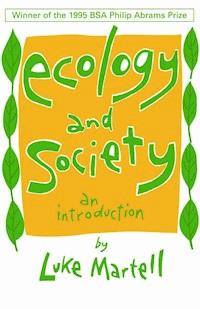
This book introduces green ideas to students of the social sciences, showing how society affects and is affected by nature and assessing the future of the green movement.
Sie lesen das E-Book in den Legimi-Apps auf:
Seitenzahl: 469
Veröffentlichungsjahr: 2013
Ähnliche




















ECOLOGY AND SOCIETY
An Introduction
LUKE MARTELL
Polity Press
Copyright © Luke Martell 1994
The right of Luke Martell to be identified as author of this work has been asserted in accordance with the Copyright, Designs and Patents Act 1988.
First published in 1994 by Polity Press in association with Blackwell Publishers Ltd.
Reprinted 1995
Transferred to digital print 2003
Editorial office:
Polity Press
65 Bridge Street
Cambridge CB2 1UR, UK
Marketing and production:
Blackwell Publishers Ltd
108 Cowley Road
Oxford OX4 1JF, UK
All rights reserved. Except for the quotation of short passages for the purposes of criticism and review, no part of this publication may be reproduced, stored in a retrieval system, or transmitted, in any form or by any means, electronic, mechanical, photocopying, recording or otherwise, without the prior permission of the publisher.
Except in the United States of America, this book is sold subject to the condition that it shall not, by way of trade or otherwise, be lent, re-sold, hired out, or otherwise circulated without the publisher’s prior consent in any form of binding or cover other than that in which it is published and without a similar condition including this condition being imposed on the subsequent purchaser.
ISBN 978-0-7456-6772-0 (Multi-user ebook)
A CIP catalogue record for this book is available from the British Library.
Typeset in 10½ on 12 pt Times by TecSet Ltd, Wallington, Surrey
Printed and bound in Great Britain by
Marston Lindsay Ross International Ltd,
Oxfordshire
Contents
List of Figures and Tables
Introduction
1 Ecology and Industrialism
2 The Sustainable Society
3 Green Philosophy
4 The Green Movement
5 Ecology and Political Theory
6 Rethinking Relations between Society and Nature
7 The Future of Environmentalism
Acknowledgements
Notes
References
Index
List of Figures and Tables
Figure 1.1The Limits to Growth computer runs
Table 2.1Centralism and co-ordination in resolving environmental problems
Figure 3.1Value in and obligations to the non-human environment
Table 4.1Explanations for social movements
Figure 4.1Smelser’s six conditions for collective action
Table 4.2New and old social movements.
Table 5.1Solutions to environmental problems: technical or structural
Table 5.2The sustainable society: reasons for proposing it
Table 5.3Environmental ethics: reasons for caring about the environment
Figure 6.1The basic ecological complex: four factors
Figure 6.2The ecological complex: extended version
Figure 6.3Stratification of knowledge in realist philosophy of social science
Introduction
This book introduces green ideas to students of society and politics. Its aim is to outline green ideas at an accessible level to people new or relatively new to them. It is also assertive. It does not just review what other people have said but proposes arguments of its own. It suggests that ecology brings insights to social and political thinking. The latter has to pay attention to non-humans and the way society affects nature and is affected by it. The book also shows how social and political thinking can bring something to ecology, helping to solve environmental problems and explaining environmentalism and environment–society relations.
I think my arguments break with problematic elements in both social analysis and green thinking. Social and political thinkers are poorly attuned to non-humans and the implications of natural environmental factors for the social and political world they study. Many radical greens are one-sided and uncritical in their thinking and make problematic, simple-minded and poorly thought-out assumptions and assertions. My arguments deal with problems in both camps. They do not fit neatly into any school of thought, and I feel they take thinking about the politics and sociology of ecology forward.
Why did I write the book?
There are a number of preoccupations which brought me to an interest in ecology. I found that concerns I had with non-statist socialist politics, animal rights and social constructionist social analysis were raised in the political ecology literature. Worries about the environment and an interest in ecology itself were only part of the reason for deciding to look in more depth at ecological debates.
(1) New social movement politics One concern I had was to find new ideas of socialism which break with statism and economic self-interest yet retain the philosophical principles and political economy of socialism. The new social movements, of which the green movement is one, seemed to offer useful sources for such ideas. Green arguments for decentralized communal living in combination with non-market and non-capitalist institutions and in pursuit of general rather than sectional interests seemed to capture the non-authoritarian non-sectional politics I was looking for. They did this without throwing out the socialist principles and political economy I felt to be of continuing necessity both generally and especially for the resolution of environmental problems. New social movements and the green movement offered exciting ideas about decentralization and civil society politics and addressed oppressions in society other than just class oppression and values other than economic self-interest.
(2) Environmental problems Then there were, of course, environmental problems themselves. Ozone depletion, global warming, acid rain, vehicle fumes, waste disposal and other forms of pollution of land, water and the air seemed to me to be major and escalating problems with serious consequences.1 Human-made CFC (chlorofluorocarbon) gases – used in fridges, among other things – deplete the protective ozone layer in the earth’s atmosphere allowing through radiation from the sun which causes skin cancer and damages food production. Annual holes in the ozone layer over the poles are already thought to let high doses of ultraviolet radiation through to population centres there. Scientists and politicians in Canada, for example, warn parents to keep their children out of the sun at the most affected times of the year. Global warming, it is suspected, is caused by emissions of CO2 (carbon dioxide) from burning coal, gas and petroleum products (as well as by other gases). CO2 may act as an insulator, leading to rising temperatures, damaging food production and causing rising sea levels which threaten low-lying population centres. Things are made worse by the destruction of forests. Not only does this cause soil erosion and undermine local human and animal life but it removes trees which absorb CO2 through photosynthesis and which when burnt, as they often are, produce more CO2.
Acid rain results from the impurities released when fossil fuels are burnt in power stations, boilers and vehicles. Released into the atmosphere, these come down in rain to damage trees and buildings and poison lakes, and are a health hazard. Acid rain often falls in countries other than those in which it is produced – pointing up the global nature of the problem and the necessity for an international perspective in solving it, something to which I will return in chapter 2. Various vehicle exhaust emissions can affect brain development in children and contribute to global warming, smogs and cancer. Some are poisonous and cause further adverse health effects. Fertilizers, weedkillers, pesticides, disease control agents and food additives which are used in food production go through the food chain and affect plants, animals and humans. Domestic and industrial waste, effluents and sewage are often toxic and contaminate drinking water. Sometimes they are dumped at sea or in poor countries who will take payments to accept them, or they are burned, producing CO2. Chemicals introduced into the water supply include aluminium which is linked to dementia and nitrate which can cause blood disease in babies. None of this is even to mention problems of resource depletion and over-population which are discussed in chapter 1.
As I will explain, many of these are global problems, caused by industrial and technological processes wrapped up in political and economic relations and tied to social lifestyles and cultural value systems. They are linked to industrial processes which can be stopped, slowed, pursued more selectively or replaced with alternatives. Many pollutants, wastes and additives to the food production process can be halted or reduced. Recycling and the minimization of resource use can reduce waste. There are alternatives to CFCs. CO2 emissions can be reduced by using tidal, wind, solar or hydro-electric power, more efficient energy use, discouragement of private vehicle use (through, say, a comprehensive public transport infrastructure) and planting rather than cutting down forests. Some (but not all) harmful vehicle emissions can be further reduced by the replacement of pollutants (e.g. lead in petrol) or by the use of catalytic converters (which break down toxic gases) or alternative fuels (e.g. alcohol fuels or electric power). In some areas small advances have been made. Yet governments and capitalists have not shown anything approaching an adequate willingness to tackle these problems or work at possible solutions. Environmental problems, their location in economic, social, political and cultural processes and the need for action by politicians and the business community to solve them was another concern that led me to ecology and to an approach to it that stresses that it is not just a technical or natural science issue but one that is tied up in questions to do with society and politics.
(3) Biology and nature As a sociologist and someone interested in socialist and feminist politics, I have always felt uneasy about the rubbishing by sociologists, socialists and feminists of arguments to do with biology and nature. Sociologists have tended to push out nature because it is perceived to fall outside the remit of the ‘social’ and to threaten their insistence on social explanations for social phenomena.2 Socialists and feminists often reject nature because it is seen to justify class or gender inequalities as ‘natural’, fixed and based in biological traits rather than socially imposed in unequal power relations and open to change. Justifiable as concerns about the evoking of notions of nature and biology may be, it seemed to me that human societies work with natural properties and biological processes, and that these have to come in somewhere to explanations of social life. We are physical creatures with biological characteristics and capacities. The environment outside us, while subject to social transformation, has traits and powers which are the pre-given natural raw material we work with. Issues to do with the environment raise questions about the relevance of natural and biological processes to society and politics that I felt were being pushed out.
(4) Social constructionism and relativism A fourth concern, related to the third was with epistemological and ontologicai issues in sociological theory and the problems of strong anti-naturalist social constructionist and relativist arguments on such issues. Such arguments come up in sociological theory, the philosophy of social science and the sociology of science. But they also arise in the sociology of the environment. Social constructionists and relativists propose that things in the world gain their character from social action rather than independent objective properties, and that our knowledge of them does not have an independent objective basis but is relative to the culture in which it is produced. Yet it seemed to me that in the encounter with ecology and the natural environment social constructionism and relativism have the ideal opportunity to recognize the role of non-social and objective inputs to social life. In ecology more than anywhere else, insights are offered by realist understandings of entities with objective properties independent of, but mediated by, social processes and comprehension. However, as I will discuss, some sociologists of the environment continue to push for strong social constructionism in the face of an external, objective, natural reality.
(5) Animal rights and vegetarianism Arguments in green philosophy tapped into issues that, as a vegetarian, I had debated with myself. I had long felt that sentience (capacity for sensory experience), rather than say intelligence, consciousness or capacity to develop, was the basis on which moral consideration should be extended. This led me to opposition to the suffering and killing of animals and to becoming a vegetarian. In debates about ecology these ideas could be worked through and elaborated. In particular, there is a debate in the philosophy of environmental ethics about the range of entities in the environment to which moral standing should be extended and for what reasons. I felt that moral standing should be extended to animals and that the reason this should be done was because they are sentient creatures.
All five sets of issues came up in the political ecology literature and made me want to look at it more closely. However, writing the book has been a learning process and not all of my initial assumptions have held out. I still think biology and nature should play a role in social explanation, that there are natural limits on, and effects of, social processes which are too much ignored and that environmental ethics should be based on concern for sentient creatures. Yet it will become clear that I am no longer so sympathetic to many of my other initial concerns. I defend in the rest of this book strong state action and global co-ordination over decentralization. Even more unfashionably, I am more worried than I was before about leaving things to the economic and political institutions of civil society. I favour political and socialist strategies for change and collective over private capitalist ownership of the means of production. Much of what I say returns to traditional socialism, the role of socialist political economy, the inadequacy of capitalism and markets and the significance of capitalist class power relations. Before starting work on this book some of these aspects of state action and traditional socialist analysis were things I was trying to get away from. I have found myself less persuaded by elements in green philosophy, green critiques of modernity and green political theory than I expected to be. Some green thinking I have found flawed and dangerous. Some of my initial concerns, in short, have been supported by my work on this book and this is reflected below. Others have been turned upside down the more I thought about green issues.
Radical ecology and other environmentalisms
In discussing environmentalism I deal in particular with one strand in green thinking which is influential in the political ecology literature and has the biggest implications for the social and political world. This is ‘radical ecology’.3 I discuss throughout the book strands in environmental thinking which require, for example, either technological tinkering or fundamental changes in economic structure and value systems or either anthropocentric or eco-centric ethics. It is the most radical strands in which I am especially interested – those that call for structural changes in economic systems, lifestyles and beliefs in the developed world and the extension of intrinsic value, rights and moral standing to entities in the environment beyond just humans or even animals. I will break down environmentalism into different strands as the book goes along and will be dealing with different sorts of environmentalist argument including the more moderate. But I will be using the words green, environmentalist or ecological to apply to radical ecology unless otherwise stated.
My dealing with radical ecology is sympathetic but critical. I sympathize with concern for environmental problems. I share the radical green belief that changes in economic systems, lifestyles and values are needed, rather than just technological adaptation. While I do not think that all entities in the environment are of intrinsic value or inherent moral worth, I do share the radical green belief that we should be concerned about the good of things in the environment other than just humans. I argue in chapter 3 for the intrinsic value and moral standing of animals.
Yet much of the radical ecology literature is one-sided and uncritical.4 Many radical greens buy the whole anti-modernist case – a hostility to consumption, science and Enlightenment philosophies and advocacy of decentralism, holism and eco-centrism – without critical thought. These planks in the theory are just assumed uncritically to be plainly the case. As a result, big flaws in radical ecology are glossed over; I attempt to deal with these. Some radical greens make simple-minded, ill-informed, arrogant and flawed dismissals of parts of the modernist project which are of social and environmental value or, at the very least, not of the uniformly environmentally damaging character they suggest. Material consumption, modern science, Enlightenment ideas, traditional political theory, the state and humanism are examples. On reflection, many things dismissed turn out to be not so socially and environmentally bankrupt as it is assumed.
Greens may perceive that the arguments in this book devote a lot of space to criticizing radical ecology and not enough to environmental problems with the way industrial societies are run. The book does take a lot of time to analyse ecological deficiencies in industrialism and capitalism and the need for traditional perspectives to take on board ecological insights. But if I do spend time on flaws in radical ecology it is because I assume that the fact that there are environmental problems with industrialism is more generally accepted. The strengths and weaknesses of radical ecology are less well known and more glossed over. Criticisms I make of radical ecology should not be taken to suggest a dismissal of it or of the reality of enormous environmental problems. I accept the case for a more ecological approach to social and political thought and action and many fundamental tenets of radical ecology. In the context of ecological sympathy, however, I am concerned to show the problems in radical ecology as well as its strengths. My concern is to show the case for ecology but to make sure that people, in the first flush of their encounter with its ideas, do not get swept away with its strengths and resistant to acknowledging its weaknesses.
Sociology and the environment
This book deals with the meeting of ecology with economic, social and political life in general and is not narrowly sociological at all. From beginning to end it will be of interest to non-sociologists. But it is in part an attempt to explain the relevance of sociology to environmental questions and of ecology to sociology.
Why is sociology relevant to the environment? The environment is frequently seen as a natural-science issue. Environmental problems involve the pollution of the land, sea and air, all things which natural rather than social scientists know about. It is technologies which use up resources and spill out pollutants, again something which is the preserve of the natural scientist or technologist.
Science has a vital role to play in these areas, and scientists have been key actors in identifying environmental problems which now have such a high profile. But scientific and technological developments which affect the environment are driven by economic and social developments and practices. It is the requirements and practices of societies that lead to technological choices and developments and make demands on the environment. Economic and social factors that stand particularly accused in the green literature include the commitment to economic development and growth, levels of consumption and acquisitive and materialistic values – in short our systems of production and consumption and their social and cultural bases. In sum, structures and processes that are central to the expertise of social scientists are as important to environmental problems as those that are of interest to natural scientists.
This is reflected in a distinction made in the green literature. On one hand there are technocratic environmentalists who see environmental problems as resolvable by the ‘technical fix’ within existing economic and social practices (recycling, lead-free petrol, banning CFCs and so on). On the other there are ecologists who see such problems as embedded in economic and social structures and practices and resolvable only by changes at that level (see Dobson 1991: 73–81).
Newby (1991) calls for a reconsideration by sociologists of their attitude to the environment. He argues they should turn their attention to studying environmental problems, showing how they have a distinctive and necessary contribution to make to understanding and resolving them. But in doing so they need to question their assumptions about how they do sociology, taking on board some of the insights and distinctive approach of the ecological perspective.
This leads to what ecology can bring to sociology. In their explanatory thinking sociologists tend to look more at the internal structures and processes of industrial societies and less at natural factors affecting their development, or at the effects of their development on the environment and the reciprocal repercussions of this for society. An ecological perspective can provide a more complete and realistic understanding of social and natural factors involved in social development. In their normative thinking sociologists tend to be concerned with the effect of social structures and processes on humans. Ecology suggests they should also incorporate environmental criteria and non-humans in their interest in the effects of social practices.
Catton and Dunlap (1978) suggest that environmental sociology has received more attention in the USA than other countries. In their survey of the US environmental sociology literature they conclude that most research has been done on social impacts of changing environmental conditions such as resource shortages, pollution or overcrowding. Sociologists have looked at the way these affect lifestyle, psychological well-being, health, values, stratification, conflict, competitiveness and, to some extent, population levels and choice of technology. Some studies, for example, suggest that resource shortages are likely to affect attitudes to nature, levels of inequality, conflict and competitiveness (Catton 1976; Burch 1970). Sociologists have also looked at the social impacts of air pollution (Burch 1976) and of different forms of built as well as natural environment (Michelson 1976).
But this sort of work is scarce and much of it is done by non-sociologists. Catton and Dunlap suggest that sociologists have little to say about the reverse direction of the equation: the social causes of environmental degradation. They do look at attitudes to the environment but other aspects of the social bases of environmental problems – population growth, choice of technology, economic and social systemic factors and cultural values – have been ignored by sociologists.
Catton and Dunlap’s survey was done some time ago and there have been significant developments since then.5 Yet when sociologists talk about the environment they are usually talking about the social environment (as in socialization studies) or the built environment (as in urban studies). They do not often look at the natural environment and it is hard to find natural-environmental questions built into mainstream sociology textbooks or courses. Writing in 1993, 15 years after they carried out the survey just discussed, Dunlap and Catton talk of environmental sociology as a ‘new and still small specialisation that represents a deviation from sociology’s tendency to ignore environmental problems’ (1993:1). Reflecting on their attempt to establish a more ecological approach in sociology they ask ‘Were we at all successful in this endeavour? The answer would seem to be an obvious “no”‘ (p. 9). Not one article on environmental problems, they point out, was published in either of the two main American sociology journals between 1970 and 1990 (p. 19).
Why are sociologists reluctant to get mixed up with the environment? A number of reasons have been put forward. Newby (1991:6) dismisses the possibility that sociologists do not subscribe to environmentalist values. Sociologists are troubled by environmental problems. But the rise of ecology is comparable to that of feminism as a new and re-invigorating influence in the discipline. It elicits sympathy from sociologists but few deeds in their private or professional lives to match their concern. However, this only redescribes the problem. It does not explain how it has come about.
A second possibility is that, while on a personal level sociologists are concerned about the environment, academically and professionally they find the greens difficult to deal with because of their catastrophic rhetoric. Some of the doom and gloom alarmism of contributors like the Club of Rome and green activists alienates academics who prefer a more sober, balanced and cautious rhetoric. More significantly, sociologists find explicitly normative analysis, alarmist or not, difficult to deal with. Value-freedom and objectivity are important parts of sociological training. Normative analysis – making prescriptive proposals about what things should be like rather than analysing how they are – may skate too close to political commitment and value-judgement for some sociologists.6
Cotgrove (1991) places more emphasis on the dominance of Marxism in post-war sociology. The dismissal of the environment as a diversionary middle-class issue irrelevant to the class struggle and the pointing of the green finger at industrialism rather than capitalism has led to the exclusion of environmental questions from sociology.7 If Cotgrove is right, this may go some way towards explaining why the environment has been taken more seriously in the USA, where Marxism has been less influential. It may also help explain the rise of environmental interest in the 1970s and 1980s, a period when Marxist thought went into crisis and decline in the social sciences.
A fourth possible explanation for the apparent inertia of sociologists on environmental issues, again one dismissed by Newby (1991:6), is the ageing research community. Age brings wisdom but also consolidation in fields of expertise and, perhaps, a reluctance to break into new fields or question long-held assumptions. The young are less dedicated to long-held views and allegiances, perhaps more open to finding new interests and less restricted by years of socialization into the appropriate parameters for sociological opinion and research.
A fifth possible argument for sociological inertia on the environment, treated as the most likely by Newby (1991) and Fox (1991), deals with these big assumptions that longstanding sociologists may be reluctant to break with. Their argument is that nature is seen to fall outside the traditional boundaries of sociology and as too politically dangerous. It is part, in fact, of an area that sociology has shunned over the years in order to establish its distinctive identity and its case for a discipline studying the ‘social’ and giving social explanations for it (see Durkheim 1950). Sociologists reject nature because of the protective social exclusivity they have thrown around their discipline. Furthermore they associate ‘nature’ with politically controversial arguments which justify racism and sexism on genetic and biological grounds. Newby (1991) and Fox (1991) argue that this heritage has made it difficult in the sociological community to advocate what Benton (1991) calls a ‘return of the repressed’, of biological and natural factors to sociological explanation. It is what makes sociologists leave the environment, against their better judgement, to natural scientists.
If this explanation is correct, then it suggests that sociological encounters with the environment will entail basic archaeological work on the assumptions of the discipline, bringing nature into the sociological remit, taking risks with the specificity of the discipline and skirting with dangerous political issues around biology and nature.8
The structure of the book
The book divides into four parts. The first two chapters look at the relationship between practices in industrial societies and the environment. Chapters 3 and 4 look at environmentalist ideology – its philosophical underpinnings and reasons for its increasing popularity in the 1970s and 1980s. Chapters 5 and 6 look at the implications of ecological ideas for traditional political and social theory. Finally, chapter 7 looks at forms of agency and transition most suitable for furthering green change in the future.
The first chapter looks at limitations of analyses of industrial societies which do not investigate society–natural environment links. It shows how the development of industrial societies is affected by the natural environment and has effects on it. It argues that an adequate understanding of such societies needs to incorporate society–environment relations but that at present sociologists fail to do this. It also looks at a classic ecological analysis of industrialism – the Club of Rome’s Limits to Growth report – and at criticisms of it. Many of the arguments put forward in the report and in critical appraisals of it are typical of those that come up in debates around environmentalism, and a detailed discussion of them here sets us up well for the rest of the book. The chapter concludes with a discussion of the relationship between development and environmental problems in less developed countries.
The book then goes on, in the second chapter, to look at forms of society and politics more appropriate to sustainability. It argues that capitalist and decentralist solutions proposed by economic liberals and greens respectively are not adequate. The chapter argues for state intervention and global co-ordination to solve environmental problems. I deal here also with changes in levels of consumption and forms of technological adaptation which may help halt ecological degradation.
Chapters 3 and 4 go on to examine environmentalism itself. Chapter 3 looks at the philosophical bases underlying environmental concern. It rejects anthropocentrism, the focusing of moral concern exclusively on humans. It argues that animals should also be of moral concern because of their capacity to experience fulfilment or pain. It argues against deep ecologists’ holistic and eco-centric arguments which say that ecosystems, species, plants and other living and non-living things in the environment beyond humans and animals have an intrinsic value and moral standing. I argue that such things are not of intrinsic value or moral worth in themselves because they do not have the sentient capacity to experience life. However they do have an extrinsic value and worth for humans and animals. This chapter goes beyond anthropocentrism in extending moral concern to animals but not as far as eco-centrism because it limits the range of entities in the environment which are said to be of intrinsic value.
Chapter 4 moves on from green philosophy to reasons for the rise in popularity of environmental concern in the post-war period. It discusses political, action, cultural and social explanations for the increasing popularity of the green movement, discussing phenomena such as corporatist closure, electoral systems, the role of environmental groups and science, post-materialism and the new middle class. It concludes that explanations of green concern have to be grounded in material economic and social experience and, in particular, in the environmental problems to which environmentalism is a reaction and which it identifies in its discourse.
Chapters 5 and 6 look at the implications of ecology for traditional political and social theory. Chapter 5 looks at the relationship of ecology to traditional perspectives in political theory such as conservatism, liberalism, socialism and feminism. It argues that ecology cannot, as many greens boast, be a new political theory which renders redundant these old perspectives. Such a claim is one-sidedly arrogant and ignorant of the strengths of the traditions. They are still needed to help work out how to solve environmental problems and to make judgements on non-environmental issues. On the other hand, ecology is not, as some sceptics suggest, open to any political conclusions. Some tenets in traditional political theories, laissez-faire for example, are not adequate to the resolution of environmental problems while others, socialist political economy for instance, are. Ecology cannot make a political theory, but it does imply some political conclusions rather than others.
Chapter 6 moves from normative political theory to explanatory social theory. It picks up from some of the concerns of chapter 1 in looking at how relations between society and nature could be conceptualized in a more ecological way than they have been in the past. It discusses the ‘ecological complex’ of American rural sociologists Dunlap and Catton. This incorporates many of the factors involved in society–nature relations. It argues that ‘social constructionism’ and ‘realism’ add an understanding of the relative weighting, balance and the nature of the interaction between these factors. Social constructionism, it suggests, gives too much power to human social processes ethically, epistemologically and ontologically. Ethically, environmentalism is not just concerned about the good of humans but also about entities in the environment itself. Epistemologically, environmental concern is not just something we socially manufacture but something which works up, through social mediation, from the objectivity of environmental problems themselves. Ontologically, the environment is not just an artefact of human mental constructs but of the fitting of objective environmental realities into conceptual constructs. Realism, on the other hand, has a scheme within which both social mediation and the objective properties and causal powers of the environment come through in ethical, epistemological and ontological analyses. It retains, however, an awareness of social mediation which is absent in environmentalist fetishizations of nature.
Finally, chapter 7 looks at forms of agency and transition most suitable for pursuing green change in the future. It looks at political strategies such as education, parliamentary and party politics, green consumerism and green communes. It examines possible social agents like the new middle class, the working class, the unemployed and other new social movements and it looks at the idea that there can be a universal agency for green change. I argue that education and consciousness-changing need to be embedded in material experience. Lifestyle politics (green consumerism and green communes, for instance) is useful. However, because green change has to come through political global co-ordination, parliamentary and party politics must be the main plank of green political strategies. All the agents discussed provide possible social bases for green change but I argue for political rather than social agency. The green movement needs to pursue change through political actors, mobilizing as many social agents behind it as are willing, rather than tying the project to specific social groups. Green parties and the green movement, meanwhile, need to form alliances with socialist and social democratic parties in order to gain power and support the political programmes which are best suited to solving environmental problems.
There are a number of main arguments which run through all this: (1) the advocacy of a more realist or naturalistic (and less strongly social constructionist) sociology which does not focus solely on human society or reduce environmental problems or concern to social functions but sees them as embedded in objective natural-environmental processes and problems; (2) a critique of capitalist and green decentralist solutions to environmental problems and an advocacy of state intervention, global co-ordination, political agency and socialist programmes; (3) a critique of both anthropocentric and eco-centric ethical philosophy in favour of a sentient basis for ethical concern; and (4) an assessment of traditional political theory as revolutionized by, but necessary for, green political thought.
Guide to further reading
At the end of each chapter in this book I give some personal proposed next steps for reading for those who wish to follow up issues raised in that chapter. More detailed and in-depth references on specific issues raised are given in the text and endnotes.
There are a number of books which provide accessible introductions to green ideas. Tim O’Riordan’s Environmentalism (1981) provides a very thorough introduction to the phenomenon written by a leading respected figure in the field. General sociological discussons of environmentalism include Stephen Cotgrove’s Catastrophe or Cornucopia (1982) and, more recently, Yearly’s stimulating The Green Case (1991). The latter includes very useful discussions of the socio-economic and technical bases of environmental problems and of environmental problems in less developed countries. In addition it gives an example of a sociological approach to explaining the rise of environmentalism. From the radical green view there is a proliferation of books presenting green ideas. Andrew Dobson’s Green Political Thought (1990) is one readable example, and Dobson is the editor of a very useful collection of nicely explained and well-presented extracts from green thinkers, The Green Reader (1991). Michael Allaby’s Thinking Green (1989) is another useful reader. Jonathon Porritt’s Seeing Green (1986) presents green ideas in a racy heartfelt way. These and other green books do not always back up their arguments strongly enough and are prone to lack adequate consideration of alternative views and possible criticisms of their own perspective, but Dobson in particular does provide a clear and readable introduction to green ideas. For well-written, carefully researched and illuminating empirical studies by environmental historians see Cronon (1983 and 1990), Worster (1986 and 1988) and Crosby (1986).
1
Ecology and Industrialism
One of the obvious areas of sociology in which environmental concerns ought to be considered is the sociology of industrialism, the rationality and practices of industrialism being a repeated object of attention in discussions about the environment. The sociology of industrialism is a longstanding and well-researched field (see Kumar 1978 and Badham 1984) in which environmental issues are highly relevant yet largely excluded. This chapter discusses how such issues are relevant to this area of sociology. It looks at the limits of the sociology of industrialism and at an environmentalist analysis of industrialism. This sets us up for the rest of the book, which is concerned with the interaction between the study of society and politics and the ideas of environmentalism.
Lesen Sie weiter in der vollständigen Ausgabe!
Lesen Sie weiter in der vollständigen Ausgabe!
Lesen Sie weiter in der vollständigen Ausgabe!
Lesen Sie weiter in der vollständigen Ausgabe!
Lesen Sie weiter in der vollständigen Ausgabe!
Lesen Sie weiter in der vollständigen Ausgabe!
Lesen Sie weiter in der vollständigen Ausgabe!
Lesen Sie weiter in der vollständigen Ausgabe!
Lesen Sie weiter in der vollständigen Ausgabe!
Lesen Sie weiter in der vollständigen Ausgabe!




