


3,49 €
Mehr erfahren.
- Herausgeber: Open Book Publishers
- Kategorie: Fachliteratur
- Sprache: Englisch
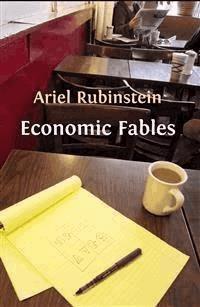
Part memoir, part crash-course in economic theory, this deeply engaging book by one of the world's foremost economists looks at economic ideas through a personal lens. Together with an introduction to some of the central concepts in modern economic thought, Ariel Rubinstein offers some powerful and entertaining reflections on his childhood, family and career. In doing so, he challenges many of the central tenets of game theory, and sheds light on the role economics can play in society at large. The book is as thought-provoking for seasoned economists as it is enlightening for newcomers to the field.Sylvia Nasar, author of A Beautiful Mind, describes Economics Fables as a "wonderfully inviting introduction to game theory, rich in personalities, history and sense of place. Ariel Rubinstein is not only a brilliant theorist with a knack for lucid exposition, but a gifted storyteller. Students will find the ideas surprisingly accessible. Aspiring scholars, wondering whether a life of the mind is worth pursuing, will find his personal journey of intellectual discovery thrilling."
Das E-Book können Sie in Legimi-Apps oder einer beliebigen App lesen, die das folgende Format unterstützen:
Veröffentlichungsjahr: 2012
Ähnliche



















ECONOMIC FABLES
Ariel Rubinstein is Professor of Economics at Tel Aviv University and New York University. His books include Bargaining and Markets (with Martin J. Osborne, 1990), A Course in Game Theory (with Martin J. Osborne, 1994), Modeling Bounded Rationality (1998), Economics and Language (2000) and Lecture Notes in Microeconomic Theory: The Economic Agent (2005). He is a member of the Israel Academy of Sciences, a Foreign Honorary Member of the American Academy of Arts and Sciences and a Fellow and former President of the Econometric Society.
Economic Fables
Ariel Rubinstein
Open Book Publishers CIC Ltd.,40 Devonshire Road, Cambridge, CB1 2BL, United Kingdom http://www.openbookpublishers.com
© 2012 Ariel RubinsteinSome rights are reserved. This book is made available under the Creative Commons Attribution-NonCommercial-NoDerivs 3.0 Unported License. This license allows for copying any part of the work for personal and non-commercial use, providing author attribution is clearly stated. Details of allowances and restrictions are available at:
http://www.openbookpublishers.com
As with all Open Book Publishers titles, digital material and resources associated with this volume are available from our website:
http://www.openbookpublishers.com/product/136
ISBN Paperback: 978-1-906924-77-5ISBN Digital (pdf): 978-1-906924-79-9ISBN Digital ebook (epub version): 978-1-906924-80-5ISBN Digital ebook (mobi version): 978-1-906924-81-2
This book was first published in Hebrew as Agadot Hakalkala (Kineret: Zemorah-Bitan, 2009).
Cover Image © Ariel Rubinstein
Typesetting by www.bookgenie.in
All paper used by Open Book Publishers is SFI (Sustainable Forestry Initiative), PEFC (Programme for the Endorsement of Forest Certification Schemes) and Forest Stewardship Council (FSC) certified.
Printed in the United Kingdom and United States by Lightning Source for Open Book Publishers
Contents
Chapter 0: Introduction
Chapter 1: Rational, Irrational
Chapter 2: Game Theory: A Beautiful Mind
Chapter 3: The Jungle Tale and the Market Tale
Chapter 4: Economics, Pragmatics and Seven Traps
Chapter 5: (Sort of) Economic Policy
Bibliographical Notes
Acknowledgements
Online ResourcesThe author has created a website containing interactive questions and games relating to various chapters in this book which is available to readers at:http://www.openbookpublishers.com/exsites/136
It is recommended (though definitely not required) that you visit the site before reading the book.
0. Introduction
Bookkeeping with my father
I sat that evening in the back of the auditorium where the first Senate session of the academic year was being held. The table on the stage was draped with a green tablecloth that reached the floor. Seated at the table were the patricians of the university, which is situated north of an almost dry riverbed. A microphone was connected to scratchy loudspeakers. The national flag and the university flag drooped side by side in their stands.
The meeting opened with a string quartet whose young members had been asked to perform a classical piece to reflect the aesthetic taste of the Senate members, devotees of culture at a prestigious university. The rector then welcomed the participants, wishing them a year of fruitful research, a year of striving for excellence, and a year of peace. He noted a number of new programs at the university, “all of which express our pursuit of excellence.” He went on to list the promotions, prizes and honors that members of the Senate had received during the summer months. Each honoree, when his name was mentioned, stood and made a slight bow, to the bored applause of a few of the more enthusiastic members of the Senate.
The Senate then discussed the appointment of members of a committee set up to examine ways of promoting excellence at the university. One by one, the candidates were introduced and their unique qualities cited. There was an occasional burst of erudite chuckling in the auditorium when one of the presenters strayed from his written recitation and inserted a witty remark in the chronicle of the candidate’s meritorious deeds. The restraint disappeared when it came to female candidates. The first to leave the meeting had already begun to sneak out. And since to reach the exit they had to cross in front of the stage, they had no choice but to render an apologetic nod toward the self-satisfied rector.
Until that evening, I had never spoken before the Senate. During the meetings, I actually thought that I had a lot to say. I sometimes felt compelled to jot down an outline of profound, daring and provocative points I would raise in response to the outrageous statements, full of pathos, being voiced there. I would write these things on the back of an ATM receipt I found in my wallet, in handwriting that even I had trouble deciphering. But at the end of the meeting, I would toss the note in the trashcan outside the auditorium. And if for some reason the note remained in my pocket and I found it the next day, I would praise myself for being smart enough to refrain from publicly expressing the ridiculous things I had wanted so much to say just the day before.
Lesen Sie weiter in der vollständigen Ausgabe!
Lesen Sie weiter in der vollständigen Ausgabe!
Lesen Sie weiter in der vollständigen Ausgabe!
Lesen Sie weiter in der vollständigen Ausgabe!
Lesen Sie weiter in der vollständigen Ausgabe!
Lesen Sie weiter in der vollständigen Ausgabe!
Lesen Sie weiter in der vollständigen Ausgabe!
Lesen Sie weiter in der vollständigen Ausgabe!
Lesen Sie weiter in der vollständigen Ausgabe!




