


22,99 €
Mehr erfahren.
- Herausgeber: John Wiley & Sons
- Kategorie: Fachliteratur
- Sprache: Englisch
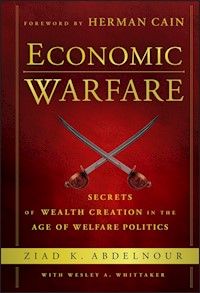
New insights for investors and business people looking to create wealth in the turbulent post-crisis world In a no holds barred expose of the 2008 financial meltdown from the inside, Ziad K. Abdelnour argues that the political and financial elites have done nothing to fix the structural problems and instead have worsened the situation. By creating more market bubbles, they are actually waging a war on the most productive members of society. For investors, business people, and entrepreneurs that need to navigate the troubled geopolitical waters of the post-crisis world, Abdelnour offers several solutions, including looking at the world anew and understanding that the federal government's primary objective is to promote the creation of an environment conducive to the creation of wealth not job creation, not bailouts, not subsidies, not expansion of the federal bureaucracy, and not providing lifetime support to those who choose not to take advantage of the innumerable opportunities that exist in this nation for them to create a better, more productive life for themselves. Written for investors that need to navigate the troubled geopolitical waters of the post-crisis world · Offers "out of the box" investment tactics and strategies to outsmart the system · Describes political and business solutions that anyone can engage in to restore freedom and prosperity The author is President and CEO of Blackhawk Partners, Inc., a private family office that has two major lines of business, private equity investments and advisory services, and physical commodities trading Compelling and persuasive, Economic Warfare reveals that wealth can be created in the new, post-crisis world, but investors need to understand that the rules of the game have changed.
Sie lesen das E-Book in den Legimi-Apps auf:
Seitenzahl: 395
Veröffentlichungsjahr: 2011
Ähnliche



















Table of Contents
Cover
Title page
Copyright page
Epigraph
Dedication
Foreword by Marc Rowan
Foreword by Herman Cain
Prologue
Preface
Acknowledgments
Introduction
Prelude
Chapter 1 The War against the Rich
Just Who Am I?
The Richest Man I Know
Why You Are Not Rich
Who Are the Rich and Why Should You Care about Them?
The Millionaire down the Street
The Socialist Fallacy
Can We Separate Economics and Politics?
Chapter 2 Report from the Battlefield
An Inside Job
Running the Red Lights
The Joker of Gotham City
A Crisis of Consciousness
Chapter 3 The Seeds of Our Destruction
“. . . In Order to Form a More Perfect Union . . .”
The Man Who Would Be King
The Hamilton Legacy
Bringing Hamilton’s Monster to Life
Springtime for the Progressives
And What about the Fed?
Chapter 4 The Face of the Enemy
Who Are the Progressives
Hubris by Any Other Name
The Bankers
Politics as Usual
Outside Influences
Chapter 5 Warfare, Not Terrorism
The Return of Civil Disobedience
Is Free-Market Capitalism Dead?
Chapter 6 Battle Plans
What Should America’s Global Role Be?
My General Philosophy for Creating “Wealth”
The Specifics of the Wealth Creation Process
Risks, Rewards, and Opportunities
Basic Tenets of My Investment and Wealth Creation Philosophy
The Future of Commodities
How to Best Protect Your Assets in the Turbulent Times Ahead
Invest in Yourself
Chapter 7 Strategic Goals
About the Private Equity Business Today
The Five Myths of Private Equity
My Personal View on the Biggest Challenges in the Private Equity Industry Today
Which Industries Are Particularly Interesting for “Distressed Investing”?
What Sectors of the Private Equity Markets Are We Focusing on Today?
Private Equity Deal Killers
How Do You Turn Billion-Dollar Ideas into Billion-Dollar Businesses?
Chapter 8 Tactical Maneuvers
Real Estate
Alternative Investment Vehicles
What Part Did Hedge Funds Play in the Crash of 2008?
Bottom Line on Hedge Funds
Private Equity Roll-ups
Skin in the Game
Chapter 9 Global Fronts
Targets of Opportunity
Rules of Engagement
Brazil
Russia
India
China
The Middle East and North Africa (MENA)
Chapter 10 The Tenth Amendment
If It’s Broke, Fix It!
How Is It Working for You?
Repeal Bad Legislation
Cutting Overhead
Toward an Equitable Tax System
End the Fed
Regime Change
Conclusion
About the Authors
Index
Copyright © 2012 by Ziad A. Abdelnour. All rights reserved.
Published by John Wiley & Sons, Inc., Hoboken, New Jersey.
Published simultaneously in Canada.
No part of this publication may be reproduced, stored in a retrieval system, or transmitted in any form or by any means, electronic, mechanical, photocopying, recording, scanning, or otherwise, except as permitted under Section 107 or 108 of the 1976 United States Copyright Act, without either the prior written permission of the Publisher, or authorization through payment of the appropriate per-copy fee to the Copyright Clearance Center, Inc., 222 Rosewood Drive, Danvers, MA 01923, (978) 750-8400, fax (978) 646-8600, or on the Web at www.copyright.com. Requests to the Publisher for permission should be addressed to the Permissions Department, John Wiley & Sons, Inc., 111 River Street, Hoboken, NJ 07030, (201) 748-6011, fax (201) 748-6008, or online at http://www.wiley.com/go/permissions.
Limit of Liability/Disclaimer of Warranty: While the publisher and author have used their best efforts in preparing this book, they make no representations or warranties with respect to the accuracy or completeness of the contents of this book and specifically disclaim any implied warranties of merchantability or fitness for a particular purpose. No warranty may be created or extended by sales representatives or written sales materials. The advice and strategies contained herein may not be suitable for your situation. You should consult with a professional where appropriate. Neither the publisher nor author shall be liable for any loss of profit or any other commercial damages, including but not limited to special, incidental, consequential, or other damages.
For general information on our other products and services or for technical support, please contact our Customer Care Department within the United States at (800) 762-2974, outside the United States at (317) 572-3993 or fax (317) 572-4002.
Wiley also publishes its books in a variety of electronic formats. Some content that appears in print may not be available in electronic books. For more information about Wiley products, visit our web site at www.wiley.com.
Library of Congress Cataloging-in-Publication Data:
Abdelnour, Ziad.
Economic warfare : secrets of wealth creation in the age of welfare politics / Ziad K. Abdelnour with Wesley A. Whittaker. – 1
p. cm.
Includes index.
ISBN 978-1-118-15012-2 (cloth); ISBN 978-1-118-19765-3 (ebk); ISBN 978-1-118-197646 (ebk); ISBN 978-1-118-197639 (ebk)
1. Investments–United States. 2. Global Financial Crisis, 2008–2009. 3. Wealth–United States. 4. United States–Economic policy. I. Whittaker, Wesley A. II. Title.
HG4910.A615 2011
330.973–dc23
2011032044
A return to first principles in a republic is sometimes caused by the simple virtues of one man. His good example has such an influence that the good men strive to imitate him, and the wicked are ashamed to lead a life so contrary to his example.
—Niccolo Machiavelli (1469–1527)
This book is dedicated to Nadia, Karl, and Mark.
I couldn’t have been luckier than having such a family.
Foreword
by Marc Rowan
While the financial crisis or Great Recession that began in 2008 dominates our financial consciousness, it strikes me that the events that began in December 2010 and will no doubt continue through the U.S. presidential election in November 2012 may have more of a lasting impact on our collective economic futures.
In December 2010, a mere day apart, rioters in London protesting cutbacks in tuition aid attacked Prince Charles’s car carrying the prince and Camilla, while the next day in Tunisia economic frustration set off a protest that has engulfed the Middle East and has already resulted in three Arab leaders being deposed.
In the rest of the world, protesters have since taken to the streets in Greece, Iceland, France, Portugal, Ireland, Israel, China, and elsewhere to vent their rage at aid cutbacks, food inflation, lack of economic opportunity, financial destruction caused by major banks, changes in retirement age, or government austerity generally. At their core, these protests are about economic policies or at least changes to existing economic policies.
The year 2011 represents a turning point where governments around the globe are finally realizing that the promises that have been made to voters may no longer be able to be kept and that an endgame of sorts has been reached where spending in excess of current receipts may no longer be able to be financed.1
Certainly, the weaker and more heavily indebted economies around the globe are already experiencing a painful austerity and an abrupt change to the social contract. On a projected basis the total of all of the promises made by politicians of all parties to a generation of voters now exceeds that which many countries can afford to pay without the destruction of their underlying economies.
It wasn’t until the riots in the United Kingdom in the summer of 2011 that I began to warm to the title of Ziad Abdelnour’s latest book, Economic Warfare: Secrets of Wealth Creation in the Age of Welfare Politics.
I found myself trying to explain to my teenagers why the streets in London near where we lived for a few years had erupted in riots and anticipating their next question as to whether or not the same thing could happen in the United States. I explained that, while there was certainly an element of hooliganism underlying the riots, the United Kingdom was going through a difficult economic period and that this was particularly difficult given significantly less economic and social mobility throughout the population in the United Kingdom when compared to the United States. It sounded so mundane when I said it that it took a while for my teenagers to appreciate that we were having an important conversation about the true nature of America and how we differ from much of the rest of the world. America does not have a tradition of class warfare.
The vast majority of Americans have never believed the concept that one must fail in order for another to succeed. In fact, we have celebrated those who have achieved economic success in our society whether in industry, Internet, medicine, fashion, music, finance, or otherwise, and our system allows for significant economic and social mobility based on ability and hard work. Further, what happens in America ultimately influences what happens in the rest of the world.
America is still roughly a quarter of worldwide gross domestic product and is a beacon for the young and ambitious around the world. Was I wrong? Is our great tradition at risk? As the United States confronts its economic challenges, the debate is no longer about if we have a problem but rather how we address the prospect of future deficits and government spending given the ripening of the entitlement promises made by a generation of politicians from both sides of the aisle to the past 80 years of voters.
With partisan politics at high decibel levels in advance of the presidential election in 2012 and a fundamental debate taking place between the “reduce the size of the problem” crowd and the “raise more money from those who can afford it” crowd, I worry that certain fundamental premises of our collective economic success are in jeopardy. Sometimes when the debate is all around us, it takes an outside observer to make us appreciate how unique our economic model really is and how privileged we are to live in a country where we have economic liberty.
Ziad Abdelnour comes from a successful and prominent merchant family in Lebanon and relocated to the United States in 1982 as that country was going through a civil war. Ziad is an accomplished businessman in his own right and has become a trusted adviser and confidant to many successful families throughout the United States and the world. Ziad’s passion in defense of the case for individual economic liberty in the United States is exceeded only by his contempt for those who have abused the system to the detriment of all.
Conservatives and liberals will each find much to agree and disagree with in Ziad’s book. Economic Warfare is a timely addition to the debate and a good history lesson in advance of the next election of how our modern financial institutions came to be and how far from the founding fathers’ intent many of them have strayed.
Ziad argues forcefully that much of what we have come to accept as “progressive” ideas needs to be looked at through a different prism—a prism of economic liberty. Traditionally, we are taught to judge the success of a society by how it deals with the least able, most vulnerable members of that society. Economic Warfare challenges us by asking whether it is not the reverse that should be true. Shouldn’t we judge a society by how they treat the most successful? Do we vilify, tax, expropriate, and condemn those who have succeeded, or do we celebrate economic success as the engine that propels our society toward greater collective well-being?
Economic Warfare’s timing could not be better. As protesters fill the streets in cities around the globe, and as the United States begins to frame the solutions to our deficit issues, Ziad takes a refreshing look at the U.S. system and offers some strong advice as to how not to destroy that which has made our country unique.
Many of Ziad’s concerns are reminiscent of a recent quote from the Financial Times:
Given the concentration of savings among a minority of the population, soaking the rich will be easier than slashing entitlement spending. But paralysis in Washington and the Fed’s dual mandate could result in a third path equally devastating to the wealthy: allowing inflation to debase private savings while easing indebtedness. Either way, America’s outnumbered savers may succumb to the tyranny of the majority.
I have known Ziad for more than 25 years since our time together at the Wharton School and as a coworker at Drexel Burnham Lambert in the mid-1980s. I truly admire Ziad’s passion as well as his ability to see events and trends for what they are. Ziad’s outsider’s perspective on what is great about the United States and what we are in danger of losing is timely and informative and an important contribution to the debate going forward.
Marc Rowan
Partner
Apollo Global Management, LLC
www.agm.com/Home.aspx
August 2011
Note
1. John Maudlin, Endgame (Hoboken, NJ: John Wiley & Sons, 2011).
Foreword
by Herman Cain
The natural state of our economy is prosperity. Freedom guarantees that. The only force capable of undermining it is government. Economic Warfare tells that truth.
We are stuck in the worst economic recovery since the Great Depression. It is so bad that at this point into the recovery, we are 8 million jobs short of being tied for last place with the previous worst recovery. Our gross domestic product is a trillion dollars or two short of where it should be, and a multiple of that in terms of wealth has dissipated. Our economic weakness has now become a top national security threat.
Did the market fail or did the government fail? If so, how? I have made my business career by asking the right questions. Are we working on the right problem? Do we have the right people? Are we close enough to the action? Ziad Abdelnour’s strong suit is to ask questions until the bottom line is found. He has surrounded himself with outstanding people and an unmatched network. You can’t get closer to the action than he, particularly at the level at which he operates.
Abdelnour lays out in detail that even the most well-meaning government policies have unintended consequences that have harmed the economy. If government policies were held accountable the way private businesses are, the scoreboard would say government is failing to help people.
This book makes one of the strongest cases yet that to have a warm heart, one must have clear eyes. Abdelnour sees clearly, and his vantage point is the front line of battle over the future of our country.
There are few problems in the world that economic prosperity cannot help solve. Yet the engines of that prosperity are under fierce attack. The forces that seek power over others have gained the upper hand against those that seek freedom. By harming wealth creation, they cause even more strain on society. Historically, this is nothing new. State domination over its subjects has roots that connect statism, totalitarianism, communism, and socialism to more modern-day variants of liberalism and progressivism. It is a constant fight and we must win.
As Abdelnour illustrates, the forces against wealth creation accelerate when the Progressives are in power. They forced Obamacare and “Dodd Frankenstein Financial Deform” upon us. Unlike the elected representatives who voted for those bills, Abdelnour actually read them and offers us his chilling dose of reality.
It speaks volumes of the resiliency of the American economy to still be standing after the onslaught of economic policy termites eating away at the foundation for so long. We now face a perfect storm, but we will fight back. One only needs to observe the unrest across the world to imagine what life will become here if we don’t get our economy turned around soon.
But how? It is not as though people lose sight of simple principles in a complex society as much as it is a Progressive tactic to confuse people. For example, if the world consists of two farmers, and one is paid government benefits, who pays? Exactly. The other farmer pays. Redistribution is a negative-sum game, and people understand that.
In another example, if one farmer raises cattle and the other grows vegetables, they are both better off through voluntary trade. Making other people better off is the only way to satisfy your needs. Is it bad that some people make many people better off? Do you deserve a special attack by government if you make millions of people better off? Voluntary exchange is a positive-sum game.
Abdelnour uses great skill explaining how a complex global economy still boils down to a few of those core principles. He reveals tactics used by the Progressives to confuse people through victimhood, race baiting, and preying on the compassionate sensibilities of most, and shows how to defeat them.
A great example is Abdelnour’s investigation that uncovers the true underpinnings of the mortgage crisis. It may be the best diagnosis you will read. As you will see, it was a colossal failure of government, the remedy of which is not to bail out and subsidize failure.
But trade and wealth creation is not all upside. It is failure, too. Failure is a necessary component to growth and success. Babe Ruth struck out 1,330 times but also hit 714 home runs. We need to let failing entities fail. Only then will successful people turn these enterprises back into wealth-creating vehicles again. “Too big to fail” is a concept that perpetuates failure and saps vitality from the rest of the wealth creators to do so.
Wealth creation is not a business suited to those whose skill set consists of voting “present.” It requires decision making, risk taking, hard information, discipline, insight, and intelligence. Abdelnour is generous with his valuable insight. He offers a range of opportunities so that each of us can find our role in the battle. He shares lessons for all of us to absorb.
In true nonpolitician, business-like fashion that makes me proud, Abdelnour focuses on commonsense solutions. We have gotten away from the 10th Amendment. The only equal outcome for all that can be achieved by the federal government is misery for all. It is not that people shouldn’t be helped. It is that in most cases, it is not the role of the federal government to do so.
He gives us a penetrating look at each major department and shows how a return to the 10th Amendment will reduce spending, limit the scope of government so freedom expands, and ultimately how that will lead to improved wealth creation, which is the only demonstrated way to help people. We know what happens when Progressives have full control and no opposing forces to draw battle lines. It’s called Detroit.
Join me in support of his prescription to reassess all regulation against a standard of whether it creates more entrepreneurs. Then install a Fair Tax and sound money, and the economy would boom for a decade or more. By adding more engines to the train, it increases the number of cars that will be pulled along.
In whose hands should you place your trust for improving the economy? An entrepreneur, whose job it is to solve problems for a profit? Or a bureaucrat, whose job it is to cause problems for a profit? I know where I put my trust, and I’m sure 90 percent of us agree. We outnumber them, so let’s act like it.
Ziad Abdelnour is a shining example that immigrants make our country stronger. He came here legally, and he came here to produce. He used freedom to pursue his dreams. God bless him for having big, big dreams. For as much wealth as he has created for entrepreneurs worldwide, he has generated a multiple of that for society. He’s a reminder that the American Dream isn’t a house, or any property, or the consumption of any good. It is to be productive creating wealth.
Get ready for a no-holds-barred attack on the forces aligned against prosperity. As a person who gets accused of flunking Political Correctness 101, I have to admit his candor and bluntness will send a wake-up call to some. I find it refreshing that he not only is willing to take many tough stands, but never once leaves you guessing where he stands.
This could indeed be the most important book you read all year.
We all must find in Economic Warfare what we can do to be part of the solution. For some, it may be expanding your investing or operating horizons. For others, it may be picking up the weapon of knowledge and defeating the enemy by casting a crucial vote.
The very people whose policies unleashed the attacks on our economic foundation are waging a full-blown assault on the true wellspring of business formation, innovation, and job creation: the wealth creators.
When you see how the Washington–Wall Street corridor, which I call the Chaos Industry, profits at the expense of average Americans, you will want to take action. He pulls back the curtain and reveals who is stealing our birthright. Progressive policies have failed. Their “throw sand in the gears, then blame the engine” approach to running the country is running it into the ground. The time to go along to get along is over.
This is for those who aspire to be rich the old-fashioned way, by understanding that consumers ultimately have the say over who becomes rich.
The turnaround must come from outside of the Washington establishment. It must come from you, Ziad Abdelnour, and me. Battle lines have been drawn. Now is time to rise up, band together, and use knowledge as our ammunition and our votes as weapons.
On one side of the battle are the fakers and takers. On the other side, there is Abdelnour and all of the wealth creators. Who offers you more opportunity?
The Founding Fathers did their job. We must be the Defending Fathers. Consider Economic Warfare as a modern version of the Federalist Papers. When you’re done reading it, you will join me in hoping Ziad Abdelnour soon makes good on his promise to keep writing more.
I am up to his challenge of creating 50 million new millionaires. As some of you may know, this book is scheduled to be published at a time when I am running for the office of President of the United States of America. My private-sector experience tells me the government doesn’t create wealth, jobs, or prosperity. I am confident that by getting the government off your back, out of your way, and out of your pocket, you will do the rest. Fifty million is a lot, but I will give it my best if you do the same.
Abdelnour does society a great service in laying bare the destructive fallacies of Keynesian economics. For that, he earns an honorary doctorate in “CAIN-sian” economics: the economics of growth, opportunity, and wealth creation.
One of my favorite political lines on the campaign trail comes from former U.S. Senator Everett Dirksen. He once said, “When they feel the heat, they will see the light.” It is no coincidence that Ziad Abdelnour’s name translates into “one who brings light to the world in abundance.” He shines light on what we all need to know so that we can bring heat to those elected to represent us.
The Cold War was won without firing a shot. Armed with Abdelnour’s insights, perspective, and wisdom, victory will be secured at the ballot box in support of policies that pay respect to the fact that the true American Dream is wealth creation.
Renew wealth creation and renew the American Dream.
Herman Cain
2012 Republican presidential candidate
http://www.hermancain.com/
Prologue
It was a lazy, hazy Sunday morning, late in the summer of 2010. I had just brewed myself a cup of coffee and was browsing through the paper while my computer booted up. It was routine for me to check in with my social networks every morning, just to stay in touch with my family, friends, and business associates. A message popped up on LinkedIn. It was a message from Ziad Abdelnour to the members of the Financial Policy Council group. The message said:
I need a ghost writer to help me put the zillion ideas running in my head in a clear and succinct fashion in a book that will totally “revolutionize” the financial world from a real Shock and Awe perspective. I already put most of my thoughts on paper and in blogs. Need though a real smart and reliable person who can help me accelerate the process; given time is of the essence and I don’t have much time on my hands these days. What do you guys say?
I had met Ziad online in 2006 when I was looking for someone to handle a deal that my firm couldn’t. Ziad ran a private family office in New York called Blackhawk Partners Inc., which was a recognized player in private equity finance. I was working for a funding consultant out of Montana. Ziad had a blog on his web site and I often commented. He seemed to like my comments. We’d talked a few times on the phone on financial topics. I would ask him questions, and he would always answer them promptly and diligently.
I had a strong respect for Ziad and was honored when he invited me to join his LinkedIn groups for Blackhawk Partners and the conservative fiscal think tank, Financial Policy Council. Still, I felt comfortable enough to privately reply to his query, asking if he needed someone to write his Christmas cards. I thought it might start off his Sunday with a chuckle and thought nothing more of it. Less than 15 minutes later, my cell phone rang. It was Ziad.
“If anyone else had sent me such a flippant response as this to my serious request,” he said in a measured and deliberate tone, “I would have sent them back a searing reply that would have set their screen on fire.”
He paused.
“But you, sonofabitch, you can write.”
Thus began what can only be described as a powerful and magical journey into the world of a very smart, focused, and gracious man; a Machiavellian “iron fist in a velvet glove” kind of man who wears his power with a comfortable awareness and a confident humility. He is an extremely astute and very successful businessman who operates on the principle of utilizing the best, most comprehensive intelligence in order to achieve flawless and ruthless execution. He is feared by some, respected by most, and admired by many.
I hope I have been able to paint an accurate portrayal of Ziad Khalil Abdelnour. His name literally translates into “One who brings light to the world in abundance.” That is truly his mission. I believe this book will bring the Light of Truth to the many people who have been kept in the darkness for far too long. Maybe it will even spark an open and honest debate about economics and free market enterprise.
I am honored to have played a part in its creation.
Wesley A. Whittaker
July 2011
Preface
For the last several years, I have been urged by many friends and colleagues to write a book encapsulating my business and political philosophies spanning 25 years in the eye of the storm.
Lesen Sie weiter in der vollständigen Ausgabe!
Lesen Sie weiter in der vollständigen Ausgabe!
Lesen Sie weiter in der vollständigen Ausgabe!
Lesen Sie weiter in der vollständigen Ausgabe!
Lesen Sie weiter in der vollständigen Ausgabe!
Lesen Sie weiter in der vollständigen Ausgabe!
Lesen Sie weiter in der vollständigen Ausgabe!
Lesen Sie weiter in der vollständigen Ausgabe!
Lesen Sie weiter in der vollständigen Ausgabe!
Lesen Sie weiter in der vollständigen Ausgabe!
Lesen Sie weiter in der vollständigen Ausgabe!
Lesen Sie weiter in der vollständigen Ausgabe!
Lesen Sie weiter in der vollständigen Ausgabe!
Lesen Sie weiter in der vollständigen Ausgabe!
Lesen Sie weiter in der vollständigen Ausgabe!
Lesen Sie weiter in der vollständigen Ausgabe!




