


64,99 €
Mehr erfahren.
- Herausgeber: John Wiley & Sons
- Kategorie: Geisteswissenschaft
- Sprache: Englisch
The need to find new approaches to the development of cities is becoming increasingly urgent in this age of continuing population growth, demographic transition, climate change, fossil fuel peak and biodiversity losses. Restoring ecosystem services and promoting biodiversity is essential to sustainable development – even in the built environment.
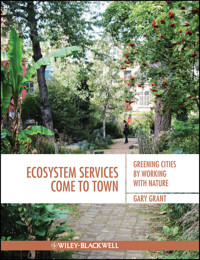
Ecosystem Services come to Town: greening cities by working with nature demonstrates how to make urban environments greener. It starts by explaining how, by mimicking nature and deliberately creating habitats to provide ecosystem services, cities can become more efficient and more pleasant to live in. The history of cities and city planning is covered with the impacts of industrial urban development described, as well as the contemporary concerns of biodiversity loss, peak oil and climate change.
The later sections offer solutions to the challenges of sustainable urban development by describing and explaining a whole range of approaches and interventions, beginning at the regional scale with strategic green infrastructure, looking at districts and precincts, with trees, parks and rain gardens and ending with single buildings, including with green roofs and living walls.
Technical enough to be valuable to practitioners but still readable and inspirational, this guide demonstrates to town planners, urban designers, architects, engineers, landscape architects how to make cities more liveable.
Sie lesen das E-Book in den Legimi-Apps auf:
Seitenzahl: 264
Veröffentlichungsjahr: 2012
Ähnliche



















Contents
About the Author
Acknowledgement
1. Introduction
Modern Cities and the Disconnected
Population Spike
Limits to Growth
Global Threats
Ecosystem Services and Stewardship
Greening Cities is Necessary
Hope
2. Origins of Cities
Why Look Back?
Emergence of the Human Species
Great Leap Forward
Agriculture and Permanent Settlements
Agriculture Around the World
Agriculture Intensifies
Empires Rise and Fall in Mesopotamia
Nile Valley
Indus Valley
Ancient China
Ancient Greece
On the Ganges
Rome
The Moche
Mesoamerica
Fortified Centres of Administration
European Renaissance
Early Modern
Squalor
3. Modern Cities
Origins of the Modern City
Industrial Revolution
Railways
Rapid Growth
Ill Health
Distinctive New Districts Emerge
Paris Re-born
Railways and Suburbs
Planning and Zoning
Garden Cities
Motor Vehicles Herald in the Oil Age
A Humane Outlook
Going Up
Continued Rise of the Motor Vehicle
Decline of the Inner City
New Towns
City Plans
An Unfinished Task
4. Issues Facing Contemporary Cities
Impacts of Cities and City Living
Habitat Loss
Habitat Fragmentation
Impacts on Soil
The Water Cycle
Water-borne Pollution
Urban Heat Islands
Air Pollution
Noise
Light Pollution
Agricultural Land Take
Concrete
Steel
Glass
Timber
Waste
Drivers of Population Growth
Peak Oil
Peak Phosphorus
Post Oil
5. Working with Nature
Ecology and Ecosystems
Born Free
Saving the Great Lakes
Earth Summit, Ecosystem Assessment and Ecosystem Services
Cities as Part of the Biosphere
Ecological Restoration
Urban Wildlife
Green Infrastructure
Sustainable Sites Initiative
Advice from Professional Bodies and Others
Mimic Nature
Working with Nature Works
6. Urban Nature
Open Space Preservation
The Naturalists
Nature Leaves the City?
Urban Nature Returns
Wildlife Gardens
Encapsulated Countryside
Bukit Timah
The Urban Forest
Urban Wastelands
Canvey Wick
Emscher Park
Urban Farming
Biodiversity Action Plans
River Corridors
London’s South Bank
Minneapolis Riverfront
7. Water and Cities
Fresh Clean Water – Essential and Increasingly Scarce
Civilisation has Modified the Water Cycle
Water Consumption
Embodied Carbon
Virtual Water
Catchment Management
Rainwater Harvesting
Grey Water
Sustainable Urban Drainage
Water Sensitive Urban Design
Rain Gardens
The Streets are Changing
Ponds
Potsdamer Platz
River Restoration
The Cheonggyecheon River
Singapore
Water and Urban Heat Islands
Towards the Water Sensitive City
8. City-wide Greening
Bioregions
Catchment Management for Clean Water
Catchment Management for Ecosystem Services
Regional Green Infrastructure Plans
Biomass and the Bioregion
Regional Ecological Networks
Community Forests
Green Belts
Green Grids
Transport
Urban Heat Islands
Blue Networks
Masterplanning
Regional Plans, Local Implementation
9. Greening Neighbourhoods and Buildings
Sense of Neighbourhood
Living Streets
Standardising the Neighbourhood
Design Your Own Park
A Phoenix Rises
Growing Their Own
Learning from Squatter Settlements
Rain Gardens
They Paved Paradise
Clapton Park Estate
People of the Trees
Tree Pits
Tree Trenches
No Space?
Energy Efficient Buildings
Water Efficiency
Autonomy
Building-integrated Vegetation
A Coat for Buildings
Value of Shade
Living Walls
Cooling Effect of Green Roofs
Green Roofs, Rainwater Attenuation and Cooling
Green Roofs Need the Right Substrate
Green Roofs for Biodiversity
London’s Black Redstart Roofs
Biodiverse Green Roofs in North America
Roof Gardens for People
Worldwide Applications
Wildlife and Buildings
Rooftop Harvests
10. Conclusion
Interesting Times
The Positives
Cities and Citizens Take the Initiative
Greening Requires Greenery
Appendices
I: award winning projects from IHDC website
Mission Earth
Transforming the Way We Think about the Built Environment
Multifunctional Design
International Inspirations
The IHDC Brief
Unusual Partnerships
Case Studies – Creating a Body of Exemplar Projects
IHDC Case Studies
Project Overview
Judges’ Comments
Project Overview
Judges’ Comments
Project Overview
Judges’ Comments
Project Overview
Judges’ Comments
Project Overview
Judges’ Comments
Project Overview
Judges’ Comments
Project Overview
Judges’ Comments
Project Overview
Judges’ Comments
Project Overview
Judges’ Comments
Project Overview
Judges’ Comments
Project Overview
Judges’ Comments
Project Overview
Judges’ Comments
Project Overview
Judges’ Comments
Project Overview
Judges’ Comments
II: useful resources
United Nations Department of Economic Affairs – Population Division
An Essay on the Principle of Population by Thomas Malthus 1798
Club of Rome
Association for the Study of Peak Oil (ASPO)
Intergovernmental Panel on Climate Change (IPCC)
UN Convention on Biological Diversity
UN Millennium Ecosystem Assessment
Environmental Literacy Council
Agroforestry Research Trust
Town and Country Planning Association
Becoming Human
Volcanic Eruptions
Jared Diamond
Earth Network
The Neolithic of the Levant (1978) by A.M.T. Moore.
Greenland Ice Core Project
Çatalhöyük
Yangshao Culture
Mesopotamia 6000-1500 BC
Ancient Egypt
The Indus Civilisation
The Shang Dynasty
Ancient Greece
Hippodamus
Ancient Rome
Moche
Foundation for the Advancement of Mesoamerican Studies
Florence
Bastides
Versailles
Staple Inn
Christopher Wren
Robert Hooke
London After the Great Fire
Age of Enlightenment
Industrial Revolution
Exploring 20th Century London
Miasma Theory
Frederick Law Olmstead
History of Building Regulations in the British Isles
Haussmann
American Planning Association
First Garden City Heritage Museum
Lewis Mumford Center
Royal Parks
Central Park
Island Biogeography
International Soil Reference and Information Centre
USGS on the Water Cycle
Sewers
Water
Urban Heat Islands
Air Pollution
Noise
Light Pollution
Bird Strike on Buildings
Agricultural Land Take
Concrete and Cement
Steel
Glass
Timber
Urban Solid Waste
Peak Phosphorus
Resilience
Darwin
Linnaeus
Reductionism and Holism
Born-free Foundation
Great Lakes
UN Convention on Biological Diversity
Millennium Ecosystem Assessment
Atlas of the Biosphere
Cod Fishery
Urban Wildlife
Green Infrastructure
Town and Country Planning Association
Biomimcry
Octavia Hill
Hampstead Heath
London Natural History Society
Ian McHarg
Natural History Museum Wildlife Garden
Camley Street Natural Park
Urban Bushland Western Australia
Bukit Timah Nature Reserve
i-Tree
Tree Council
Alliance for Community Trees
Canvey Wick
Emsher Park
Urban Farming
UK Biodiversity Action Plan
Water Sensitive Urban Design
Catchment Management
Rainwater Harvesting
Grey Water Recycling
Sustainable Drainage Systems (SuDS)
Low Impact Development
Rain Garden
River Restoration
Chongyecheong
ANC Waters
Bioregions
Biomass as energy
Ecological Networks
Community Forests
Green Belts
All London Green Grid
Green-Blue Networks
Regional Plans
Masterplans
Living Streets
Design Your Own Park
Guerrilla Gardening
Allotments
Stormwater Tree Pits
Passivhaus
Green Roofs
Building Biodiversity
Biodiversity and Planning
Hundertwasser
Alliance for Healthy Cities
Notes and References
Chapter 1
Chapter 2
Chapter 3
Chapter 4
Chapter 5
Chapter 6
Chapter 7
Chapter 8
Chapter 9
Index
Advertisements
This edition first published 2012 © 2012 by John Wiley & Sons, Ltd
Blackwell Publishing was acquired by John Wiley & Sons in February 2007. Blackwell’s publishing program has been merged with Wiley’s global Scientific, Technical and Medical business to form Wiley-Blackwell.
Registered OfficeJohn Wiley & Sons, Ltd, The Atrium, Southern Gate, Chichester, West Sussex, PO19 8SQ, UK
Editorial Offices9600 Garsington Road, Oxford, OX4 2DQ, UKThe Atrium, Southern Gate, Chichester, West Sussex, PO19 8SQ, UK2121 State Avenue, Ames, Iowa 50014-8300, USA
For details of our global editorial offices, for customer services and for information about how to apply for permission to reuse the copyright material in this book please see our website at www.wiley.com/wiley-blackwell.
The right of the author to be identified as the author of this work has been asserted in accordance with the UK Copyright, Designs and Patents Act 1988.
All rights reserved. No part of this publication may be reproduced, stored in a retrieval system, or transmitted, in any form or by any means, electronic, mechanical, photocopying, recording or otherwise, except as permitted by the UK Copyright, Designs and Patents Act 1988, without the prior permission of the publisher.
Designations used by companies to distinguish their products are often claimed as trademarks. All brand names and product names used in this book are trade names, service marks, trademarks or registered trademarks of their respective owners. The publisher is not associated with any product or vendor mentioned in this book. This publication is designed to provide accurate and authoritative information in regard to the subject matter covered. It is sold on the understanding that the publisher is not engaged in rendering professional services. If professional advice or other expert assistance is required, the services of a competent professional should be sought.
Library of Congress Cataloging-in-Publication Data
Grant, Gary, 1958–Ecosystem services come to town : greening cities by working with nature / by Gary Grant.pages cmIncludes bibliographical references and index.
ISBN 978-1-4051-9506-5 (pbk. : alk. paper)1. City planning–Environmental aspects. 2. Sustainable urban development. I. Title.NA9053.E58G73 2012711′.4–dc23
2012006681
A catalogue record for this book is available from the British Library.
Wiley also publishes its books in a variety of electronic formats. Some content that appears in print may not be available in electronic books.
Cover design by Andy MeadenCover image shows Phoenix Garden in London’s West End. Photograph by Gary Grant
About the Author
Gary Grant is a Chartered Environmentalist, Member of the Institute of Ecology and Environmental Management, an Academician at the Academy of Urbanism, Member of the All Party Parliamentary Committee on Biodiversity, thesis supervisor at the Bartlett Faculty of the Built Environment, University College London, Chair of the Judges of the Integrated Habitats Design Competition and Director of the Green Roof Consultancy Ltd. After graduating from Nottingham University in 1980 with a degree in Biology, he worked for the London Wildlife Trust (LWT), campaigning for and managing urban wildspace. He conceived the London Wildlife Garden Centre which won a RIBA/Times Award. Later he led the Wildlife in Docklands Project, a joint venture between the Wildfowl and Wetland Trust and LWT, which promoted nature as part of the redevelopment of London’s Docklands. In the early 1990s, he participated in the Royal Fine Art Commission’s River Thames Study and worked on the Natural History Museum’s Wildlife Garden. Since the early 1990s he has designed green roofs, including the CUE Building at the Horniman Museum. Based in Hong Kong for the much of the 1990s, he worked on housing, tourism and infrastructure projects. In 2003, Gary wrote English Nature’s Research Report on green roofs and followed that in 2006 with Green Roofs and Facades published by BRE Press. From 2006 to 2009 he was a Director of EDAW and then AECOM Design + Planning, where he worked on large-scale planning projects including the London 2012 Olympic Park, the Bedford Valley River Park, the Whitehill-Bordon Eco Town, Education City, Qatar and Saadiyat Island, Abu Dhabi.
Lesen Sie weiter in der vollständigen Ausgabe!
Lesen Sie weiter in der vollständigen Ausgabe!
Lesen Sie weiter in der vollständigen Ausgabe!
Lesen Sie weiter in der vollständigen Ausgabe!
Lesen Sie weiter in der vollständigen Ausgabe!
Lesen Sie weiter in der vollständigen Ausgabe!
Lesen Sie weiter in der vollständigen Ausgabe!
Lesen Sie weiter in der vollständigen Ausgabe!
Lesen Sie weiter in der vollständigen Ausgabe!
Lesen Sie weiter in der vollständigen Ausgabe!
Lesen Sie weiter in der vollständigen Ausgabe!
Lesen Sie weiter in der vollständigen Ausgabe!
Lesen Sie weiter in der vollständigen Ausgabe!
Lesen Sie weiter in der vollständigen Ausgabe!
Lesen Sie weiter in der vollständigen Ausgabe!
Lesen Sie weiter in der vollständigen Ausgabe!
Lesen Sie weiter in der vollständigen Ausgabe!




