


11,99 €
Mehr erfahren.
- Herausgeber: Iluminuras
- Kategorie: Geisteswissenschaft
- Sprache: Englisch
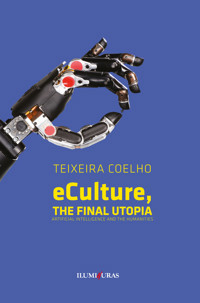
Computational culture --eCulture-- has so far been considered as a set of more or less loose traits and phenomena that part of the humanity (those over 30 years old) does not try to understand ("it is too difficult to apprehend -- and besides, it works") while the other half, the younger ones, who were born inside this new culture, blanketed by it and who tend to think of it as "natural given", do not feel the urge to fully understand, neither. "Virtual reality gives me this, the algorithms give me that, what else there is to it?" eCulture, however, has become dense and rich enough to be considered as a language, with its units of meaning -- both at the level of its visible figures or significants and at the level of the meaning each one of them conveys. It is a language just as film and English are languages. If humanity does not break the code of this language as an overall and comprehensive tool to represent the world, therefore failing to use it according to its own will and needs, this new language will speak the human being, will express itself through the human being, instead of being spoken by humanity. This book suggests the way to consider eCulture as a language and chooses as an instrument of analysis a convergence between the Humanities (philosophy, arts and culture) and the "hard sciences".
Sie lesen das E-Book in den Legimi-Apps auf:
Seitenzahl: 512
Veröffentlichungsjahr: 2020
Ähnliche




















eCulture,
the final utopia
eCulture,
the final utopia
Artificial Intelligence and the Humanities
Teixeira Coelho
eCulture’s Narrative
I was ambiguously lucky enough to watch a culture arise. In other words, I have had the doubtful luck of watching a culture beginning to stand up on its feet and develop into a grown up, all too powerful entity in a very short span of time. I call it a doubtful luck because, if on one hand, as an observer, that is a rare occasion in one’s life, perhaps an unique occasion, on the other, as a living being that discovers himself ever more blanketed by this new culture as if it were one of those huge spaceships looming threateningly above some capital of the world in some science fiction film, I feel often astonished and marveled as well as frightened and excited by the phenomenon and all the possibilities it opens up.
A culture, of course, does not arise, does not emerge abruptly. A volcano may explode “suddenly” — but even a volcano usually gives people time to take some protective action against its effects or to look for shelter in some safer and distant place. The difference between this new culture that arises, eCulture, and the volcano situation is that eCulture does not offer us any safe shelter nor allows us to look for one elsewhere outside it: there is no outside, there’s no distant place. It’s no use even considering escaping to a desert island: it may seem deserted but certainly several satellites pass over it every day and night and drop on it a rain of electronic signals that various devices will decode as messages of texts, images and sounds. And even if in this island there is no device to capture them and identify them, those satellites will known there is someone down there and that this someone is most probably you. I can leave behind me at my departing harbor or airport all electronic devices that normally surround me: but I am not ready to abandon all this humanity around me, yet.
But, going back to the anticipatory signs sent by a volcano about to break out. Escaping its guts one can hear disturbing noises and see and smell rolls of smoke and some narrow, lava-colored stream flows slowly down the mountain slope; and even if this burning stream does not show up, within the mountain there is this boiling, burning matter evolving for millions and billions of years, the same matter that formed Earth in its first moment, whatever it might have been. The emerging of a culture is not much different. I cannot even say “I am fortunate enough to see a culture emerging”: this culture has been slowly appearing over time, displaying a number of more or less clear signs of its eruption, anticipatory signs of what it would look like later on, signs which a more enlightened mind might have been able to slowly grasp but whose full meaning not even this privileged mind might have been able to apprehend in all its developments. Embryonic concepts of the computer machine were advanced by Pascal and Leibniz in the 17th century and in 1784 the engineer J. H. Müller designed and built an adding machine before describing in a book, two years later, the principles of a difference engine that he never managed to transform into reality for lack of funds but which opened the doors to another difference machine, Charles Babbage’s, in 1833. Well before these machines, the Chinese abacus or the Greek Antikytera also proposed themselves as calculating machines.
Fig. 1: Pascal’s Pascaline, 1652.
Fig. 2: The Pascaline, internal mechanism.
Fig. 3: A model of Babbage’s first version of his difference engine built according to his design (Science Museum, Londom).
Fig. 4: The Antikythera, ancient Greek analog computer used for calendar and astrological purposes.
The 2019 regular computer is not that much different from those machines in its function that consists mainly in combining numbers. At a click Wikipedia will display dozens of devices that anticipated the Turing machine, which helped to win the World War II with its considerably big wheels and belts and gears not very different, at least in their exterior shape, from Babbage’s difference machine. All these were strong anticipatory signs of the (at the time) slowly emerging culture — easy to identify in retrospect. It is no difficult task (and actually a very convenient one) to put on the capes of a prophet of the past but it is by wearing his clothes and shoes and occasional glasses that the undeniable evidence comes into focus: from within a culture that was barely a culture of the word (the Iliad is from the 8th century BC1) strenuously materialized at the time of the Antikytera, and from a culture of the press-with-movable types (an authentic typo-graphy) at the time of the difference machine, there slowly emerged the culture of computing, a slowly emerging culture, in Raymond Williams’ terminology, rehearsing its first steps alongside the stronger culture, the dominant culture at the time which was exactly the slow culture of the sequentially spoken and printed word.
Going back, I was fortunate enough to at least see a culture taking shape, a culture that the previous generation knew almost nothing about, had scarcely imagined and with which it never dreamed of. There was however one writer that was able to imagine it with an astonishing technological and existential refinement at the time this culture was still just an infant or little more than a fetus — and that was E. M. Forster in his short novel The Machine Stops, 1909, which I will quote over and over again throughout this book. 1909: eight years before, Santos Dumont was able to circumvent the Eiffel Tower, a feat he completed in 1889, two years after the tower was built (and two years after his flight, in 1903 the Wright brothers were also able to move a flying machine through the air). To put it another way, there was nothing like a computational culture when E. M. Forster foresaw the basic structure, the outline (in striking details) of the current life in our homes and offices. But I had not yet read The machine stops when I began to realize what was growing up around me even though I was already beginning to use that which was for me not much more than a black box allowing me to type a text and then correct it and reassemble and edit it and freely invert its parts as much as I wanted and also to find in that text — in an extremely fast way — any of the words I had just typed. That was something… I barely noticed this new culture come together and unfold in a number of directions while I remained trapped in the universe of an earlier material and conceptual culture and, much more serious than that, while I kept myself entangled in the explanatory meshes of that previously dominant culture which saw the light not even in the 20th century, in whose convulsive picture I was born, but in the previous 19th century that was already slipping out of sight albeit it was been kept alive (by means of artificial oxygenation) in a number of university’s classrooms. At a certain moment, when the computational environment had already become openly dense and had its effects explored again and again by science fiction — while the theory of culture, which included the famous critical theory of culture, kept on distrusting and rejecting all technology that it considered to be a result of a technocracy to be fought by every possible way in the name of the Humanities (and of humanity) — I could no longer delay the task of understanding and interpreting this new culture that already had its first native speakers, those who were already born within it and who never got to know any other cultural mode, who were able to move in it like fishes in the water and that, for that very reason, would scarcely perceive the water and the aquarium around them while I , on my side, I who am an immigrant to this new culture, sometimes felt an acute lack of oxygen when I dived in the computational environment ... Those are the benefits and disadvantages of seeing a culture come up alive, on one side, and of being born into one, on the other. When I realized that around me children who were still not much more than babies, some of them without having completely abandoned their diapers and who did not read or write yet, were already able to grasp their mothers’ iPhone or iPad and move their small screens up and down and left to right in order to search for and find by themselves the cartoon site they had seen just a couple of times before, I understood the full impact of the new culture and the full meaning of the word that the computer industry had transformed into a leitmotiv: friendly. A friendly technology. The new culture, not just its electronic devices, was itself entirely friendly, something that the previous ones, like the culture of the word, had never been. I could not postpone any longer the study of the nature and the consequences of this friendliness and what, exactly, the new culture was saying to those children — and not just to them.
However, understanding technically the nature of any isolated experience allowed by this new culture–such as the experience of virtual reality, for instance (what kind of hardware and software it requires, let’s say) — or identifying the exponentiality of all those successive changes in the computers’ capacity to calculate, would not take me far enough nor fast enough. Innovations in this field pop up almost every day, ditto in relation to the new possibilities of application of the previous innovations not yet properly ingested and digested. Analyzing one by one all the new culture’s phenomena, their incidence on contemporary life and, above all, identifying the impacts of each of the computational operations emerged as a mission with no predictable end at sight in the horizon of an human life. The alternative was to consider all this information as integrating a system, as they do in fact, in which all novelty could be accommodated even if they were not foreseeable at first or were just barely delineated, as in Mendeleev’s periodic table. The hypothesis within my reach, considering my previous formation in linguistics and semiotics, was the most obvious to me: to consider the new culture as a language. There is hardly any human phenomenon that escapes the possibility of configuring a language, which is an essential mediation between man and the world and which, emerging to human life in the form of the written word 5,200 to 5,500 years ago, made possible the emergence of what one can still call the human spirit or the human mind. A traffic light is a language, just like Mathematics and Portuguese and each one of the different cultural modes. The low degree of complexity of one particular language does not disqualify it as such: the language of the traffic lights (red, yellow, green — in such a sequence that after the yellow there comes the green or the red one although after the green does not follow the red unless that’s a two-color only traffic light) probably only finds a simpler manifestation, in everyday life, in the language of the light switch that triggers the lighting of a room or starts a motor (the light is on and the motor is running if the vertical line ( an I) is up and the light is off, or the motor is idle, if the circle (a zero, 0) is up, as one still sees in some old time, old culture switch). If computational culture is a language, the investigation must be able to identify its figures (its words or terms) and the relation among them, just as the English language structures itself on its words (some 300,000 words must be found in a good, regular dictionary) that must be combined according to certain rules (its grammar). Just like all possible language, all cultures, in Lévi-Strauss’s understanding, are built on signs that would mean nothing if they were isolated from one another: meaning arises through the combination of those signs, animated by an internal logic that attributes to each language — to each culture— the characteristics that make it recognizable as an specific individual. Identifying these figures or signs may be a rather simple operation. Following Emile Benveniste’s formulation, it consists in the identification of the field of what he calls a semiotics (the visible or audible or perceptible signs that may be apprehended by the five human senses for example) and then of what he describes as its corresponding semantics (the meaning of those signs). This perspective does not conform entirely to the more elaborate conception proposed by Ch. S. Peirce’s semiotics but is enough as a starting point.
It was thus necessary to identify, not exactly the signs, but the figures of meaning of the computational culture — or the semantic nodes of this culture, those points where meanings are lodged, eventually overcrossing or overlapping one another. Those nodes will hold the sense (that which a sign must convey, that which a sign has been proposed for, like when one opens the dictionary and find the sense of a word, that which the word must in general signify), the immediate signification (the signified, in French, or the meaning a sign actually has for a given user in a concrete situation) and the dynamic signification (the total sum of meanings that a sign ends up representing for a given user). Going straight to the point, it was thus possible to identify the twenty-four figures of the computational culture listed here and which are formulated and commented in the next pages. These figures present themselves with the status of historical individuals, in Max Weber’s words2, which present themselves as a complex of relations embedded in the synchronically detected historical reality (although Weber did not addressed these categories directly and in a profound way, as it would have been necessary) in a particular slice of time but that have developed themselves in a diachronic movement of greater magnitude: it is by virtue of their broad cultural significance that these figures are gathered here. Max Weber’s introduction to his examination of the “spirit of capitalism” perfectly fits the nature of the present study, both when he says that the definitive concept of the object examined can only be defined, or at least described, at the end of the investigation and never at its beginning, and when he allows one to chose the best way to formulate the understanding of the language under scrutiny, in which case “best” is nothing more than the most appropriate point of view to suit one’s objective. The outcome may not be a “conceptual definition” of these figures but it will certainly be at least a provisional marking of what can be understood by the language of eCulture, eCulture’s speech. This provisional marking will, however, be decisive for the final understanding of what this new language and its effects are.
From the beginning it was clear that the investigation should not remain on the superficial level of manifestation of each of these figures such as they present themselves at first sight. Virtual reality, for example, clearly is a figure of this language in its capacity of a phenomenon as such brought to the scene of human experience by the possibilities of computing — and it is to this specific figure that one often refers to as something new. But what one has to look for when one is studying the language of the computational culture is the internal or subjacent quality that corresponds to that figure, its essence in a way — which is virtuality. The twenty-four identified figures represent, therefore, the qualities of eCulture (its traits, its properties, ways in which its meanings form themselves, are transmitted and as such apprehended). In addition to the quality of each one of them, all these figures enter in a relation of sorts with other figures in order to produce their final effect — a relation that, according to Louis Hjelmslev’s analytical method, can be that of interdependence (A and B are so related that if A is to exist, B must also exist and vice versa), determination (B needs A to exist but the reverse is not true) or constellation (A and B and C and D and F etc. are in some way related but this connection is too loose or uncertain or unknown or still uncertain and still unknown to identify). The more dependent or interdependent they are, the more predictable will be the figures involved and their meanings and possibilities of signification; the more “constellar” the relations between them, the more unexpected and instigating the found results will be — if and when they are. James Joyce and Guimarães Rosa have proved how constellar their respective old literary languages could be after both of them, each one in his own way, exploded the physical conformation of each one of their figures or signs, the relations among them and the senses and significations they could carry.
Although the full meaning of the ensemble formed by this “historic individual”, which is eCulture, depend mainly on those relations, I am not so concerned, here, with explicitly pursuing them. (For instance, the eventual virtuality resulting from a codification or program depends on the nature of the computing but the opposite is not true: the relation between those two figures is one of determination). Besides the realization that it would take longer to get a meaningful result — and far more pages than this book allows, something counterproductive at this time when book publishing and book selling and book reading is dwindling — it should suffice me to know that these figures can be further explored in their architectures and combinations by other researchers moved by similar interests. It will be sufficient here to identify these figures and fill in their blank spaces in their respective fields (semiotics) with their nuclear features (and not only with their superficial traits, as already mentioned) and to gather enough material to fill their semantic field, figures of semantics to be harvested in the universe of cultural meanings that have been structuring the signification of this language. This material will be collected in the available and relevant semantic fields, that of the science as much as those of the arts, philosophy, technology, mythology.
Needless to say, these figures will not be explored technically, that is not the nature of this study, nor am I qualified for this kind of approach. Some of the figures come from a strict technical field and others derive from various branches of physics for which I also have restricted understanding skills beyond the necessary minimum that allows me to enter into a conversation about them. What really interests me in this study, and this is its dominant point of view, is the cultural approach of eCulture, an insight of this new culture in the perspective in which I move myself more comfortably, the perspective of the Humanities, even if this word and concept are far from clear. The annoyance with this expression is not exclusive to the culture associated with the Portuguese language: in all territories and geographies in which the label Humanities is used the discomfort it causes is the same, a discomfort which has not been investigated well enough, so far, with the exception of a couple of attempts. A discomfort that becomes clear when a scholar from the Humanities enters in a dialogue — that famous interdisciplinary dialogue that academia has been advocating for decades without ever achieving a clear understanding of what it actually is nor an explanation of “how to “— with a physicist, for instance. The difficulty a specialist in physics feels when he is talking to a colleague from the Humanities is a real one (it is not a strategic option, nor just a rhetoric) and is visible in his facial traits and gestures, not only his words. The difficulty this physicist will mention, in those occasions, is related to what he calls a lack of concreteness, of materiality of the terms and themes with which the Humanities operate, although the reverse is not always true: those from the Humanities do not have an equivalent problem when dealing with concepts that are capable of manifesting themselves with bunt clarity: they may not understand in full what is on stake but they acknowledge the concreteness of it all. This physicist faces an understandable difficulty.
Nevertheless, I do not give up the perspective of approaching eCulture from the point of view of the Humanities. The choice of the figures is itself a tributary of this perspective and that is immediately visible when I say that what interests me most is not, for example, a figure such as virtual reality in itself, but the quality that sustains it: virtuality. Anyway, it is in the field of semantics that the humanistic approach will become more evident, as iy will become clear further on.
In the process of understanding the semantics of these figures, the content of these figures, the Humanities’ point of view is responsible for investigating what mythology, art, literature and, also, science fiction have to say. Cinema, specifically, is a very rich source of instruments for the understanding of computational culture, as much as literature. Or mythology for that matter, the insurmountable poetry of humanity. Recently, the director of a European high-computing center, a reference in the field, begun his conference about the future of computing and its impact on the idea of reality by warning that one of the topics he would not address was exactly that of science fiction, together with the concepts of information, utopia and dystopia that were the topics in discussion at this seminar held in São Paulo in November 2018. And so he did. However, as soon as his lecture was over and the dialogue with the public opened up, in the first answer he gave to the first question from the audience he could not avoid mentioning... a science fiction film. The presence of science fiction in its varied modes in this study is an inevitability; and it is also a player in the territory of strict and technical physics itself, something that physicists, astrophysicists and other researchers of this domain do not avoid or deny. The opposite is also true, filmmakers, artists and writers will never hide the scientific origins of their works. Filmmaker Christopher Nolan, in order to prepare for his Interstellar (2014), appealed to the American physicist Kip Thorne as a scientific consultant. Thorne specializes in gravitational physics and astrophysics and has won the 2017 Nobel Prize in Physics for his contributions to the field of gravitational waves in cooperation with Rainer Weiss and Barry C. Barish. He was also a colleague and friend of Stephen Hawking’s and Carl Sagan’s in Cambridge. Thorne was the film’s scientific advisor and, as such, its scientific guarantor. This is not the only example of a physicist acting as a sci-fi film advisor.
The influence of cinema (and of literature and the arts) on scientific and technological discoveries is also an evidence. On November 28, 2018, it was announced the first flight of a solid-state aircraft, meaning the first airplane with no moving parts in its propulsion system.3 Even though it was not much more than a model that flew for no more than 60 meters (the equivalent, in a way, to the first Wright brothers’ attempts and Santos Dumont’s first flight), this solid state aircraft moves according to the principles of the technology called “ionic wind” based on the use of a powerful electric field in order to generate nitrogen ions expelled from the rear of the apparatus and that generate the propulsion it needs. The resulting flight generates almost no noise and pollution, with a propulsion-power ratio comparable to that of a conventional jet engine system, which makes its use in commercial aviation technology very likely sometime in the future. Steven Barrett, the project’s leading researcher, who is a MIT professor and the main author of an article published by Nature about his feat, reported that the inspiration for this project came from the science fiction films he watched in his childhood and youth, in particular the Star Trek franchise. Barrett was born in 1982 and the first Star Trek was originally released in 1966 and has been periodically refreshed to the delight of its fans who seem to react to this movie phenomenon just as football fans around their favorite teams (and there may be more interest and excitement and money involved annually around the “Star Trek system” than in several national football tournaments ...). Following Captain Kirk in his space adventures, which he shared with his lieutenant and all too rational alien Mr. Spock (but everybody is an alien in that universe...) — whose function in the films has always been to bring out the weaknesses but also the benefits of the human emotionalism (the earthlings’ emotionalism, at least) — Steven Barrett, a legitimate son of the new technology, who was born in its womb and arms, admitted he was from the start fascinated by the starships that moved silently through space, without any moving parts in their engines, and by the “blue glow” around them. Driven by this impulse — or by this propulsion — Barrett set out to investigate the possibility of this kind of flight and found the concept known as “ionic wind” that was first investigated in the 1920s. Examples such as this abound and the discarding of reciprocal influences between science and art has simply become unthinkable and unproductive. The reading of The machine stops, by the British novelist E. M. Forster, who will be mentioned in this essay a number of times due to his heuristic power, will provide to those interested in these topics some very good reasons to actively seek the approximation between the two fields. It is a fact that reality, with its heuristic potential, often surpasses fiction. It is no less true, however, that fiction also outperforms reality and science, no less true that fiction overtakes reality and science by going very close to them, so much so that both reality and science can feel the strong displacement of air carried out by this impressive mass called imagination that, in its movement, spreads itself widely all around science and reality and across all borders and gaps between them and between consciousness and the world.
Science, art, mythology, religion define semantic nuclei to be repeatedly explored in this essay — so that the initially detected figures, the twenty-four of them that make up the central proposition of this work, actually emerge as semantic nodes,semantic intersections rather than simple and one-dimensional figures; complex nodes, complex and dense, formed by an immense tangle of threads whose initial manifestation dates back to some 50,000 years ago when the first signs of human mourning ceremonies, probably accompanied by the sounds extracted from a piece of wood or bone transformed into the first flute, and then thickened by other threads like cave paintings around 37, 000 years ago and made even more complex and varied by the dawn of the written word and so much more that came after that. The boldness of this attempt to isolate at least some of the contents of these semantic nodes is quite clear; and maybe they will not be the only ones or the sufficient ones, although sufficient enough for this first journey inside eCulture. This is a bold move that seems to pay its dividends, the first being the clear perception of the existence of one and same thread — even if each time made of a different material, now and then rather in a mended shape and who knows with what missing pieces — connecting the primeval forms of humankind to the one in which we have plunged in these first two decades of the 21st century.
This mixt between “hard” science and the Humanities — this flexible, complacent science to which the science label is often denied, for reasons that are sometimes less, sometimes more justified—is not an arbitrary one. In the book The Science of Interstellar that he wrote to report his participation in the film Interstellar, the physicist Kip Thorne describes the scientific knowledge embedded in Christopher Nolan’s film and that constitute the tripod on which the film was built: “hard” science (that which physics already knows for sure), educated guesses (an intuition generated from solid but not yet verified knowledge) and speculation, a concept that does not ask for clarification (although it is never sheer speculation: a physicist’s speculation on physics is not the same as a lay man’s speculation). Actually, that’s how science is done: starting upon an intuition, the scientist comes up with an unverified proposal that has however a solid ground beneath it and from where she may proceed to something that is “solid”, undisputable science. Incidentally, the general process of relating consciousness to the world is not that different from the one described by Thorne: first there are sensations, feelings, intuitions, abductions; secondly, observation, empirical practice, the validation by experience or experiment of that observation hic et nunc only; thirdly, the general principles that may develop from the first two steps, the norms, the code, the laws, abstraction, theory, just like in the three semiotic modes formulated by Charles S. Peirce to which he assigns the labels of firstness, secondness and thirdness. From this perspective, in the structuring of this essay one can find principles deriving from established or “hard” sciences, here reported as much as allowed by the brevity of the analysis; and also, “educated guesses” in some interpretation of the correlations made; and then, some speculation. This essay shares another point of view with Kip Thorne, who explains how he himself, in his capacity as a scientist and from the perspective of science, interpreted that film (for which he is not solely accountable) — and his interpretation, in his own words, was not dissimilar from that of “the art critic, or common observer, who interprets a canvas by Picasso.”4 This freedom in the reception and interpretation, the “well grounded freedom” in the recreation of the meaning of a phenomenon is what I claim in the interpretation of the scientific subjects here discussed, which are for me the equivalent to the Picasso’ canvas Thorne took as an example. And in order to do it, as a matter of fact, I will bring about my own experience as a professional art critic and a lover of Picasso’s art, exactly... In this process of interpretation of eCulture’s figures, and of their semantic nodes, I will incur undoubtedly in extrapolations — and the meaning of this work probably lies, above all, in precisely that. The result may be an essay in artscience, an option that seeks to evade the conflict and the abyss between C.P.Snow’s “two cultures” and to overtake the unnecessary idea of Jerome Kagan’s “three cultures”5: artscience, a single culture in which both entities merge, will be both necessary and sufficient.
Bydoing this, I do not hesitate therefore to include in this book, and sometimes to refer to them at length, some speculations — although they are not all mine, coming, as they do, from a couple of physicists whose names will be mentioned on due time. And they are speculations that clearly present themselves as such even if developed from “educated guesses” and “hard” sciences. To my point of view, which is that of the Humanities, these speculations or “speculations” are rather important, perhaps decisive and essential. Speculation is what moves artistic and scientific creation, there is no reason to reject it. It is possible today to give another name to the idea embedded in the word speculation: imaginary. It is not just a change of labels, some sort of decorative aggiornamento. The imaginary also has its rules, its categories; it is a (recent) branch of anthropology as developed, for instance, by Gilbert Durand6. And it draws from psychoanalysis also, among other disciplines. A physicist friend of mine will describe aspects of the imaginary such as it is discussed here as an “uninteresting delirium.” I greatly appreciate the observations and comments of this particular friend of mine, who has contributed strongly –even if not consciously and purportedly — to the development of this book (and who, when and if reading it, may feel compelled at once to deny having ever meeting me). But deliriums — even in the acceptable and social or civilized form of legends and myths and religions — are a considerable part of the imaginary, if not a vital one. The same with the uninteresting part of his expression: strictly speaking, nothing is uninteresting or insignificant in this field. In some respects, the work of an interpreter of narratives, like the narrative written or spoken by eCulture, resembles that of a detective in charge of the unraveling of a case in whose analysis he is confronted with a sequence of seemingly uninteresting signs. But he will never know for sure how uninteresting those clues are as long as he does not build the general and final picture and frame around his case, as Max Weber warns us. In my case, this final general framework is not yet designed, the enigma has not been solved and most of all, in a very specific way, the enigma that is the subject of many a scientific speculation — as discussed in the topic Completeness, which is “simply” related to the end of knowledge, the end of the universe and the end of life — has not even been equated yet. During the investigative process, it is not possible to know what is in fact uninteresting, nor what is delirium. The “hard” scientist, in her laboratory or in her scientific “speculation”, necessarily discards what is delirium and what is uninteresting. It is understandable that she does so. She has to. But in this approach to eCulture from the point of view of the Humanities I cannot do it: it would be contrary to my own principle, something I am not yet prepared to do. And that I do not want to do...7
1 Or 8th century BCE, Before Current Era, for a more secular resonance.
2L’étique protestante et l’esprit du capitalism. Presses Électroniques de France, 2013.
3The Guardian, November 28, 2018.
4 Kip Thorne, op.cit., loc.57.
5 Jerome Kagan discusses his ideas in The Three Cultures: Natural Sciences, Social Sciences and the Humanities in the 21st Century (Cambridge University Press, 2009). Seeking to review Snow’s proposed 1959 binary confrontation between hard and soft sciences, another name for the Humanities, — a conflict that in Snow’s words ended by the sentencing of the Humanities as inadequate and, at the end of the day, useless —, Kagan suggested a third field, that of the “social sciences”, and underlined the value that the three areas forwarded in the title of his book represents for the advancement of knowledge. Kagan describes the assumptions, vocabulary, methodology and contributions of each of those areas, drawing the attention of the experts in each of the three fields to the contribution of each one of them to the explanation of human life and the world. But the prejudices he intended to put aside re-enter the scene when he attributes to the “social sciences” the label of science while continuing to deny it to the Humanities, that remains as Humanities, period. The “social sciences” — sociology, anthropology, political science, economics, psychology — are as scientific or unscientific as the Humanities (philosophy, aesthetics, literature, music, cinema ...), not to mention that at least one branch of the “ social sciences,” psychology, has everything to put itself entirely on the list of the Humanities. The fact is that the same argument about or against the Humanities extends to “political science,” sociology, economics... Also, the fact is that the delimitation of borders within knowledge, be they two or three, does not contribute to the advancement of the cause. The process of knowledge is one and the same, and may be described as a dynamics among the three modes of relationship between consciousness and what lies outside it and between consciousness and itself, such as described in Charles S. Peirce’s semiotics: first, the mode of intuition, sensation, of feeling, abduction, of that which may be — of art, for instance; secondly, that of the empirical and objectified relationship with the world and life; and thirdly, that of abstract thought, of what must be, of the norm, theory, logic, formal deduction, formal induction. There is a constant overlap and traffic between these three spheres, with intuition associating itself to the empirical discovery of something and then to its logical justification according to some corresponding law, a very solid and verifiable dynamics. To say that the third sphere, the one that hard science presents as the scientific method, can be constituted in isolation from the other two and in opposition to them is as senseless as denying the first and second of them the faculty of generating knowledge.
6Les estructures anthropologiques de l’imaginaire. Paris, Bordas, 1969.
7 In continuation to note 5, to say that there is a way of approaching eCulture that would be called artscience, to be defined by a fusion or junction between the two fields, will be considered by many, especially by the practitioners of the “hard sciences”, as an unacceptable provocation. Among them there may be, for example, Sabine Hossenfelder such as she presents herself in her book Lost in Math: How Beauty Leads Physics Astray (Basic Books, June 2018), dedicated to demonstrate how physics entered a dead end when it surrendered itself to the concept of Beauty as an indicator of the validity of a theory or as a beacon leading to the right theory, the best theory. This attitude or methodological option that she criticize is well portrayed in the statement of the German mathematician, physicist and philosopher Hermann Weyl (1855-1955) when he writes that he intends “to unite the True and the Beautiful; but when I have to choose between one of them, I usually opt for the Beautiful.” And saying that he claimed that Beauty is an index of Truth. Weyl’s arguments, very often shared by mathematicians and physicists who never tire of mentioning the beauty of a well-proved theorem or the pristine clarity, and identical beauty, of some successful proposition of physics, is of course denied by several other mathematicians and physicists, such as Joe Silk and George Ellis who, in their article “Scientific method: Defend the Integrity of physics” (Nature, vol. 516, December 18/25, 2014), warned against the “disruption of a secular philosophical tradition that defines scientific knowledge as empirical” and expressed their fear that theoretical physics would be transforming itself into a “no man’s land between mathematics, physics and philosophy that does not meet the demands of any of these fields.” Sabine Hossenfelder broadly shares the fear of both authors in her allegations against the fascination exerted by Beauty on physics, a Beauty that she considers to be responsible for taking this branch of knowledge into what she describes as a total impasse and exhaustion. Although Hossenfelder has sufficient breadth of mind to include the testimony of countless physicists and mathematicians who boldly defend Beauty as the criterion of truth (or at least of adequacy of a theory), it remains clear that she supports the return to a moment (uncertain and perhaps illusory) in which both mathematics and physics were defined solely and exclusively (according to her) by their empiricity. Her position is exemplary of the conflict between hard sciences — empirical or factual — and the Humanities, a conflict to be overcome if the goal is really to attain a kind of knowledge that explains the Man in Nature as an integral whole of which neither component can be removed. Her argument is also exemplary of how much the “hard” scientists” the achievements of semiotic research (in particular, the one developed by Ch.S.Peirce), which is not mentioned in her book, a discipline that underlines how logical, emotional and empirical judgments form a kind of relationship (by means of an epistemological dispositif) between consciousness and the world that does not purge and can not purge the sphere of abduction (or intuition, as Hossenfelder rightly writes), which is also that of Beauty, Feeling and Sensations, as well as it does not rule out and can not discard the sphere of pragmatism proper and, of course, that kind of thinking that is responsible for the proposal of logical laws. These three spheres are intimately connected but not in any order whatever: the sphere of intuition (of sensation, feeling, aesthetics) is the first base; that of the empirical, the second; and that of logic, of the rule, rational argument, the third. The third base does not exist or does not reach its fullness without the previous two, although from the occurrence of the first and second the third may not arise. Reflections such as that of Hossenfelder’s illustrate the false conflict, repeatedly reaffirmed, between the modes of knowledge of the world and of life. If the use of a term like artscience serves to draw attention to what is a clear false problem, so much the better. More likely, however, it will bring about more accusations — and an increased entrenchment of the hard sciences’ in their Elysian field — just like those in Hossenfelder’s book. Her book begins with the author’s admission that she chose physics because she did not “understand human behavior,” a statement that indicates also her arrogance: I do not understand human behavior and therefore I turn to physics that does not deal with human behavior and refuses the fragile and fictional instruments used by the Humanities whose discourse is incomprehensible; and when physics gives signs of resorting to concepts and methods proper to human behavior, I accuse physics of decaying. It should also be remembered that the Humanities themselves have actively contributed to the process of mutual detachment between the two fields by rejecting many of the hard sciences contributions and repelling the “technicality” that the Humanities consider to be a trait of those hard sciences. To be fair to Hossenfelder, it must be recognized that all along her book — based not only but also in conversations held with physicists scattered around the world in order to obtain her direct and emotional contact with her interlocutors — Hossenfelder proceeds to soften her rejection to the Humanities, a rejection that she addresses mainly to philosophy. In her final pages, she recognizes that physicists start from presuppositions based on philosophy without paying due attention to what they are doing and how they are doing it; and that the physicists take from philosophy more than they like to admit; and that philosophy is the backdrop against which physics builds itself. Even when she gives the floor to physicists who are critical of philosophy, i.e., of the Humanities — such as Stephen Hawking, who decreed (in The Grand Design, written in collaboration with L. Molodinowa in 2010) the “death of philosophy” for not having followed the developments of modern science, especially physics), — Hossenfelder ends by recognizing that physics needs philosophers to at least fill the gap between pre-scientific confusion and scientific argument. (It may also need aesthetics, I’d add.) She also admits that science is a “social construct in the sense that scientists are people who work in collaboration with others” (op.cit. p.196) and that “in order to be good scientists we must be aware of our desires, expectations and weaknesses, aware of our humanity [...]” (ibid, 223) — and I do not know how this would be possible without the Humanities. In the very last pages of her book she even admits that “I am totally in favor of using intuition in the construction of presuppositions that can only be justified later on (or not)” (op.cit., 234). Great. That’s what it’s all about. Hossenfelder is a talented writer, coming from the field of theoretical physics herself, with a keen sense of irony and willing to reexamine and transform her own field into something better. And to reexamine, probably, her own assumptions.




