


Erhalten Sie Zugang zu diesem und mehr als 300000 Büchern ab EUR 5,99 monatlich.
- Herausgeber: The History Press
- Kategorie: Geisteswissenschaft
- Sprache: Englisch
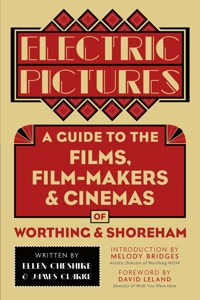
Written as part of the Worthing WOW festival celebrations, Electric Pictures commemorates 120 years of film in the Sussex coastal towns of Worthing and Shoreham, capturing the region's rich cinematic legacy and its place in British film history. From film-making pioneers through to blockbuster films and key events in the film history of the coast, this volume draws on research from film archives and local history resources to tell the story of the south coast film world. Richly illustrated and featuring contributions from local historians and film and theatre specialists, this book also includes an additional Heritage Trail guide that reveals key filming locations and the towns' cinemas.
Sie lesen das E-Book in den Legimi-Apps auf:
Seitenzahl: 180
Veröffentlichungsjahr: 2017
Das E-Book (TTS) können Sie hören im Abo „Legimi Premium” in Legimi-Apps auf:
Ähnliche




















First published in 2017
The History Press
The Mill, Brimscombe Port
Stroud, Gloucestershire, GL5 2QG
www.thehistorypress.co.uk
This ebook edition first published in 2017
All rights reserved
© Ellen Cheshire & James Clarke, 2017
The right of Ellen Cheshire & James Clarke to be identified as the Authors of this work has been asserted in accordance with the Copyright, Designs and Patents Act 1988.
This ebook is copyright material and must not be copied, reproduced, transferred, distributed, leased, licensed or publicly performed or used in any way except as specifically permitted in writing by the publishers, as allowed under the terms and conditions under which it was purchased or as strictly permitted by applicable copyright law. Any unauthorised distribution or use of this text may be a direct infringement of the author’s and publisher’s rights, and those responsible may be liable in law accordingly.
EPUB ISBN 978 0 7509 8202 3
Original typesetting by The History Press
eBook converted by Geethik Technologies
CONTENTS
About the Authors
Acknowledgements
Foreword by David Leland, Director of Wish You Were Here
Introduction by Melody Bridges, Artistic Director of Worthing WOW
Part 1:
A New Wave of Entertainment: Film-making in Worthing and Shoreham
1 Movies and Bungalows: The Story of Shoreham Beach
2 Early Actuality Films: Superstar Cinematographer in Worthing
3 Shoreham: England’s Hollywood by the Sea
4 Progress Films at Shoreham
5 A Close Look at A Lowland Cinderella
6 Scoring A Lowland Cinderella
7 ‘Lost’ Progress Film Found: Fires of Innocence
8 Nell Emerald: Jewel of the South Coast Movieland
9 Shoreham’s Leading Lady: Joan Morgan
10 The Star of Casterbridge: Mavis Clare and her Progression with Progress
11 On the Border: What a Coastal Setting Might Mean
12 SASE’s Shoreham & Worthing Collections
13 Eric Sparks: Worthing’s Saviour of Silent Film
Part 2:
Electrifying the Imagination: Cinema-going in Worthing and Shoreham
14 Cinema-going: A History
15 Echoes of Lancing’s Cinemas Past
16 ‘How Lucky Can You Be!’ Sir Sydney Samuelson CBE
17 Heritage Trail
18 Filmography of Worthing, Lancing and Shoreham, 1898–2015
Further Reading
I’d like to dedicate my work for this book to my grandad, Arthur Bowden.
It’s good to bring the story full circle, Pop.
James
My father, David F. Cheshire, was a theatre historian who specialised in two areas: British music hall and theatre buildings. So, for me, this project was a real nod to my dad as I explored the bridge between British music hall and early film-making, and the transition in theatre-going to cinema-going and the changes these brought about in theatre and cinema buildings. Miss you Dad!
Love Ellen
ABOUT THE AUTHORS
ELLEN CHESHIRE is a freelance film researcher, writer and lecturer. She has published books on biopics (for Columbia University Press), Ang Lee and Jane Campion (for Supernova Books), Audrey Hepburn and the Coen Brothers (for Pocket Essentials), and has contributed chapters to books on James Bond and Charlie Chaplin (for Taschen Books), silent film and counterculture (for Supernova Books), fantasy films (for MS Publications) and war movies (for Ian Allen). She has lectured in film and media at the University of Chichester and Chichester College. In 2016 she was Film Historian for Worthing WOW’s Heritage Lottery funded project celebrating 120 years of film in Sussex.
JAMES CLARKE is a freelance writer and lecturer. His books include The Virgin Film Guide: War Films and Movie Movements: Films that Changed the World of Cinema and he has contributed to The Rough Guide to Film. He has worked extensively in community film-making and film education and several of his short film projects have played at national and international film festivals. He writes regularly for the magazines 3DArtist and SciFi Now. His writing has also been published by Resurgence and Country Walking magazines. James has taught at a number of universities, including the Universities of Gloucestershire and Warwick. James is currently co-writing a feature-film screenplay.
ACKNOWLEDGEMENTS
There are many people to thank. Firstly, thank you to Melody Bridges, Worthing WOW, The History Press and Heritage Lottery Fund for allowing us to take this wonderful journey through 120 years of film-making and cinema-going in Worthing and Shoreham.
Helping us along the way have been film historians Frank Gray at Screen Archive South East, Kevin Brownlow, Tony Fletcher, Martin Humphires and Ronald Grant. From a local history perspective, thanks go to Emma O’Connor, curator at Sussex Past/Marlipins Museum, Gary Baines and Sharon Penfold at Shoreham Fort, Brian Meetens, Ian Merriwoode, Roger Bateman, Kelly Mikula at Sussex Film Office, Stefan Sykes at Worthing Film Club and the team at Ropetackle in Shoreham.
Special thanks go to David Leland for speaking to James about his memories of making Wish You Were Here and to Sir Sydney Samuelson for talking with Ellen, and to Gillian Gregg for allowing us to use images from her archives.
Photographs: thanks go to everyone who helped to source and share some incredible images. We have added a credit alongside each photograph. We have endeavoured to find the copyright holder for all images but apologise to anyone we may have inadvertently missed out.
FOREWORD
I am appalled by my ignorance. Having devoted most of my life to working in the film and television industry, I discover I have been ignorant of a significant portion of British cinematic history. That is, until I read this thoroughly entertaining book, Electric Pictures.
The first surprise in the book, which is full of fascinating information, is that film was first shown in Worthing in 1896. That’s ninety years before I showed up in the town with my crew to make my feature film Wish You Were Here. At the time, I was unaware that, as film-makers, we were part of an ongoing film-making tradition on that part of the south coast.
Incongruously, it all began along the south coast with a burst of activity at newly constructed film-studio space at Shoreham-by-Sea. By 1918, it had become the blue touchpaper for a cinematic explosion across the UK. Here were the trailblazers of early cinema, and this book offers extraordinary insights into their film-making on the south coast of England, a place that was to become known as Hollywood by the Sea.
During the silent film era, crowds would show up to watch the filming; it was a spectator sport. One of the biggest crowds turned out to watch a comic scene of two men trying to carry a piano through deep mud on a river bank – god knows how it got there. It was called Moving a Piano, of course. The rumour was that Charlie Chaplin had travelled from Hollywood to feature in the scene. On the day, the two actors were covered in so much mud the crowd couldn’t tell if it was Chaplin or not. The rumour was never resolved. The sequence reminds me of a Laurel and Hardy film that both amused and alarmed me as a boy – they wreaked so much havoc – featuring Stan and Ollie delivering a piano up a flight of extremely high steps. You can find it on YouTube. Chaplin may not have appeared in Shoreham, but he did make a silent film called Musical Tramp in which – guess what? – he moves a piano up extremely high steps. Brilliant. Very funny. This leaves me wondering if Laurel and Hardy saw this film before they made theirs. And this is the wonderful thing about this book: it sends one off to looking for gems one might not ever have discovered.
Among the numerous stories of the films and filming at Hollywood by the Sea featured in the book, there is Joan Morgan. I must confess I had never heard of Joan. She became a child star before the First World War, went to Hollywood when she was 15, returned and went on to star in numerous films made in Shoreham. Before the Second World War, she was linked to the Fascist movement, survived, made more films, and lived to be 99. One of her quotes strikes me as being particularly prescient for our times. Commenting on the British way of life, she said, ‘We’ve been successful for so long that we still blindly believe in our ability to muddle through.’
A still from the Wish You Were Here shoot, with David Leland rehearsing with Emily Lloyd on Worthing seafront. ‘I’m showing her how to pose like Betty Grable.’ (Courtesy of Ian Pleeth)
Kevin Brownlow’s piece on his encounters with Eric Sparks, a cantankerous and anti-social collector of transport films, is a knockout.
Discovering the Dome Cinema in Worthing when we were filming Wish You Were Here was a stroke of great good fortune. On the back row of the stalls, there were ‘double’ seats specially made for courting couples, with cupids in plaster relief on the wall behind them. I hope they’re still there. At that time there were plans to demolish the Dome to make way for a high-rise car park. We did our bit to support the campaign to preserve the Dome. Good sense prevailed over commerce and the Dome survived. It is a cinematic treasure. Long may it remain.
Now read on …
David Leland, 2017 Film director, screenwriter and actor
INTRODUCTION
Until recently a crumbling plaque fixed to the wall of the Pavilion Theatre at the land-end of Worthing Pier informed visitors that film was first shown in Worthing in 1896. One day during the summer of 2015 I was looking at this plaque when it struck me that the 120th anniversary of that event would be the perfect time for a project about the history of film in Sussex. I contacted the Heritage Lottery Fund with this suggestion, and was fortunate to secure the necessary funding for Worthing WOW to lead this project.
I had, as it happened, recently had a meeting with Ellen Cheshire, and I realised at once that she would be the perfect choice to be the project historian. And so began a year-long adventure across time, looking back at 120 years of film activity in Worthing and Shoreham. This culminated in a series of exhibitions and events in May and June 2016, a Heritage Trail app, and now this fascinating book, full of quirky facts, amusing anecdotes and insightful analysis.
There were a number of exciting discoveries along the way. Films thought to be lost were recovered, and new connections were established. Cinema-going, the history of cinema and film-making itself are interconnected worlds, and Ellen Cheshire and James Clarke have deftly interwoven them in the pages that follow.
The story begins at the time when music hall was the dominant form of popular entertainment, and the Electric Pictures no more than a novelty attraction. No one guessed that ‘the Magic Lantern’, as early cinema was also sometimes known, would within a few years become both a major art form and a massive industry generating billions of dollars of revenue. Cinema-going has survived the arrival of television and the DVD, and millions of people still attend regularly, watching everything from Hollywood blockbusters to obscure European films, children’s adventures to cult classics.
Cheshire and Clarke take us on the twelve-decade journey from 1896 to 2016, stopping off to examine – among other things – silent films, early cinematographers, and Charlie Chaplin and Alfred Hitchcock’s visits to Worthing. During that period cinemas have opened and cinemas have closed, but the art of film storytelling has remained as vibrant and innovative as ever.
Nearing the present day, this book looks at major films that were filmed in our area – including The Da Vinci Code – and notes the growing number of production companies that are active here, as well as the newly formed Sussex Film Office. These new bodies will help to ensure that the buildings and the landscape of Sussex continue to be immortalised on film.
Meanwhile, as a by-product of the Worthing WOW film project and the 2016 Festival, there is now a shiny new plaque on the side of the pier’s southern pavilion, to remind future generations of the town’s important place in the history of cinema.
Melody Bridges
Plaque marking the first ‘film’ screening in West Sussex at Southern Pavilion, unveiled in May 2016.
The Storytelling on Film Project: Then and Now – held in 2016 and funded by the Heritage Lottery Fund – consisted of two exhibitions, several school workshops and numerous special events, which were enjoyed by over 10,000 people. The discoveries and activities have been archived at a new webiste, www.filminsussex.co.uk, which, together with the present book, will ensure that the research of 2016 and the record of that year’s festival will remain available to film historians and lovers of cinema.
Melody Bridges is the Artistic Director of Worthing WOW, a non-profit-making body that exists to promote arts, culture and heritage in Sussex. It provides a platform for new work, celebrates creativity, and encourages artistic expression.
The history of British film-making is powerfully tied to the development of the medium. In early twentieth-century Worthing and Shoreham, pioneering film-makers set up their studios by the beach, making the most of the picturesque area as a place in which to put movies into motion. This section introduces key players and productions that emerged in the film-making history of the area, from sensitively rendered melodramas to thrifty 1950s B-movies.
The early twentieth century saw a vibrant influx of new residents and industries to the small south coast seaside town of Shoreham. Of particular lasting importance was the establishment of ‘bungalow town’ and the development of the early film industry on Shoreham Beach for a decade from 1914–1924. The beach community thrived for many years until the sudden evacuation of residents and the clearing of the buildings at the outbreak of the Second World War.
Developing ‘Bungalow Borough’
The spit of shingle beach that was to become known as Bungalow Town was largely undeveloped and uninhabited until the latter part of the nineteenth century.
The 1891 census for the area lists no residential beach properties other than the Shoreham Coast Guard Station and Shoreham Fort. However, the beginnings of the beach development are clearly there as the same census records three unoccupied ‘beach huts’.
In 1879 a local oyster merchant, John Maple, had sited an old railway carriage on the beach to serve as a store for fishing equipment and as a part-time bathing hut. Maple later developed the building, and it became the bungalow ‘Sea View’.
In 1896 there were just eleven dwellings listed on the beach. By 1900 there were 120 and in 1909 this had increased to 200 dwellings. The arrival of Marie Loftus, one of the country’s most popular entertainers, is said to have led the theatrical colonisation of Bungalow Town. The idyllic setting soon attracted many of her friends from London – life on the beach offering a welcome respite to the pressures of appearing on stage. This ‘bungalow boom’ was also made possible with the advent of a direct train service from London in 1897.
Within just a few years the beach had become known as a popular bohemian holiday destination.
Building the Bungalows
Plots of land on the beach could be purchased through agents acting on behalf of the landowners. In 1900 the price of a plot was around £25 (now about £2,775). The plots were generally 20 sq. m and several people purchased double or even larger plots.
Feature in the Daily Express on the development of Bungalow Town, 16 August 1904.
The majority of owners had their holiday homes built around redundant railway carriages, which cost around £10 each (£1,100). Carriages, usually from the London, Brighton and South Coast Railway, once stripped of usable parts offered a comparatively quick and affordable means of building a holiday bungalow.
The bungalows were generally formed of two carriages placed, parallel to each other, on the simple foundation of a concrete ‘raft’ over the shingle. The space between the carriages would be swiftly and inexpensively roofed over with corrugated iron. The central space became one or two rooms and the coach compartments were converted into bedrooms and kitchens. Verandas were created at one or both ends and in several instances additional storeys were added.
There was no planning control and amongst the more typical bungalows were several that displayed an owner’s individual taste – these included a castle, a Queen Anne-style mansion and a Chinese pagoda.
The beach was split into two areas: the east and west. A number of the bungalows along the eastern side, around what became Ferry Road, were considered ‘shaky’, with poorer foundations.
The proximity of the sea and the somewhat flimsy construction methods and materials meant that the bungalows were vulnerable to the elements. Fire and storm damage were a regular cause of loss; a newspaper article of 1935 reported that railway carriages were no longer to be allowed on the beach and all new properties had to be constructed of fire resistant materials.
Life on the Beach
Until the 1920s there was little development of infrastructure on the beach to support the bungalow colony.
Access to the beach remained difficult, especially on the eastern side. There were just a few rough roads and most people relied upon rowing boat ferries that operated from the town, though this service was weather dependent.
Built in 1910 the railway station Bungalow Halt served the western end of the beach until 1933. The first footbridge was constructed in 1921 but this was initially a toll bridge: 1d each way for adults, a halfpenny for children and 1d for bicycles.
Many of the bungalows were occupied by their owners but a considerable number were let as furnished rentals for long and short seasonal periods. The influx of visitors contributed significantly to the local economy.
One local in particular, butcher Tom Avis, took advantage of the affluent holidaymakers, declaring he ‘made the wealthy blighters on the beach pay extra’ (Shoreham Herald, 1914).
A group of young people enjoying life at Shoreham in 1913 proved to be the envy of Londoners according to the Daily Sketch, 20 July 1913.
The End of an Era
Although the brief flourishing of the film-making companies came to an end in 1923, Bungalow Town continued to provide a haven for theatrical residents.
The carefree life the beach residents enjoyed came to an abrupt end in July 1940. As German forces amassed along the French coast the War Office demanded that all south-coast beaches should be made ready to defend the country in the event of an invasion.
Evacuation notices were issued to those living on the beach; residents were given just forty-eight hours to pack their possessions and vacate their homes.
The army was deployed to demolish the bungalows and the majority of the buildings were soon lost. The beach was then laid with a series of minefields and covered in barbed wire. Remarkably, a few of the beach homes escaped the destruction, and today visitors, if they look carefully enough, can find one or two of the original bungalows with a railway carriage at their heart.
Surprisingly, the glass daylight studio survived the Second World War but was eventually demolished in 1963.
BRIGHTON AND HOVE CINEMA PIONEERS
From the dawn of cinema there has been film-making on the south coast, and at the turn of the century the epicentre was Brighton and Hove. For more information on this important and vibrant moment in film-making history do visit the permanent exhibition at Hove Museum, or make use of the online resources on the Brighton Museums’ website.
In April 1898 one of the world’s first superstar cameramen visited Worthing to capture the realities of a British seaside resort on film.
William Kennedy Dickson (1860–1935) was a Scottish inventor who moved to America in 1883 and worked with Thomas Edison. In 1889 Edison, keen to develop a machine that would ‘do for the Eye what the phonograph does for the Ear’, commissioned Dickson to make this a reality. Dickson and his team spent two years developing ‘the Kinetoscope’ and in 1891 unveiled their first working prototype; in 1892 he turned to producing films that would put the device into use. The following year saw the first public demonstration of the Kinetoscope. It may now be better known as a ‘peep show’ (or a ‘what the butler saw’) as this machine allowed only a single viewer to look through the small hole, and see a short roll of 35mm film on a continuous loop. On 14 April 1894 ten machines were installed at Kinetoscope Parlour in Broadway, New York, to great success. During that year Dickson made seventy-five films of approximately twenty seconds in length for these machines.
Unbeknown to Edison, Dickson was also secretly working with other inventors to create better and/or cheaper alternatives to the Kinetoscope. At Woodville Latham, with former Edison employee Eugene Lauste, they developed a system for showing much longer strips of film, and created an early projector, the Eidoloscope. Some claim this combination of film and projector was the first commercial film screening in May 1895.
With Herman Casler he developed the much cheaper machine, ‘the Mutoscape’, which used a flipbook method of delivery (rather than film) and a large-format 70mm Biograph camera.
Dickson left Edison’s in 1895 and with three other partners, including Casler, formed the American Mutoscope and Biograph Company. In 1897 he returned to Britain as manager and chief cameraman of British Mutoscope and Biograph Company. Using a Biograph camera he captured major events on film such as Queen Victoria’s Diamond Jubilee procession (1897) as well as smaller local activities.
On 6 and 7 April 1898 he visited Worthing and over the two days he made at least seven films: three films of a Worthing lifeboat; two of the steamboat Brighton Queen; people walking along the seafront and a water polo match at West Worthing Baths. Three films are known to survive, two from the lifeboat sequence and the water polo match.
In its May 1898 edition, The Optical Magic Lantern Journal gave an account of Dickson’s two days in Worthing:




