


14,99 €
Mehr erfahren.
- Herausgeber: Parkstone International
- Kategorie: Geisteswissenschaft
- Sprache: Englisch
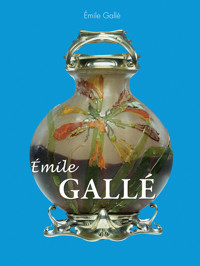
An icon in the Art Nouveau movement, Émile Gallé (1846-1904) sought to portray the beauty and simplicity of nature in his glass art. His designs, referred to as “poetry in glass”, range from fine pottery to jewellery to furniture. Everything Gallé produced contains traces of his masterful technique which reflects his innovativeness as an artist and his skill as a designer. In this rich text, Gallé unravels the beauty and ingenuity found within his own work.
Das E-Book können Sie in Legimi-Apps oder einer beliebigen App lesen, die das folgende Format unterstützen:
Seitenzahl: 172
Veröffentlichungsjahr: 2023
Ähnliche


















Author:
Émile Gallé
© 2023 Confidential Concepts, worldwide, USA
© 2023 Parkstone Press International, New York, USA
Image-Barwww.image-bar.com
All rights reserved.
No part of this publication may be reproduced or adapted without the permission of the copyright holder, throughout the world. Unless otherwise specified, copyright on the works reproduced lies with the respective photographers, artists, heirs or estates. Despite intensive research, it has not always been possible to establish copyright ownership. Where this is the case, we would appreciate notification.
Émile Gallé
Contents
INTRODUCTION
LOVER OF NATURE
The Best is the Enemy of the Good
The Symbolic Decor
Toast Pronounced at theLorraine-ArtisteBanquet on 16 February 1901
Porcelain
L’École de Nancy in Paris
MASTER GLASSMAKER
The Pasteur Vase
The Balsam Tree
The Hazel Tree
Wreck
TheProuvéVase
THE OFFICIAL ARTIST
About the Prix de Rome
The Exhibitions of 1897
My Shipments to the Salon
Goncourt and the Arts and Crafts
THE DECORATOR
Contemporary Furniture Adorned by Nature
The Table with Garden Herbs
Fruits of the Spirit
BIOGRAPHY
Pitcher, c. 1878. Faience, yellow flakes,
white tin glaze, height: 45cm,width: 38cm,
depth: 19cm.
INTRODUCTION
“Chasseur et Chasseresse” coffee service, 1882-1884.
Faience, yellow flakes, blue tin glaze,
coffee pot: height: 26.5cm,width: 22cm,
depth: 15cm.Musée de l’École de Nancy, Nancy.
During the end of the 19th century, Western Europe experienced a great rebirth and reinvigoration in decorative arts, with a focus on the imitation of nature. In fact, in the 1860s, vital scientific works (by Haeckel, Kommode, Blossfeldt, etc.) were published, offering the new art a repertoire of forms, and directing it towards a path of modernity. At the same time, a taste for Japanese art started to develop, seen through personalities such as Hayashi Tadamasa, an art dealer, who set up residence in France, enabling Western Europe to discover Japanese modes of production. Japanese art is based on the observation of nature, on the poetic interpretation of natural forms. Science and art displayed a similar move towards renewal during the 19th century.
This went hand in hand with an artistic awakening of nationalities throughout Western Europe. It was no longer a question of the past nor foreign taste. Instead each nation developed its own aesthetic. Above all, functionality became a priority in arts, decorative embellishments were reduced and useful decoration and objects moved to the foreground. Such art was forbidden during the century through various trends: “[this century] had no folk art” said Émile Gallé in 1900. In the 1870s to the 1880s, their forces returned. What was seen as superfluous in the past was revived in the field of arts. All these events occurred in Western Europe at the same time, and led in the late 19th century to the birth of Art Nouveau, a name that perfectly reflected the innovativeness of the art movement. Although an overall stylistic similarity existed, the formal development of Art Nouveau varied from land to land.
The 1889 World Exposition in Paris reflected the scale of the influence of Art Nouveau, exposing a complete image not only of the various areas of production, but also of the national tendencies. Art Nouveau exploded in France in 1895 in a similar way that Alphonse Mucha’s placard for Sarah Bernhardt in the role of Gismonda caused a sensational uproar. In December of the same year, Siegfried Bing, an art dealer with German ancestry but French nationality, opened a gallery entirely devoted to Art Nouveau and played a significant role in the diffusion of the movement.
“Fleurs ornemanisées”, four bowls, “Animaux héraldiques” service, 1884.Faience,
grey flakes, blue tin glaze, height: 3.5cm,width: 22cm,
depth: 19cm.Landesmuseum Württemberg, Stuttgart.
In the realm of decorative arts Émile Gallé (1846-1904) – a Nancy-born glassmaker, carpenter, and ceramicist – acquired over the decade much fame with his Art-Nouveau-style art pieces. He incorporated his passion for botany in his father’s trade of pottery and glassware in 1877. His inspiration came from nature and from the works of Japanese artists, which he collected. He developed new techniques, filed patents, and directed various steps in the process of development, a legacy in the industrial revolution in his workshops. During the 1889 World Exposition, Gallé received three awards for his entries. He then acquired the epithet homo triplex from the critic Roger Marx.
In 1901, together with Victor Prouvé (1858-1943), Louis Majorelle (1859-1926), and Eugène Vallin (1856-1922), he founded Alliance Provinciale des Industries d’Art, also known as École de Nancy. Their goal was to eliminate the separation between disciplines: there should no longer exist a distinction between experienced and unexperienced artists. Nature is the foundation of their aesthetic, seen through the creation of flower and plant stylisation. After Art Nouveau reached its peak in 1900, he quickly disappeared from the world of art. In contradiction to his major speeches, Art Nouveau is a luxury style, difficult to reproduce on a large scale. The First International Exhibition of Modern Decorative Arts in Turin of 1902 indicated that a new art movement was already underway: Art Deco.
Stationery holder, c. 1878.Faience,
yellowish flakes,white tin glaze,
height: 13.5cm,width: 34cm,depth: 20.5cm.
LOVER OF NATURE
Daisies inkwell, before 1872.Faience,
yellow-reddish flakes,white tin glaze,
height: 6.5cm,width: 7cm,depth: 7
Miniature commode, before 1872. Faience,
yellow-reddish flakes,white tin glaze,
height: 13.5cm,width: 23cm,depth: 14.5cm.
Landesmuseum Württemberg, Stuttgart.
The Best is the Enemy of the Good
The constant need to create something new makes us sometimes forget the rules of taste and aesthetics. Have we not witnessed before, people raving about this nonsense: a green rose! A green rose is not a rose, it is a Brussels sprout.
This desire to innovate, based on commercial requirements, would eventually cause the undoing of nature’s charm, replacing grace with stiffness. Out of this flower called violet, we make a wallflower and we rejoice.
Thus we can see one of our excellent and distinguished colleagues in the horticultural press write the following odd lines, about the bearing of one of the most graceful plants: “If I have one criticism to make about the genus Fuchsia, it would be about the pendulous, ‘tear-drop’ shape of the flowers, which means that we can see them only from underneath, making them unsuitable for bouquets.” Hence, he advocates an old form Fuchsia erecta of which he gives a sample. “Look at these massive rods, swollen, abnormal, these stiff stems, called ‘made of iron’, then you will get a sense of what, sometimes, disturbed by intensive farming, nature had done so well to be seen from the bottom up.” The florist Garo “can obtain something ugly with one of the most beautiful, the most dainty floral arrangements, these tiny threaded bells, these coral and garnet pendants, these ‘earrings’ as pointed out by our good friend Carrière.” Little did he know just how right he was when the famous Parisian jeweller, Lucien Falize, created those earrings one day, with rubies and diamonds, the most exquisite ornaments, for the ears of a princess of the Arabian Nights.
The horticultural selector needs a natural taste originating from a sincere admiration, to be passionate of natural masterpieces. His role is not to alter, to distort in a counter-aesthetic way to unbalance ungracefully the natural characteristics of a genre, but to exalt only those that are decorative, stylish, and to bring them to their supreme beauty. The sower of fruit who would make the other earring, this delightful gem, out of a cherry, from the branch to the lips, an artificial fruit, set up on a tight wire, would it not deserve to be hanged on its tree?
Fortunately, the public is resistant to certain innovations. See how happily they discovered again in the exhibitions, among the collections, natural and simple shapes. Also, the Fuchsia erecta does not scare us. For a long time it will not take down the nice ‘earrings’ that embellish our windows and balconies.
The Symbolic Decor
Acceptance speech delivered at the Académie de Stanislas in the public session of 17 May 1900 and printed in the“Mémoires de cette Compagnie”in the seventeenth book of the fifth series, for Émile Gallé’s election as a member of the Académie de Stanislas in 1891:
At the very moment when I came here to thank the Académie de Stanislas for the honour it has bestowed upon me by public admission, I am aware of what I owe you for the hospitality: almost ten years!
My mentors have not been too harsh towards the parsimony of my contribution to their works. And I am only too well aware of your patience, as well as of the insufficiency of my credentials compared to your favours.
These delays, simply tolerated by you, deprive me today of joy. Two friends who were my guarantors with you are missing – Jules Lejeune and Pastor Othon Cuvier are no longer with us. I mention these two noble persons, not out of vanity, but I appreciate that by welcoming a craftsman too superficial in his various experiments, you paid credit to the good judgement of these two valued men, both of them being paragons through the light of their charity, their tolerance of any sincere belief, and their honourable zeal to unite men in appreciation, study, and peace.
They only had to alleviate a little my anxieties and doubts, not about your kindness, but about myself. My commitment to our Academy dates far back to my youth, to the days of annual sessions, these ancient and good Thursdays in May when my classmates from high school in Nancy, Hubert Zæpfell and the angelic Paul Seigneret, two pure victims, picked us up from the joys of the noisy Institution Leopold to come and listen, in this royal decor, to the Lacroix, the Margeries, the Burnoufs, the Benoîts, the Godrons, the Lombards, the Vollands, and the Duchênes.
Our young humanities savoured the indulgence of a generous science, of an Atticism, pretty as the golden Jean Lamour guipure. Who would have thought that the mediocre student of the best masters ever would one day dare to present, here, in front of many, a belated French essay?
This task will find favour, I hope, more easily thanks to the choice of a familiar theme in my usual work. It might be more sincere and more significant. Hence it is from a composing decorator, an image assembler, who requires voice this time, who wants to talk to you about the symbolism in the decor.
Imagining themes that are specific to coating lines, shapes, shades, thoughts, the decoration of our homes and the objects of utility or pure pleasure, adapting its purpose in a material-specific way to metal or wood, marble or fabric; it is, without any doubt, an absorbing occupation. But it is actually more serious, the consequences grave, which the creator of the adornments usually does not suspect.
Daisy vase (front and reverse),1874-1878.
Faience, white tin glaze, yellow-reddish flakes,
height: 17.4cm,width: 17cm,depth: 7.5cm.
Smoking service: tray, tobacco tin, ash tray,cigarette holder, and match case, date unknown.
Faience. Landesmuseum Württemberg, Stuttgart.
Each implementation of human effort, however minute the overall result may be, is summed up in the gesture of the sower, sometimes an awe-inspiring gesture. However, per chance or intentionally, the designer, too, acts as the sower. He plants a field, the decor, devoted to a special culture, the decor, to tools, to some workmen, to germs, to special crops.
Because among the ornaments that arise from his conventional issues, the most humble as the most exalted ones can one day become elements in this compelling documentary ensemble: the decorative style of an era. Indeed, any creation of art is conceived and born under influences, amidst the atmosphere of reverie and the most customary volition of the artist. It is there, in any case, that his work arises from. Regardless of his consent, his concerns are like a newborn for godmothers, good fairies, or witches, who cast evil spells or confer magical gifts.
The work will bear the indelible mark of cogitation, a passionate habit of mind. It synthesises a symbol in the unconscious, in the depth. Some Asian rugs contain, amongst the frame and the wools, a silky female hair, that is the personal branding of the task performed, such as a faded ribbon in a closed book reveals the page meditated upon, preferred, the page sometimes interrupted forever.
Thus, the designer intermingles into his book something of himself. Later on, we unravel the skein; we will find the blanched hair, the dried tears – making the autographs of Marceline Valmore often unreadable – and exhale something inaudible or the sigh of weariness and disgust for the involuntary and repulsive task, or the manly satisfecit of the poet:
Oh night, friendly night, desired by the one
Whose arms, truthfully, can say today
We have worked!
We ignore the name of this fine artist thinker, Egyptian statuary, royal goldsmith, mage, or temple decorator, who, having stopped to contemplate the agitation of a muddy insect, the dung beetle, the dung-making skua kneading a ball of manure, in order to lay its eggs into the heat of the Libyan sand, was moved by religious respect.
He was the first one to know, beyond the appearances, to discover a noble image and invent this mystical gem, the sacred scarab. Its forelegs – and later in the Phoenician imitations its outstretched wings – support the solar sphere, source of the light, of the heat; in his hind legs he maternally rolls another celestial body, a globe, the earth where it puts down the seeds of life. What a testimony given by the inventing artist, to the existence of a creative God, the providential development of the satellite with the source of heat! Strange and very ancient prescience, it seems, the global terrestrial planetary form itself: here you have an artistic, cosmographic, religious, and divinatory symbol. But what is especially corroborated with the artist is that such an invention is a testament of the spiritual quality and the habitual thinking of surprising and prophetic beauty.
Hen terrine, after 1880.
Faience, yellow flakes, white tin glaze,
height: 16cm,width: 27cm,depth: 18cm.
Musées royauxd’Art et d’Histoire, Brussels.
Lion-shaped candlestick, 1874.
Faience, reddish flakes, white tin glaze,
height: 43cm,diameter: 23cm.
Cockatoo pitcher, designed in 1874,executed in 1889.Faience, yellow flakes,
blue tin glaze, height: 38cm,diameter: 19cm.
Musée de l’École de Nancy, Nancy.
Duck jardinière, 1884-1889.
Faience, yellow flakes, white tin glaze,
height: 18cm,width: 21cm,depth: 14.5cm.
Designmuseum Danmark, Copenhagen.
This characteristic example allows me to set aside the more or less boring definitions that have been given for symbol, symbolism, and symbolic art. We mean it, don’t we? That the symbol in the various fields of art, poetry, religion, is the representation of a thing, usually an abstract, conventional representation, agreed amidst insiders, which is in the decor, in the vase as well as in the coin, the statue, the painting, the bas-relief, the temple, or in the poem, the sung or mimed work. It is always the translation, the awakening of an idea for a picture.
In the unpolished symbol surges the epitome, said Maurice Bouchor. And the symbolic decoration humbly adapts to this definition: up to it to render just any figure ornamental, any synthesis of drawing, plastic, shades, designed to turn them into the most subtle abstractions provided he is something of a poet, he has carte blanche, for the poet is a symbolist par excellence. How will the decorator do it? A bit like Bernardin de Saint-Pierre: “I will bring a rose bud with thorns as a symbol of my hopes, mingled with many fears.”
But it is desirable that the symbol is not too enigmatic for the spirit of France likes clarity. As Hugo says:
The idea that to which everything yields is always clear.
And the French audience, in front of the modern British anthologies, sometimes real blooming charades, takes pride in the end, as Victor Hugo, deciphering the riddle:
A Rose said: Guess!
And I replied: Love!
Does this mean that the rose is more romantic than the peony? “The weeping willow,” said the aesthetician Lévéque in The Science of Beauty, “does not weep more than other willows, the violet is not more modest than the poppy.” The moral expression of plants is purely symbolic.
Fellow citizens of one of the most charming symbolists, Grandville, we have learned to read in Animated Flowers and Stars, and we know that this eloquence of the flower, through the mysteries of its body and its destiny, through the synthesis of the plant symbol seen through the eyes of the artist, sometimes exceeds in intensely suggestive power the authority of the human figure. We know that the expression in our heraldic thistle for example, is specific to the brave gesture and, in other plants, with a tilted front, with a thoughtful appearance, with a symbolic nuance and shade, the curves, and perfumes are the terms of what Baudelaire called: “The language of flowers and silent things.”
Owl, c. 1889.Faience, reddish flakes, float glaze
mottled in brown, white, and olive green,
height: 33.5cm,diameter: 13.5 cm (base).
“Fleurs ornemanisées” plate, “Fleurs héraldiques” service, 1889.
Faience, grey flakes, blue paste tin glaze,
height: 3.5cm,diameter: 26cm.
“Herbier Lorrain” plate, c. 1870. Faience,
grey-yellow flakes,white tin glaze,
height: 3.5cm,diameter: 23.1cm.
Musée de l’École de Nancy, Nancy.
This presents a question: What is the decorative quality of the symbol? To use a professional term, is the symbol in the ornament ‘furnishing’? Does the symbolist not sacrifice the pleasure of the eyes to mind games? It is certain that the symbolic sign of the noblest idea will not make a more decorative mark than any ordinary rosette, if it is not invigorated by drawings, enhanced and emphasised by simulacrum, using the prestige of reliefs or shades of colours. Equally evident is the fact that it is not the use of the symbol that will magically give special graces to a decor, without the presence of talent and genius.
But will he who does not consider that the artist looked at reproducing the flower, the insect, the landscape, the human figure, and seeks to extract the personality, the inside feeling, perform a more vibrant work and of a more contagious emotion than the one whose tool will be nothing but a camera or a cold scalpel?
The most scrupulous naturalist document reproduced in a scientific work does not move us, because the human soul is absent, whereas the reproduction, albeit a natural reproduction of the Japanese artist, for example, captured the spirit of the evocative motif in an inimitable way, or the little faces sometimes mocking, sometimes full of melancholy of the human being, the thoughtful thing. He will unconsciously, moved only by his passion for nature, create true symbols of Forest, of Joys of Spring or Sorrows of Autumn.
Thus, in the ornament, the symbol is a bright spot within the quiet and anticipated meaninglessness of the foliage and the arabesques; the symbol captures attention, it is the symbol that introduces the thought, the poetry and art. The symbols are the point where reality translates into ideas.
But also, frankly, it would be useless to advise the decorator against the use of the symbol, which is so readily accepted in poetry. And as long as the mind guides the pen, the brush, the pencil, there can be no doubt that the symbol continues to charm men. Moreover, the love of nature always leads to symbolism: the flower beloved by all, popular, will always play a major and symbolic role. Gutskow says that a researcher of true happiness, having questioned the flower, then questioned the star. In turn the star said to the man: “Go quickly back to the cornflower.”




