


28,99 €
Mehr erfahren.
- Herausgeber: John Wiley & Sons
- Kategorie: Fachliteratur
- Sprache: Englisch
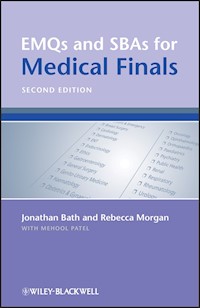
Prepare for final and penultimate-year exams with EMQs and SBAs for Medical Finals
- Five complete practice question papers for realistic preparation
- Each question paper contains 60 Single Best Answer questions and 30 Extended Matching Questions
- Includes topic index so that readers can target problem areas
- Detailed explanation of the knowledge behind both correct and incorrect answers
EMQs and SBAs for Medical Finals is perfect for the student looking to test their knowledge and identify weak subject areas. Practice questions cover all key topics in medicine, with the subject balance reflecting the weighting in real exams. For this edition, all content has been updated and focused to remain relevant for today's finalists and the exams they will face. Inclusion of the topic index means that the title allows for both wide-ranging and focused revision. All in all, an essential resource for anyone facing their final medical exams.
Sie lesen das E-Book in den Legimi-Apps auf:
Seitenzahl: 501
Veröffentlichungsjahr: 2013
Ähnliche



















Contents
Preface
Abbreviations
Part 1: Practice Papers
Paper 1 Questions
Single Best Answer Questions
Extended Matching Questions
Paper 2 Questions
Single Best Answer Questions
Extended Matching Questions
Paper 3 Questions
Single Best Answer Questions
Extended Matching Questions
Paper 4 Questions
Single Best Answer Questions
Extended Matching Questions
Paper 5 Questions
Single Best Answer Questions
Extended Matching Questions
Part 2: Answers to Practice Papers
Paper 1 Answers
Single Best Answer Questions
Extended Matching Questions
Paper 2 Answers
Single Best Answer Questions
Extended Matching Questions
Paper 3 Answers
Single Best Answer Questions
Extended Matching Questions
Paper 4 Answers
Single Best Answer Questions
Paper 5 Answers
Single Best Answer Questions
Extended Matching Questions
Topic index
This edition first published 2011 © 2011 by John Wiley & Sons, Ltd.
Previous edition © 2007 Jonathan Bath, Rebecca Morgan & Mehool Patel. Published by Blackwell Publishing.
Wiley-Blackwell is an imprint of John Wiley & Sons, formed by the merger of Wiley’s global Scientific, Technical and Medical business with Blackwell Publishing.
Registeredoffice: John Wiley & Sons, Ltd, The Atrium, Southern Gate, Chichester, West Sussex, PO19 8SQ, UK
Editorial offices: 9600 Garsington Road, Oxford, OX4 2DQ, UK The Atrium, Southern Gate, Chichester, West Sussex, PO19 8SQ, UK 111 River Street, Hoboken, NJ 07030-5774, USA
For details of our global editorial offices, for customer services and for information about how to apply for permission to reuse the copyright material in this book please see our website at www.wiley.com/wiley-blackwell.
The right of the author to be identified as the author of this work has been asserted in accordance with the UK Copyright, Designs and Patents Act 1988.
All rights reserved. No part of this publication may be reproduced, stored in a retrieval system, or transmitted, in any form or by any means, electronic, mechanical, photocopying, recording or otherwise, except as permitted by the UK Copyright, Designs and Patents Act 1988, without the prior permission of the publisher.
Designations used by companies to distinguish their products are often claimed as trademarks. All brand names and product names used in this book are trade names, service marks, trademarks or registered trademarks of their respective owners. The publisher is not associated with any product or vendor mentioned in this book. This publication is designed to provide accurate and authoritative information in regard to the subject matter covered. It is sold on the understanding that the publisher is not engaged in rendering professional services. If professional advice or other expert assistance is required, the services of a competent professional should be sought.
Library of Congress Cataloging-in-Publication Data
Bath, Jonathan.
EMQs and SBAs for medical finals / Jonathan Bath, Rebecca Morgan, Patel, Mehool. p. ; cm.
Rev. ed. of: EMQs and MCQs for medical finals / Jonathan Bath, Rebecca Morgan, Mehool Patel. 2007.
Includes bibliographical references and index.
ISBN978-0-470-65444-6 (pbk. : alk. paper)
1. Medicine–Examinations, questions, etc. I. Morgan, Rebecca. II. Patel, Mehool. III. Bath, Jonathan. EMQs and MCQs for medical finals. IV. Title.
[DNLM: 1. Medicine–Great Britain–Examination Questions. W 18.2]
R834.5.B37 2011
610.76–dc22
2011007201
A catalogue record for this book is available from the British Library.
1 2011
Preface
The idea for the first edition of EMQs and MCQs for Medical Finals was to provide a solid question book that provided detailed explanations with the answers to enable the reader to learn not only why the answer was correct, but also why the other options were incorrect. At the time of publication in 2007, the number of question and answer books with this detailed answer format was limited, allowing EMQs and MCQs for Medical Finals to establish a niche, which has been quickly recognized by subsequent question and answer books to be the preferred format for examination preparation resources.
The second edition reflects feedback from many students, doctors and other readers and has led to many improvements. The title of the book has evolved to better describe the question format used in current examinations, question stems have been shortened to allow quick and precise reading of questions, and factual information has been updated where needed to reflect changes in clinical practice. Finally, the five practice examination papers have been indexed to allow for rapid review of specific areas, for example Cardiology or Vascular Surgery, as required.
We hope that these improvements will ensure that EMQs and SBAs for Medical Finals will continue to provide an excellent resource for identifying key examination topics and, more importantly, help to focus preparation on less familiar areas of knowledge for Finals.
Jonathan Bath Pittsburgh
Rebecca Morgan London
Abbreviations
AAA
abdominal aortic aneurysm
ABC
airway–breathing–circulation
ABG
arterial blood gas
ACE
angiotensin-converting enzyme
ACTH
adrenocorticotropic hormone
ADH
antidiuretic hormone
A&E
Accident and Emergency
AFP
alpha-fetoprotein
ALL
acute lymphocytic leukaemia
ALT
alanine transaminase
AML
acute myeloid leukaemia
AMT
abbreviated mental test
ANCA
antineutrophil cytoplasmic antibody
A/P
antero-posterior
APTT
activated partial thromboplastin time
ARMD
age-related macular degeneration
AST
aspartate transaminase
AV
atrioventricular
BCG
Bacille Calmette Guerin
BMI
body mass index
BPH
benign prostatic hyperplasia
bpm
beats per minute
CA 15-3
cancer antigen 15-3
CEA
carcino-embryonic antigen
CK
creatine kinase
CLL
chronic lymphocytic leukaemia
CML
chronic myeloid leukaemia
CMV
cytomegalovirus
CoA
coenzyme A
COPD
chronic obstructive pulmonary disease
CPP
cerebral perfusion pressure
CREST
calcinosis
,
R
aynaud’s phenomenon, o
e
sophageal dysmotility,
s
clerodactyly and
t
elangiectasia)
CSF
cerebrospinal fluid
CT
computed tomography
CT-PA
computed tomography with pulmonary angiography
DC
direct current
DCIS
ductal carcinoma
in situ
ds-DNA
double-stranded DNA
ECG
electrocardiogram/electrocardiography
ECT
electroconvulsive therapy
EMDR
eye movement desensitization and reprocessing
ENT
ear, nose and throat
ERCP
endoscopic retrograde cholangiopancreatogram
ESR
erythrocyte sedimentation rate
ETT
exercise tolerance test
FAST
focused assessment with sonography for trauma
FENa
fractional excretion of sodium
GBM
glomerular basement membrane
GCS
Glasgow coma scale
γ-GGT
gamma glutamyl transpeptidase
GORD
gastro-oesophageal reflux disease
GP
general practitioner
G6PD
glucose-6-phosphatase
GTN
glyceryl trinitrate
hCG
human chorionic gonadotropin
5-HIAA
5-hydroxyindoleacetic acid
HIDA
hepatobiliary iminodiacetic acid
HIV
human immunodeficiency virus
HMG CoA
3-hydroxymethylglutaryl coenzyme A
HMMA
4-hydroxy methyl mandelate
HPV
human papilloma virus
HSV
herpes simplex virus
HTLV
human T-cell lymphotropic virus
ICP
intracerebral pressure
ICU
Intensive Care Unit
IgA
immunoglobulin A
IgE
immunoglobulin E
IgG
immunoglobulin G
IL
interleukin
IM
intramuscular
INR
international normalized ratio
IUCD
intrauterine contraceptive device
IV
intravenous
IVU
intravenous urogram
JVP
jugular venous pressure
LDH
lactate dehydrogenase
LFT
liver function test
LKM1
liver/kidney microsomal type I antibodies
LSD
lysergic acid diethylamide
MAOI
monoamine oxidase inhibitor
MAP
mean arterial pressure
MCV
mean corpuscular volume
MI
myocardial infarction
MMR
measles, mumps and rubella
MRI
magnetic resonance imaging
NMDA
N-methyl-D-aspartic acid
NSAID
non-steroid anti-inflammatory drug
NSE
neurone specific enolase
OGD
oesophagogastroduodenoscopy
PaCO
2
partial pressure of carbon dioxide in arterial blood
PaO
2
partial pressure of oxygen in arterial blood
PAS
Periodic acid Schiff
pCO
2
partial pressure of carbon dioxide in blood
PCP
phencyclidine
PDA
patent ductus arteriosus
PEFR
peak expiratory flow rate
PEG
percutaneous endoscopic gastrostomy
PFT
pulmonary function test
pO
2
partial pressure of oxygen in blood
PSA
prostate-specific antibody
PSC
primary sclerosing cholangitis
PTCA
percutaneous transluminal coronary angioplasty
PUVA
psoralen plus ultraviolet A
SA
sinoatrial
SIADH
syndrome of inappropriate ADH secretion
SLE
systemic lupus erythematosus
SSRI
selective serotonin reuptake inhibitor
TCA
tricyclic antidepressant
TFT
thyroid function test
THC
δ-1-tetrahydrocannabinol
TIBC
total iron binding capacity
TNF-α
tumour necrosis factor
α
TPN
total parenteral nutrition
TRH
thyroid-releasing hormone
TSH
thyroid-stimulating hormone
TURP
transurethral resection of the prostate
vWF
von Willebrand factor
V/Q
ventilation–perfusion
VZV
varicella zoster virus
PART 1
Practice Papers
PAPER 1
Questions
Single Best Answer Questions
Lesen Sie weiter in der vollständigen Ausgabe!
Lesen Sie weiter in der vollständigen Ausgabe!
Lesen Sie weiter in der vollständigen Ausgabe!
Lesen Sie weiter in der vollständigen Ausgabe!
Lesen Sie weiter in der vollständigen Ausgabe!
Lesen Sie weiter in der vollständigen Ausgabe!
Lesen Sie weiter in der vollständigen Ausgabe!
Lesen Sie weiter in der vollständigen Ausgabe!
Lesen Sie weiter in der vollständigen Ausgabe!
Lesen Sie weiter in der vollständigen Ausgabe!
Lesen Sie weiter in der vollständigen Ausgabe!




