


Erhalten Sie Zugang zu diesem und mehr als 300000 Büchern ab EUR 5,99 monatlich.
- Herausgeber: Dostercios editorial
- Kategorie: Geisteswissenschaft
- Sprache: Englisch
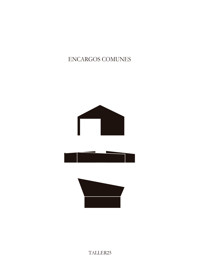
"Encargos Comunes" se presenta como un proyecto editorial que resume, a partir de tres obras de arquitectura, la práctica e investigación desarrollada por la oficina de arquitectura Taller25 en torno a esta profesión y su vínculo con la clase media contemporánea chilena. Estas obras identifican y visibilizan tres demandas sobre la vivienda: una Construcción nueva, una Reforma y una Ampliación, realizadas en comunas que normalmente se conocen como "Pericentrales" y "Periféricas" de la región Metropolitana (Lo Prado, San Bernardo y Maipú), cuyos mandantes o dueñas/os se inscriben en lo que estadísticamente se define como la clase media, transformándose así en un compendio atípico dentro de la disciplina de la arquitectura. De esta manera, la publicación propone una discusión crítica sobre la producción de la vivienda, y no de cualquier vivienda, sino de las más comunes de todas y, paradójicamente, menos abordadas desde el campo editorial y de divulgación en el área, como pueden ser las operaciones sobre la vivienda de y para los sectores medios.
Sie lesen das E-Book in den Legimi-Apps auf:
Seitenzahl: 96
Veröffentlichungsjahr: 2023
Das E-Book (TTS) können Sie hören im Abo „Legimi Premium” in Legimi-Apps auf:
Ähnliche




















© Fabiola González
© Yair Estay
© Text: the authors
© Dostercios
No part of this publication may be reproduced, stored or transmitted in any form or by any means, whether it’s electronic, chemical, mechanical or optical –including recording or photocopying- without prior authorization of the authors.
I.S.B.N: 978-956-6142-02-7
I.S.B.N digital: 978-956-6142-12-6
Editors: Ignacio A. Sáez Araneda and Patricio I. Zeiss Pérez
Management and production: Dostercios and Taller25
Graphic direction: Taller25
Graphic production: Emilio Cid and Catalina Lavanderos
Editorial design: Ignacio A. Sáez Araneda
Transcriptions: Benjamín Laura and Bárbara Gaete
Proofreading: David Romero
Photographs: Marcelo Plaza, Carlo Hevia Riera and Taller25 archive
Translation: Diego Campos
Digital layout: ebooks Patagonia
www.ebookspatagonia.com
INDEX
TALLER25: THE CRAFT AND THE OFFICE
Gabriela García de Cortázar
ENCARGOS COMUNES
Problems among architecture, housing and contemporary Chilean middle class.
NEW HOME
Labarra House
REFORMATION
Lucía House
ENLARGEMENT
Corner House
NOTHING COMMON EVERYTHING PARTICULAR
Expressions of instability and change
HOLDING AND EXPANDING THE DISCUSSION:
An open talk on architecture, housing and contemporary Chilean middle class.
Gonzalo Carrasco, Taller25
Taller25: THE CRAFT AND THE OFFICE
Gabriela García de Cortázar1
Taller25, conformed by Fabiola González and Yair Estay, is an architecture office. They design buildings, take part in the architectural debate, teach in different universities and now, they have published a book about their work. Each of these activities, that may well belong to a traditional practice, are formulated to be carried out from a periphery. For instance, with this book they have taken on the challenge that the publication of part of their work implies a responsibility of reflecting on Chilean architecture, defining their position in relation to what they call hegemonic discourse. Equally, they take for granted that distance in relation to the other aspects that define their practice. In other words (paraphrasing Juan Herreros), they have appropriated –although maybe not necessarily in a consciously manner2- the idea that the construction of their own practice is a project in itself: each of the activities they cultivate in Taller25 demonstrates that they stand, as Herreros says, “in a useful way, and necessarily in accordance with the time in which they have to operate”.
Fabiola González and Yair Estay are architects graduated from the now extinct Universidad de Arte y Ciencias Sociales ARCIS. After briefly working for other people, in 2014 they received their first commission, C House, in Villarrica, whose exceptional conditions (comfortable budget, creative freedom and extended deadlines) allowed them to imagine themselves practising their profession in an independent way. When they were working in that project, they received the commission of the house in the borough of Lo Prado, which inaugurated what would later become the “Encargos Comunes Series and Research”. At that time they decided to open an architecture office in Barrio Yungay. After the house in Lo Prado they got the commission of the house in San Bernardo, and after that, the one of the house in Maipú, which hurried the need for formulating the project that was being opened ahead of them. As their commissions were being carried out as designs, Taller25 was also naming and defining the scope of the project niche: small commissions, in peri-central or peripheral boroughs, whose architectural answer fits generally in the category of “minor work”. This would allow them to enter an area where traditionally architecture offices did not reach.
At the same time they dedicate themselves to developing these projects, they were establishing collaborative and contact networks with colleagues and contemporaries, in Chile and the rest of Latin America. Taller25 is an office that defines itself in conversation with others, since their work is not just the building, but the formulation, reflection and systematization of what has been carried out, through words and public doings. These conversations began to take place first at the Latin American level (for instance, with their participation in the 10th version of the Festival Internacional de Arquitectura de Venezuela, or the Bienal de Buenos Aires, both in 2017) and then, at their request, at the local level. Along with Nicolás Valencia, Taller25 has developed the series #XFORMAS, creating a platform of conversations that explores the tension between a dispassionate view of the architects’ work (in opposition to vocation, or genius) with the expansion of the possibilities of contemporary practice. In this series, Taller25 has made public their interest in exchanges, creating the scene at the same time they participate in it, and turning conversations towards academy, practice and the market.
Teaching is also key to Taller25 since, in their way of seeing things, it’s a space that allows for experimentation and research, as well as for new approaches to the questions they deal with in the professional sphere. In the workshop des_VINCULADOS (FAU, Universidad de Chile, 2018), they asked: “Does architecture exists in middle class?”, exploring the possibilities of designing houses with limited budgets, while in their current participation in UDLA they utilize “alterations” in order to question the definition of the ways of living in of contemporary middle class. What they work in the classroom is directly related to their questions as designers, outlining teaching as a way of looking at the old with new eyes; teaching allows them to present a question, opening it up to others’ speculation and receiving new points of view.
Taller 25 has done this in no more than ten years, more or less: they have found a project niche interesting to the discipline and sustainable in economic terms; they have formulated and made public their intellectual project; they have built bridges with teaching and the discipline’s reflection process; they have participated in –an even created- a certain local and Latin American “scene”; they have established a self-conscious practice, and they have taken a position. What are they doing now? Taller25 is working in the production of another book, drawing upon the contents of the sessions of the #XFORMAS3 series, along with Valencia, and in terms of project design in line with Encargos Comunes, they are working towards doing a “scale shift” (from the individual house to housing projects, potentially housing cooperatives in the shape of small gated communities).
Within this expansive logic, eager to connect, this book emerges as an opportunity for setting up what they have done so far, naming it and making it public. However, more than a milestone that crowns a trajectory (in the practice of architecture, ten years is a very short period), this publication aims to set a starting point. Even more: what the book contains, given the slowness of editorial projects, is a starting point that is already in the past; one they have now distanced from. How many other “Encargos Comunes” were left out of this book? In which way the next commissions are or will be included in the series? What features make a commission “Común”? How many projects are part of the series? When does it end? The definition of the series –its direction- is therefore the most necessary project, and the affirmation of the role played by each part, the most urgent one.
If we observe the projects presented here only as buildings, there is nothing to relate them in terms of the construction: the materials used are diverse (one has details in the brick surface, another has new smooth surfaces covering the original, the third uses light veneers), the same as the structural solutions (one adds wooden trusses, another strengthens the masonry with reinforced concrete reinforcements, the third adds metallic carpentry), and the strategy for intervening changes (one fragmentizes and fills in, another acts on what has already been built, the third adds a second floor). In this sense, the architectural project is not a series. On the other hand, neither are the commissions; as Taller25 tell us, each case is unique, with different actors getting together in space and time to generate them: children that remodel a future inheritance, parents thinking on their children’s future, daughters working out living-in arrangements with their mother, all kind of family synchronicities embodied in these works.
So far, then, the series is composed by the will of Taller25, by the name that encompasses it, “Encargos Comunes”, and by the definition of the niche they occupy: architecture for the so-called “middle class”. However, it is worth questioning whether both labels dilute the special copiousness of Taller 25’s findings. The real interest of the series is not the generic name that encompasses the projects, but the specificity of each work, since their characteristics are given by the specificity of the client, the place and what pre-exists there. If the attention is called from discourse to work (from exhibiting to the outside and the public doing towards the object), then we have to ask which are the aspects that each particular project is allowing to be tested on its own, and also in relation to the series. Because, in the end, is in the building where whether the finding has been fruitful –or the intellectual inquire has paid off- can be verified. If every building, as a part and a series –as work and discourse- is essential, therefore what is being tested? The conversation strategies with what pre-exists, always pragmatic, varied and modest? The structures and materials to work with? The achieved spatialities and the quality of the finishes?
The opportunity of exploring though architectural projects both the particular and the general, both the material and the theoretical, is what makes the self-imposed challenge of Taller25 interesting –and what makes the work presented in this book a useful and necessary starting point. This is so in the aspect of the more traditional practice of architecture: that one of the projects. The challenge for the office, however –for the “practice project”, in terms of Herreros-, is how to put together the contemporary, the eager, the agile (being part of a “scene”, teaching, the dialogue with peers) with the serene, the detailed and the thorough search for an architecture that fits their Encargos Comunes.
1Architect, Universidad de Chile (2006). Master in Architectural History, Bartlett, UCL (2010) and PhD, Architectural Association (2017). Has taught in London and Santiago, dictated conferences in Mexico, Chile and England, and published (among others) “Margarita”, in ARQ, Chile, “Palladian Feet”, in AA Files 73, England and “Argumentos gráficos”, in Revista R 17, Uruguay. Since 2020 she is head of the Masters in Architecture at FAU, U. de Chile.
2Herreros has reflected about contemporary practice in architecture in numerous instances. Among them, a workshop in Universidad San Sebastián (2016), in his conference “El proyecto de la práctica”. The transcription of the conference can be found in the book Razmilic, Silva (eds.) (2018). Workshop Juan Herreros, with the participation of Enrique Walker. Santiago: Ediciones Universidad San Sebastián.
3“XFORMAS de hacer arquitectura” is a research carried out with Nicolás Valencia, which deals with problems of academic training and workplace possibilities within architecture through a review of contemporary practices (architects that neither design nor make “buildings”). The publication was edited and published by Dostercios Editorial in March 2022, and it includes Tomo I: Conversaciones periféricas sobre arquitectura and Tomo II: Reflexiones periféricas sobre arquitectura.(nota editorial)
ENCARGOS COMUNES
Problems among architecture, housing and contemporary Chilean middle class.
What is middle class? Is Chile a middle-class country? Middle class and its Latin American condition.




