


32,99 €
Mehr erfahren.
- Herausgeber: John Wiley & Sons
- Kategorie: Geisteswissenschaft
- Serie: Blackwell Classic Histories of England
- Sprache: Englisch
This is an updated and expanded edition of a classic introduction to medieval England from the reign of William the Conqueror to Edward I.
- Includes a new chapter on family and gender roles, revisions throughout to enhance the narrative flow, and further reading sections containing the most up-to-date sources
- Offers engaging and clear discussion of the key political, economic, social, and cultural issues of the period, by an esteemed scholar and writer
- Illustrates themes with lively, pertinent examples and important primary sources
- Assesses the reigns of key Norman, Angevin, and Plantagenet monarchs, as well as the British dimension of English history, the creation of wealth, the rise of the aristocracy, and more
Sie lesen das E-Book in den Legimi-Apps auf:
Seitenzahl: 687
Veröffentlichungsjahr: 2014
Ähnliche



















Table of Contents
Wiley Blackwell Classic Histories of England
Title page
Copyright page
Preface to the Fourth Edition
List of Abbreviations
Maps
1: England's Place in Medieval Europe
England and its conquerors
Europe and the world
England's destiny
Interpretations of English history
England and Britain
PART I: The Normans (1066–1135)
2: The Norman Conquest (1066–87)
Immediately after the Conquest
Debates about the Conquest
English feelings about the Normans
Names and languages
Domesday Book
3: Norman Government (1087–1135)
William Rufus and Henry I
The development of institutions
The Exchequer
Feudalism
4: Church Reform
The Anglo-Saxon church
Lanfranc and Norman control
Anselm and religious perfection
Monastic expansion
5: The Creation of Wealth
Competition between churches and towns
Markets and money
What was wealth?
Did the Normans make a difference?
PART II: The Angevins (1135–99)
6: Struggles for the Kingdom (1135–99)
Property and inheritance
Stephen and Matilda
Henry II's ancestral rights
Henry II and his sons
Richard I
7: Law and Order
The law and feudalism
The system described by Glanvill
Henry II's intentions
Bureaucracy
Why did England develop a system of its own?
8: The Twelfth-century Renaissance
England's place in this Renaissance
Curiales and Latinists
The Owl and the Nightingale
Artists and patrons
9: The Matter of Britain
Arthur and Merlin
Wales – defining an allegiance
Modernization in Scotland
Civilization in Ireland
10: Family and Gender
Gender
Clerics and the family
The law of marriage
House and home
PART III: The Poitevins (1199–1272)
11: King John and the Minority of Henry III (1199–1227)
The Poitevin connection
The record of King John
Magna Carta
The regency of William the Marshal
Implications of the minority
12: The Personal Rule of Henry III (1227–58)
Contemporary rulers
The return of Peter des Roches
Henry's style of kingship
Henry's European strategy
The ‘Sicilian business’
13: National Identity
National feeling in Henry III's reign
The papacy and internationalism
The identity of England
The use of the English language
From lordship to nation state
The expulsion of the Poitevins
14: The Commune of England (1258–72)
The confederates of 1258
The idea of the commune
The Provisions of Oxford
Henry III's recovery
Monarchy versus community
The king and Westminster abbey
15: Lordship and the Structure of Society
Homage and honour
Women and lordship
Lords, freemen and serfs
Lordship and management
EPILOGUE
16: Edward I (1272–1307)
Assessing the king's character
The enforcement of royal rights
The conquest of Wales
The subjection of Scotland
English law and nationalism
Genealogical Tables
Suggestions for Further Reading
Index
Wiley Blackwell Classic Histories of England
This series comprises new editions of seminal histories of England. Written by the leading scholars of their generation, the books represent both major works of historical analysis and interpretation and clear, authoritative overviews of the major periods of English history. All the volumes have been revised for inclusion with the series and many include updated material to aid further study. Wiley Blackwell Classic Histories of England provides a forum in which these key works can continue to be enjoyed by scholars, students and general readers alike.
Published
This edition first published 2014
© 2014 John Wiley & Sons, Ltd
Edition history: Blackwell Publishing Ltd (3e 2006, 2e 1998), Fontana Paperbacks (1e 1983)
Registered Office
John Wiley & Sons Ltd, The Atrium, Southern Gate, Chichester,
West Sussex, PO19 8SQ, UK
Editorial Offices
350 Main Street, Malden, MA 02148-5020, USA
9600 Garsington Road, Oxford, OX4 2DQ, UK
The Atrium, Southern Gate, Chichester, West Sussex, PO19 8SQ, UK
For details of our global editorial offices, for customer services, and for information about how to apply for permission to reuse the copyright material in this book please see our website at www.wiley.com/wiley-blackwell.
The right of M.T. Clanchy to be identified as the author of this work has been asserted in accordance with the UK Copyright, Designs and Patents Act 1988.
All rights reserved. No part of this publication may be reproduced, stored in a retrieval system, or transmitted, in any form or by any means, electronic, mechanical, photocopying, recording or otherwise, except as permitted by the UK Copyright, Designs and Patents Act 1988, without the prior permission of the publisher.
Wiley also publishes its books in a variety of electronic formats. Some content that appears in print may not be available in electronic books.
Designations used by companies to distinguish their products are often claimed as trademarks. All brand names and product names used in this book are trade names, service marks, trademarks or registered trademarks of their respective owners. The publisher is not associated with any product or vendor mentioned in this book.
Limit of Liability/Disclaimer of Warranty: While the publisher and author have used their best efforts in preparing this book, they make no representations or warranties with respect to the accuracy or completeness of the contents of this book and specifically disclaim any implied warranties of merchantability or fitness for a particular purpose. It is sold on the understanding that the publisher is not engaged in rendering professional services and neither the publisher nor the author shall be liable for damages arising herefrom. If professional advice or other expert assistance is required, the services of a competent professional should be sought.
Library of Congress Cataloging-in-Publication Data
Clanchy, M. T.
England and its rulers, 1066–1307 / M.T. Clanchy. – Fourth edition.
pages cm
Includes bibliographical references and index.
ISBN 978-1-118-73623-4 (pbk.)
1. Great Britain–History–Medieval period, 1066-1485. 2. Great Britain–History–Norman period, 1066-1154. 3. Great Britain–History–Angevin period, 1154-1216. 4. Great Britain–History–Henry III, 1216-1272. 5. Great Britain–Kings and rulers. I. Title.
DA175.C57 2014
942.02–dc23
2014002671
A catalogue record for this book is available from the British Library.
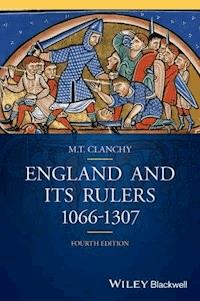
Cover image: Detail of illuminated initial ‘E’, from Bishop Puiset's Bible, c.1170–80. Durham Cathedral Library, A.II.1, vol. 3, fo. 131v. Reproduced by permission of the Dean and Chapter of Durham.
Preface to the Fourth Edition
In this edition I have added one new chapter, on ‘Family and Gender’. I have also updated the Suggestions for Further Reading and made other minor corrections. This edition is dedicated to the memory of Sir Rees Davies (1938–2005), who did so much to clarify medieval ideas of lordship and nationhood which are the framework of this book.
M. T. Clanchy
Institute of Historical Research
University of London
List of Abbreviations
Map 1 England and France
Map 2 England and the Mediterranean
Map 3 Edward I's kingdom in Britain in 1305
1
England's Place in Medieval Europe
This book concerns the rulers of England and their aspirations in the period between the Norman Conquest of 1066 and the death of Edward I in 1307. During these two and a half centuries England was dominated by men from overseas. This trend had begun before 1066 with the rule of the Danish king Cnut (1016–35) and of the half-Norman Edward the Confessor (1042–66), and it lingered on after 1272 in the French-speaking court of Edward I (1272–1307) and his successors. Nevertheless the most significant period of overseas domination of political and cultural life in the English kingdom followed the Norman Conquest and continued into the twelfth century and beyond. When the Norman dynasty failed in the male line with the death of Henry I in 1135, England became the battleground between two of William the Conqueror's grandchildren, Stephen and the Empress Matilda. On Stephen's death the kingdom was inherited by Henry II (1154–89), who was count of Anjou in his own right and duke of Aquitaine by marriage. The area of the king of England's political concern had therefore widened beyond William the Conqueror's Normandy to include Anjou and the huge lands of Aquitaine and Poitou south of the Loire. This extension of power is described by historians – though never by contemporaries – as the ‘Angevin Empire’, implying an overlordship by the dynasty of Anjou over England and half of modern France. According to Gerald of Wales, Henry hoped to extend his rule beyond France to Rome and the empire of Frederick Barbarossa.
In leading Christendom in the crusade against Saladin, Richard I (1189–99) was following in the footsteps of the Angevin kings of Jerusalem as well as fulfilling promises made by Henry II. His death in the struggle with Philip Augustus of France and King John's subsequent loss of Normandy to Philip did not bring an end either to overseas influence in England or to the ambitions of its kings, as John hoped to regain Normandy from his base in Poitou and Aquitaine. He established the strategy, which was vigorously pursued by his successor Henry III (1216–72), of using Poitevins as administrators and war captains in England. Through them and the support of the papacy Henry hoped to construct a system of alliances which would win his family the huge inheritance in Italy and Germany of the greatest of the medieval emperors, Frederick II, and thus surpass the achievements of Henry II and Richard I. ‘We wish’, wrote Pope Alexander IV in 1255, ‘to exalt the royal family of England, which we view with special affection, above the other kings and princes of the world.’1
The rebellion of 1258 against Henry's Poitevins and papal ambitions compelled both king and barons to recognize the separateness of England: the king by conceding the Norman and Angevin lands to Louis IX of France in 1259, and the barons by forming their revolutionary commune of England. As if to emphasize the persis-tence of overseas influence, that commune was led by a Frenchman, Simon de Montfort. This period of rebellion and civil war marked a turning point in the definition of English identity. Its rulers thereafter continued to pursue overseas ambitions, first in France in the Hundred Years War and then as a worldwide maritime power, but they did so now as heads of an English nation and not as alien warlords like William the Conqueror and Henry II. In order to emphasize the in-fluence of outsiders and at the same time to provide a chronological framework, this book is divided into parts comprising three periods each of about seventy years' duration: the Normans (comprising the reigns of William the Conqueror, William Rufus and Henry I); the Angevins (the reigns of Stephen, Henry II and Richard I); the Poitevins (the reigns of John and Henry III). The titles ‘Normans’, ‘Angevins’ and ‘Poitevins’ are not intended to suggest that the rulers came ex-clusively from these regions, but that the king of England's predominant overseas connections shifted from Normandy in the eleventh century through Anjou in the twelfth to Poitou in the thirteenth. Edward I gave as high a priority as his predecessors to his possessions in France, while at the same time conducting large-scale wars in Wales and Scotland.
England and its conquerors
The English had developed a settled identity precociously early among the European powers. The Anglo-Saxon kings of the tenth century, building on the achievements of Offa in Mercia and Alfred in Wessex, had created a single kingdom. At its best, a sacrosanct king headed a well-defined structure of authority (consisting of shires, hundreds and boroughs), which used a uniform system of taxation and coinage and a common written language in the Old English of writs and charters. Even the fragility of these achievements, in the face of the Danish and Norman invasions of the eleventh century, encouraged a sense of common identity in adversity, as the kingdom's misfortunes were attributed in such works as Wulfstan's to the sinfulness of the people rather than to the shortcomings of the political system. Monastic writers were therefore able to transmit to their successors the hope that the English kingdom would emerge intact from foreign domination. Thus Orderic Vitalis, who was sent to Normandy when still a child to become a monk, nevertheless identified fiercely with England's woes. Describing Norman atrocities after the rebellion of Edwin and Morcar, he upbraids the Normans who ‘did not ponder contritely in their hearts that they had conquered not by their own strength but by the will of almighty God, and had subdued a people that was greater, richer and older than they were’. This sense of Englishness, transmitted like the English language as a mother tongue despite its disappearance in official circles, persisted as a powerful undercurrent throughout the twelfth century to emerge as a political force in the thirteenth. The isolated monks who continued with the Anglo-Saxon Chronicle after the Norman Conquest, noting for example that the year 1107 was the ‘forty-first of French rule in this country’, and the gregarious mothers and wet nurses who naturally spoke to their infants in English had together saved the nation's identity.
Lesen Sie weiter in der vollständigen Ausgabe!
Lesen Sie weiter in der vollständigen Ausgabe!
Lesen Sie weiter in der vollständigen Ausgabe!
Lesen Sie weiter in der vollständigen Ausgabe!
Lesen Sie weiter in der vollständigen Ausgabe!
Lesen Sie weiter in der vollständigen Ausgabe!
Lesen Sie weiter in der vollständigen Ausgabe!
Lesen Sie weiter in der vollständigen Ausgabe!
Lesen Sie weiter in der vollständigen Ausgabe!
Lesen Sie weiter in der vollständigen Ausgabe!
Lesen Sie weiter in der vollständigen Ausgabe!
Lesen Sie weiter in der vollständigen Ausgabe!
Lesen Sie weiter in der vollständigen Ausgabe!
Lesen Sie weiter in der vollständigen Ausgabe!
Lesen Sie weiter in der vollständigen Ausgabe!
Lesen Sie weiter in der vollständigen Ausgabe!
Lesen Sie weiter in der vollständigen Ausgabe!
Lesen Sie weiter in der vollständigen Ausgabe!
Lesen Sie weiter in der vollständigen Ausgabe!
Lesen Sie weiter in der vollständigen Ausgabe!
Lesen Sie weiter in der vollständigen Ausgabe!
Lesen Sie weiter in der vollständigen Ausgabe!




