


22,49 €
Mehr erfahren.
- Herausgeber: Robert Hale Non Fiction
- Kategorie: Geisteswissenschaft
- Sprache: Englisch
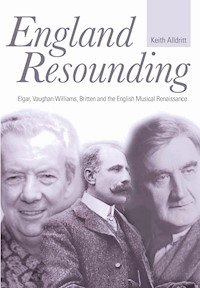
The spectacular revival of serious music in England is a chief feature of the history of British culture from the turn of the twentieth century and after. For some two centuries the art form had stagnated in England, which was referred to, notoriously, by a German commentator as 'the land without music'. But then came a great renaissance. In the three linked essays that make up this book, Keith Alldritt, the most recent biographer of Vaughan Williams, examines the several phases and genres of this revival. A number of composers including Gustav Holst, Arnold Bax and William Walton contributed to the renewal. But this book presents the renaissance as centrally a continuity of enterprise, sometimes of riposte, running from Elgar to Vaughan Williams and then to Benjamin Britten. Their concern was with music at its most serious, though not unceasingly humourless. All three explored music's frontier with philosophy. They also probed the psychological impact of the unprecedently violent and destructive century in which they practised their art. Going beyond musicological comment, England Resounding essays insights into the historical, geopolitical and personal events that elicited the major works of these three great composers.
Das E-Book können Sie in Legimi-Apps oder einer beliebigen App lesen, die das folgende Format unterstützen:
Veröffentlichungsjahr: 2019
Ähnliche




















Only through its historical characteristics does music acquire its relation to the unattainable. Without historical mediations, understood as a mere principle or primal phenomenon, it would be utterly impoverished, abstract and in the real sense, lacking in essence.
Consideration of the contemporary relation of philosophy and music leads to the insight that the timeless essence of music must be viewed as a chimera. Only history itself, real history with all its suffering and all its contradiction, constitutes the truth of music.
Theodor W. Adorno, Essays in Music
First published in 2019 by
Robert Hale, an imprint of
The Crowood Press Ltd,
Ramsbury, Marlborough
Wiltshire SN8 2HR
www.crowood.com
This e-book first published in 2019
© Keith Alldritt 2019
All rights reserved. This e-book is copyright material and must not be copied, reproduced, transferred, distributed, leased, licensed or publicly performed or used in any way except as specifically permitted in writing by the publishers, as allowed under the terms and conditions under which it was purchased or as strictly permitted by applicable copyright law. Any unauthorised distribution or use of this text may be a direct infringement of the author’s and publisher’s rights, and those responsible may be liable in law accordingly.
British Library Cataloguing-in-Publication Data
A catalogue record for this book is available from the British Library.
ISBN 978 0 7198 2975 8
Ebook ISBN 978 0 71982 976 8
The right of Keith Alldritt to be identified as author of this work has been asserted by him in accordance with the Copyright, Designs and Patents Act 1988.
For Janet
With love and gratitude for making this book possible
Contents
Acknowledgements
Introduction
1Edward Elgar
2Ralph Vaughan Williams
Plate section
3Benjamin Britten
References
Index
Acknowledgements
I am grateful for the kind help of Hugh Cobbe and The Vaughan Williams Trust. I must also thank Dr Nick Clark of the Britten Pears Library for his resourceful assistance.
Introduction
IN THIS BOOK I offer an account of the spectacular revival of serious music in England that began at the start of the twentieth century. It was music of a semantic richness that had not been produced in this country since the time of Purcell and Handel. The renaissance was begun by Edward Elgar and sustained, most robustly and protractedly, by composers from the next two generations: Ralph Vaughan Williams and Benjamin Britten. It lasted for at least the first three quarters of the twentieth century and its artefacts were of a quality to equal those created in this same period by the art form traditionally seen as the predominant one in English culture: literature.
Benjamin Britten never met Elgar. Vaughan Williams knew them both – but not well. There was no sense of musical legacy to relate them. Indeed, Britten reacted very strongly, sometimes with violent distaste, against the work of his two elders. Nevertheless there were many features in their chief compositions that make them appear to constitute a tradition, not least the highly developed awareness that each had of English literature and their passionate belief in music as a profound and serious art.
The story I have to tell will be something other than a musicological history. I will seek to place the achievements of these three principal figures of the great revival of English music in a much larger context, one that illuminates their relationships with the other arts, particularly with literature, and with the historical forces that impinged on their lives.
There was, for instance, for all three of these English composers, the fact of America. In 1898, the year in which Elgar initiated England’s renaissance with the composing of his Variations on an Original Theme, popularly known as the Enigma Variations, the United States was in the process of joining, and soon clearly surpassing, Britain as a world power. The opportunities and the money available in America attracted all three composers. They each spent time in the United States and each responded very differently to the higher standard of material living and to the democratic manners that they encountered there. More significantly for their music, they each looked to American authors for the texts of some of their most ambitious compositions. An important source for Elgar’s early cantatas was the writings of Henry Wadsworth Longfellow, a highly regarded figure in American literary life towards the end of the nineteenth century. Walt Whitman, who has maintained a more enduring reputation as a poet, provided the words for Vaughan Williams’s exhilarating first symphony and for several of his other works. The American poet was one of his great inspirations and admirations throughout his life. Benjamin Britten lived in America in the 1930s. His greatest achievements, unlike those of his two predecessors, were in opera and two of his three operatic masterpieces derive from American texts: Billy Budd is based on a novella by Herman Melville and The Turn of the Screw on one by Henry James.
The emerging influence of America and its culture is just one of the influences conditioning the English musical revival. Another is the rapid and dramatic political change that marked the seventy-five years or so covered by this book. All three composers were extremely aware, socially and politically. Elgar frequently proclaimed his Toryism and even, at one point in his life, discussed the appropriateness of offering himself as a parliamentary candidate for the Conservative and Unionist Party of which he was such an ardent supporter. Vaughan Williams was anything but a Tory. Often a Labour voter but at heart an Asquithian Liberal, he unfailingly took a definitive position on each of the great political issues of the day. As I have shown in my biography of him, he declared, clearly and unambiguously, his attitude to the Boer War, to the issue of Home Rule in Ireland and to the General Strike of 1926. Political principles also drove him to involve himself in the two world wars of the century to a degree far beyond what was expected of a man of his years. Benjamin Britten was similarly conscious politically. Maturing, while at the Royal College of Music and after, among left-wing film and theatre people and close to the then Marxist poet W.H. Auden, Britten was also, in the 1930s and indeed throughout his life, a pro-active pacifist. Such a moral and political position shows itself very explicitly in his War Requiem. But Britten’s views also show themselves implicitly and more subtly in many other of his works. The greatest works of Elgar and Vaughan Williams are also very much a music of philosophical attitude. In some very obvious respects they are a response to history. Within them there is a long-term movement from one musical genre to another. It proceeds from the choral forms of Elgar’s early years, cantatas and oratorios, to the symphony, and thence, in Britten’s maturity, to the opera. To take the major works in the chronological order of their composition, as I will do here, is an illuminating way of reading the history of the time and the responses of three unusually perceptive men to it. Other composers such as Gustav Holst, William Walton, Arnold Bax and Malcolm Arnold contributed significantly to the English musical renaissance of this period. But the three who are my subject maintained the most sustained and deepest engagement with the issues presented by the times. As we proceed through the near three quarters of a century I shall have cause to mention the insights offered by the other arts, by poetry, fiction, painting and sculpture. But the main focus will be on the music of these three generations of composers and on the insights and perceptions into the dramas, tragedies and calamities of the century that the semantics of music uniquely convey.
1
Edward Elgar
THE PRECISE MOMENT of the beginning of the radical revival of English music at the end of the nineteenth century has been vividly described by the composer who launched it, Edward Elgar. It happened on the evening of 21 October 1898. The year before, Queen Victoria had celebrated her sixtieth year on the throne of Britain and its worldwide Empire. And just a month before that historic moment for English music there occurred, in the Sudan, the great Battle of Omdurman. It was one of the worst acts of slaughter in the history of the British Empire. An army under General Kitchener, which was amply equipped with Maxim guns and up-to-date artillery, massacred an army of Dervishes who had only pre-industrial weapons. The British offensive was an attempt to reassert imperial power in the region. It was also viewed as an act of revenge for the killing some thirteen years before nearby at Khartoum of General Gordon, who had a reputation in Britain as a heroic, near saintly Christian imperialist. (In 1899 Elgar’s proposal for a ‘Gordon’ symphony was accepted for the Three Choirs Festival in Worcester.) But the avenging of General Gordon at Omdurman with relentless, mechanical slaughter gave pause even to the young Winston Churchill, present as a war journalist and long hardened to the realities of modern warfare. Walking the battlefield two days after the engagement, he was appalled by the sight and stench of the thousands of Dervish dead. They were, he concluded ‘destroyed not conquered by machinery’.1
This was also the year in which the disgraced Oscar Wilde published his lengthy poem of punishment, humiliation and suffering, The Ballad of Reading Gaol. At the same time his fellow Irishman George Bernard Shaw had a major success with his play Arms and the Man, which had for its central theme the futility of war. Another great success during these months was Hiawatha’s Wedding Feast, a setting by the twenty-three-year-old Samuel Coleridge-Taylor of a text by the then widely admired poet, Henry Wadsworth Longfellow.
But for the forty-one-year old Edward Elgar, then living in suburban Malvern in Worcestershire, there had not yet been any comparable success. He too had composed cantatas using texts by Longfellow: The Black Knight of 1892 and Scenes from the Saga of King Olaf, first given a performance some five years later. Longfellow was in some respects the Walt Disney of the nineteenth century. Early Disney films such as The Sword and the Rose (1953) and The Story of Robin Hood and his Merrie Men (1952) are highly reminiscent of the extremely romanticized, emphatically picturesque view of old Europe that Longfellow supplied to his fellow Americans in a novel such as Hyperion (1839). And not only Americans. Longfellow was widely read in England. Elgar’s mother was a keen admirer. Her son grew up sharing this enthusiasm and it must certainly have helped confirm his delight in the world of feudalism and chivalry. An early expression of this was his concert overture Froissart (1890), named for the fourteenth-century French chronicler. Elgar also set Rondel (1894), a poem deriving from Froissart and translated into English by Longfellow.
However, none of Elgar’s Longfellow settings brought him great success – certainly not financially. He still earned much of his living as an itinerant, overworked musician and music teacher. On the historic evening of 21 October 1898 he was weary after spending much of the day giving violin lessons at The Mount, a girls’ school in Malvern. He came home dispirited. Years later he gave an account of what suddenly happened:
I came home very tired. Dinner being over my dear wife said to me ‘Edward, you look like a good cigar’, and having lighted it I sat down at the piano …
In a little while, soothed and feeling rested I began to play, and suddenly my wife interrupted by saying: ‘Edward that’s a good tune’. I awoke from the dream: ‘Eh! tune, what tune?’ And she said, ‘Play it again, I like that tune’. I played and strummed and played, and then she exclaimed: ‘That’s the tune.’2
He played on he remembered, and then
The voice of C.A.E. [Alice Elgar] asked with a sound of approval, ‘What is that?’ I answered, ‘Nothing – but something might be made of it’.
This was the origin of the work that was to be entitled Variations on an Original Theme and is now usually referred to as the Enigma Variations. It was Elgar’s breakthrough work and vastly enhanced his reputation in Britain, and within a few years successful performances in Germany and Russia helped to bring him European fame.
For all its Worcestershire associations, audiences abroad will have enjoyed the work simply as music, for the impressive sequences of sound it contains, with all its many changes in texture, speed, tone and volume, with its alternations from the skittish to the noble, from the knockabout to the near sacred. Distant audiences will probably not have taken a great deal of interest in the piece as the kind of programme music that Elgar indicated in his dedication of the work ‘to my friends pictured within’. But programmatic the work certainly is in one important respect and writers on Elgar have offered a great deal of background information and characterizations of the fourteen individuals, nine men and five women, evoked for us in the music. Looked at in this way the Enigma Variations is a sound picture of life in a rural English county at the very end of Queen Victoria’s long reign. With its wide range of characters, mostly middle class and cultured, and one of them titled, it recalls the group portrait created by George Eliot in her great novel Middlemarch, published almost a quarter of a century before the Enigma Variations. This too gives us a vivid sense of a small town and a rural community at the very end of a readily definable historical period, at a moment of historical change.
Elgar’s Variations do not, of course, probe the failings, limitations and suffering in provincial life that George Eliot investigates. The group portrait of Elgar’s circle of Worcestershire and Malvern friends is for the most part a sunny one, showing the individuals ‘pictured within’ as amusing, entertaining, sensitive, good-hearted. Some of them are people of emotional and spiritual depths.
But the well-to-do country town of Malvern, where he lived from 1891 to 1899, was but one half of Elgar’s story over the years as he struggled and persevered to establish himself as a composer. The other half was Birmingham.
In 1882, the year that Wagner’s final opera Parsifal had its debut at the Festspielhaus in Bayreuth, the twenty-five-year old Edward Elgar took a lowly musical job in Birmingham. He was engaged to play among the second violins in William Stockley’s Orchestra. This was Birmingham’s very first symphony orchestra and had been established in the fast-thriving industrial city just over a quarter of a century before Elgar joined as a very junior member. He would work for Stockley for some seven years, that is to say until he was thirty-two and had a wife who was able to help support him financially.
The job in Birmingham provided a significant part of his income as a young jobbing musician. Verdi once spoke of his ‘years in the galleys’ as an aspiring opera composer. Elgar’s seven years as an obscure orchestral player constitute a similar protracted period of struggle. For seven years, a span of time with a biblical ring to it, Elgar commuted regularly between the country quiet of the small cathedral city of Worcester and the din, dirt and smells of Britain’s greatest centre of heavy industry and manufacturing. His train would take him from Worcester through the green, well-wooded, orchard countryside of his native county into and along the southern fringe of the Black Country, and thence to the vast, noisy railway station in Birmingham with its reek of coal and hiss of thronging steam trains. For seven years he would make his way up either Colmore Row or New Street. In Elgar’s time New Street was far grander than it is today. It was lined with imposing banks, stylish shops, department stores and arcades that were patronized by elegantly dressed members of the city’s moneyed middle class. (A mosaic at the entrance to the city’s art gallery commemorates the urbanity of Corporation Street at that time.) As Elgar, the struggling country musician, moved up the incline of the grand thoroughfare there would come into sight the Town Hall, the dramatic and characterful Birmingham landmark that stood, and stands, as an important site in the history of English music. It would be the scene of memorable occasions in Elgar’s career long after he left what he knew as ‘Mr Stockley’s Orchestra’. To his right as he approached the top of the rise that is New Street Elgar would have seen Christchurch, an early nineteenth-century church in the Classical style but endowed with a spire. It stood between the columned Town Hall and the newly built Council House. This latter building was a much larger, grander place with a busy baroque frontage and a soaring cupola. A showy construction, it had been completed and opened just three years before Elgar began working for William Stockley and was ostentatious testimony to the new wealth of Birmingham at the time. The older and more modest Christchurch was important for Birmingham people because, unlike other Anglican churches, it did not charge to rent a pew. It was also reputed to contain the remains of one of Birmingham’s many famous eighteenth-century entrepreneurs, the printer and type designer John Baskerville. In the year in which the Enigma Variations was first performed, this beloved church at the very centre of the city was pulled down and replaced by luxury shops.
The nearby Town Hall to which, for seven years, Elgar regularly directed his steps was closely involved with the musical life of Birmingham. Indeed it had been built to cater to it. One of England’s great provincial occasions for the performance of serious music had long been the Birmingham Triennial Festival. It had been founded in 1784 and became an important part of Birmingham’s burgeoning intellectual life. Some fifty years earlier the young Samuel Johnson had lived in the city for four years, lodging for a time in the High Street in the house of Thomas Warren, the founder of the city’s first newspaper, the Birmingham Journal. The venture was a precursor of the intellectual ferment at the end of the eighteenth century that led to the achievements of the Lunar Society, which met locally and in the city. It was these achievements that provided much of the theoretical as well as practical expertise that made Birmingham the fountainhead of the Industrial Revolution.
The rapid expansion of the city that came from industrialization created a large working class in the city, many of which came from Ireland and were Roman Catholic. One of the reasons that Cardinal John Henry Newman founded the Birmingham Oratory in 1847 was to cater for the spiritual needs of this transplanted community. This was the same year in which Karl Marx, Friedrich Engels and others offered those in the exploited working class an alternative view of salvation with the founding in London of the Communist League.
Newman was a prominent figure in the intense theological and ecclesiastical turbulence of the nineteenth century. He was a leading member of the Oxford Movement, arguing for the introduction of more Catholic elements into the Church of England. Beginning his career as an Anglican priest, this extremely gifted apologist converted to Roman Catholicism in 1845, thereby bringing a moment of drama and shock into English church history. In Rome Newman was authorized by Pope Pius IX to establish a religious community in England. Newman came to industrial Birmingham. He first gathered his followers together in an old gin distillery in Deritend, the medieval quarter of the city that by then had become something of a slum. He next proceeded to found his Oratory at St Anne’s, Alcester Street, a Gothic Revival building he had built nearby in the Digbeth area of central Birmingham. The community later moved to a more pleasant area in Hagley Road, Edgbaston, where another church was erected in 1852. Newman dedicated his Oratory church to the sixteenth-century Italian priest St Philip Neri, who founded an oratory in Rome where he ministered to the sick and poor. One of the devotional aids he employed in services was the use of laude spirituale or sacred songs. In time these became more complex and were known as oratorios; among St Philip’s followers who composed music for services there was Palestrina. The Newman Oratory on the southwest side of Birmingham thus related to a distinguished strain in the history of the cultural context of Catholic religious practice. The institution became a well-known feature of Birmingham life from the late nineteenth century onwards, often referred to locally as ‘Little Rome in Brum’. Like the grand landmark Town Hall and the Triennial Festival, the Birmingham Oratory was to play an important part in the life of the composer of The Dream of Gerontius.
Founded in 1783, the year that saw the conclusion of the American War of Independence, the Birmingham Triennial Festival grew rapidly and acquired an ever-expanding audience in the city and in its environs. The Festival was originally held in St Philip’s, a Baroque church (now a cathedral) built in 1715 by Thomas Archer, the architect of St John’s, Smith Square, in London. This church was part of the westward expansion of the city from its medieval centre around St Martin’s in the Bull Ring. Showing the influence of Borromini, whose buildings Archer had seen in Rome, St Philip’s, like many English churches of the period, had extensive wooden galleries to accommodate a larger congregation than would have been possible in a medieval church with a comparably sized ground plan. Despite this the church became too small as audiences grew and the Triennial Festival transferred to the Theatre Royal on New Street. By the early nineteenth century such was the size of the audience for serious music that this venue again proved too small and the idea of a purpose-built hall for the Festival was proposed. Such were the origins of Birmingham Town Hall, which lay more in the musical than in the political life of the city. This was in 1832, the year of the eventual passing of the Great Reform Bill and in which George Eliot set her novel Middlemarch, where the dramatic political struggle for the extension of voting rights provides a shadowy but highly significant background.
The imposing concert venue that is Birmingham Town Hall was an architectural expression of the civic self-consciousness and confidence that the Industrial Revolution and its attendant wealth brought to the city. It was this confidence, here and in the other burgeoning industrial cities, that compelled the political recognition and representation granted by the Great Reform Bill of 1832. Birmingham Town Hall was first planned in that same year and was completed and opened two years later. Still outstanding amidst modern high-rise Birmingham, the building is a Corinthian temple in the robust Roman style that emerged in British public buildings in the early nineteenth century. The sequence of emphatic columns that enclose the outer walls, inspired by the proportions of the Temple of Castor and Pollux in the Roman Forum, allude to its origins in the Roman Republic, which was a political model attractive to the energetic radicals of Birmingham and other fast-developing cities at the time of the Reform Bill.
After its opening the Town Hall soon attracted such leading figures in nineteenth-century musical life as Mendelssohn and Saint-Saëns. It was also the most important location in Edward Elgar’s long and arduous progress from obscurity as an impecunious violinist, travelling up from the country to a lowly place among the second violins in ‘Mr Stockley’s Orchestra’ at the Town Hall, to sudden, brilliant celebrity. Some twenty years later in 1903, the year in which King Edward VII was proclaimed Emperor of India, Elgar was the star at one of the grandest social and musical occasions ever seen in Birmingham Town Hall. This was the first performance of his oratorio The Apostles. Having achieved success with works such as the Enigma Variations, The Dream of Gerontius and the Military March no. 1 (‘Pomp and Circumstance’), Elgar now entered the Town Hall as an acclaimed celebrity. The demand for tickets to the premiere was such that extra seating had been installed. A large crowd stood outside the Town Hall to watch distinguished members of the audience arrive. Earl Howe, a prominent Conservative politician and President of the Triennial Festival, arrived with his wife. They were soon followed by members of Birmingham’s dynastic family, the Chamberlains of Highbury Hall in Moseley, the ladies strikingly dressed. The Birmingham Daily Mail reported,
A large party came from Highbury, Mrs Chamberlain who was wearing a red costume with black hat, being accompanied by the Misses Chamberlain and several other ladies and Mr Neville Chamberlain … so fashionable was the assembly this morning that comparatively few of the visitors arrived on foot … When Dr Elgar took his seat shortly before half-past eleven every inch of the interior of the vast building was occupied by an audience which will undoubtedly rank as one of the most brilliant of the many distinguished companies seen within the walls of the historic hall.3
Elgar’s slow, difficult rise to such eminence was very much in and through Birmingham. As a young man avid and energetic in the pursuit of recognition as a composer he had attempted many forays into the musical world of London. And indeed he had enjoyed some successes at the concerts organized and conducted at the Crystal Palace by Sir August Manns, which were an important part of the musical offerings in the capital from 1855 to 1901. But up to the time of Elgar’s marriage in October 1889, and to a lesser extent afterwards, Birmingham was an indispensable source of income and opportunities for performing his compositions.
William Stockley’s memoir of musical life in Birmingham contains kindly recollections of the young Elgar and also conveys the intense energy that pervaded the musical life of the city and the nearby Black Country at the time. His book shows very clearly how there was a vital, fast-growing musical culture in provincial England long before there were any renowned English composers. Elgar, Vaughan Williams and Britten were later to have careers that were only possible with these foundations. Stockley’s musical zeal could be, in more than one sense of the word, messianic. Here is his account of one of his numerous idealistic musical ventures:
It occurred to me that there was one class in town to which the enjoyment of music was almost impossible, through the nature of their occupation, viz., cabmen and drivers and conductors of omnibuses. Their loss was the harder, inasmuch as they conveyed others to the concerts etc., which they themselves had no chance of attending. I therefore laid the matter before the band and chorus and they cheerfully agreed to give up Sunday afternoon for a really good concert if the Town Hall could be secured for the purpose.
The Mayor readily consented to give us the hall for free if we would perform sacred music and make the concert a kind of service. This we, of course, did, the Mayor giving a short address and the whole company joining in the Old Hundredth Psalm.
The Town Hall Mission kindly helped by conveying the invitations and a unique audience of cabmen etc. and their families assembled in goodly numbers to hear a selection from The Messiah.4




