


0,49 €
Niedrigster Preis in 30 Tagen: 1,99 €
Niedrigster Preis in 30 Tagen: 1,99 €
Mehr erfahren.
- Herausgeber: Booksell-Verlag
- Kategorie: Bildung
- Sprache: Englisch
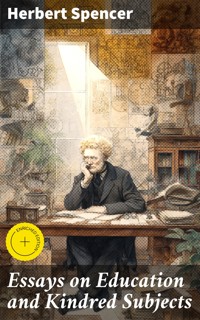
In "Essays on Education and Kindred Subjects," Herbert Spencer presents a thought-provoking exploration of educational philosophy and its intersection with society, politics, and ethics. Spencer employs a clear and incisive literary style, weaving together philosophical arguments and empirical observations to advocate for an education system that emphasizes individual development and social relevance. Positioned within the broader context of the 19th-century intellectual movement, this work reflects the Victorian era's interest in progress, utilitarianism, and the application of evolutionary theory to human institutions, making it essential reading for those studying the evolution of educational thought. Herbert Spencer, a prominent philosopher, and sociologist known for his evolutionary perspective on society, was profoundly influenced by the scientific discoveries of his time. His experiences as a writer and social critic, combined with his intimate knowledge of the educational system, fueled his desire to reform education in a way that aligned with natural laws. Spencer's ideas contributed significantly to the foundation of modern educational practices, focusing on the importance of adapting education to the needs of the individual and society as a whole. This collection of essays is highly recommended for educators, sociologists, and anyone interested in the dynamic relationship between education and society. Spencer's insights encourage readers to reflect on the purpose and methods of education, making this book a vital resource for understanding the historical context and ongoing evolution of educational practices. In this enriched edition, we have carefully created added value for your reading experience: - A comprehensive Introduction outlines these selected works' unifying features, themes, or stylistic evolutions. - The Author Biography highlights personal milestones and literary influences that shape the entire body of writing. - A Historical Context section situates the works in their broader era—social currents, cultural trends, and key events that underpin their creation. - A concise Synopsis (Selection) offers an accessible overview of the included texts, helping readers navigate plotlines and main ideas without revealing critical twists. - A unified Analysis examines recurring motifs and stylistic hallmarks across the collection, tying the stories together while spotlighting the different work's strengths. - Reflection questions inspire deeper contemplation of the author's overarching message, inviting readers to draw connections among different texts and relate them to modern contexts. - Lastly, our hand‐picked Memorable Quotes distill pivotal lines and turning points, serving as touchstones for the collection's central themes.
Das E-Book können Sie in Legimi-Apps oder einer beliebigen App lesen, die das folgende Format unterstützen:
Veröffentlichungsjahr: 2019
Ähnliche










Essays on Education and Kindred Subjects
Table of Contents
Introduction
This collection brings together Herbert Spencer’s sustained reflections on education and a series of related inquiries into society, culture, and human behavior. Its scope is deliberately integrative: it presents a coherent view of how individuals learn and develop, and how that development connects with wider patterns in knowledge and social life. By situating a pedagogical work alongside essays on progress, manners, science, laughter, and music, the volume offers readers a single, continuous argument about the conditions that shape minds and communities. The purpose is not merely to assemble notable pieces, but to display the architecture of Spencer’s thought as it moves from classroom to culture.
The contents include prefatory material that clarifies Spencer’s aims, the book-length Education: Intellectual, Moral, and Physical, and a suite of essays that Spencer considered kindred to the educational project. Among these are What Knowledge Is of Most Worth?, Intellectual Education, Moral Education, and Physical Education, which develop the core pedagogical thesis. A second part gathers essays such as Progress: Its Law and Cause, On Manners and Fashion, On the Genesis of Science, On the Physiology of Laughter, and On the Origin and Function of Music. Together they form a unified body of expository prose addressing learning, social change, and human experience.
As a whole, the collection is designed to show how educational principles radiate outward into broader questions about civilization and culture. Education provides the foundation: the formation of intellect, character, and body. The companion essays then examine how societies advance, how conventions arise, how ordered inquiry develops, and how expressive behaviors illuminate mental life. In doing so, the volume demonstrates Spencer’s conviction that understanding one domain often clarifies another. The arrangement invites readers to see recurrent methods and motifs across topics, emphasizing continuity rather than compartmentalization and presenting a comprehensive standpoint on the development of both persons and institutions.
The texts collected here are nonfiction prose. They include a programmatic pedagogical treatise, essays in social theory, and pieces that today might be called popular science or cultural analysis. There are no novels, stories, poems, letters, or diaries. The writing advances arguments, defines terms, traces causes, and offers examples drawn from common observation and recorded knowledge. Prefatory sections provide context for the author’s intentions, while the essays proper articulate theses and their implications. Readers should expect sustained analysis, conceptual distinctions, and illustrative comparisons rather than narrative arcs or personal memoir. The genre mix thus concentrates on reasoning, exposition, and synthesis.
The first group of writings focuses on education. What Knowledge Is of Most Worth? poses the organizing question that anchors the series, asking how studies should be prioritized in light of human needs. Intellectual Education considers the cultivation of mental powers and the ordering of studies. Moral Education examines the formation of character and the conditions under which ethical conduct is learned and strengthened. Physical Education treats health, development, and the bodily basis of sustained learning. Together these texts offer a systematic view of ends and means in schooling, attentive to curriculum, method, and the interplay between instruction, habit, and environment.
The second group extends the argument beyond the schoolroom. Progress: Its Law and Cause addresses the general conditions under which societies and institutions change. On Manners and Fashion explores how customs and tastes emerge and gain authority. On the Genesis of Science examines the growth of organized knowledge. On the Physiology of Laughter and On the Origin and Function of Music consider expressive phenomena that reveal aspects of mind and sociality. These essays are not digressions; they test and elaborate the same explanatory habits. The result is a broader portrait of development, order, and adaptation across domains of collective life.
Across the volume, unifying themes recur: the search for principles that account for growth and adaptation; the relation between means and ends; and the responsibility to align instruction with human requirements. Spencer’s approach consistently asks what functions practices serve and how complex forms emerge from simpler ones. He places emphasis on coherence among intellectual, moral, and physical aims, arguing that education gains force when these are coordinated rather than separated. The essays on society and culture apply the same lens, treating seemingly disparate subjects as expressions of general tendencies and inviting readers to recognize order in variety.
Stylistically, the writing is clear, declarative, and systematic. Arguments are often built by defining terms, arranging points in logical sequence, and drawing illustrative contrasts. Spencer favors broad generalizations backed by examples accessible to common experience, with transitions that link propositions to larger frameworks. The cadence is that of the nineteenth-century essay: measured, purposeful, and intent on persuasion through reasoned exposition. Readers will notice a preference for economy over ornament and for structure over anecdote. This method suits the collection’s aims, enabling it to handle diverse topics with a consistent voice and to present complexity without obscuring essentials.
The historical context informs the collection’s significance. Written in the nineteenth century, these works participate in debates about mass education, the place of science in curricula, and the relation between individual development and social change. They speak to a period that sought systematic accounts of knowledge and institutions. By bringing education into conversation with topics such as progress, manners, and science, the collection exemplifies a confidence that general principles can illuminate varied phenomena. Its arguments contributed to public discussions about what schooling should accomplish and how cultural forms might be understood as products of identifiable conditions and processes.
The enduring value of the collection lies in its breadth and its insistence on connecting pedagogy with larger patterns. Readers interested in the aims of schooling gain a framework for considering what studies matter and why. Those drawn to cultural questions find analyses that relate expression and custom to underlying tendencies. The essays encourage interdisciplinary thinking: insights from one piece refine the understanding of another. Even when readers disagree with conclusions, the method—seeking causes, defining ends, balancing parts with wholes—remains clarifying. That coherence makes the volume more than the sum of its parts and sustains its relevance.
The arrangement of texts helps readers navigate the arguments. The prefatory material frames the aims and limits of the project. The educational treatise establishes premises and practical implications. The essays in the final part test those premises against distinct phenomena, showing how related questions arise once the basic framework is set. Readers may proceed sequentially to observe the unfolding of the case, or consult essays individually, trusting that each rests on the same set of commitments. Cross-connections are frequent, so ideas introduced early reappear to guide later analyses, reinforcing the sense of a single, continuous inquiry.
This introduction invites engagement with the collection as a coherent intellectual enterprise. Its purpose is to present Herbert Spencer’s work on education alongside writings that illuminate the wider cultural environment in which education operates. The volume offers an integrated perspective on how minds are formed, how knowledge grows, and how social practices take shape. It is intended for readers seeking a structured statement of principles and for those exploring the links between pedagogy and culture. By uniting focused educational arguments with broader essays, the collection exemplifies a sustained effort to interpret learning within the larger dynamics of collective life.
Author Biography
Herbert Spencer was a Victorian-era English philosopher and system builder whose work sought to unify knowledge across biology, psychology, sociology, and ethics. Active from the mid-nineteenth century into the early twentieth, he became one of the most widely read public intellectuals of his day. Spencer popularized evolutionary thinking beyond the natural sciences and is closely associated with the phrase “survival of the fittest,” which he introduced to describe natural selection. His multivolume Synthetic Philosophy aimed to present a comprehensive, secular account of the development of the natural world, mind, and society. While celebrated for ambition and clarity, he was also a focal point for controversy and debate.
Spencer’s education was irregular and largely self-directed. As a young man he trained in practical mathematics and surveying and worked as a civil engineer during Britain’s railway expansion. This early technical experience informed a lifelong preference for systematic explanation and mechanical analogies. Gradually he moved from engineering to letters, contributing essays and reviews to periodicals. His transition into full-time intellectual work was facilitated by editorial and journalistic positions, which gave him exposure to contemporary debates in political economy and science. The combination of self-education, practical engineering, and immersion in public discourse shaped both his prose style and his commitment to general principles.
Spencer’s intellectual formation drew on British liberalism and utilitarian currents, as well as early evolutionary ideas circulating before and after Charles Darwin. He engaged with political economy and was attentive to demographic and comparative arguments associated with nineteenth-century social thought. He contributed regularly to journals, notably the Westminster Review, where essays such as “Progress: Its Law and Cause” explored development as a general process. He also served as a sub-editor at The Economist in the late 1840s and early 1850s, deepening his familiarity with market institutions and policy debates. These venues provided both audience and momentum for his emerging philosophical system.
Spencer’s first major book, Social Statics, appeared in the early 1850s and argued for individual liberty, voluntary cooperation, and minimal state interference. He soon extended his project to psychology, publishing The Principles of Psychology in the mid-1850s, an effort to explain mental life naturalistically and to relate mind to environment and adaptation. His collection Education: Intellectual, Moral, and Physical gathered widely read essays advocating science-based schooling and the cultivation of self-reliance. These works established his reputation as an original synthesizer who applied consistent principles across domains, and they set the stage for the more elaborate architectural framework he would call the Synthetic Philosophy.
The Synthetic Philosophy began with First Principles in the early 1860s, where Spencer defined evolution as a universal tendency toward increasing complexity and integration. He elaborated biological aspects in The Principles of Biology, coining “survival of the fittest” to express natural selection in concise form. He then turned to society in The Study of Sociology and the extensive Principles of Sociology, analyzing institutions, social organization, and a transition from “militant” to “industrial” types. The Principles of Ethics addressed conduct and the conditions for cooperative life. He also compiled Descriptive Sociology, a comparative data project intended to underpin his sociological generalizations.
Spencer’s political philosophy championed individual liberty, free exchange, and limitations on state functions beyond protection from aggression. He criticized militarism and imperial expansion and warned that compulsory schemes, even when benevolent in intent, could erode spontaneous cooperation. His evolutionary sociology, however, drew substantial criticism. Later commentators labeled some of his social arguments “social Darwinism,” though Spencer’s usage of evolution preceded and was not identical to Darwin’s. Admirers praised his system’s breadth and reformist confidence; detractors faulted its reliance on analogies from biology and its insensitivity to structural inequalities. The resulting debates made him a touchstone for arguments about progress, policy, and the scope of scientific explanation.
Spencer’s later years were marked by persistent health problems that limited public activity but did not end his writing and revisions. He continued to elaborate and defend his system while engaging controversies generated by evolutionary and social thought. By the early twentieth century, shifting academic fashions and new methodological standards reduced his influence within professional philosophy and sociology. Yet his ideas helped shape early sociological theory, comparative anthropology, and strands of classical liberalism. Today, his work is studied for its historical significance, for its role in popularizing evolution, and for its grand synthetic ambition, often read critically with attention to context and the limits of analogy-driven social theory.
Historical Context
Herbert Spencer (1820–1903) was born in Derby, England, into a dissenting, science-friendly milieu shaped by the Derby Philosophical Society founded by Erasmus Darwin. His father, William George Spencer, a schoolmaster, taught him geometry and natural science outside formal schooling. Trained as a civil engineer, he surveyed for the London & Birmingham Railway in the late 1830s before turning to letters in London. As sub-editor of The Economist (1848–1853) he entered metropolitan debates on policy and progress. Social Statics (1851) announced his liberal philosophy; The Principles of Psychology (1855) extended it to mind. In 1861 he issued Education: Intellectual, Moral, and Physical, consolidating earlier essays.
The collection emerged amid accelerated industrialization and urban growth that transformed Victorian society after 1830. Railways, mechanized factories, and the electric telegraph reorganized work, time, and communication. The Great Exhibition of 1851 in Hyde Park’s Crystal Palace showcased applied science as national prowess, even as slums, epidemics, and child labor exposed social costs. Debates over educational provision accompanied these changes, weighing classical curricula against practical training. Spencer’s essays, written in the 1850s and early 1860s, address what knowledge serves such a society, how to form character for self-regulating communities, and how bodily well-being relates to civic productivity in an industrial nation.
Mid-nineteenth-century Britain was a republic of letters powered by periodicals. Spencer wrote for and circulated within the Westminster Review circle at John Chapman’s 142 Strand, alongside Marian Evans (George Eliot), G. H. Lewes, Harriet Martineau, and later T. H. Huxley. His articles also appeared in venues such as Fraser’s Magazine and Macmillan’s Magazine, then common routes from essay to book. The Economist provided him statistical and policy literacy. This print ecosystem favored argumentative essays addressed to educated lay readers, encouraging Spencer’s aphoristic style and his habit of drawing evidence from travelogues, blue books, and laboratory science to discuss education, manners, science, and art.
Spencer’s social philosophy developed within a liberal milieu shaped by Jeremy Bentham, James Mill, and the Manchester School of free-trade politics led by Richard Cobden and John Bright. He championed voluntary cooperation, opposed paternal state regulation, and defended what he termed a 'right to ignore the state' in Social Statics (1851). Those commitments inform his reflections on schooling, philanthropy, and moral formation. He argued that spontaneous social order, not bureaucratic oversight, best cultivates capacity. His distrust of compulsory schemes places the education essays within broader nineteenth-century controversies over poor laws, factory legislation, vaccination mandates, and state-funded elementary instruction in England and Wales.
Science gained unprecedented cultural authority during Spencer’s prime. The British Association for the Advancement of Science (founded 1831) popularized research; the Royal Institution amplified figures such as Michael Faraday; and university reforms in the 1850s expanded scientific curricula. William Whewell’s coinage of 'scientist' (1833) and histories of induction, together with J. S. Mill’s System of Logic (1843), codified new epistemic ideals. T. H. Huxley’s 'A Liberal Education; and Where to Find It' (1868) publicized a curriculum centered on natural knowledge. Spencer’s insistence that physiology, physics, and hygiene outrank classical drill reflects this revaluation of science as both intellectual training and social utility.
Before and after Darwin’s On the Origin of Species (1859), evolutionary idioms shaped Victorian thought. Robert Chambers’s Vestiges (1844) popularized transformist speculation; Karl Ernst von Baer’s embryological law informed models of differentiation. Spencer’s 'Progress: Its Law and Cause' (1857) proposed a universal tendency from homogeneity to heterogeneity across nature and society, later integrated into his First Principles (1862). He coined 'survival of the fittest' in Principles of Biology (1864) to name selective processes Darwin described. This evolutionary framework underlies his accounts of the growth of knowledge, the development of moral sentiments, and the organization of education suited to increasingly complex social systems.
Educational reform during Spencer’s lifetime mixed philanthropy, denominational rivalry, and state hesitation. The British and Foreign School Society (1808) and the National Society (1811) spread monitorial instruction; Mechanics’ Institutes, proliferating from the 1820s, provided adult technical learning; Ragged Schools, championed by Lord Shaftesbury, served the destitute from the 1840s. Continental ideas from Johann Heinrich Pestalozzi and Friedrich Fröbel inspired child-centered methods, while Horace Mann’s Massachusetts reforms (1837 onward) offered American exemplars. Spencer wrote as Parliament debated national provision, culminating in the Elementary Education Act (Forster Act) of 1870. His triad—intellectual, moral, physical—engaged these controversies, advocating science-rich curricula and home-inflected character training.
Public health crises supplied an urgent backdrop to arguments about bodily training. Edwin Chadwick’s 1842 Report on the Sanitary Condition of the Labouring Population exposed urban filth; John Snow’s analysis of the 1854 Broad Street cholera outbreak advanced epidemiological reasoning; the 1848 and 1875 Public Health Acts expanded sanitary governance. Gymnastics systems circulated from German Turnvereine and Pehr Henrik Ling’s Swedish method, while drill entered British schools after the Crimean War (1854–1856) highlighted physical unfitness. Spencer’s emphasis on hygiene, exercise, and dress reform reflects this milieu, treating 'physical education' as a civic technology of vitality, longevity, and economic efficiency.
Victorian Britain codified conduct through an expanding literature of etiquette, taste, and consumption that recast rank as respectability. Middle-class domestic manuals by authors such as Sarah Stickney Ellis and, later, Mrs. Isabella Beeton (1861) prescribed manners and household management. Parisian haute couture, reorganized under Baron Haussmann (1853–1870) and couturiers like Charles Frederick Worth, set international fashion cycles distributed through illustrated periodicals and department stores. Debates over sumptuary laws and social emulation revived older moral discourses in a commercial age. Spencer’s analyses of manners and fashion situate these practices within social evolution, linking convention, imitation, and utility rather than mere caprice.
The historical study of science matured alongside Spencer’s project. William Whewell’s History and Philosophy of the Inductive Sciences (1837–1840) and Auguste Comte’s Cours (1830–1842) proposed hierarchies of disciplines and stages of development. New institutions—the Royal School of Mines (1851), the Cavendish Laboratory (1874), and technical colleges—professionalized inquiry. The X Club (founded 1864) knit together Huxley, Joseph Hooker, John Tyndall, and others to promote scientific naturalism. In this setting, Spencer’s reflections on the genesis and diffusion of scientific knowledge emphasize cumulative differentiation and the interplay of practical arts, abstract theory, and social organization, themes resonant with broader Victorian historiography of science.
Spencer’s essays on mind and emotion draw upon a rapidly consolidating physiological psychology. His Principles of Psychology (1855) blended associationist accounts with nervous-system analogies, anticipating later neurophysiological research. Theories of expression by Sir Charles Bell (1806) and experiments by Guillaume-Benjamin Duchenne de Boulogne (1862) connected muscular movement to feeling. Alexander Bain’s The Senses and the Intellect (1855) elaborated on mental processes. Darwin’s The Expression of the Emotions in Man and Animals (1872) cited Spencer’s 'nervous discharge' account of laughter. This intellectual network frames his treatment of amusement, sentiment, and moral habit as phenomena continuous with bodily economy and adaptive function.
Musical life in mid-Victorian Britain ranged from Philharmonic subscription concerts (founded 1813) and choral societies to burgeoning music halls. Scientific acoustics advanced through Hermann von Helmholtz’s On the Sensations of Tone (1863), while evolutionary debates reconsidered the origin of art. In 1857 Spencer argued that music derives from heightened and rhythmic speech, a thesis Darwin contested in The Descent of Man (1871) with a sexual-selection account of proto-music. These exchanges linked aesthetics to physiology, language, and social communication, enabling Spencer to treat art as a byproduct of evolved expressive systems rather than a metaphysical exception to natural laws.
Questions about who should be educated, and for what roles, grew sharper with women’s higher education. Bedford College (1849) in London and Girton College (1869) at Cambridge institutionalized advanced study for women; the University of London opened degrees to women in 1878. Figures such as Florence Nightingale reorganized professional training through the Nightingale School at St Thomas’ Hospital (1860). Debates over female curricula—domestic economy, science, languages—engaged moral philosophy and physiology alike. Spencer’s stress on competence, health, and character resonated across these disputes, even as his broader social theory remained skeptical of state compulsion as the engine of cultural improvement.
An imperial frame threaded many nineteenth-century discussions of knowledge and custom. Thomas Babington Macaulay’s Minute on Indian Education (1835) and the founding of universities at Calcutta, Bombay, and Madras (1857) exemplified projects to disseminate European science and literature. The 1857 uprising in India reconfigured British governance and intensified cultural comparison. Missionary reports, travel narratives, and ethnographies supplied Victorian writers with data about kinship, ritual, and technology across societies. Spencer drew widely on such sources for generalizations about fashion, manners, and the evolution of knowledge, integrating imperial-era information flows into a grand comparative sociology of social structure and mental habits.
Spencer’s essays circulated internationally through robust transatlantic publishing networks. D. Appleton & Company in New York issued American editions; Edward L. Youmans championed Spencer’s system and founded Popular Science Monthly (1872) as a vehicle for scientific naturalism. In the United States, John Fiske and other educators adapted Spencerian themes to common-school debates. Translations into French, German, Russian, and Japanese carried his evolutionary sociology abroad; Meiji reformers after 1868, including Nishi Amane and Mori Arinori, engaged related ideas while restructuring education and state. This global readership reinforced the appeal of Spencer’s programmatic claims about science, morality, and social progress.
Political change within Britain reshaped the stakes of education and social policy. The Second Reform Act (1867) expanded the electorate; trade unions gained legal status in 1871; and rates-supported schooling grew after 1870, provoking liberal disputes over compulsion and conscience. As 'social Darwinism' became a contested label in the 1880s and 1890s, Spencer defended individual liberty in The Man versus the State (1884), warning against bureaucratic overreach. These currents clarify why he tied moral education to self-governance, why he prized scientific literacy for citizens, and why he interpreted manners and amusements as emergent, self-regulating conventions rather than artifacts of centralized design.
By the time of his death in 1903, Spencer was interred at Highgate Cemetery in London, a Victorian pantheon near the grave of Karl Marx, symbolizing his stature within nineteenth-century thought. Subsequent editions of his writings, including collections that preface and introduce the education essays, sought to situate mid-century periodical pieces within his larger Synthetic Philosophy. The arrangement foregrounds continuities: a commitment to evolution as a unifying idea; a defense of voluntary social organization; and the elevation of scientific knowledge for civic life. Read together, the educational treatises and essays on culture and science map the Victorian conditions that formed them.
Synopsis (Selection)
INTRODUCTION
Frames Spencer’s program by situating the essays within nineteenth‑century debates on education, science, and society, and outlines the scope and arrangement of the collection.
ORIGINAL PREFACE
Spencer states his aims in bringing the essays together, arguing for an education grounded in scientific method and coordinated development of the intellect, character, and body.
EDUCATION: INTELLECTUAL, MORAL, AND PHYSICAL
A manifesto for natural, science-centered education that harmonizes intellectual training, moral formation through natural consequences, and physical well-being as mutually reinforcing aims.
SPENCER'S ESSAYS
A two-part selection that extends Spencer’s evolutionary and utilitarian principles beyond schooling to social change, cultural norms, the growth of knowledge, and the psychology of aesthetics.
PART I—ON EDUCATION
Four essays laying out a systematic theory of education: what to teach, how the mind learns best, how to cultivate moral autonomy, and why health must underwrite all learning.
WHAT KNOWLEDGE IS OF MOST WORTH?
Argues that scientific and practical studies should take precedence because they most directly serve self-preservation, livelihood, citizenship, and rational enjoyment.
INTELLECTUAL EDUCATION
Advocates learning that follows the child’s natural development—from concrete to abstract and from simple to complex—favoring discovery over rote and science as the core discipline.
MORAL EDUCATION
Proposes shaping character by reliance on natural consequences rather than punitive authority, fostering self-control, sympathy, and social responsibility.
PHYSICAL EDUCATION
Urges systematic attention to health—diet, exercise, hygiene, and bodily regimen—as the indispensable foundation for mental and moral development.
PART II
Essays applying an evolutionary framework to society, knowledge, and art, explaining how complexity arises, why customs persist, and how feelings are expressed in laughter and music.
PROGRESS: ITS LAW AND CAUSE
Defines progress as evolution from homogeneity to heterogeneity and greater integration, attributing it to the multiplication of effects under persistent forces.
ON MANNERS AND FASHION
Analyzes etiquette and dress as products of social evolution and class imitation, critiquing conformity and survivals from earlier militant societies.
ON THE GENESIS OF SCIENCE
Traces the development of the sciences from empirical observation to organized theory, mapping a movement from the concrete to the abstract and increasing systematization.
ON THE PHYSIOLOGY OF LAUGHTER
Explains laughter as a nervous discharge produced by sudden relief or incongruity, linking humorous effects to shifts in emotional tension.
ON THE ORIGIN AND FUNCTION OF MUSIC
Argues that music arises from the vocal expression of emotion and functions to heighten and communicate feeling, rather than to imitate external sounds.




