



0,49 €
Niedrigster Preis in 30 Tagen: 2,49 €
Niedrigster Preis in 30 Tagen: 2,49 €
Mehr erfahren.
- Herausgeber: Booksell-Verlag
- Kategorie: Geisteswissenschaft
- Sprache: Englisch
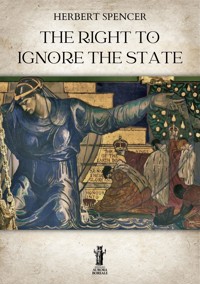
In "The Right to Ignore the State," Herbert Spencer presents a compelling critique of government authority, intertwining philosophical discourse with a profound exploration of individual liberty. Written in the late 19th century, this work reflects the burgeoning ideas of anarchism and classical liberalism, emphasizing the moral and ethical imperatives behind the state's role '— or lack thereof '— in citizens' lives. Spencer's eloquent prose skillfully navigates complex ideas, urging readers to reconsider the legitimacy of state power and the intrinsic rights of the individual to live free from coercion. Herbert Spencer, a pivotal figure in the development of social philosophy, was profoundly influenced by the evolutionary theory of his time. His background as a sociologist and naturalist contributed to his advocacy for a society grounded in competition and individual self-reliance. Spencer, often viewed as a precursor to modern libertarianism, fervently believed in the natural rights of individuals and the inherent dangers of state interference. His multifaceted perspective was shaped by both personal convictions and the cultural milieu that questioned governmental overreach in an era marked by industrialization and social change. This thought-provoking work is highly recommended for those interested in political philosophy, individual rights, or the historical context of anarchist thought. Spencer's arguments compel readers to engage with fundamental questions about authority and personal autonomy. "The Right to Ignore the State" offers a timeless appeal for anyone seeking to explore the delicate balance between society and the individual. In this enriched edition, we have carefully created added value for your reading experience: - A succinct Introduction situates the work's timeless appeal and themes. - The Synopsis outlines the central plot, highlighting key developments without spoiling critical twists. - A detailed Historical Context immerses you in the era's events and influences that shaped the writing. - An Author Biography reveals milestones in the author's life, illuminating the personal insights behind the text. - A thorough Analysis dissects symbols, motifs, and character arcs to unearth underlying meanings. - Reflection questions prompt you to engage personally with the work's messages, connecting them to modern life. - Hand‐picked Memorable Quotes shine a spotlight on moments of literary brilliance. - Interactive footnotes clarify unusual references, historical allusions, and archaic phrases for an effortless, more informed read.
Das E-Book können Sie in Legimi-Apps oder einer beliebigen App lesen, die das folgende Format unterstützen:
Veröffentlichungsjahr: 2019
Ähnliche
















The Right to Ignore the State
Table of Contents
Introduction
A single conscience stands before the machinery of government and claims the moral right to step aside.
This work is counted among the small set of political essays that continue to unsettle settled assumptions, not merely explain them. Its endurance as a classic rests on the clarity with which it poses a timeless question: by what right does the state command our allegiance? Readers return to it for its uncompromising logic, its elegant compression, and the way it crystallizes debates about freedom, consent, and authority. It has helped define a vocabulary for subsequent thinkers in the liberal and libertarian traditions, and it retains a place in literary history as a model of principled, lucid polemic.
The Right to Ignore the State is by Herbert Spencer, the English philosopher best known for his broad system of social and moral theory. Written in the milieu of mid-nineteenth-century Britain and first published in 1851 as a chapter of his book Social Statics, the essay presents a concise, forceful argument for individual moral autonomy. Spencer’s purpose is to examine the legitimacy of political obligation and to test the boundaries of consent, using an ethical standard he develops elsewhere in his work. Without rehearsing every step of his reasoning, this introduction notes his aim: to ground civic duties in principles, not habit or force.
At its core, the essay explores whether a person who harms no one may refuse participation in political institutions, including their financial support. Spencer frames the issue within a broader theory of equal freedom, arguing that any authority worth obeying must be reconcilable with the rights it purports to protect. He does not offer a blueprint for social withdrawal so much as a moral litmus test for political legitimacy. The argument is presented with measured confidence, inviting readers to consider how consent is given, how it might be withheld, and what follows when the state exceeds the ethical limits it claims to uphold.
Spencer’s method is notably systematic. He proceeds from abstract ethical maxims to practical implications, a characteristic Victorian confidence in reasoned deduction guiding his prose. The structure employs a steady sequence of propositions, counter-considerations, and clarifications that illuminate rather than overwhelm. His style is temperate but unflinching, avoiding rhetorical excess while pressing difficult conclusions. This composure—philosophical rather than polemical in temperature—has helped the essay endure. It speaks to readers across generations who seek moral arguments stated without evasion, and it exemplifies a form of political writing that treats logic as a discipline of care for human freedom.
The book’s classic status also reflects the debates it inspired. By treating political obedience as something that must be justified, not presumed, the essay helped shape later discussions about voluntary association, individual sovereignty, and the limits of collective power. It has been frequently cited in conversations about the consent of the governed, the ethics of taxation, and the legitimacy of exit from public institutions. While different schools of thought read Spencer variously, his insistence that rights place real constraints on authority remains a touchstone. In this way, the work has influenced both sympathetic exponents of liberty and critics who challenge its conclusions.
Historically, the essay emerges from a period of rapid industrial change, reform, and debate over the scope of government in Britain. Spencer wrote in an intellectual climate shaped by utilitarian calculation, classical liberal principles, and evolving democratic claims. He engages that setting by asking whether expanding political participation necessarily sanctifies political power. Rather than taking tradition or mere majorities as decisive, he urges a test grounded in universal moral constraints. The result is a distinctive contribution to nineteenth-century thought: a confrontation with the idea of tacit consent and an invitation to consider whether genuine agreement can be compelled by birth, custom, or necessity.
As with most influential arguments, this one drew resistance. Critics questioned its practicality, worried about free-riding, and asked how shared goods could be sustained if individuals could decline participation. Spencer, for his part, treated such objections as serious but not decisive, since for him ethical first principles limited what ends could justify what means. Over time, he revisited various views advanced earlier in his career, and later editions of his work did not preserve every original chapter, a reminder that political philosophy is a living conversation rather than a monument. The essay’s provocations thus remain fertile ground for both endorsement and critique.
The literary value of the work lies in its compositional economy and moral poise. Spencer compresses a problem of perennial difficulty into clear, accessible prose without sacrificing nuance. He builds an atmosphere of intellectual candor, where readers are trusted to follow exacting lines of thought and to weigh conclusions for themselves. The tone is as much ethical as political, encouraging a reflective posture rather than partisan fervor. This makes the essay a durable companion to more expansive treatises: it stands alone as a meditation on authority and allegiance, yet it also frames questions that echo through legal theory, economics, and civic education.
For contemporary readers, the essay’s relevance is immediate. Modern life offers countless institutional memberships—public and private—where consent can blur into inertia. Questions about exit, opt-out rights, conscientious refusal, and the legitimacy of mandates recur in new forms, from digital governance to local civic obligations. Spencer’s argument does not settle these disputes, but it equips readers with a principled lens for viewing them: weigh power by the freedoms it preserves, not merely by the benefits it claims. The enduring utility of that lens explains why the work continues to be taught, debated, and invoked in discussions of liberty and responsibility.
Several themes organize the essay’s lasting appeal. Autonomy is central: the individual as a moral agent who bears duties to others but is not reducible to a subject of the state. Consent is examined not as a slogan but as a test with teeth, requiring voluntary adherence rather than acquiescence under pressure. Equality enters as a standard of mutual limit, guiding both personal action and public authority. Finally, the theme of restraint—on governments and individuals alike—pervades the analysis, emphasizing that freedom is structured by the equal freedom of others. Together, these motifs shape a rigorous, humane vision of political ethics.




