


52,99 €
Mehr erfahren.
- Herausgeber: John Wiley & Sons
- Kategorie: Fachliteratur
- Sprache: Englisch
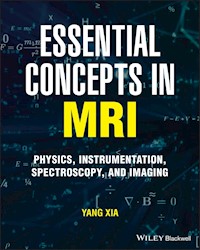
ESSENTIAL CONCEPTS IN MRI
A concise and complete introductory treatment of NMR and MRI
Essential Concepts in MRI delivers the first comprehensive look at magnetic resonance imaging with a practical focus on nuclear magnetic resonance spectroscopy applications. The book includes the essential components of MRI and NMR and is written for anyone new to the field of MRI who seeks to gain a complete understanding of all four essential components of MRI: physics theory, instrumentation, spectroscopy, and imaging.
Highly visual and including numerous full color figures that provide crucial graphical descriptions of key concepts discussed in the book, Essential Concepts in MRI includes discussions of quantitative and creative MRI, as well as spatial mapping in MRI and the effects of the field gradient and k-space imaging. The book also covers:
- A thorough introduction to essential concepts in nuclear magnetic resonance, including classical descriptions of NMR and quantum mechanical descriptions of NMR
- Comprehensive explorations of essential concepts in NMR instrumentation, including magnets, radio-frequency coils, transmitters, and receivers
- Practical discussions of essential concepts in NMR spectroscopy, including simple 1D spectroscopy, double resonance, and dipolar interactions in two-spin systems
- In-depth examinations of essential concepts in MRI, including the design of MRI pulse sequences and the elements of MRI instrumentation, with a special focus on quantitative MRI
Essential Concepts in MRI is a must-read reference for upper-level undergraduate and postgraduate students in the physical and medical sciences, especially radiology, MRI, and imaging courses. It is also essential for students and researchers in the biomedical sciences and engineering.
Sie lesen das E-Book in den Legimi-Apps auf:
Seitenzahl: 649
Veröffentlichungsjahr: 2022
Ähnliche



















Essential Concepts in MRI
Physics, Instrumentation, Spectroscopy, and Imaging
Yang Xia
Oakland University
Rochester, MI, USA
This edition first published 2022
© 2022 John Wiley & Sons Ltd
All rights reserved. No part of this publication may be reproduced, stored in a retrieval system, or transmitted, in any form or by any means, electronic, mechanical, photocopying, recording or otherwise, except as permitted by law. Advice on how to obtain permission to reuse material from this title is available at http://www.wiley.com/go/permissions.
The right of Yang Xia to be identified as the author of this work has been asserted in accordance with law.
Registered Office(s)
John Wiley & Sons, Inc., 111 River Street, Hoboken, NJ 07030, USA
John Wiley & Sons Ltd, The Atrium, Southern Gate, Chichester, West Sussex, PO19 8SQ, UK
Editorial Office
9600 Garsington Road, Oxford, OX4 2DQ, UK
For details of our global editorial offices, customer services, and more information about Wiley products visit us at www.wiley.com.
Wiley also publishes its books in a variety of electronic formats and by print-on-demand. Some content that appears in standard print versions of this book may not be available in other formats.
Limit of Liability/Disclaimer of Warranty
The contents of this work are intended to further general scientific research, understanding, and discussion only and are not intended and should not be relied upon as recommending or promoting scientific method, diagnosis, or treatment by physicians for any particular patient. In view of ongoing research, equipment modifications, changes in governmental regulations, and the constant flow of information relating to the use of medicines, equipment, and devices, the reader is urged to review and evaluate the information provided in the package insert or instructions for each medicine, equipment, or device for, among other things, any changes in the instructions or indication of usage and for added warnings and precautions. While the publisher and authors have used their best efforts in preparing this work, they make no representations or warranties with respect to the accuracy or completeness of the contents of this work and specifically disclaim all warranties, including without limitation any implied warranties of merchantability or fitness for a particular purpose. No warranty may be created or extended by sales representatives, written sales materials or promotional statements for this work. The fact that an organization, website, or product is referred to in this work as a citation and/or potential source of further information does not mean that the publisher and authors endorse the information or services the organization, website, or product may provide or recommendations it may make. This work is sold with the understanding that the publisher is not engaged in rendering professional services. The advice and strategies contained herein may not be suitable for your situation. You should consult with a specialist where appropriate. Further, readers should be aware that websites listed in this work may have changed or disappeared between when this work was written and when it is read. Neither the publisher nor authors shall be liable for any loss of profit or any other commercial damages, including but not limited to special, incidental, consequential, or other damages.
Library of Congress Cataloging-in-Publication DataNames: Xia, Yang, author.Title: Essential concepts in MRI : physics, instrumentation, spectroscopy, and imaging / Yang Xia, Oakland University, Rochester, MI, USA.Description: First edition. | Hoboken, NJ : John Wiley & Sons, Inc., 2022. | Includes bibliographical references and index.Identifiers: LCCN 2021025868 (print) | LCCN 2021025869 (ebook) | ISBN 9781119798217 (paperback) | ISBN 9781119798231 (pdf) | ISBN 9781119798248 (epub)Subjects: LCSH: Magnetic resonance imaging.Classification: LCC RC78.7.N83 X53 2022 (print) | LCC RC78.7.N83 (ebook) | DDC 616.07/548--dc23LC record available at https://lccn.loc.gov/2021025868LC ebook record available at https://lccn.loc.gov/2021025869
Cover image: © EDUARD MUZHEVSKYI/Getty Images
Cover design by Wiley
Set in 10/12 pt Trade Gothic LT Std by Integra Software Services Pvt. Ltd, Pondicherry, India
To my parents, and , for their unconditional love and unwavering support during the turbulent years when my sister, Xing , and I grew up in Shanghai, China, and to my two wonderful children, Aimee and Derek , for their love and friendship – it is so great to have you two in my life.
Contents
Cover
Title page
Copyright
Dedication
Preface
Chapter 1 Introduction
1.1 Introduction
1.2 Major Steps in an NMR or MRI Experiment, and Two Conventions in Direction
1.3 Major Milestones in the History of NMR and MRI
1.4 The Organization for a One-semester Course
Part I Essential Concepts in NMR
Chapter 2 Classical Description of Magnetic Resonance
2.1 Fundamental Assumptions
2.2 Nuclear Magnetic Moment
2.3 The Time Evolution of Nuclear Magnetic Moment
2.4 Macroscopic Magnetization
2.5 Rotating Reference Frame
2.6 Spin Relaxation Processes
2.7 Bloch Equation
2.8 Fourier Transform and Spectral Line Shapes
2.9 CW NMR
2.10 Radio-frequency Pulses in NMR
2.11 FT NMR
2.12 Signal Detection in NMR
2.13 Phases of the NMR Signal
Chapter 3 Quantum Mechanical Description of Magnetic Resonance
3.1 Nuclear Magnetism
3.2 Energy Difference
3.3 Macroscopic Magnetization
3.4 Measurement of the x Component of Angular Momentum
3.5 Macroscopic Magnetization for Spin 1/2
3.6 Resonant Excitation
3.7 Mechanisms of Spin Relaxation
Chapter 4 Nuclear Interactions
4.1 Dipolar Interaction
4.2 Chemical Shift Interaction
4.3 Scalar Interaction
4.4 Quadrupole Interaction
4.5 Summary of Nuclear Interactions
Part II Essential Concepts in NMR Instrumentation
Chapter 5 Instrumentation
5.1 Magnets
5.2 Radio-frequency Coil, Its Resonant Circuitry, and the Probe
5.3 Frequency Management
5.4 Transmitter
5.5 Receiver
5.6 Pulse Programmer and Computer
5.7 Other Components
Chapter 6 NMR Experimental
6.1 Shimming
6.2 Preparing Samples
6.3 Pulse Sequences and FID
6.4 Digitization Rate and Digital Resolution
6.5 Dynamic Range
6.6 Phase Cycling
6.7 Data Accumulation
6.8 Pre-FFT Processing Techniques
6.9 Fast Fourier Transform
6.10 Post-FFT Processing
6.11 Signal-to-Noise Ratio
Chapter 7 Spin Manipulations by Pulse Sequences
7.1 SINGLE PULSE: 90˚I
x
, 90˚I
y
, 90˚I
-
x
, 90˚I
-
y
7.2 Inversion Recovery Sequence, Saturation Recovery Sequence, and
T
1
Relaxation
7.3 Spin-Echo Sequence (Hahn Echo) and
T
2
Relaxation
7.4 CPMG Echo Train
7.5 Stimulated Echo Sequence
7.6 SPIN-LOCKING AND
T
1ρ
RELAXATION
7.7 How to Select the Delays in Relaxation Measurement
Part III Essential Concepts in NMR Spectroscopy
Chapter 8 First-order 1D Spectroscopy
8.1 Nomenclature of the Spin System
8.2 Peak Shift – the Effect of Chemical Shift
8.3 Peak Area – Reflecting the Number of Protons
8.4 Peak Splitting – the Consequence of
J
Coupling
8.5 Examples of 1D Spectra
Chapter 9 Advanced Topics in Spectroscopy
9.1 Double Resonance
9.2 Dipolar Interaction in a Two-spin System
9.3 Magic Angle
9.4 Chemical Exchange
9.5 Magnetization Transfer
9.6 Selective Polarization Inversion/Transfer
9.7 Radiation Damping
Chapter 10 2D NMR Spectroscopy
10.1 Essence of 2D NMR Spectroscopy
10.2 COSY – Correlation Spectroscopy
10.3 J-resolved Spectroscopy
10.4 Examples of 2D NMR Spectroscopy
Part IV Essential Concepts in MRI
Chapter 11 Effect of the Field Gradient and
k
-space Imaging
11.1 Spatially Encoding Nuclear Spin Magnetization
11.2
k
Space in MRI
11.3 Mapping of
k
Space
11.4 Gradient Echo
Chapter 12 Spatial Mapping in MRI
12.1 Slice Selection in 2D MRI
12.2 Reading a Graphical Imaging Sequence
12.3 2D Filtered Back-Projection Reconstruction
12.4 2D Fourier Imaging Reconstruction
12.5 Sampling Patterns Between the Cartesian and Radial Grids
12.6 3D Imaging
12.7 Fast Imaging in MRI
12.8 Ultra-short Echo and ZTE MRI
12.9 MRI in Other Dimensions (4D, 1D, and One Voxel)
12.10 Resolution in MRI
Chapter 13 Imaging Instrumentation and Experiments
13.1 Shaped Pulses
13.2 The Gradient Units
13.3 Instrumentation Configurations for MRI
13.4 Imaging Parameters in MRI
13.5 Image Processing Software
13.6 Best Test Samples for MRI
Part V Quantitative and Creative MRI
Chapter 14 Image Contrast in MRI
14.1 Non-trivial Relationship Between Spin Density and Image Intensity
14.2 Image Contrast in MRI
14.3 How to Obtain Useful Information from Image Contrast?
14.4 Magnetization-prepared Sequences in Quantitative MRI
Chapter 15 Quantitative MRI
15.1 Quantitative Imaging of Velocity
v
and Molecular Diffusion
D
15.2 Quantitative Imaging of Relaxation Times
T
1
,
T
2
,
T
1ρ
15.3 Quantitative Imaging of Chemical Shift δ
15.4 Secondary Image Contrasts in MRI 259
15.5 Potential Issues and Practical Strategies in Quantitative MRI
Chapter 16 Advanced Topics in Quantitative MRI
16.1 Anisotropy and Tensor Properties in Quantitative MRI
16.2 Multi-Component Nature in Quantitative MRI
16.3 Quantitative Phase Information in the FID Data – SWI and QSM
16.4 Functional MRI (fMRI)
16.5 Optical Pumping and Hyperpolarization in MRI
Chapter 17 Reading the Binary Data
17.1 Formats of Data
17.2 Formats of Data Storage
17.3 Reading Unknown Binary Data
17.4 Examples of Specific Formats
Appendices
Appendix 1 Background in Mathematics
A1.1 Elementary Mathematics
A1.2 Fourier Transform
Appendix 2 Background in Quantum Mechanics
A2.1 Operators
A2.2 Expansion of a Wave Function
A2.3 Spin Operator I
A2.4 Raising and Lowering Operators I
+
and I
-
A2.5 Spin-1/2 Operator (in the Formalism of Pauli’s Spin Matrices)
A2.6 Density Matrix Operator ρ
Appendix 3 Background in Electronics
A3.1 Ohm’s Law for DC and AC Circuits
A3.2 Electronics at Radio Frequency
Appendix 4 Sample Syllabi for a One-semester Course
Appendix 5 Homework Problems
Index
End User License Agreement
List of Illustrations
Chapter 1
Figure 1.1 The resonance phenomenon,...
Figure 1.2 The
B
0
direction in NMR and MRI....
Figure 1.3 The positive directions of rotations in...
Figure 1.4 The first NMR spectrum of ethanol...
Figure 1.5 The first proton NMR image of two tubes of...
Figure 1.6 Major conceptual components of NMR and MRI.
Chapter 2
Figure 2.1 (a) Moving charges at velocity...
Figure 2.2 The application of an external magnetic...
Figure 2.4 (a) A single nucleus in an external magnetic...
Figure 2.5 Two counter-rotating fields (right)...
Figure 2.6 (a) A magnetic moment
µ
...
Figure 2.7 In the rotating frame that has...
Figure 2.8 Motion of the magnetization in the...
Figure 2.9 The motion of the longitudinal magnetization...
Figure 2.10 The motion of the magnitude...
Figure 2.11 Two equivalent functions...
Figure 2.12 Comparison between a Lorentzian and...
Figure 2.13 Fourier transform of (a) a hard...
Figure 2.14 (a) and (b) The time-domain NMR...
Figure 2.15 (a) A vector
M
rotates in...
Chapter 3
Figure 3.1 The quantities in a spin-1/2...
Figure 3.2 (a) A precise value of the Zeeman...
Figure 3.3 Schematic power spectra of the...
Figure 3.4 Schematic log/log trends of relaxation...
Chapter 4
Figure 4.1 (a) A nuclear spin behaves...
Figure 4.2 The application of the external...
Figure 4.3 The introduction of the chemical...
Figure 4.4 TMS is commonly used as the...
Figure 4.5 The scalar interaction arises via...
Figure 4.6 The influences of the chemical shift...
Figure 4.7 The effect of the
J
-coupling constant...
Figure 4.8 A schematic summary of the...
Chapter 5
Figure 5.1 A block diagram for an NMR...
Figure 5.2 A cut-open vertical-bore...
Figure 5.3 Halbach magnet configurations....
Figure 5.4 Shimming patterns that make the...
Figure 5.5 Basic configurations of rf coils,...
Figure 5.6 The rf coil and two capacitors form...
Figure 5.7 An NMR spectrometer, where all six...
Figure 5.8 The imperfections in the leading and...
Chapter 6
Figure 6.1 (a) A slightly off-resonance FID...
Figure 6.2 (a) A text file for a simple...
Figure 6.3 Consequences of under-sampling....
Figure 6.4 A spectrum of the ethanol’s triplet....
Figure 6.5 The issue of dynamic range in signal...
Figure 6.6 Basic relationships in phase cycling,...
Figure 6.7 CYCLOPS phase cycling. The size of...
Figure 6.8 Improvement of SNR by data accumulation....
Figure 6.9 (a) The FID has a finite and constant...
Figure 6.10 Sensitivity enhancement by filtering...
Figure 6.11 Zero-filling the time-domain data...
Figure 6.12 The effect of the zeroth-order phase shift...
Figure 6.13 The first-order phase shift...
Figure 6.14 Estimation of the SNR from a spectrum...
Chapter 7
Figure 7.1 (a) A pulse sequence with a...
Figure 7.2 The magnetization vectors and...
Figure 7.3 (a) An inversion recovery pulse sequence....
Figure 7.4 (a) A saturation recovery pulse sequence....
Figure 7.5 The cover of the November 1953 issue of...
Figure 7.6 Two versions of the spin-echo sequence, which...
Figure 7.7 (a) CPMG sequence, which can have a...
Figure 7.8 (a) Stimulated echo sequence....
Figure 7.9 (a) The
T
1ρ
...
Figure 7.10 Two ways to sample an exponential...
Chapter 8
Figure 8.1 Fundamental relationships among the...
Figure 8.2 A low-resolution spectrum of...
Figure 8.3 Schematic line patterns of a two...
Figure 8.4 Schematic line patterns of the A...
Figure 8.5 Schematic line patterns of the A...
Figure 8.6 The full
1
H NMR spectrum of...
Figure 8.7a
1
H spectrum of styrene, where...
Figure 8.7b
13
C spectrum of styrene when...
Figure 8.7c
13
C spectrum of styrene when...
Figure 8.8
1
H NMR spectrum of ethyl acetate,...
Figure 8.9
1
H NMR spectrum of quinoline....
Chapter 9
Figure 9.1 Pulse sequences for double-resonance...
Figure 9.2 Schematic of homonuclear decoupling,...
Figure 9.3
13
C NMR spectra of quinoline...
Figure 9.4
13
C NMR spectra of quinoline dissolved...
Figure 9.5 The rate of chemical exchange,...
Figure 9.6 (a) Two resonant peaks represent two...
Figure 9.7 Magnetization transfer can be used to...
Figure 9.8 Numerical illustrations for selective...
Figure 9.9 Comparison of two CH
2
resonant peaks...
Chapter 10
Figure 10.1 A schematic illustration of...
Figure 10.2 (a) 2D heteronuclear COSY sequence,...
Figure 10.3 An energy-level diagram for a heteronuclear...
Figure 10.4 A schematic 2D heteronuclear COSY spectrum,...
Figure 10.5 A conceptual pulse sequence for 2D homonuclear...
Figure 10.6 A schematic 2D homonuclear COSY spectrum,...
Figure 10.7 (a) A conceptual pulse sequence for 2D...
Figure 10.8 (a) The general pulse sequence for 2D...
Figure 10.9 (a) The general pulse sequence for 2D...
Figure 10.10a 2D homonuclear
1
H COSY...
Figure 10.10b The AMX peaks in the 2D homonuclear...
Figure 10.11a 2D heteronuclear
13
C J-resolved
Figure 10.11b The enlarged spectra of the individual...
Chapter 11
Figure 11.1 1D profiles of a tube of water....
Figure 11.2 Spatially encoding the nuclear...
Figure 11.3 Components of the 3D field gradient,...
Figure 11.4 Insignificant effect of the field gradient...
Figure 11.5 Moving around in 2D
k
space,...
Figure 11.6 (a) Covering the first quadrant in
k
Figure 11.7 Four non-standard 2D mapping...
Figure 11.8 The dephasing and re-phasing by a...
Chapter 12
Figure 12.1 Imaging matrices, assuming each...
Figure 12.2 Slice selection in MRI....
Figure 12.3 (a) A soft rf pulse means long...
Figure 12.4 (a) A slice selection sequence...
Figure 12.5 Pulse sequences in slice selection....
Figure 12.6 Relationships among the slice selection...
Figure 12.7 Three common slice orientations in...
Figure 12.8 2D back-projection imaging sequence...
Figure 12.9 The image reconstruction in the filtered...
Figure 12.10 2D FT sequence (a) that uses a...
Figure 12.11 The spin-echo version (a) and the...
Figure 12.12 Re-gridding or interpolation process...
Figure 12.13 3D MRI sequences. (a) 3D back-projection...
Figure 12.14 A 2D fast imaging sequence when a small tip angle...
Figure 12.15 A 2D fast imaging sequence when the magnetization...
Figure 12.16 An illustration for the concept of...
Figure 12.17 Example of the sampling patterns in MRI...
Figure 12.18 TE in imaging sequences. 2D imaging sequences...
Figure 12.19 A double-tube phantom filled with water,...
Figure 12.20 A 1D imaging sequence, which utilizes two slice...
Figure 12.21 A single-voxel imaging sequence, where the signal...
Figure 12.22 A resolution scale in MRI and beyond....
Chapter 13
Figure 13.1 (a) Various sinc pulses, each having...
Figure 13.2 Basic configurations for the gradient...
Figure 13.3 Two examples of imaging probe design for...
Figure 13.4 (a) The desired shape of the gradient pulses...
Figure 13.5 A schematic configuration for an MRI...
Figure 13.6 Two images of water phantoms. From these...
Figure 13.7 A phantom of agarose gel glued to a piece...
Chapter 14
Figure 14.1 (a) Two 14-µm-resolution images...
Figure 14.2 Two axial images of a cucumber acquired...
Figure 14.3 Three sequential segments of an imaging...
Figure 14.4 Quantitative one-shot imaging using the concept...
Figure 14.5 Quantitative multi-slicing approach in...
Figure 14.6 PGSE-like effect due to the slice gradients...
Figure 14.7 Magnetization-prepared T
2
imaging...
Chapter 15
Figure 15.1 Summary of image contrasts....
Figure 15.2 The PGSE pulse sequences in the...
Figure 15.3 A sinusoidal wave can be characterized...
Figure 15.4 The dynamic dimension conjugate to...
Figure 15.5 (a) A 2D imaging sequence that employs...
Figure 15.6 A set of 2D
q
space MRI data...
Figure 15.7 A configuration of two glass tubes...
Figure 15.8 (a) A set of 2D
q
-space...
Figure 15.9 (a) The
T
2
-weighted proton...
Figure 15.10 (a) A 2D imaging sequence that can...
Figure 15.11 (a) A 2D imaging sequence that can quantify...
Figure 15.12 A 2D
T
1ρ
imaging sequence that uses...
Figure 15.13
T
1ρ
dispersion in articular cartilage...
Figure 15.14 A 1D NMR spectrum of a fresh acorn,...
Figure 15.15 A schematic diagram for chemical shift ...
Figure 15.16 Two CHEmical Shift Selective (CHESS)...
Figure 15.17 A CHESS imaging example. (a) A phantom of...
Figure 15.18 Two CHESS imaging examples, using (a) a fresh...
Figure 15.19 Effect of susceptibility artifact....
Figure 15.20 A plot of the self-diffusion of water as...
Figure 15.21 Quantitative correlation of the GAG....
Figure 15.22
T
2
and
T
2
* profiles in articular cartilage...
Figure 15.23 A simulated noiseless double-exponential...
Figure 15.24 The same simulated double-exponential decay...
Figure 15.25 Fitting decay data with a single exponential....
Chapter 16
Figure 16.1 An evolutional view of MRI images....
Figure 16.2 (a) Dipolar interaction between two...
Figure 16.3 (a) The proton images of one cartilage-bone...
Figure 16.4
T
1ρ
dispersion plots of the bovine...
Figure 16.5 Schematics of free diffusion (a) and restricted...
Figure 16.6 An example of a restricted diffusion...
Figure 16.7 Examples of brain DTI of different animals...
Figure 16.8 The Brownian motion of water molecules...
Figure 16.9 The nature of multiple pools of water molecules...
Figure 16.10 Example of multi-component...
Figure 16.11 (a) An original magnitude image of...
Figure 16.12 The coronal mid-lung
1
H MR image...
Chapter 17
Figure 17.1 (a) The selections in the...
Figure 17.2 (a) Binary view of an FID data that...
Appendix 1
Figure A1.1 The directions in the vector cross...
Figure A1.2 The Argand diagram of complex numbers...
Figure A1.3 A 2D matrix rotation.
Figure A1.4 Discrete time and frequency...
Appendix 3
Figure A3.1 (a) The real and imaginary...
Figure A3.2 A schematic of a transmission...
List of Tables
Chapter 2
Table 2.1 Properties of common nuclei.
Table 2.2 Some functions and their FT...
Table 2.3 Some features of Lorentzian...
Chapter 4
Table 4.1 Magnitudes of nuclear interactions.
Table 4.2 Orientational properties of nuclear...
Chapter 5
Table 5.1 Shimming of magnetic field.
Chapter 7
Table 7.1 Two series of delay times in T2...
Chapter 8
Table 8.1 Basis product functions...
Table 8.2 Basis product functions...
Table 8.3 Pascal’s triangle for...
Table 8.4 Normalization of the intensities...
Chapter 14
Table 14.1 Relationships in signals...
Guide
Cover
Title page
Copyright
Dedication
Table of Contents
Preface
Begin Reading
Appendices
Appendix 1 Background in Mathematics
Appendix 2 Background in Quantum Mechanics
Appendix 3 Background in Electronics
Appendix 4 Sample Syllabi for a One-semester Course
Appendix 5 Homework Problems
Index
End User License Agreement
Pages
i
ii
iii
iv
v
vi
vii
viii
ix
x
xi
xii
xiii
1
2
3
4
5
6
7
8
9
10
11
12
13
14
15
16
17
18
19
20
21
22
23
24
25
26
27
28
29
30
31
32
33
34
35
36
37
38
39
40
41
42
43
44
45
46
47
48
49
50
51
52
53
54
55
56
57
58
59
60
61
62
63
64
65
66
67
68
69
70
71
72
73
74
75
76
77
78
79
80
81
82
83
84
85
86
87
88
89
90
91
92
93
94
95
96
97
98
99
100
101
102
103
104
105
106
107
108
109
110
111
112
113
114
115
116
117
118
119
120
121
122
123
124
125
126
127
128
129
130
131
132
133
134
135
136
137
138
139
140
141
142
143
144
145
146
147
148
149
150
151
152
153
154
155
156
157
158
159
160
161
162
163
164
165
166
167
168
169
170
171
172
173
174
175
176
177
178
179
180
181
182
183
184
185
186
187
188
189
190
191
192
193
194
195
196
197
198
199
200
201
202
203
204
205
206
207
208
209
210
211
212
213
214
215
216
217
218
219
220
221
222
223
224
225
226
227
228
229
230
231
232
233
234
235
236
237
238
239
240
241
242
243
244
245
246
247
248
249
250
251
252
253
254
255
256
257
258
259
260
261
262
263
264
265
266
267
268
269
270
271
272
273
274
275
276
277
278
279
280
281
282
283
284
285
286
287
288
289
290
291
292
293
294
295
296
297
298
299
300
301
302
303
304
305
306
307
308
309
310
311
312
313
314
315
316
317
318
319
320
321
322
323
324
325
326
327
328
329
330
331
332
333
334
335
336
337
338
339
340
341
342
343
344
345
346
347
348
349
Preface
In the fall semester of 1994, I became a new assistant professor of physics at Oakland University, in the specialization of medical physics. After receiving my assignment to teach a graduate-level one-semester course in magnetic resonance imaging (MRI) for the next semester, I sat in my nearly empty office and wondered what and how to teach my students. As someone who had been working in MRI research for eight years at that time, I knew the importance of the fundamental theory. As someone who had been a hands-dirty experimentalist, I knew the importance of hardware and software that enabled any experiment. As someone who was specialized in quantitative MRI, I loved this field of research where the final result was an image, hopefully a beautiful and useful one. At the same time, I remembered my occasional regret during my imaging career that I did not know much about spectroscopy. I therefore determined to teach my students a little bit of nuclear magnetic resonance (NMR) spectroscopy.
I started to read the books that were available at the time, to find a potential textbook for my students. I wished I had read some of these books earlier, since there was so much that I simply didn’t know! As I went over these books for a possible adaptation for my course, I could not find any single book that contained what I had in my mind as the four essential and inseparable components of MRI – theory, instrumentation, spectroscopy, and imaging. There were books that were excellent and extensive in each of the four essential components in MRI. I was, however, unable to find one book that introduces all four components that I had in mind. (Asking my students to buy multiple books for one course was not an option.) I eventually realized, painfully, that I would have to put together the materials myself, if I wanted to teach the course as I had planned in my mind. My starting point was two excellent books that were available at that time: P.T. Callaghan’s Principles of Nuclear Magnetic Resonance Microscopy (Oxford University Press, 1991) and R.K. Harris’s Nuclear Magnetic Resonance Spectroscopy (Longman Scientific & Technical, 1989). I had the pleasure to communicate with both authors on their books during my teaching. My lecture notes, evolved and revised substantially during the last 26 years, became the basis for this book.
Since my course is for one 14-week semester, I must pick and choose what I could cover within that given time; I simply do not have time to cover all important concepts in all four components in great detail. I, however, determined to cover all four components of MRI: the theory of physics that explains this fascinating phenomenon, the instrumentation and experimental techniques that facilitate the execution of this fascinating phenomenon, the early adaptation of this physics phenomenon in the practice of NMR spectroscopy, and finally MRI. The requirements and time constraints of the course reflect the compromised (or optimized) choices, which are personal, for the topic selections in this book and the words “Essential Concepts” in the title of this book.
This book is grouped into five parts. Part I introduces the essential concepts in magnetic resonance, including the use of the classical description and a brief introduction of the quantum mechanical description. It also includes the description for a number of nuclear interactions that are fundamental to magnetic resonance. Part II covers the essential concepts in experimental magnetic resonance, which are common for both NMR spectroscopy and MRI. Part III describes the essential concepts in NMR spectroscopy, which should also be beneficial for MRI researchers. Part IV introduces the essential concepts in MRI. The final part is concerned with the quantitative and creative nature of MRI research. At the end of the book there are several short appendices, which include some background information on several topics in the book, some sample syllabi for possible ways to teach this course, as well as some homework problems.
I owe a great debt to the late Sir Paul T. Callaghan, who was my graduate advisor at Massey University in Palmerston North, New Zealand during 1986–1992. He taught me the art and science of NMR imaging at microscopy resolution (µMRI).
In my own research journey at Oakland University since 1994, I am very grateful for the beautiful works of my graduate students (Jonathan Moody, Hisham Alhadlaq, Jihyun Lee, Farid Badar, Daniel Mittelstaedt, David Kahn, Syeda Batool, Hannah Mantebea, Amanveer Singh, Austin Tetmeyer, Aaron Blanc), the mutual education of my former postdocs in MRI (ShaoKuan Zheng, Nian Wang, Rohit Mahar, Nagaraja Cholashetthalli), and the stimulating exchange of many visiting and sabbatical scientists to my lab (Paul T. Callaghan, Siegfried Stapf, Hisham A. Alhadlaq, Ekrem Cicek, RanHong Xie, ZhiGuo Zhuang, Zhe Chen). I have also benefited in my MRI research from the collaboration and interactions with many professional colleagues in MRI (Eiichi Fukushima, Kenneth Jeffrey, Gregory Furman, Jia Hua, Yong Lu, Quan Jiang, Jiani Hu, Craig Eccles, Mark Mattingly, Dieter Gross, Thomas Oerther, Volker Lehmann). Thank you.
I am grateful for four five-year R01 grants from the National Institutes of Health (NIH NIAMS) to my research lab at Oakland University, much internal support from the Research Excellence Fund in Biotechnology and the Center for Biomedical Research at Oakland University, the Department of Physics at Oakland University, and an NMR instrument endorsement from R.B. and J.N. Bennett (Oakland University), which initiated and supported my micro-imaging adventure at Oakland University.
My special thanks go to several colleagues who contributed directly to this book: Bradley J. Roth (Oakland University) and Siegfried Stapf (Technische Universität Ilmenau), who generously offered to read and comment on a draft of this book; Dylan Twardy (Oakland University), who worked with me during a previous semester to obtain some NMR spectra that are used in the book and also read the spectroscopy chapters; Roman Dembinski (Oakland University), who read the spectroscopy chapters in this book; and Farid Badar (Oakland University), who provided several image examples used in the book. I also thank the students in my classes over the years (in particular, several students in my most recent class, who had the opportunity to use an early version of the typed notes); all of you have made this book better.
My final thanks go to my sister, Xing, my daughter, Aimee, and son, Derek – you have successfully kept the homebound me during the 2020 pandemic sane and productive. You see, I had dreamed about publishing my lecture notes as a book for some 15 years. I started on this journey several times in the past, and each time I dropped it without completion due to the onset of a few work-/family-related tasks. Yes, these were excuses, I know! When this pandemic started in the beginning of 2020, I had to prepare to teach this course online. After I transcribed the mostly handwritten notes onto a home computer, I kept revising it using the lockdown months when I was working from home. So, here it is.
To my readers, I would love to hear from you, for any corrections and suggestions you might have.
Yang Xia
Distinguished Professor
Professor of Physics
Fellow of the American Physical Society (APS)
Fellow of the International Society for Magnetic Resonance in Medicine (ISMRM)
Fellow of the American Institute for Medical and Biological Engineering (AIMBE)Fellow of the Orthopaedic Research Society (ORS)
Department of Physics
Oakland University
Rochester, Michigan, USA
The first draft 2020.8.2
The second draft 2021.1.20
The final revision 2021.3.31




