


51,99 €
Mehr erfahren.
- Herausgeber: John Wiley & Sons
- Kategorie: Fachliteratur
- Serie: Essentials of Psychological Assessment
- Sprache: Englisch
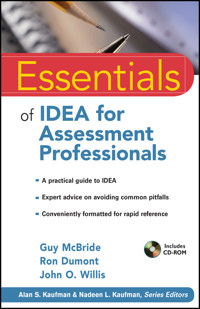
Quickly acquire the practical coverage and guidance you need to understand the Individuals with Disabilities Education Act (IDEA)
The Individuals with Disabilities Education Act (IDEA) governs how states and public agencies provide early intervention, special education, and related services to children with disabilities.
To understand it thoroughly, school psychologists, teachers, and other school service providers need a comprehensive resource to guide them in what this frequently amended Act means and how it should be interpreted. The first concise, yet authoritative, book of its kind on which professionals can rely to navigate this often-misunderstood law, Essentials of IDEA for Assessment Professionals is that source.
Like all the volumes in the Essentials of Psychological Assessment series, each chapter features numerous callout boxes highlighting key concepts, bulleted points, and extensive illustrative material, as well as test questions that help you gauge and reinforce your grasp of the information covered. Written in the user-friendly and well-known Essentials format, each of the seven concise chapters covers terminology, classification, assessments/evaluations, and other topics related to IDEA.
With an accompanying CD offering commentary on judicial decisions related to interpretation of IDEA, as well as references to the 2006 final regulations for IDEA 2004 and Section 504 regulations, Essentials of IDEA for Assessment Professionals provides helpful guidelines for educational assessments and evaluations.
Sie lesen das E-Book in den Legimi-Apps auf:
Seitenzahl: 452
Veröffentlichungsjahr: 2011
Ähnliche



















Contents
Cover
Series
Essentials of Psychological Assessment Series
Title Page
Copyright
Dedication
Series Preface
Acknowledgments
One: OVERVIEW OF THE IDEA 2004
STATUTES AND REGULATIONS
STATUTES
REGULATIONS
A COMMENT ON SPEDLAW
A VERY BRIEF HISTORY OF IDEA
SOME GENERAL GUIDANCE
THE 46753 TRICK: COMMENTARY VERSUS REGULATIONS
FINAL THOUGHTS
Two: IDEA TERMINOLOGY
DISABILITIES
FREE APPROPRIATE PUBLIC EDUCATION
LEAST RESTRICTIVE ENVIRONMENT
CHILD FIND
PROCEDURAL SAFEGUARDS
FERPA
INFORMED WRITTEN CONSENT
NATIVE LANGUAGE
INDEPENDENT EDUCATION EVALUATIONS
“SHOULD,” “SHALL,” “MAY,” AND “MUST”
Three: IDEA AND EVALUATIONS/ASSESSMENTS
ANNUAL REVIEWS AND ELIGIBILITY SECTION 300.324 DEVELOPMENT, REVIEW, AND REVISION OF IEP
EVALUATIONS
TESTING ON OR OFF MEDICATIONS
INDEPENDENT EDUCATIONAL EVALUATION
REEVALUATIONS FOR POSTSECONDARY INSTITUTIONS
REEVALUATION TIMELINES
CONSENT TO EVALUATE
WHO IS A PARENT?
PARENTAL CONSENT TO SCREEN (§ 300.302 SCREENING FOR INSTRUCTIONAL PURPOSES IS NOT EVALUATION)
SECOND-LANGUAGE LEARNERS
WHO PAYS
USING PARENTS' INSURANCE
REPORTS
Four: SPECIAL CONSIDERATIONS WHEN TESTING FOR SPECIFIC LEARNING DISABILITIES
WHAT IS A SPECIFIC LEARNING DISABILITY?
SECTION 300.307–300.311 DETERMINING THE EXISTENCE OF A SPECIFIC LEARNING DISABILITY
INTRA-INDIVIDUAL DIFFERENCES
INTELLECTUAL DEVELOPMENT
DISCREPANCY
PSYCHOLOGICAL PROCESSING DISORDER
RESPONSE TO INTERVENTION
COMPARISON GROUPS
GRADE EQUIVALENTS
AGE NORMS VERSUS GRADE NORMS
EXCLUSIONS
SLD ELIGIBILITY CATEGORIES
REEVALUATIONS WHEN CHANGING METHODOLOGIES
SPECIAL EFFECTS
Five: IDEA and Classification/Eligibility
DETERMINING ELIGIBILITY
SERVICES AND LABELS
EVALUATION REPORTS
ELIGIBILITY CRITERIA
SPECIFIC LEARNING DISABILITY
SERVICES
LACK OF APPROPRIATE INSTRUCTION
ADVERSE EFFECT
TEAM MEETING
MEDICAL AND PSYCHOLOGICAL “DIAGNOSES”
Six: IDEA AND BEHAVIOR
MANIFESTATION DETERMINATION
REMOVAL FROM SCHOOL
CONFUSING QUIRKS AND TWISTS
POSITIVE BEHAVIORAL INTERVENTIONS AND SUPPORTS
Seven: IDEA, SECTION 504, AND ADA
OVERVIEW OF SECTION 504
MISCONCEPTIONS ABOUT 504
SECTION 504 AND ADA
SECTION 504 AS A CONSOLATION PRIZE
SECTION 504 AND THE AMERICANS WITH DISABILITIES AMENDMENTS ACT
DIAGNOSES
504 PLANS
MAJOR LIFE FUNCTIONS
RIGHTS, ACCOMMODATIONS, AND SERVICES
IMMIGRATION ISSUES
CONSENT
Eight: IDEA AND DAMAGES
DEFINITIONS OF “DAMAGES”
Nine: FERPA AND THE PPRA: CONFIDENTIAL RECORDS
DESTRUCTION OF PROTOCOLS IN SCHOOL RECORDS
PROTECTION OF PUPIL RIGHTS ACT
Appendix A: Common Abbreviations and Acronyms
Appendix B: CD-ROM Contents
References
Annotated Bibliography
Author Index
Subject Index
About the Authors
About the CD-ROM
Introduction
USING THE CD WITH A MAC
Essentials of Psychological Assessment Series
Series Editors, Alan S. Kaufman and Nadeen L. Kaufman
Essentials of 16 PF® Assessment by Heather E.-P. Cattell and James M. Schuerger
Essentials of Assessment Report Writing by Elizabeth O. Lichtenberger, Nancy Mather, Nadeen L. Kaufman, and Alan S. Kaufman
Essentials of Assessment with Brief Intelligence Tests by Susan R. Homack and Cecil R. Reynolds
Essentials of Bayley Scales of Infant Development'II Assessment by Maureen M. Black and Kathleen Matula
Essentials of Behavioral Assessment by Michael C. Ramsay, Cecil R. Reynolds, and R. W. Kamphaus
Essentials of Career Interest Assessment by Jeffrey P. Prince and Lisa J. Heiser
Essentials of CAS Assessment by Jack A. Naglieri
Essentials of Cognitive Assessment with KAIT and Other Kaufman Measures by Elizabeth O. Lichtenberger, Debra Broadbooks, and Alan S. Kaufman
Essentials of Conners Behavior Assessments™ by Elizabeth P. Sparrow
Essentials of Creativity Assessment by James C. Kaufman, Jonathan A. Plucker, and John Baer
Essentials of Cross-Battery Assessment, Second Edition by Dawn P. Flanagan, Samuel O. Ortiz, and Vincent C. Alfonso
Essentials of DAS-II® Assessment by Ron Dumont, John O. Willis, and Colin D. Elliott
Essentials of Evidence-Based Academic Interventions by Barbara J. Wendling and Nancy Mather
Essentials of Forensic Psychological Assessment, Second Edition by Marc J. Ackerman
Essentials of IDEA for Assessment Professionals by Guy M. McBride, Ron Dumont, and John O. Willis
Essentials of Individual Achievement Assessment by Douglas K. Smith
Essentials of KABC-II Assessment by Alan S. Kaufman, Elizabeth O. Lichtenberger, Elaine Fletcher-Janzen, and Nadeen L. Kaufman
Essentials of Millon™ Inventories Assessment, Third Edition by Stephen Strack
Essentials of MMPI-A™ Assessment by Robert P. Archer and Radhika Krishnamurthy
Essentials of MMPI-2® Assessment, Second Edition by David S. Nichols
Essentials of Myers-Briggs Type Indicator® Assessment, Second Edition by Naomi Quenk
Essentials of NEPSY®-II Assessment by Sally L. Kemp and Marit Korkman
Essentials of Neuropsychological Assessment, Second Edition by Nancy Hebben and William Milberg
Essentials of Nonverbal Assessment by Steve McCallum, Bruce Bracken, and John Wasserman
Essentials of PAI ® Assessment by Leslie C. Morey
Essentials of Processing Assessment by Milton J. Dehn
Essentials of Response to Intervention by Amanda M. VanDerHeyden and Matthew K. Burns
Essentials of Rorschach® Assessment by Tara Rose, Nancy Kaser-Boyd, and Michael P. Maloney
Essentials of School Neuropsychological Assessment by Daniel C. Miller
Essentials of Stanford-Binet Intelligence Scales (SB5) Assessment by Gale H. Roid and R. Andrew Barram
Essentials of TAT and Other Storytelling Assessments, Second Edition by Hedwig Teglasi
Essentials of Temperament Assessment by Diana Joyce
Essentials of WAIS®-IV Assessment by Elizabeth O. Lichtenberger and Alan S. Kaufman
Essentials of WIAT®-III and KTEA-II Assessment by Elizabeth O. Lichtenberger and Kristina C. Breaux
Essentials of WISC-III® and WPPSI-R® Assessment by Alan S. Kaufman and Elizabeth O. Lichtenberger
Essentials of WISC®-IV Assessment, Second Edition by Dawn P. Flanagan and Alan S. Kaufman
Essentials of WJ III ™ Cognitive Abilities Assessment by Fredrick A. Schrank, Dawn P. Flanagan, Richard W. Woodcock, and Jennifer T. Mascolo
Essentials of WJ III™ Tests of Achievement Assessment by Nancy Mather, Barbara J. Wendling, and Richard W. Woodcock
Essentials of WMS®-IV Assessment by Lisa Whipple Drozdick, James A. Holdnack, and Robin C. Hilsabeck
Essentials of WNV™ Assessment by Kimberly A. Brunnert, Jack A. Naglieri, and Steven T. Hardy-Braz
Essentials of WPPSI™-III Assessment by Elizabeth O. Lichtenberger and Alan S. Kaufman
Essentials of WRAML2 and TOMAL-2 Assessment by Wayne Adams and Cecil R. Reynolds
This book is printed on acid-free paper.
Copyright © 2011 by John Wiley & Sons, Inc. All rights reserved.
Published by John Wiley & Sons, Inc., Hoboken, New Jersey. Published simultaneously in Canada.
No part of this publication may be reproduced, stored in a retrieval system, or transmitted in any form or by any means, electronic, mechanical, photocopying, recording, scanning, or otherwise, except as permitted under Section 107 or 108 of the 1976 United States Copyright Act, without either the prior written permission of the Publisher, or authorization through payment of the appropriate per-copy fee to the Copyright Clearance Center, Inc., 222 Rosewood Drive, Danvers, MA 01923, (978) 750-8400, fax (978) 646-8600, or on the web at www.copyright.com. Requests to the Publisher for permission should be addressed to the Permissions Department, John Wiley & Sons, Inc., 111 River Street, Hoboken, NJ 07030, (201) 748-6011, fax (201) 748-6008.
Limit of Liability/Disclaimer of Warranty: While the publisher and author have used their best efforts in preparing this book, they make no representations or warranties with respect to the accuracy or completeness of the contents of this book and specifically disclaim any implied warranties of merchantability or fitness for a particular purpose. No warranty may be created or extended by sales representatives or written sales materials. The advice and strategies contained herein may not be suitable for your situation. You should consult with a professional where appropriate. Neither the publisher nor author shall be liable for any loss of profit or any other commercial damages, including but not limited to special, incidental, consequential, or other damages.
This publication is designed to provide accurate and authoritative information in regard to the subject matter covered. It is sold with the understanding that the publisher is not engaged in rendering professional services. If legal, accounting, medical, psychological or any other expert assistance is required, the services of a competent professional person should be sought.
Designations used by companies to distinguish their products are often claimed as trademarks. In all instances where John Wiley & Sons, Inc. is aware of a claim, the product names appear in initial capital or all capital letters. Readers, however, should contact the appropriate companies for more complete information regarding trademarks and registration.
For general information on our other products and services please contact our Customer Care Department within the U.S. at (800) 762-2974, outside the United States at (317) 572-3993 or fax (317) 572-4002.
Wiley also publishes its books in a variety of electronic formats. Some content that appears in print may not be available in electronic books. For more information about Wiley products, visit our website at www.wiley.com.
Library of Congress Cataloging-in-Publication Data:
McBride, Guy Madara, 1944-
Essentials of IDEA for assessment professionals / Guy McBride, Ron Dumont, and John O. Willis.
p. cm. — (Essentials of psychological assessment ; 86)
Includes bibliographical references and index.
ISBN 978-0-470-87392-2 (pbk.)
ISBN 978-1-118-04169-7 (ebk)
ISBN 978-1-118-04170-3 (ebk)
ISBN 978-1-118-04168-0 (ebk)
1. Children with disabilities–Services for–United States. 2. Children with disabilities– Education–United States. I. Dumont, Ron. II. Willis, John Osgood. III. Title.
HV888.5.M24 2011
371.90973–dc22
2010051399
To Peggy, my wonderful wife, and the only person as happy as I am that I never got sued. Also to my daughter, Lori Muse, and my grandson, Tyler Muse, who taught me the meaning of unconditional love . . . and that it really is all about the children.
—GMM
To my beloved wife and partner Marybeth, who has been forever supportive in my projects, thank you. I will try to find another project for a cruise. To my daughter Kate, for whom everything in my life has been dedicated, I love you.
—RPD
To Ursula with all my love forever, deep gratitude for your loving and patient support, heartfelt thanks for four wonderful decades, and joyful hopes for more to come. You still make everything possible and worthwhile. To Janet, Doug, Bernie, Amy, Bob, and Anna with great love and deep appreciation.
—JOW
Series Preface
In the Essentials of Psychological Assessment series, we have attempted to provide the reader with books that will deliver key practical information in the most efficient and accessible style. The series features instruments in a variety of domains, such as cognition, personality, education, and neuropsychology. For the experienced clinician, books in the series will offer a concise yet thorough way to master utilization of the continuously evolving supply of new and revised instruments, as well as a convenient method for keeping up to date on the tried-and-tree measures. The novice will find here a prioritized assembly of all the information and techniques that must be at one’s fingertips to begin the complicated process of individual psychological diagnosis.
Wherever feasible, visual shortcuts to highlight key points are utilized alongside systematic, step-by-step guidelines. Chapters are focused and succinct. Topics are targeted for an easy understanding of the essentials of administration, scoring, interpretation, and clinical application. Theory and research are continually woven into the fabric of each book, but always to enhance clinical inference, never to sidetrack or overwhelm. We have long been advocates of “intelligent” testing—the notion that a profile of test scores is meaningless unless it is brought to life by the clinical observations and astute detective work of knowledgeable examiners. Test profiles must be used to make a difference in the child’s or adult’s life, or why bother to test? We want this series to help our readers become the best intelligent testers they can be.
The Essentials of IDEA for Assessment Professionals is written by experienced assessment professionals, not by attorneys or government officials. It is designed to be a practical reference for psychologists and special education professionals trying to meet mandates of the IDEA, Section 504, and the Family Educational Rights and Privacy Act (FERPA) in the assessment of public school children ages three through 21 years. The book is also intended for students, interns, and professionals responsible for supervising or collaborating with assessment professionals in schools. The authors weave expert guidance throughout to help the reader avoid common legal errors; they also offer insightful guidance, particularly with regard to evaluations, assessment, classifications, and eligibility. The accompanying CD-ROM contains Microsoft WordTM documents and Adobe PDFTM files that the authors reference throughout the book to permit the reader to study and evaluate primary source documents rather than blindly accepting the authors’ interpretations or the interpretations of other professionals. Even before Section 504 and the IDEA gave parents every due process right known to man (and woman), and then invented a few more, the assessment professional’s life was governed by rules. However, the rules have grown ever more complicated since P. L. 94-142 (Education for All Handicapped Children Act, in effect the first “IDEA”) was passed in the mid-1970s.
This book will also assist the prudent practitioner in identifying and avoiding those landmines and pitfalls while protecting children’s civil and educational rights. This assistance is given in an appropriate and legally defensible manner under laws enforced by the Office of Special Education Programs (OSEP), the Office for Civil Rights (OCR), and the Family Policy Compliance Office (FPCO) in the United States Department of Education, including the FERPA, Section 1983 of the Civil Rights Act, and Title VI and Title IX. Interpretative advice from various enforcement agencies and landmark court decisions are cited to validate the authors’ opinions. Written by assessment professionals for assessment professionals, this book is a highly practical guide, but not a substitute for legal advice from government officials and licensed attorneys.
Alan S. Kaufman, Ph.D., and Nadeen L. Kaufman, Ed.D., Series Editors Yale University School of Medicine
Acknowledgments
Without the support and forbearance of our families, this book could never have been written. We give loving thanks to Peggy, Marybeth, Kate, Ursula, Janet, Doug, Amy, Bernie, Anna, and Bob.
We truly appreciate Alan and Nadeen Kaufman's generosity in allowing us to make a contribution to the Essentials of Psychological Assessment series. This is distinguished company and we are grateful for the opportunity.
Our thanks to Isabel Pratt, former Editor for John Wiley & Sons, for her early encouragement and support with developing the idea for this book and the daunting process of beginning it. We are very grateful to Leigh Camp, Production Editor, for incredible diligence and patience as we struggled through the later stages of the process. Thanks also to Marquita Flemming, Senior Editor, who inherited this project and saw it through to completion. Credit for any indication of literacy on our part is due to Debra Manette's extremely skilled and careful copy editing. Throughout the entire process, Kara Borbely, Senior Editorial Assistant, has handled many major tasks and myriad essential details with phenomenal efficiency, tact, kindness, and extraordinary attention to all of those details.
J.O.W. owes a particular debt of gratitude to J. Philip Boucher, for whom he worked in private and public special education programs for half a decade before and more than a decade after the passage of Public Law 94-142. We joyfully celebrated the signing of that law, and Phil, who apparently memorized every word of the federal regulations and state rules, was a magnificent mentor in special education law and the delivery of special education services.
R.P.D. and J.O.W. have long been appreciative fans of G.M.M.'s generously helpful and carefully documented listserv posts on special education law, which were the inspiration for this book and the source of much of the information in it.
G.M.M., on the other hand, acknowledges the contribution of R.P.D., whose idea this book was in the first place, and who single-handedly provided the first draft copy; and of course last but not least J.O.W., whose attention to details enabled us to provide the reader with a thoroughly reviewed references list, as well as saved us from a multitude of potentially embarrassing errors.
One
OVERVIEW OF THE IDEA 2004
The Buck Stops Here
—Sign on President Truman's desk in his White House office
The buck never stops here.
—McBride, Dumont, and Willis (2004)
The federal laws affecting the rights of children with disabilities have always been, to put it tactfully, ambiguous. For many school systems, getting simple answers to simple questions has been a lengthy and costly process, sometimes analogous to seeing if a gun is loaded by staring down the barrel and pulling the trigger. After publication of the 1999 Final Regulations, (entitled “Assistance to States for the Education of Children With Disabilities and the Early Intervention Program for Infants and Toddlers With Disabilities; Final Regulations,” 1999), that situation seemed to intensify. The authors, participants in a number of national listservs related to school psychology and special education, saw an increasing number of questions about the law and the burdens it imposed. Over the years, in attempting to find and share answers to those questions, the authors accumulated a substantial body of information. That body of information provided the basis for this book. We took some of the more frequently asked questions and updated our answers based on the most recent statutory and regulatory revisions (up to 2010) affecting children with disabilities. It is our hope that our readers might find herein answers to some of their questions without incurring the inconvenience or expense of litigation. Recognizing that our unsupported opinions might carry little weight in an adversarial situation, wherever possible, we have, on the accompanying CD, also provided our readers with authoritative resources (statutes, regulations, case law, federal letters, and federal topic briefs) that can be relied on.
Traditionally, when writing a book whose basis is the law, the first thing anyone does is provide a statement ensuring that the buck never stops here—a major theme of this book, as it turns out. Nailing the basics of special education law (henceforth referred to as spedlaw) is like trying to nail pudding to a post. Some wonder if it can be done at all, and anyone who does try ends up becoming exceedingly frustrated as well as running the risk of feeling incredibly stupid. It would be nice if we could say with some assurance, “If you read such and such, and adhere to the rules therein, you will be safe from harm.” But it is not true. Anybody can be sued any time for any reason. Understanding the law from a layperson's perspective may help to avoid some litigations or due process procedures, but knowing the law is no guarantee that we will never be sued. A person does not have to be evil, wrong, or mistaken. He or she just has to be in the wrong place at the right time. Ambrose Bierce, writing in , defined litigation as “a machine which you go into as a pig and come out of as a sausage” (Bierce, 1911/1958, p. 78).
Lesen Sie weiter in der vollständigen Ausgabe!
Lesen Sie weiter in der vollständigen Ausgabe!
Lesen Sie weiter in der vollständigen Ausgabe!
Lesen Sie weiter in der vollständigen Ausgabe!
Lesen Sie weiter in der vollständigen Ausgabe!
Lesen Sie weiter in der vollständigen Ausgabe!
Lesen Sie weiter in der vollständigen Ausgabe!
Lesen Sie weiter in der vollständigen Ausgabe!
Lesen Sie weiter in der vollständigen Ausgabe!
Lesen Sie weiter in der vollständigen Ausgabe!
Lesen Sie weiter in der vollständigen Ausgabe!
Lesen Sie weiter in der vollständigen Ausgabe!
Lesen Sie weiter in der vollständigen Ausgabe!
Lesen Sie weiter in der vollständigen Ausgabe!
Lesen Sie weiter in der vollständigen Ausgabe!
Lesen Sie weiter in der vollständigen Ausgabe!




