


28,99 €
Mehr erfahren.
- Herausgeber: John Wiley & Sons
- Kategorie: Fachliteratur
- Serie: Essentials Series
- Sprache: Englisch
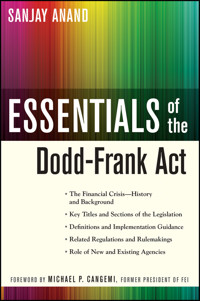
An executive overview of the new Financial Regulations Act This book provides an executive summary of the newly passed Financial Regulations Act. It examines the most important sections of the Act, how it impacts the financial industry, as well as what executives must know and do in order to comply with the Act. * One of the first books to provide an executive summary from a compliance perspective * Presents responsibilities of senior level executives regarding this new Act * Reveals what has changed within the regulatory environment * Provides tips and techniques throughout Describing the government regulation of securities, securities markets, and securities transactions in the United States, this timely book succinctly defines, describes, and explains domestic securities regulation for compliance officers, accountants, and broker-dealers.
Sie lesen das E-Book in den Legimi-Apps auf:
Seitenzahl: 222
Veröffentlichungsjahr: 2011
Ähnliche



















Contents
Cover
Essentials Series
Title Page
Copyright
Dedication
Foreword
Preface
Acknowledgments
Chapter 1: Introduction to the Dodd-Frank Act
Chapter 2: History and Background
Financial Instability
Scope
Architects of the Dodd-Frank Act
The Plan and Proposal
Timeline
Key Goals of the Act
Summary
Chapter 3: Key Titles and Sections
Title I: Financial Stability
Title II: Orderly Liquidation Authority
Title III: Transfer of Powers to the Office of Comptroller of the Currency, Corporation, and Board of Governors
Title IV: Regulation of Advisers to Hedge Fund and Others
Title V: Insurance
Title VI: Improvements to the Regulation of Bank and Savings Association Holding Companies and Depository Institutions
Title VII: Wall Street Transparency and Accountability
Title VIII: Payment, Clearing, and Settlement Supervision
Title IX: Investor Protections and Improvements to the Regulation of Securities
Title X: Bureau of Consumer Financial Protection
Title XI: Federal Reserve System Provisions
Title XII: Improving Access to Mainstream Financial Institutions
Title XIII: Pay It Back Act
Title XIV: Mortgage Reform and Anti-Predatory Lending Act
Title XV: Miscellaneous Provisions
Title XVI: Section 1256 Contracts
Summary
Chapter 4: Institutions Impacted
Foreign Banking Organizations
Derivatives
Insurance Companies
Consumers and Mortgage Banking
Broker-Dealers
Banks, Thrifts, and Bank Holding Companies
Summary
Chapter 5: Dodd-Frank Act Rulemaking
SEC and Rulemaking
Corporate Governance
Investment Advisers
Securities Lending
Arbitration
Swaps
Credit Rating Agencies
Securitization
Other Legislation
Summary
Chapter 6: Role of New and Existing Agencies
Financial Stability Oversight Council
Office of Financial Research
Bureau of Consumer Financial Protection
Bank Holding Companies
Nonbank Financial Companies
Depository Institutions
Office of Thrift Supervision
Federal Deposit Insurance Corporation
Office of Comptroller of the Currency
Orderly Liquidation Authority
Securities Investor Protection Corporation
Securities and Exchange Commission
Federal Reserve Board
Commodity Futures Trading Commission
Government Accountability Office
Summary
Chapter 7: Global Impact and Implications
Banking Industry
Investment Industry
Summary
Chapter 8: Advice for Specific Professions
Executive Management
Municipal Securities Markets
Broker-Dealers
Investment Advisers
Insurers
Summary
Chapter 9: Relationship with SOX and the Basel Accords
The Dodd-Frank Act and SOX
The Dodd-Frank Act and the Basel Accords
Summary
Appendix A: Contents of the Dodd-Frank Act
Appendix B: Effective Dates and Deadlines
Dodd-Frank Effective Dates/Rules Promulgation Deadlines
Glossary of Key Acronyms
About SOX Institute and the GRC Group
Training Programs and Professional Certifications
Index
Essentials Series
The Essentials Series was created for busy business advisory and corporate professionals. The books in this series were designed so that these busy professionals can quickly acquire knowledge and skills in core business areas.
Each book provides need-to-have fundamentals for those professionals who must:
Get up to speed quickly, because they have been promoted to a new position or have broadened their responsibility scopeManage a new functional areaBrush up on new developments in their area of responsibilityAdd more value to their company or clientsOther books in this series include:
Essentials of Accounts Payable, Mary S. Schaeffer
Essentials of Balanced Scorecard, Mohan Nair
Essentials of Business Ethics, Denis Collins
Essentials of Business Process Outsourcing, Thomas N. Duening and Rick L. Click
Essentials of Capacity Management, Reginald Tomas Yu-Lee
Essentials of Cash Flow, H.A. Schaeffer, Jr.
Essentials of Corporate Fraud, Tracy L. Coenen
Essentials of Corporate Governance, Sanjay Anand
Essentials of Corporate Performance Measurement, George T. Friedlob, Lydia L.F. Schleifer, and Franklin J. Plewa, Jr.
Essentials of Cost Management, Joe and Catherine Stenzel
Essentials of Credit, Collections, and Accounts Receivable, Mary S. Schaeffer
Essentials of CRM: A Guide to Customer Relationship Management, Bryan Bergeron
Essentials of Enterprise Compliance, Susan D. Conway and Mara E. Conway
Essentials of Financial Analysis, George T. Friedlob and Lydia L. F. Schleifer
Essentials of Financial Risk Management, Karen A. Horcher
Essentials of Foreign Exchange Trading, James Chen
Essentials of Licensing Intellectual Property, Paul J. Lerner and Alexander I. Poltorak
Essentials of Knowledge Management, Bryan Bergeron
Essentials of Managing Corporate Cash, Michele Allman-Ward and James Sagner
Essentials of Managing Treasury, Karen A. Horcher
Essentials of Patents, Andy Gibbs and Bob DeMatteis
Essentials of Payroll Management and Accounting, Steven M. Bragg
Essentials of Sarbanes-Oxley, Sanjay Anand
Essentials of Shared Services, Bryan Bergeron
Essentials of Supply Chain Management, Michael Hugos
Essentials of Trademarks and Unfair Competition, Dana Shilling
Essentials of XBRL, Bryan Bergeron
For more information on any of the above titles, please visit www.wiley.com.
Copyright © 2011 by Sarbanes-Oxley Group. All rights reserved.
Published by John Wiley & Sons, Inc., Hoboken, New Jersey.
Published simultaneously in Canada.
No part of this publication may be reproduced, stored in a retrieval system, or transmitted in any form or by any means, electronic, mechanical, photocopying, recording, scanning, or otherwise, except as permitted under Section 107 or 108 of the 1976 United States Copyright Act, without either the prior written permission of the Publisher, or authorization through payment of the appropriate per-copy fee to the Copyright Clearance Center, Inc., 222 Rosewood Drive, Danvers, MA 01923, (978) 750-8400, fax (978) 646-8600, or on the web at www.copyright.com. Requests to the Publisher for permission should be addressed to the Permissions Department, John Wiley & Sons, Inc., 111 River Street, Hoboken, NJ 07030, (201) 748-6011, fax (201) 748-6008, or online at http://www.wiley.com/go/permissions.
Limit of Liability/Disclaimer ofWarranty: While the publisher and author have used their best efforts in preparing this book, they make no representations or warranties with respect to the accuracy or completeness of the contents of this book and specifically disclaim any implied warranties of merchantability or fitness for a particular purpose. No warranty may be created or extended by sales representatives or written sales materials. The advice and strategies contained herein may not be suitable for your situation. You should consult with a professional where appropriate. Neither the publisher nor author shall be liable for any loss of profit or any other commercial damages, including but not limited to special, incidental, consequential, or other damages.
For general information on our other products and services or for technical support, please contact our Customer Care Department within the United States at (800) 762-2974, outside the United States at (317) 572-3993 or fax (317) 572-4002.
Wiley also publishes its books in a variety of electronic formats. Some content that appears in print may not be available in electronic books. For more information about Wiley products, visit our web site at www.wiley.com.
Library of Congress Cataloging-in-Publication Data:
Anand, Sanjay, 1969- author.
Essentials of the Dodd-Frank Act/Sanjay Anand.
p. cm. —(Essentials Series)
Includes index.
ISBN 978-0-470-95233-7 (pbk.): ISBN 978-1-118-02831-5 (ebk); ISBN 978-1-118-02832-2 (ebk); ISBN 978-1-118-02833-9 (ebk)
1. United States. Dodd-FrankWall Street Reform and Consumer Protection
Act. 2. Financial services industry—Law and legislation—United States. 3. Financial institutions—Law and legislation—United States. I. Title.
KF969.58201A2 2011
346.73'082—dc22
2010047242
To my son
Foreword
Great business leaders share many common positive attributes, such as intellectual curiosity and a propensity to act. In periods of significant business transformation, consummate business leaders step out even further to train and explain new business and regulatory developments to the masses.
I met Sanjay Anand at the beginning of last decade's massive regulatory overhaul, triggered by the passage of the Sarbanes-Oxley Act of 2002 (SOX). This swift legislative reaction to major corporate and accounting scandals, at Enron and other companies, caused those at publicly held companies to scramble in an attempt to grasp the compliance requirements for their organizations. Sanjay stepped up with his book, Essentials of Sarbanes-Oxley (John Wiley & Sons, 2007), which provided actionable information for those responsible for implementing SOX. I reviewed and commented on his book, and witnessed his commitment to professional development with his subsequent books and the many courses sponsored by his SOX Institute.
In the aftermath of the 2008 credit crisis and related economic downturn, once again Sanjay Anand has stepped forward to lead and explain the Dodd-Frank Wall Street Reform and Consumer Protection Act of 2010 (Dodd-Frank Act) in this book.
It is crucial that everyone in business and proportionally every “consumer” understand this new and far-reaching law of the land. The Act is extensive, but even more significant are the expected regulations that will follow. Unlike earthquakes, where aftershocks diminish as time passes, the flow of regulations from the Dodd-Frank Act is anticipated to be considerable and ever expanding.
Dodd-Frank addresses too-big-to-fail bailouts and includes recommendations for risk committees at certain financial institutions. It gives the Federal Deposit Insurance Corporation (FDIC) powers to “disaffirm or repudiate any contract or lease to which the covered financial institution is a party” and recover or clawback compensation in certain circumstances. The Act expands bounties for whistleblowers and gives shareholders some “say on pay.” These are revolutionary changes of epic proportions!
For the consumer, the Dodd-Frank Act establishes a new independent watchdog agency within the Federal Reserve to make sure consumers receive clear and accurate information regarding financial products' terms and costs. It creates a consumer hotline, a new office of financial literacy, and generally expands accountability for consumer protection.
As a business executive and board member whose business foundation is as a CPA, I clearly see how important it is to update laws in order to meet modern-day business conditions and velocities. It is incumbent on all business owners and managers, and indeed all consumers, to understand the Dodd-Frank Act. More important, as a business manager and director, I call on readers to get involved in helping to shape the regulations that are certain to follow from this new law. Too much regulation—or the wrong kind of regulation—can be a drag on businesses and the economy.
Dodd-Frank is also significant in that it implements the first amendments to SOX. Who better to provide insights on Dodd-Frank than Sanjay Anand, who was among the first responders of consummate business leaders to explain SOX? You have chosen wisely, and I know you will greatly benefit from reading this book.
Michael P. Cangemi, CPA
Michael P. Cangemi, CPA, an author and business advisor, is the former president, chief executive officer, and director of Etienne Aigner Group, Inc., a leading designer of women's accessories (1991–2004), and president, chief executive officer, and director of Financial Executives International, the professional association for senior-level corporate financial executives (2007–8). He currently serves as president of Cangemi Company LLC. Mr. Cangemi recently completed a two-year term on the International Accounting Standards Board Standards Advisory Council and a year as the FEI representative on the board of COSO. For more information seewww.canco.us.
Preface
On July 21, 2010, President Barack Obama signed into law the Dodd-Frank Wall Street Reform and Consumer Protection Act (Dodd-Frank Act; this Act is also often referred to as DFA, SOX II, the Sequel, Financial SOX, F-SOX, and other variants of these), arguably the most significant financial reform legislation enacted since the Securities Act of 1933 and the Securities Exchange Act of 1934. Just as those Depression-era pieces of legislation were crafted in response to the Great Crash of 1929, the Dodd-Frank Act grew out of what is termed the Great Recession of 2008.
At 848 pages, the final length of the Dodd-Frank Act (H.R. 4173) is considerably shorter than the 2,000-plus pages hyped by the media, yet its length and complexity far surpass the 66-page Sarbanes-Oxley Act of 2002 and the 37-page Glass-Steagall Act of 1933. Many have argued that the incremental repeal of various provisions of Glass-Steagall, such as removing the wall between investment and depository banks, sowed the seeds of the 2008 crisis—a series of events that brought our globally interwoven financial system to the brink of collapse.
Just as Sarbanes-Oxley was created to increase the transparency of and accountability within publicly traded companies, the intention of the Dodd-Frank Act was to unravel the tangled web of financial service company valuations—valuations that were all too often obscured by complex and opaque financial instruments. The introduction of H.R. 4173 on December 2, 2009, was a reaction to having witnessed banks, ratings agencies, insurance companies, accounting firms, and hedge funds serve up a toxic stew of tainted assets and liabilities that reeked of systemic non-disclosure.
As with Sarbanes-Oxley, critics have charged that the Dodd-Frank Act was hastily assembled and rammed through Congress as a short-term fix, absent consideration of its long-term consequences. Although at press time, regulators are still in the process of sorting through its requirements, creating new agencies, and seeking public comment on various regulatory provisions, it is clear that the Dodd-Frank Act will represent a sea change in the way financial services companies—from debt collection agencies to too-big-to-fail banks—conduct their governance, risk management, and compliance activities. As such, the Dodd-Frank Act of 2010 must be understood, accommodated, and mastered in order to integrate regulatory requirements with business objectives.
To stay up-to-date with the Dodd-Frank Act as it evolves from here, visit www.TheDoddFrankAct.com.
Lesen Sie weiter in der vollständigen Ausgabe!
Lesen Sie weiter in der vollständigen Ausgabe!
Lesen Sie weiter in der vollständigen Ausgabe!
Lesen Sie weiter in der vollständigen Ausgabe!
Lesen Sie weiter in der vollständigen Ausgabe!
Lesen Sie weiter in der vollständigen Ausgabe!
Lesen Sie weiter in der vollständigen Ausgabe!
Lesen Sie weiter in der vollständigen Ausgabe!
Lesen Sie weiter in der vollständigen Ausgabe!
Lesen Sie weiter in der vollständigen Ausgabe!
Lesen Sie weiter in der vollständigen Ausgabe!
Lesen Sie weiter in der vollständigen Ausgabe!
Lesen Sie weiter in der vollständigen Ausgabe!
Lesen Sie weiter in der vollständigen Ausgabe!
Lesen Sie weiter in der vollständigen Ausgabe!




