


139,99 €
Mehr erfahren.
- Herausgeber: John Wiley & Sons
- Kategorie: Fachliteratur
- Sprache: Englisch
Practical and conceptual, the Responsible Research and Innovation set of books contributes to the clarification of this new requirement for all sciences and technological innovation. It covers the multiple and international responsibilities, by using various philosophical resources, mostly discussing the following topics: ethics, contingency, normative economy, freedom, corporate social responsibility (CSR), participative technological evaluation, sustainable development, geoengineering, the precautionary principle, standards, interdisciplinarity, and climate management.
The ethics of efficiency must be considered with regard to the logic of action or to economic, political, legal or scientific systems.
This book presents a question on the central theme of responsible research and innovation (RRI), which has an ethical influence on effective logics. The issue is to question the opportunity and modularities of an ethical effective influence on the logics of efficiency of research and innovation.
From the distinction of efficiency and effectiveness, lies the problem of efficacy, the ethical accord between the two. Thus appears the possibility of taking effective responsibility with respect to systematic injustices potentially linked to this efficiency. This book proposes categories to understand the ethical implications of research and innovation processes, under the aspect of their efficacy.
Sie lesen das E-Book in den Legimi-Apps auf:
Seitenzahl: 272
Veröffentlichungsjahr: 2016
Ähnliche


















Table of Contents
Cover
Title
Copyright
Foreword
Preface
Introduction
I.1. Logical efficiency
I.2. Two types of logic
I.3. Three types of motive
I.4. A reflection on effectiveness (connecting efficiency and freedom)
I.5. Efficiency compromises effectiveness
I.6. Problematization
I.7. Common thread of the text
1 The Question of Justice in Logics of Expansion and Reductionist Efficiency
1.1. Problematic structure of the question
1.2. Its explicit scope
1.3. Further clarification
1.4. The typical content
1.5. Relational structure
2 The Question of Justice in Stabilization Logics and Limitative Effectiveness
2.1. Problematic structure of the question
2.2. Its explicit scope
2.3. Further clarification
2.4. Its typical content
2.5. Overarching summary of the first two steps
3 Reworking of the Effectiveness Concept
3.1. Need for such reworking
3.2. Development of the principle of this reworking
3.3. Corroboration of these overviews
3.4. A liberty other than subjective
3.5. Efficacy as integration of efficiency and effectiveness
4 Practices of Efficiency
4.1. On a “between” the logics
4.2. Spheres and legitimacy (effectiveness and separation)
4.3. Neither “invisible hand” nor “cunning of reason”
4.4. The contingent partition and its score
4.5. Human rights: a continuous policy
4.6. Negative or positive freedom
4.7. Categories from here and elsewhere
Conclusion
Bibliography
Index
End User License Agreement
Cover
Table of Contents
Begin Reading
Pages
C1
iii
iv
v
vii
viii
ix
x
xi
xiii
xiv
xv
xvi
xvii
xviii
xix
xx
xxi
xxii
xxiii
xxiv
xxv
xxvi
xxvii
xxviii
xxix
xxx
xxxi
xxxii
xxxiii
xxxiv
xxxv
xxxvi
xxxvii
1
2
3
4
5
6
7
8
9
10
11
12
13
14
15
16
17
18
19
20
21
22
23
24
25
26
27
28
29
30
31
32
33
34
35
36
37
38
39
40
41
42
43
44
45
46
47
48
49
50
51
52
53
54
55
56
57
58
59
60
61
62
63
64
65
67
68
69
70
71
72
73
74
75
76
77
78
79
80
81
82
83
84
85
86
87
88
89
90
91
92
93
94
95
96
97
98
99
100
101
102
103
104
105
106
107
109
110
111
112
113
114
115
117
118
119
120
121
122
123
124
125
126
127
128
129
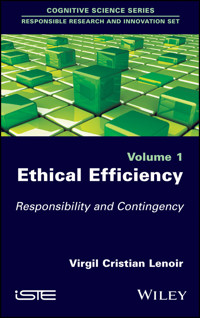
Ethical Efficiency
Responsibility and Contingency
Volume 1
Virgil Cristian Lenoir
Responsible Research and Innovation Set
coordinated byBernard Reber
First published 2016 in Great Britain and the United States by ISTE Ltd and John Wiley & Sons, Inc.
Apart from any fair dealing for the purposes of research or private study, or criticism or review, as permitted under the Copyright, Designs and Patents Act 1988, this publication may only be reproduced, stored or transmitted, in any form or by any means, with the prior permission in writing of the publishers, or in the case of reprographic reproduction in accordance with the terms and licenses issued by the CLA. Enquiries concerning reproduction outside these terms should be sent to the publishers at the undermentioned address:
ISTE Ltd27-37 St George’s RoadLondon SW19 4EUUKwww.iste.co.uk
John Wiley & Sons, Inc.111 River StreetHoboken, NJ 07030USAwww.wiley.com
© ISTE Ltd 2016
The rights of Virgil Cristian Lenoir to be identified as the author of this work have been asserted by him in accordance with the Copyright, Designs and Patents Act 1988.
Library of Congress Control Number: 2015958953
British Library Cataloguing-in-Publication Data
A CIP record for this book is available from the British Library
ISBN 978-1-84821-898-7
Foreword
The title of this book is as intriguing as it is promising. Indeed, it implies a number of theories that go against the grain of certain ways of thinking which affect both philosophy and the studies of the relationships between innovation, research and responsibility. First, efficiency is not set in opposition to ethics. Second, efficiency has an ethical dimension. Furthermore, this ethical potential can be acknowledged and developed. The subtitle refers to the issue of responsibility combined with that of contingency. The answers to the first three questions will, therefore, be provided in relation to the issue of contingency, addressed in a serious and reflective manner.
I am delighted that for contingent reasons – in the non-technical sense – it should be the book by Virgil Cristian Lenoir that opens this set. First, very early on, he addresses the problem presented by the design of scientific and managerial policy for responsible research and innovation (RRI), the older corporate social responsibility or even, to paraphrase the philosopher Hans Jonas, responsibility in a technological civilization. Second, owing to the authors discussed and the method of approaching the practicality of these subjects, this text provides a perspective that is very new, thoroughly examined and avoids the repetition of philosophically basic theories in research communities studying these two areas, while remaining both significant and sensitive. Moreover, looking beyond these two fields, and in the event that RRI fails to become established and implemented by the European Commission, the reflection loses none of its relevance here. This is the case in terms of the philosophical consideration itself and as an aid to understanding our existence both in its mundanity and the most complex and highly organized collective action. Indeed, the reflection that follows is tight, dense and powerful. Although it may make for a demanding read, it offers many new avenues for departing from the opposition between ethics and efficiency or for tackling the question of contingency or justice to be found from among the logical arguments that are now separated into various spheres. Likewise, the scope of questioning is as broad as it is deep. The clear style, often interspersed with new discoveries in order to carve out new categories of thought, provides support and invites the reader to address the issues in a radical way, from the “grassroots,” or as the author would put it, from upstream. He also supports his strategy with a self-explained punctuation system, as well as highlighting the opening and coherent direction of thought in the problems being addressed. Though the reflection and presentation of the arguments are both personal, a number of significant authors are referenced and, frequently, some of their red lines are crossed. Notably mentioned are Luhmann, Rawls, Bourdieu, Sen, Pareto, Roemer, Kolm, Delmas-Marty, Arendt, Walzer, Leibniz, Deleuze and Hegel, used extensively for examining questions of contingency and efficiency. These philosophers are even occasionally in agreement with the author’s argument, summoned by his own logical reasoning, using an explanatory model of a new condition that leads to numerous explorations, an honest consultation of the evidence, or even in the form of reciprocal adaptation and mutual redefinitions. The field of the economy and its more regional version of the normative economy feature heavily in the book, as does the area of law and its subsection the philosophy of law. These disciplines are especially necessary when reflecting on issues relating to justice.
Lesen Sie weiter in der vollständigen Ausgabe!
Lesen Sie weiter in der vollständigen Ausgabe!
Lesen Sie weiter in der vollständigen Ausgabe!
Lesen Sie weiter in der vollständigen Ausgabe!
Lesen Sie weiter in der vollständigen Ausgabe!
Lesen Sie weiter in der vollständigen Ausgabe!
Lesen Sie weiter in der vollständigen Ausgabe!
Lesen Sie weiter in der vollständigen Ausgabe!
Lesen Sie weiter in der vollständigen Ausgabe!
Lesen Sie weiter in der vollständigen Ausgabe!
Lesen Sie weiter in der vollständigen Ausgabe!




