


17,99 €
Mehr erfahren.
- Herausgeber: John Wiley & Sons
- Kategorie: Geisteswissenschaft
- Sprache: Englisch
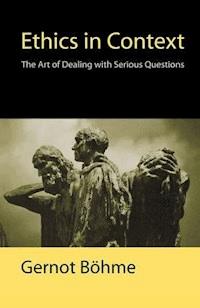
In this clear and accessible book, Gernot Böhme places philosophical ethics in the context of our individual and social lives. Arguing against the conception of ethics as a body of knowledge, Böhme defines morality as a matter of ‘serious questions'. In the case of an individual, a serious question is one that determines that person's mode of living. In the case of society, a serious question is one that shapes our social norms.
In Ethics in Context, Böhme explores the key areas of moral living and moral discourse. He examines some of the urgent issues affecting society today, such as the moral implications of reproductive technology, man's mastery over nature and the right of citizenship.
This book is a lucid and engaging guide to ethics, which will be of great interest to students of philosophy and, indeed, to all those interested in the subject.
Sie lesen das E-Book in den Legimi-Apps auf:
Seitenzahl: 380
Veröffentlichungsjahr: 2015
Ähnliche




















Contents
Acknowledgements
1 Introduction
From a Critique to a New Approach: Serious Questions
Themes of Ethics
2 The Context of Moral Living and Argumentation
The State of Civilization
Our Historical Background
Basic Moral Ideas
Human Rights, Fundamental Rights
3 The Moral Life
Skills for Moral Living
Being-human-well
Play and Seriousness
4 Moral Argumentation
Moral Questions Concerning External Nature
Moral Questions Concerning the Nature We Ourselves Are
Moral Problems in Dealing with Foreigners
5 Summary
Notes
Index
Copyright © this translation Polity Press 2001First published in Germany as Gemot Böhme, Ethik im Kontext: Über den Umgang mit ernsten Fragen, © Suhrkamp Verlag Frankfurt am Main 1997
First published in 2001 by Polity Press in association with Blackwell Publishers Ltd.
Published with the assistance of the Max-Himmelheber Stiftung and the Professor Dr Alfred Schmid Stiftung.
Editorial office:Polity Press65 Bridge StreetCambridge CB2 1UR, UK
Marketing and production:Blackwell Publishers Ltd108 Cowley RoadOxford OX4 1JF, UK
Published in the USA byBlackwell Publishers Inc.350 Main StreetMalden, MA 02148, USA
All rights reserved. Except for the quotation of short passages for the purposes of criticism and review, no part of this publication may be reproduced, stored in a retrieval system, or transmitted, in any form or by any means, electronic, mechanical, photocopying, recording or otherwise, without the prior permission of the publisher.
Except in the United States of America, this book is sold subject to the condition that it shall not, by way of trade or otherwise, be lent, re-sold, hired out, or otherwise circulated without the publisher’s prior consent in any form of binding or cover other than that in which it is published and without a similar condition including this condition being imposed on the subsequent purchaser.
A catalogue record for this book is available from the British Library.
Library of Congress Cataloging-in-Publication DataBöhme, Gemot.
[Ethick im Kontext. English]
Ethics in context: the art of dealing with serious questions / Gemot Böhme ; translated by Edmund Jephcott.
p. cm.
Includes index.
ISBN 0-7456-2638-6—ISBN 0-7456-2639-4 (pbk.)
1. Applied ethics. I. Title.
BJ1125 .B6413 2001
170—dc21
2001021634
Acknowledgements
This book evolved from a series of lectures on ethics I gave at the Technische Universität Darmstadt in the Winter Semester 1995/96. My thanks are due to my audience and students for the extensive discussions I had with them. I would also like to thank Professor Heidrun Abromeit, Darmstadt, Professor Adalbert Podlech, Darmstadt, Professor T. Maruyama, Kyoto, and Dr Christoph Rehmann, Basel, for their criticism and helpful comments on individual chapters.
We are not concerned to know what goodness is but how to become good men, since otherwise our enquiry would be useless.
Aristotle, Nicomachean Ethics, II, 1103b 27–9
1
Introduction
From a Critique to a New Approach: Serious Questions
Interest in a book on ethics can be taken for granted today. That makes it all the more important to be clear from the outset about the nature of this interest. Normally, what is expected from a book is information. But is that still the case when the book is about ethics?
In posing this question one realizes that the word interest, which in any other subject is used without a second thought, takes on a special meaning in the case of ethics. Whereas one’s interest in other subjects can be satisfied by information, so that interest means the same as curiosity, the situation is quite different with ethics. Ethics does not inform us about anything; it does not enlarge knowledge; it does not respond to curiosity but to a very different kind of unease. What one expects from ethics is not information but guidance. To be interested in ethics therefore means to be ‘interested’ in the sense of being involved, being affected. Ethics in the form of a written text occupies a peculiar position. It presupposes in the reader a personal commitment, a disquiet, a willingness to pose questions, a desire to change.
To elucidate this special position of texts on ethics, and at the same time to clarify the sense in which the term ‘ethics’ is used in what follows, I think it would be useful to call to mind the threefold division of philosophy which I adopted in my introduction to philosophy.1 In my view, there are three different ways of approaching philosophy: it can be seen as a way of life, as practical wisdom and as a science. The third of these, philosophy as a science or a body of knowledge, is the one ordinarily practised at academic institutions. Philosophy is understood as an area of knowledge of a specific kind, with its own methods and schools, with a research frontier which is constantly moving forward and with special problems generated by the advance of this frontier. The manner in which this academic philosophy is presented consists essentially in argument and refutation. It shares with science the ideal of objectivity, which implies a strict division between knowledge and the person holding that knowledge: the argument is supposed to be independent of the person who puts it forward and, conversely, the person can be entirely unaffected by the knowledge he or she possesses and pursues.
I shall not approach moral philosophy in this way. That does not mean, however, that such an approach is not possible. On the contrary, one cannot help observing that the major part of what is taught at universities under the heading of ethics, moral philosophy or practical philosophy does, indeed, fall into the category of philosophy-as-science. In it the structure of deontic statements is examined, the speech-act of imperatives is defined, the possibility of moral arguments is studied and the legitimacy of moral judgements analysed. None of this need have anything to do with personal involvement or commitment; indeed, it does not have to affect the philosopher, or his or her listeners and readers, at the personal level at all. Quite the contrary: the less it has to do with such things, the better – that is, the more scientific. In what follows, therefore, I shall not expound academic philosophy, or what might be called the discourse of practical philosophy; nor shall I discuss its historical development, that is, the history of ethics. Indeed, I do not know what benefit readers, who, in most cases, will not be professional philosophers, might derive from such an exercise. I am aware, or course, that the broad interest in ethics today, which stems from a profound sense of unease, is fed to a large extent by the debate being conducted among academic philosophers. Later in this book, therefore, I shall touch on the history of ethics and the current academic discourse, but only when something worthwhile can be learned from it. In this introduction, though only here, I should like to comment on academic discourse and practical philosophy from a critical standpoint, in order to make clear how my approach differs from it.
Lesen Sie weiter in der vollständigen Ausgabe!
Lesen Sie weiter in der vollständigen Ausgabe!
Lesen Sie weiter in der vollständigen Ausgabe!
Lesen Sie weiter in der vollständigen Ausgabe!
Lesen Sie weiter in der vollständigen Ausgabe!
Lesen Sie weiter in der vollständigen Ausgabe!




