


39,99 €
Mehr erfahren.
- Herausgeber: John Wiley & Sons
- Kategorie: Fachliteratur
- Serie: Foundations of Business Ethics
- Sprache: Englisch
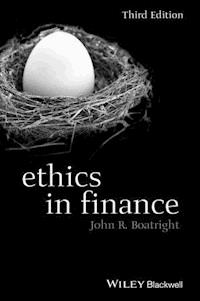
The third edition of Ethics in Finance presents an authoritative and wide-ranging examination of the major ethical issues in finance.
This new edition has been expanded and thoroughly updated with extensive coverage of the recent financial crisis and the very latest developments within the financial world.
- Substantially updated new edition with nearly 40% new material, including sections on credit cards, mortgage lending, microfinance, risk management, derivatives, and securitization
- Includes coverage and references to the recent financial crisis and the very latest developments within the financial world
- Focuses on the practical issues that confront finance professionals, policy makers, and consumers of financial services
- Cites examples of the scandals that have shaken public confidence in Wall Street and world financial markets
- Includes numerous examples throughout to illustrate the concepts and issues described within the text
Sie lesen das E-Book in den Legimi-Apps auf:
Seitenzahl: 624
Veröffentlichungsjahr: 2013
Ähnliche


















Table of Contents
Foundations of Business Ethics
Title page
Copyright page
Preface
Acknowledgments
Abbreviations
Chapter One: Finance Ethics: An Overview
The Need for Ethics in Finance
The Field of Finance Ethics
Chapter Two: Fundamentals of Finance Ethics
A Framework for Ethics
Agents, Fiduciaries, and Professionals
Conflict of Interest
Chapter Three: Ethics and the Retail Customer
Sales Practices
Credit Cards
Mortgage Lending
Arbitration
Chapter Four: Ethics in Investment
Mutual Funds
Relationship Investing
Socially Responsible Investing
Microfinance
Chapter Five: Ethics in Financial Markets
Fairness in Markets
Insider Trading
Hostile Takeovers
Financial Engineering
Chapter Six: Ethics in Financial Management
The Corporate Objective
Risk Management
Ethics of Bankruptcy
Corporate Governance
Index
Foundations of Business Ethics
Series editors: W. Michael Hoffman and Robert E. Frederick
Written by an assembly of the most distinguished figures in business ethics, the Foundations of Business Ethics series aims to explain and assess the fundamental issues that motivate interest in each of the main subjects of contemporary research. In addition to a general introduction to business ethics, individual volumes cover key ethical issues in management, marketing, finance, accounting, and computing. The books, which are complementary yet complete in themselves, allow instructors maximum flexibility in the design and presentation of course materials without sacrificing either depth of coverage or the discipline-based focus of many business courses. The volumes can be used separately or in combination with anthologies and case studies, depending on the needs and interests of the instructors and students.
Forthcoming
Denis Arnold, Ethics of Global Business
This edition first published 2014
© 2014 John Wiley & Sons, Inc
Registered Office
John Wiley & Sons Ltd, The Atrium, Southern Gate, Chichester, West Sussex, PO19 8SQ, UK
Editorial Offices
350 Main Street, Malden, MA 02148-5020, USA
9600 Garsington Road, Oxford, OX4 2DQ, UK
The Atrium, Southern Gate, Chichester, West Sussex, PO19 8SQ, UK
For details of our global editorial offices, for customer services, and for information about how to apply for permission to reuse the copyright material in this book please see our website at www.wiley.com/wiley-blackwell.
The right of John R. Boatright to be identified as the author of this work has been asserted in accordance with the UK Copyright, Designs and Patents Act 1988.
All rights reserved. No part of this publication may be reproduced, stored in a retrieval system, or transmitted, in any form or by any means, electronic, mechanical, photocopying, recording or otherwise, except as permitted by the UK Copyright, Designs and Patents Act 1988, without the prior permission of the publisher.
Wiley also publishes its books in a variety of electronic formats. Some content that appears in print may not be available in electronic books.
Designations used by companies to distinguish their products are often claimed as trademarks. All brand names and product names used in this book are trade names, service marks, trademarks or registered trademarks of their respective owners. The publisher is not associated with any product or vendor mentioned in this book.
Limit of Liability/Disclaimer of Warranty: While the publisher and author(s) have used their best efforts in preparing this book, they make no representations or warranties with respect to the accuracy or completeness of the contents of this book and specifically disclaim any implied warranties of merchantability or fitness for a particular purpose. It is sold on the understanding that the publisher is not engaged in rendering professional services and neither the publisher nor the author shall be liable for damages arising herefrom. If professional advice or other expert assistance is required, the services of a competent professional should be sought.
Library of Congress Cataloging-in-Publication Data applied for
Paperback ISBN: 978-1-118-61582-9
A catalogue record for this book is available from the British Library.
Cover image: © Getty Images / pepifoto.
Cover design by Cyan Design.
Preface
Writing a book on ethics in finance poses a special challenge. The difficulty does not arise from a lack of subject matter, despite the cynical view that there is no ethics in finance. To the contrary, finance is infused with ethics and could not exist without it. Financial activity is governed by detailed rules, and a high level of integrity is expected of people who bear great responsibility. As a field of study, however, finance ethics is barely formed, and so the first task for a writer in this area is to define the subject, frame the main issues, and identify the relevant ethical principles. Whereas most textbooks present standard material, this one is forced by necessity to be original. Hopefully, Ethics in Finance, Third Edition, will continue to advance the important task of creating the field of finance ethics.
Not only is the field of finance ethics still being formed, but it is also highly diverse. People trained in finance enter many different lines of work, in which they encounter a variety of ethical situations and issues. The situation of a stockbroker is different from that of a mutual fund manager, a market regulator, or a corporate financial officer. In addition, finance ethics encompasses broader ethical issues in financial markets, financial services, and financial management, which are addressed by both industry leaders and government regulators. A book on finance ethics must also identify the relevant ethical principles for resolving many different kinds of questions. Some of these involve dilemmas of individual conduct, but the most perplexing and significant issues are related to the operation of financial services providers and financial markets and institutions.
Many ethical issues in finance have already been addressed by legal regulation, as well by firm and industry self-regulation. The role of ethics in such a highly regulated environment is problematic. Why is it not sufficient merely to obey the applicable rules? One answer to this question is that ethical principles lie at the heart of much regulation, and issues not yet settled by law or self-regulation are debated, in part, as matters of ethics. Much of this book is devoted, therefore, to an examination of existing regulation and proposals for regulatory reform. In addition, regulation, whether it is by government or industry, is a rather ineffective, uncertain guide, and so a commitment to high ethical standards, and not merely to legal compliance, is essential.
Since the publication of the first two editions of this book, much has changed and much has remained the same. In particular, the financial crisis that began in 2007 has renewed interest in finance ethics and led to calls for greater attention to the subject. However, this crisis, for all of the misconduct involved and damage done, raises few novel issues in finance ethics and presents mostly familiar issues in new guises. Still, the third edition of this book devotes considerable space to the ethical aspects of the greatest financial crisis since the Great Depression.
Readers of the first two editions will find the third one extensively revised and expanded. Although the number of chapters remains the same, the material has been substantially reorganized for greater clarity and orderliness. Chapter 2 now offers a more explicit framework for approaching ethics, which presents, first, ethics in markets and, second, the ethics of roles and relationships, including those of agents and fiduciaries. The remaining material is organized around the areas of financial services, financial markets, and financial management. Subjects that are new to this third edition include ethical issues in credit cards, subprime mortgages, microfinance, derivatives, high-frequency trading, and risk management.
As with the first two editions, I am indebted to W. Michael Hoffman and Robert E. Frederick of Bentley University, the editors of the series Foundations of Business Ethics, and my editor at Blackwell, Jeffrey Dean. The Quinlan School of Business at Loyola University Chicago has provided critical support for the preparation of the third edition. I am especially grateful for the resources of the Raymond C. Baumhart, S.J., Chair in Business Ethics, which was created to honor a former president of Loyola University Chicago and a pioneer in the field of business ethics. To Ray Baumhart I owe a special debt of gratitude. I also wish to express my appreciation to Kathleen A. Getz, dean of the Quinlan School of Business for her enthusiastic support. As always, I am indebted to my wife Claudia, whose affection, patience, and encouragement have been essential for my work.
John R. Boatright
Acknowledgments
The following material is used in the third edition of Ethics in Finance with permission from the copyright holders.
John R. Boatright, “Financial Services,” in Michael Davis and Andrew Stark, Conflict of Interest in the Professions (New York: Oxford University Press, 1999), copyright 1999 by John R. Boatright.
John R. Boatright, “Fiduciary Duty,” “Soft Dollar Brokerage,” and “Bankruptcy,” in Robert W. Kolb (ed.), Encyclopedia of Business Ethics and Society (Thousand Oaks, CA: Sage Publications, 2007), by permission of the publisher.
John R. Boatright, “Ethics in Finance” in John R. Boatright (ed.), Finance Ethics: Critical Issues in Theory and Practice (New York: John Wiley & Sons, Inc., 2010), by permission of the publisher.
John R. Boatright, “The Ethics of Risk Management: A Post-Crisis Perspective,” Ethics and Values for the 21st Century (Madrid: BBVA, 2011), copyright 2011 by John R. Boatright.
John R. Boatright, “Why Financial Innovation Seems to be Associated with Scandals, Crises, Mischief, and other Mayhem,” in Risks and Rewards of Financial Innovation (Chicago: Loyola University Chicago School of Business Administration, 2010), copyright 2010 by John R. Boatright.
John R. Boatright, “Corporate Governance,” in Encyclopedia of Applied Ethics, Ruth Chadwick (ed.) (Amsterdam: Elsevier, 2011), by permission of the publisher.
Abbreviations
Chapter One
Finance Ethics: An Overview
Some cynics jokingly deny that there is any ethics in finance, especially on Wall Street. This view is expressed in a thin volume, The Complete Book of Wall Street Ethics, which claims to fill “an empty space on financial bookshelves where a consideration of ethics should be.”1 Of course, the pages are all blank! However, a moment's reflection reveals that finance would be impossible without ethics. The very act of placing our assets in the hands of other people requires immense trust. An untrustworthy stockbroker or insurance agent, like an untrustworthy physician or attorney, finds few takers for the services offered. Financial scandals shock us precisely because they involve individuals and institutions that we should be able to trust.
Trust is essential in finance, but finance ethics is about far more than trust. Finance consists of an array of activities that involve the handling of financial assets—usually those of other people. Not only does the welfare of everyone depend on the safeguarding and deployment of these assets, but billions of financial transactions take place each day with a high level of integrity. With this large volume of financial activities, there are ample opportunities for some people to gain at other’s expense. Simply put, finance concerns other people's money (OPM), and OPM invites misconduct. Individuals in the financial services industry, such as stockbrokers, bankers, financial advisers, mutual fund and pension managers, and insurance agents, have a responsibility to the customers and clients they serve. Financial managers in corporations, government, and other organizations have an obligation to manage the financial assets of these institutions well. It is important that everyone else involved in finance, in whatever role, conduct themselves with the utmost attention to ethics.
The ethics of an occupation or a profession is best understood not by examining the worst conduct of its members but by attending to the conduct that is commonly expected and generally found. In finance, as in other areas of life, three questions of ethics are critical: What are our ethical obligations or duties? What rights are at stake? And what is fair or just? Beyond these more specific questions lies the ultimate ethical question: How should we live? In the case of finance, this question goes to the heart of the purpose of financial activity: What role should finance play in our individual lives and in the development of a good society?2 These four fundamental questions are not easily answered, but an attempt to answer them—or at least the first three—is the main task of this book.
This chapter lays the groundwork for the ones that follow by providing an overview of the need for ethics in finance and the main areas of finance ethics. A comprehensive treatment of ethics in finance is, of necessity, long and involved because of the diversity of financial activities and the range of ethical issues they raise. However, there is little that is unique to finance ethics. The ethics of finance has counterparts in other areas of business and in the professions, such as medicine and law. Thus, our discussion of ethics in finance can be facilitated by drawing on the well-developed fields of business and professional ethics.
The Need for Ethics in Finance
Although the need for ethics in finance should be obvious, it is useful to understand both the misconduct that occurs all too frequently and its causes. Most people in finance are decent, dedicated individuals, but, unlike the professions, which involve a strong commitment to service, finance relies mainly on the search for gain, which can easily become greed. Moreover, individuals operate within and through organizations, institutions, and systems, including markets, which may be faulty. Consequently, scandals may occur that were part of no one person's intentions and for which no one bears responsibility. Many scandals result not from deliberate misconduct—doing what one knows to be wrong—but from rational actors following incentives in situations with complex interactions. Ethical misconduct is not always a matter of bad people doing bad things, but often of good people who stumble unwittingly into wrongdoing. This section describes some of the scandals of recent years, which have created an image of finance as an activity devoid of ethics, and it also explores some of the causes for these scandals.
Lesen Sie weiter in der vollständigen Ausgabe!
Lesen Sie weiter in der vollständigen Ausgabe!
Lesen Sie weiter in der vollständigen Ausgabe!
Lesen Sie weiter in der vollständigen Ausgabe!
Lesen Sie weiter in der vollständigen Ausgabe!
Lesen Sie weiter in der vollständigen Ausgabe!




