


62,99 €
Mehr erfahren.
- Herausgeber: John Wiley & Sons
- Kategorie: Fachliteratur
- Sprache: Englisch
An interesting and accessible introduction to ethical issues raised by various forms of human use of animals. This textbook avoids moral lecturing and presents a range of ethical viewpoints without defending or applying any specific stance. Readers are encouraged and provoked to reflect for themselves, and to sharpen their own points of view regarding the ethical limits on our use of animals. They will also gain further understanding of the views held by other people.
Early chapters of this interdisciplinary book cover changes over time in our view of animals, the principles of animal ethics, and different views of what counts as a good animal life. Later chapters apply the conceptual tools to specific issues including: food animal production, advanced veterinary treatment of pets, control of infectious diseases, wildlife management, as well as the use of animals in research.
Specifically designed for students of veterinary medicine, animal science, welfare and behaviour, and veterinary nursing. Also of interest to those wanting to combine an up-to-date, science-based account of animal issues with clear-headed moral reflection.
"The book covers an impressive range of topics with accuracy and fairness. Despite its ambitious scope, the authors have achieved remarkable unity in the book, and have produced a book that is easy and pleasant to read. Their work will surely provide a major tool for rationalizing the debate about the ethics of animal use, and I commend them for their invaluable contribution." From the Foreword by Professor Bernard Rollin, Colorado State University.
Sie lesen das E-Book in den Legimi-Apps auf:
Seitenzahl: 402
Veröffentlichungsjahr: 2013
Ähnliche


















Contents
Foreword
Acknowledgements
Introduction
Chapter 1 The Changing Face of Animal Ethics
Traditional ways of using animals and the emergence of anti-cruelty legislation
New ways of using animals and the emergence of animal welfare initiatives
Companion animals, fascination with wild animals and the animal rights movement
Key points
Further reading
Chapter 2 What Are Our Duties to Animals?
Is it necessary to theorise about ethics?
Contractarianism
Utilitarianism
The animal rights view
The relational view
Respect for nature
Hybrid views
Key points
Further reading
Chapter 3 What Is a Good Animal Life?
Theories of the good (animal) life
Measuring animal welfare
Welfare assessment in the light of theories about the good life
Key points
Further reading
Chapter 4 Role of Veterinarians and Other Animal Science Professionals
Being a professional
Advocates for the animals?
Limits to one’s duties?
Looking after the interests of clients – autonomy versus paternalism
Duties in regard to third parties
Key points
Further reading
Chapter 5 The Use of Animals in Food Production
Do farm animals live a worse life now than they did in the past?
Do farm animals today live a good enough life?: four ethical perspectives
The animal welfare strategy
The vegan strategy
Key points
Further reading
Chapter 6 Controlling Animals with Infectious Diseases
Controlling animal diseases
Threats to humans – food-borne diseases
The control of wildlife carrying infectious diseases
Key points
Further reading
Chapter 7 The Use of Animals in Experiments
Three views of animal experimentation
Possibilities for a moral compromise?
Vital benefits?
Animal welfare in the lab
Key points
Further reading
Chapter 8 Companion Animals
The special status of companion animals
The value of the life of a companion animal
Veterinary treatment: drawing the line
Four views about the limits for veterinary treatment of companion animals
Key points
Further reading
Chapter 9 Animal Breeding and Biotechnology
New ways of changing animals
Problems caused by animal breeding and biotechnology
Ethical limits to breeding and biotechnology?
Breeding and biotechnology viewed in light of the four ethical theories
Key points
Further reading
Chapter 10 Management and Use of Wild Animals
Developments in human relations with wild animals
Respect for nature – extending the concern?
Human use of wild animals: four ethical perspectives
Key points
Further reading
References
Index
This edition first published 2008© 2008 Peter Sandøe and Stine B. Christiansen
Blackwell Publishing was acquired by John Wiley & Sons in February 2007. Blackwell’s publishing programme has been merged with Wiley’s global Scientific, Technical, and Medical business to form Wiley-Blackwell.
Registered officeJohn Wiley & Sons Ltd, The Atrium, Southern Gate, Chichester, West Sussex, PO19 8SQ, United Kingdom
Editorial office9600 Garsington Road, Oxford, OX4 2DQ, United Kingdom
For details of our global editorial offices, for customer services and for information about how to apply for permission to reuse the copyright material in this book please see our website at www.wiley.com/wiley-blackwell.
The right of the author to be identified as the author of this work has been asserted in accordance with the Copyright, Designs and Patents Act 1988.
All rights reserved. No part of this publication may be reproduced, stored in a retrieval system, or transmitted, in any form or by any means, electronic, mechanical, photocopying, recording or otherwise, except as permitted by the UK Copyright, Designs and Patents Act 1988, without the prior permission of the publisher.
Wiley also publishes its books in a variety of electronic formats. Some content that appears in print may not be available in electronic books.
Designations used by companies to distinguish their products are often claimed as trademarks. All brand names and product names used in this book are trade names, service marks, trademarks or registered trademarks of their respective owners. The publisher is not associated with any product or vendor mentioned in this book. This publication is designed to provide accurate and authoritative information in regard to the subject matter covered. It is sold on the understanding that the publisher is not engaged in rendering professional services. If professional advice or other expert assistance is required, the services of a competent professional should be sought.
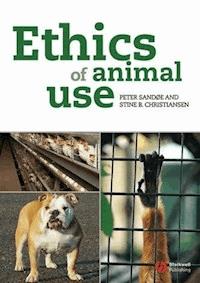
Cover credits: the monkey hand photograph on the cover is reproduced courtesy of Getty Images. The other cover images are courtesy of: Tommy Wølk (battery hens), Wiegaardens Foto-Studie (English bulldog) and Reuter/Scanpix (featherless chickens).
Library of Congress Cataloging-in-Publication DataSandøe, Peter.Ethics of animal use / Peter Sandøe and Stine B. Christiansen.
p. cm.
Includes bibliographical references and index.ISBN-13: 978-1-4051-5120-7 (pbk. : alk. paper)ISBN-10: 1-4051-5120-X (pbk. : alk. paper) 1. Animal welfare. I. Christiansen, Stine B. II. Title.
HV4708.S19 2008179′.3–dc22
2007049692
A catalogue record for this book is available from the British Library.
1 2008
Foreword
In my youth, animal welfare issues were socially invisible, with the possible exception of truly egregious revelations – starving of animals, beatings, burnings and explicit torture. As a child, I remember asking adults about a lion kept in a small cage at the zoo, and receiving only blank stares in response. At the risk of extravagant understatement, one can affirm that this is no longer the case.
Indeed, the degree to which animal welfare has ‘taken off’ as a ubiquitous, international social concern – so much so that the Chinese ambassador to the USA recently remarked that China must transcend its notoriously cavalier attitude towards animal treatment if it is to trade with the West – is matched in my experience only by the transmutation of exercise, fitness, and diet from the esoteric pursuits of ‘health nuts’ to a multi-billion dollar industry none of us can escape.
Indeed, when I studied and later taught the history of philosophy from the 1960s into the late 1970s, I was amazed at how philosophers, busy proving such things as the unreality of time and motion, had been virtually silent about our obligations to other living sentient beings, save for some remarks by Descartes, who said animals were machines, and Kant, who dismissed their moral relevance by pointing out their lack of rationality and moral agency. This lacuna bothered me, as did philosophers’ ignoring of the despoliation of nature. So in 1970, a colleague and I proposed to publish an anthology dealing with moral obligations to animals and nature. We received a raft of ‘don’t be ridiculous’ letters, informing us that there was no interest in such issues.
No one, including myself, could have anticipated the degree to which animal treatment would emerge as a major social issue by the end of the century, attracting careful philosophical examination and major social figures across the political spectrum who took these issues very seriously – people as diverse as Jane Goodall, Coretta Scott King (Martin Luther King’s widow), Cesar Chavez, the last two popes, conservative US Senator Robert Byrd, feminists, attorneys, physicians, research scientists, and movie and rock stars. In Britain, animal welfare receives an eight out of a possible ten on a scale representing issues of societal importance. In Spain, the economic institution of bull-fighting, in a real sense an emblem of Spanish culture, is being vigorously challenged on animal ethics grounds by Spanish youth.
In Germany, the parliament affirmed that animals were covered by the German Constitution; in Sweden in 1988, the legislature passed a law phasing out confinement agriculture of the sort taken for granted in North America, and the European Union has followed suit. In the USA, federal law was passed minimising pain and distress in animal research, despite vigorous opposition from much of the research community, who claimed that such laws would jeopardise innovations that benefit human health care. (In fact, the laws have strengthened research, by minimising pain, stress, distress and other variables deforming research results.) The nucleus of such laws, oversight by an animal ethics committee, has been adopted by numerous countries. The US public is so concerned about animal treatment that over 2,100 laws were proposed in 2004 relevant to animal welfare, and that same public is beginning to reject sow stalls, battery cages, veal crates and other mainstays of industrialised agriculture by legislation and citizen referenda. Egregious practices in wildlife management, such as bear hunting in the spring, where lactating mother bears may be shot leaving the cubs to die of dehydration and starvation, have been eliminated in numerous jurisdictions, as has the steel-jawed trap. Companion animals are viewed as ‘members of the family’ by the vast majority of the US public, as the aftermath of Hurricane Katrina dramatically evidenced, and veterinary medicine has been transformed in four decades from ancillary to agriculture to overwhelming companion-animal oriented activity, with veterinary specialty practices proliferating. More than 80 law schools have courses in animal law, and cruelty to animals has been elevated to a felony in 40 states.
With the proliferation of societal interest in animal issues, partially as cause and partially as effect, has come a significant philosophical literature on animal ethics. It is incumbent, therefore, on any educated citizen, and particularly those who are involved in animal-using industries, to understand, at least at a basic level, the debate over the ethics of animal use, the various philosophical positions that have been proposed in that area, and the ethical issues occasioned by the multifarious uses of animals in society. Peter Sandøe and Stine Christiansen have done a marvelous job in providing a highly readable, accessible, and well-informed introduction to these matters in this short volume. Particularly laudable is their skill in presenting complex ethical theories in a distilled form, without sacrificing accuracy, and with great fairness to all positions.
Obviously veterinarians and animal scientists are most significantly affected by the rise of animal ethics and animal welfare concerns. Yet there is little material dealing with these issues available to them in a concise and intelligible manner. The result has been a radical misunderstanding or lack of understanding of these matters by the veterinary and agricultural community, paradigmatically illustrated by their insistence on basing answers to ethical questions about animal use, such as the legitimacy of gestation crates, by appealing to ‘sound science’. Similarly, lack of conceptual clarity has led the US agricultural community to define animal welfare as ‘productivity’, an egregious logical error. Those who study the Sandøe and Christiansen volume are very unlikely to perpetuate such errors and will be in a far better position to engage societal concerns without loss of credibility. In addition, animal scientists will gain an understanding of the fact that the values of efficiency and productivity alone no longer suffice to ground agricultural research and practice in the future.
The book covers an impressive range of topics with accuracy and fairness – quality and end of life issues in companion animals, animal experimentation, animal agriculture, wildlife management, animal breeding and genetic engineering. Despite its ambitious scope, the authors have achieved remarkable unity in the book, and have produced a book that is easy and pleasant to read. Their work will surely provide a major tool for rationalising the debate about the ethics of animal use, and I commend them for their invaluable contribution.
Bernard E. Rollin
University Distinguished ProfessorColorado State University
Acknowledgements
We would like to offer warm thanks to a number of colleagues who have helped us in the process of writing this book.
Various people kindly agreed to read and comment on individual chapters or supplied important advice on specific subjects: Jens Frederik Agger, Svend Bresson, Lars Gjøl Christensen, Hans Henrik Dietz, Christian Gamborg, Anne Katrine Gjerløff, Torben Greve, Nils Holtug, Hans Houe, Karsten Klint Jensen, Frederik Karlsson, Jens Lodal, Poul Maddox-Hyttel, Erik Bisgaard Madsen, Jørgen Madsen, Thomas Mark, Jan Mousing and Clare Palmer.
Others have been good enough to read and comment on the entire manuscript or large parts of it: Pia Haubro Andersen, Kim Holm Boesen, Trine Dich, Mickey Gjerris, Tina Hansen, Rikke Ingemann, Carol Morgan, Anna Olsson, Bernard E. Rollin, Erik Sandøe and James Yeates.
Jeanne Oakman took on the huge job of dealing with practical matters, including dealing with the figures, and Paul Robinson helped us to present our ideas in lively and readable English.
Publisher’s note: Despite our best efforts, we were unable to identify the copyright holder of Figures 2.1, 4.2 and 6.2 in order to obtain permission.
Introduction
The aim of this book is to introduce readers to some of the more important ethical issues raised by human use of animals. The first four chapters offer a general survey of animal use. They also present conceptual tools in the form of principles of animal ethics. The last six chapters discuss more specific issues. Topics here include our use of animals in food production and for research, animal companions, pest control and animal biotechnology. In each of these chapters the conceptual tools introduced earlier are applied. These applications serve both to shed light on the issues and deepen the reader’s understanding of the ethical principles.
The book takes a pluralist approach to animal ethics. Unlike some of the classic works in the field – by, for example, Peter Singer, Tom Regan, R.G. Frey and Roger Scruton – it does not seek to defend or apply one specific ethical view or perspective. Rather, both in the theoretical and in the applied chapters, the book presents a range of views: five views about our duties to animals, three views about what makes for a good animal life, and a number of hybrids of these views. The book does not side with any of these outlooks. Instead it encourages the reader to develop an understanding of the strengths of the different views, and to see why people have been drawn to the different approaches.
The choice of a pluralist approach does not suggest that we, the authors of this book, do not have our own views. We do, and although we have done our best to present the arguments dispassionately, and in a fair and balanced way, it is of course unlikely that we have always succeeded in concealing our sympathies. The pluralist approach is, however, founded on a strong conviction about the best way to teach ethics and the right way to handle public controversies.
One intended purpose of this book is to serve as a textbook for teaching animal ethics at university level in veterinary and animal science courses. Ethics teaching at a university should not, in our view, amount to a kind of moral lecturing. We believe that the aim of teaching is to give the students state of the art knowledge and understanding. And the state of the art in ethics (unlike, for example, basic chemistry) is that leading scholars in the field of ethical theory disagree deeply about many, if not most, matters. Therefore the best way to present ethics to students on an introductory course is to describe competing theories, show that each has certain strengths, but make it obvious at the same time that they cannot all be correct because they are incompatible.
A clear advantage of this approach is that, through it, the students themselves become engaged in ethical reflection. They are not just presented with things to learn. They are challenged to make up their own mind on matters that call for answers but where the ‘right answers’ cannot be simply set before them. However, although there are no right answers, and every answer can, therefore, be right in a way, the student is not given an easy way out and asked merely to choose one theory or another. Each view has its own weaknesses, and readers are confronted by those weaknesses throughout the book.
In reality few people, if any, stick strictly to a single, defined ethical principle. Our opinions about rights and wrongs are generally complex and vary across situations. When describing an ethical framework and its applications, this book frequently refers to ‘utilitarians’, ‘contractarians’ and the like. These labels, however, are not intended to suggest that real people fall into such clear-cut categories.
The Internet based learning tool Animal Ethics Dilemma, freely available at www.aedilemma.net, is structured around the same ethical framework as this book. This tool may therefore serve to engage the students further. It is hoped that it will be a useful addition to the book. When using the programme, students are confronted with ethical dilemmas to which there are no simple and comfortable solutions. They obtain insights into the relationship between their own intuitive judgements and the main ethical theories.
In the book we have not, of course, tried to present all possible disagreements at all possible levels of ethical discourse. What is presented here is a staged disagreement encouraging structured discussion. This may be irritating to readers who feel strongly that certain key assumptions are not challenged in the book. It might be felt, for example, that it is unreasonable to assume (as we do) that basic differences of ethical opinion can usefully be construed as disagreements about simple principles like the principle that animals have rights and the utilitarian principle.
Two things can be said in our defence here. First, we do not pretend to cover all the issues and all the angles on the issues. We would readily agree that there are ethical disagreements we do not discuss. Second, if the book did not stage its discussions, but instead tried to deal with every sort of disagreement, it would be extremely long and probably boring to read. One should not knowingly bore other people, of course, but more importantly, a boring book is unlikely to be read. Obviously, we want this book to be read and used – not least, in the training of future veterinarians, animal scientists and others who have a professional involvement with animals. It is our belief that an introductory text on animal ethics will be more stimulating if the reader has a structured overview of prominent dilemmas and conflicts and is not lost in details and nuances.
For those who miss detailed elaboration of the ethical issues, or who just want more information about the topics covered, we provide suggestions for further reading at the end of each chapter. The lists we offer are fairly short and are only intended to serve as starting points. In line with our intention to reduce complexity in the text, we have also kept references to an absolute minimum. Again, readers looking for references might wish to explore the publications listed in suggested further reading.
The teaching of ethics is a relatively new part of the veterinary and animal science curricula. Until recently veterinary and animal science students mainly learned about the perceived rights and wrongs of dealing with animals through views implied – but rarely explicitly stated – by their teachers. However, this is not good enough. The backgrounds of students and teachers in these fields are no longer as similar as they used to be. Disagreements within the profession are therefore more likely to arise, and when they do they have to be dealt with. In any case, this is not the best way to prepare students for discussions in society as a whole.
Traditionally, it has been assumed that veterinarians and other animal science professionals are authorities on what is right and wrong in our dealings with animals. Times have changed, however. Today people have confidence in their own views and expect to be listened to and treated respectfully by veterinarians and others who give professional advice on animal use. This means that the professional must now accept that there are different ethical views, and that his or her own view is not the only one that a person can reasonably hold.
Factual aspects of an issue are often highly relevant when one is seeking to form an opinion about an ethical issue. This is why we have invited colleagues with backgrounds in veterinary science or other branches of biology to co-author all the chapters dealing with specific forms of animal use and specific animal issues. Our co-authors have provided state of art knowledge of their fields of expertise. They have helped us to ensure that the ethical discussions we present do not contradict or ignore relevant biological insights. In addition to our co-authors we have consulted a number of colleagues on specific matters.
The link between factual knowledge and sound ethical judgement is not as simple and straightforward as many people with a science background seem to think. An important lesson to be learned from this book is that, in order to make up one’s mind about an animal issue on an informed basis, it is not enough to be knowledgeable about the facts. One also needs to engage and be proficient in ethical thinking. Just as one can be more or less competent regarding the science of an issue, one can do one’s ethical thinking in a more or less thorough and imaginative way. Part of being imaginative in ethics is the ability to see issues in the light of different ethical principles before one makes up one’s mind.
Nearly all countries place legal restrictions on the use of animals. In some countries these limits are minimal; in others they are more extensive. However, all over the world much is left to personal decision. There is plenty of room for public discussion about how animal use should be regulated in the future – either in legal terms or by means of voluntary codes.
To some people the idea of developing regulations is too liberal. To them, the problems are of such a magnitude that civil disobedience is called for rather than ethical debate. On the other side, people involved in, say, animal production or experimentation may be reluctant to engage in an open, fair discussion about animal use and abuse. We hope that the conceptual tools presented in this book will facilitate mutual understanding and respectful dialogue. We believe that both for the sake of protecting democracy, and for the sake of progress when it comes to decent treatment of animals, the only way forward is open discussion of the issues – a discussion informed equally by biological insight and ethical reflection.
Chapter 1
The Changing Face of Animal Ethics
This is a book about animal ethics. It describes and explains different views about how we – as human beings, capable of moral thought – ought to treat the animals in our care. However, a sober discussion of this issue must take as its starting point the way in which we do as a matter of fact treat the animals in our care and the attitudes we have towards these animals. This factual background is not static. The relationship between humans and animals has changed dramatically over the last 100 years or so, and remarkable changes have followed in the attitudes that humans have towards animals. The aim of this chapter is to describe these developments.
Lesen Sie weiter in der vollständigen Ausgabe!
Lesen Sie weiter in der vollständigen Ausgabe!
Lesen Sie weiter in der vollständigen Ausgabe!
Lesen Sie weiter in der vollständigen Ausgabe!
Lesen Sie weiter in der vollständigen Ausgabe!
Lesen Sie weiter in der vollständigen Ausgabe!
Lesen Sie weiter in der vollständigen Ausgabe!
Lesen Sie weiter in der vollständigen Ausgabe!
Lesen Sie weiter in der vollständigen Ausgabe!
Lesen Sie weiter in der vollständigen Ausgabe!
Lesen Sie weiter in der vollständigen Ausgabe!




